There’s a moment every newcomer to Osaka faces. It’s not a matter of if, but when. You’re standing on a street corner, smartphone in hand, Google Maps spinning its little blue dot in a vortex of digital confusion. The address you need is supposedly right here, but all you see is a narrow alley housing a bicycle repair shop, a tiny shrine, and the tantalizing smell of grilled eel. You’re lost. Not hopelessly lost, just… frictionally misplaced. In most cities, this is a private struggle. You’d stare at your screen, maybe walk a block in the wrong direction, and eventually recalibrate. In Osaka, your private struggle is about to become a public performance. You look up, a flicker of bewilderment on your face, and that’s all it takes. An older woman adjusting the flowers in front of her shop catches your eye. A man on a bicycle slows to a halt. The invisible bubble of personal space that shields you in Tokyo or London simply evaporates. Before you can even formulate a question, you’re no longer just a person looking at a map; you’re a problem to be solved, a story to be understood, and, most importantly, you’re their responsibility now. This isn’t just about being friendly. It’s a fundamental difference in the software of human interaction. Asking for help in Osaka isn’t a simple transaction of data. It’s an invitation to a conversation, a negotiation, a short-term, high-intensity relationship that goes far beyond the lines on any map. It’s a dive into a communication style so personal, so detailed, and so wonderfully overwhelming that it defines the very rhythm of daily life in this city.
This deep-seated drive to connect and solve problems extends even to how locals meticulously plan their leisure time, as seen in the detailed strategies for organizing a value-packed weekend trip from Osaka.
The “Just the Facts” Fallacy: Why Asking for Directions is Never Simple
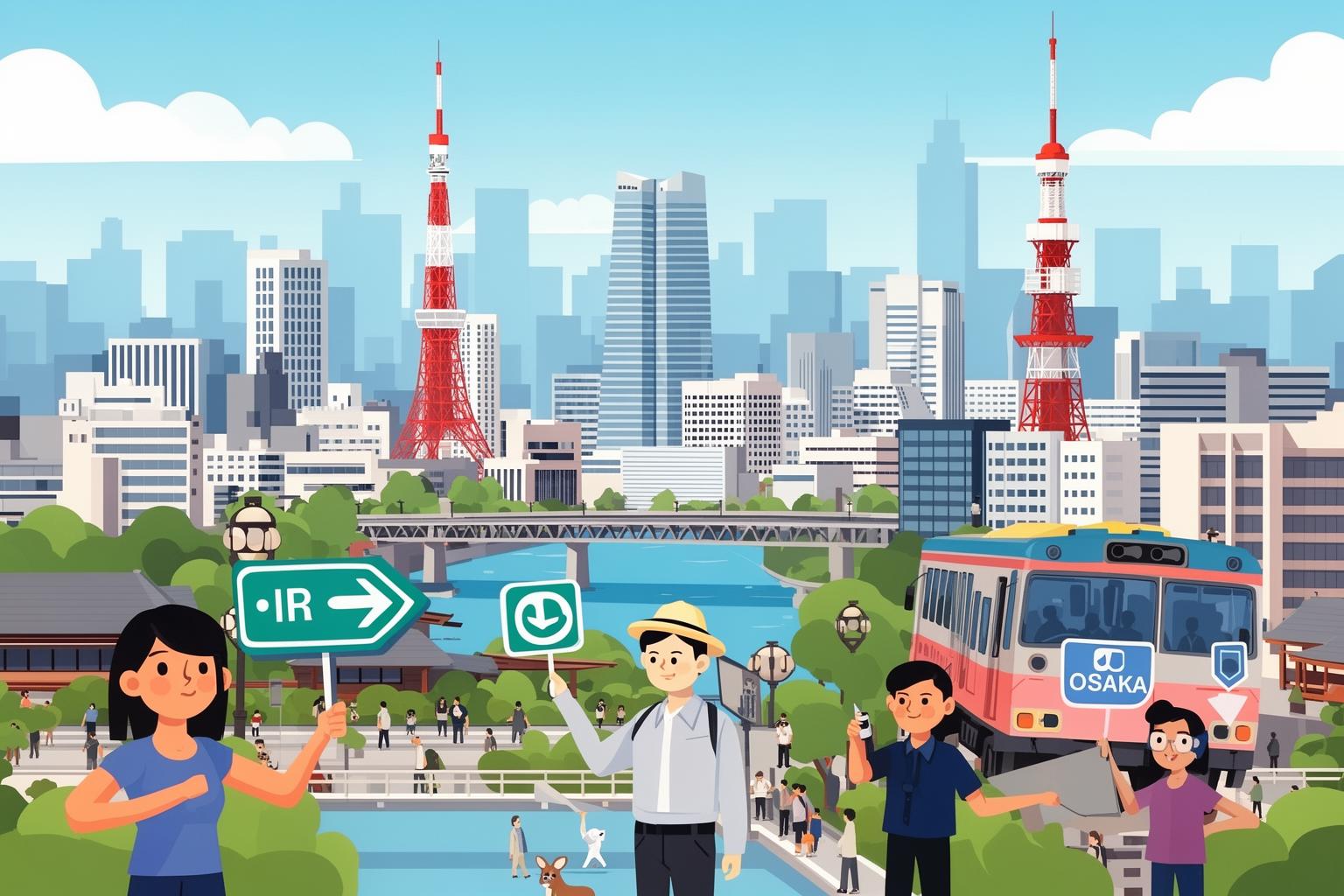
In many cultures, asking for directions follows an unspoken agreement of efficiency: you ask, they answer, and then you part ways. It’s straightforward, simple, and respects everyone’s time. But in Osaka, that agreement is quickly discarded and replaced with something far more complex. The aim isn’t just to answer your question; it’s to address the underlying issue behind your inquiry.
Your Simple Question, Their Thorough Inquiry
Picture this scene: you approach a middle-aged man arranging items outside his hardware store. You’ve rehearsed your phrase and ask with a polite smile, “Sumimasen, eki wa doko desu ka?” (Excuse me, where is the station?).
In Tokyo, you might receive a pointed finger and a quick, “Massugu itte, futatsume no kado o migi desu.” (Go straight, turn right at the second corner.) The whole exchange lasts about ten seconds.
In Osaka, however, your simple question triggers a detailed investigation. The man stops what he’s doing, tilts his head, and the questioning begins.
“Eki? Which station do you mean? The JR one? The subway? Hankyu? Nankai? They’re all in different places.”
You, somewhat surprised, specify, “The subway station.”
“Ah, the subway! Okay, okay. Which line? Midosuji? Yotsubashi? Sennichimae? It matters because the entrances are all different. If you pick the wrong one, you’ll be walking underground for ten minutes. Where are you headed?”
Here’s the turning point: the conversation shifts from simply locating a station entrance to learning your final destination. You might feel a bit hesitant, wondering why this stranger needs your travel plans. But for an Osakan, this isn’t prying—it’s practical logic. They’ve assessed your situation: since you’re not a local, you might not know the most efficient route. Answering your literal question—“Where’s the subway entrance?”—without confirming your destination would be neglecting their self-appointed responsibility. It’s like giving you a tool without showing you how to use it.
So you tell him you’re going to Shin-Osaka. His face brightens. “Shin-Osaka! Ah, then you want the Midosuji Line! Don’t use that entrance over there—that’s the Yotsubashi. You’d have to transfer trains. No, no. The entrance you want is over here, by the big red crab sign. Much easier. Are you in a hurry? Carrying heavy bags?”
Within a minute, you’ve transformed from a stranger seeking directions into someone with a specific destination and circumstances, all considered as part of the best possible solution. Your initial question was just a key; the Osakan must turn it to unlock the true problem.
From Oral Directions to Personal Escort
Sometimes, a verbal explanation isn’t enough. Words can be vague, gestures misunderstood, and the risk of you getting lost again shortly after is too high. In these cases, an Osakan often goes beyond advisor to become a personal guide.
“You know what,” the hardware store owner might say, wiping his hands on his apron, “With all the construction, it’s tricky. I’ll just take you.”
Before you can object, he’s off, motioning for you to follow. This isn’t unusual—it’s standard practice. Grandmothers may abandon their trip to the supermarket, businessmen might miss their train, and shopkeepers leave their posts briefly, all to make sure a lost visitor finds their way. It’s a remarkable act of spontaneous kindness that can feel almost overwhelming to those used to maintaining polite distance.
As you walk, the true Osaka experience comes alive. Your guide doesn’t remain silent but fills the journey with remarks, tips, and insights. “See that takoyaki place? Best around here, but don’t go now; the line’s too long. Come after 3 PM. This street is a shortcut, but only if you’re on a bike—don’t try walking it at night.”
You’re no longer merely escorted to the subway; you’re receiving a live, tailored tour of the neighborhood’s hidden social fabric. You learn local stories, unspoken customs, and the community’s rhythm. In essence, you’re being temporarily inducted into their world. The destination fades into the background as the shared journey becomes a meaningful connection sparked by a simple question.
The Anatomy of an Osaka Conversation: More Than Just Words
To truly grasp why these interactions feel so distinct, you need to look beyond the conversation’s content and examine its form. Communication in Osaka is an immersive, full-body, multi-sensory experience. It’s a performance where words are just one element of a larger orchestra.
A Symphony of Gestures, Onomatopoeia, and Sound Effects
An Osakan giving directions rarely remains still. Their hands constantly move, carving shapes in the air to create a three-dimensional map visible only to them. They don’t simply point; they slice through the air with a flat hand to indicate a straight path (“Go suuuutto down this street”), then bunch their fingers together and jab to highlight a specific, unmistakable landmark (“It’s right there, don!”).
This physical language is paired with a rich mix of onomatopoeia and mimetic words that add depth and meaning. These aren’t just playful sound effects; they are information-packed descriptors.
- Instead of saying “Go straight for a while,” you’ll hear, “Go gyuuuuun down that road.” The stretched vowel expresses a sense of considerable distance and speed.
- Rather than “The building is on the corner,” it’s, “You’ll see it right on the corner, kaku-kaku.” The sharp, clipped sound imitates the hard angle of a street corner.
- Instead of “It’s a big, impressive building,” they’ll say, “It’s right there, dooon!” The deep, resonant sound conveys scale, presence, and importance. It’s impossible to miss.
This style of language makes directions more vivid and memorable. You might not recall the street names, but you’ll remember the feeling of “gyuuuuun” and the impact of “dooon.” It’s a communication style crafted for clarity and retention, bypassing purely intellectual processing and speaking directly to the gut.
The Unsolicited Advice and Personal Commentary
An interaction that starts with a practical question seldom stays on topic. Osakans possess an uncanny ability to shift from navigation help to life coaching in the same breath. The line between public service and personal opinion is delightfully, wonderfully blurred.
If you ask for the location of the ward office to register your new address, the person assisting you will, naturally, provide directions. But they won’t stop there.
“The ward office? Ah, it’s a bit of a walk. You’ll be there a while, the lines can be crazy on a Monday. Did you bring a book? You should have brought a book. And don’t forget to go to Window 3 for your health insurance first, or they’ll just send you back, and you’ll have to wait all over again. Oh, you’re from… America? Is it true that everyone there eats giant steaks all the time?”
This cascade of information is a hallmark of the Osaka communication style. It’s based on an assumption of shared experience. The helper has likely been to the ward office, endured the long lines, and navigated the bureaucracy. For them, withholding this hard-earned knowledge would be unthinkable. It’s a form of practical empathy. They’re not just handing you a map; they’re handing you a strategy guide for the quest you’re about to embark on.
This can be jarring for foreigners or even Japanese from other regions. In Tokyo, a stranger offering unsolicited life advice might be seen as overstepping boundaries. In Osaka, it signals that they’ve, however briefly, welcomed you into their circle of care. It’s the city’s way of saying, “We’re all in this together, so here’s what I know.”
Decoding the Mindset: Why Are Osakans Like This?
This distinctive style of communication is no accident. It is the result of centuries of history and a particular set of cultural values that distinguish Osaka from the rest of Japan. It is embedded in the city’s very DNA.
The Merchant’s DNA: Efficiency Means Addressing the Real Issue
For centuries, Osaka was Japan’s commercial center, a city of merchants (shonin no machi). While Tokyo (formerly Edo) was known for its stoic samurai and bureaucrats, Osaka thrived on akinai—the art of business. A successful merchant understood that a sale involved more than just exchanging goods for money. It required grasping a customer’s genuine needs, fostering a relationship, and ensuring satisfaction to secure repeat business.
This merchant mentality remains deeply woven into local culture. When an Osakan interacts with a lost stranger, they approach the situation like an experienced shopkeeper. Your expressed request (“Where is the station?”) is merely the start of a negotiation. Their role is to determine what you really need and provide the best overall solution, which in this case is a complete travel guide. Simple, literal answers are poor customer service. They neither build relationships nor guarantee successful outcomes. The Osakan wish to accompany you to your destination reflects not just kindness but also quality control—they want to make sure their “product” performs as promised.
This pragmatic, results-focused approach is a fundamental value. It emphasizes effectiveness over mere politeness. It means getting things done in the most humanly efficient way possible, even if that requires more time upfront to diagnose the problem correctly.
“Ame-chan” Culture and the Blurring of Public and Private Boundaries
A well-known cultural image in Osaka features the obachan (auntie, or middle-aged/older woman) who always carries ame-chan (candy) in her purse to offer to crying children, friendly strangers, or anyone needing a small uplift. The ame-chan is more than candy; it symbolizes the low barrier between strangers.
In many societies, a clear and firm boundary separates private life from the public sphere. You do not converse with strangers unless necessary, nor do you offer unsolicited advice or gifts. In Osaka, however, this boundary is far more fluid and permeable. Streets, markets, and train stations are not cold, anonymous spaces—they are extensions of the community’s living room.
Offering someone an ame-chan or spending several minutes escorting them to a station is an act of treating a stranger like a neighbor. It operates on an assumption of mutual goodwill and shared humanity. This mindset breaks down the social distance typically found between strangers. It enables, and even encourages, the kind of personal, slightly intrusive, yet genuinely helpful interactions that characterize life in Osaka. You are not an anonymous face in the crowd; you are a temporary guest in their neighborhood, and they are your temporary hosts.
Potential Misunderstandings for Foreigners
While this communication style stems from genuine goodwill, it can easily be misunderstood by newcomers. Grasping the intention behind the behavior is essential for handling these encounters smoothly.
Is This Intrusive? Handling Personal Questions
For those from cultures that highly value privacy and personal space, the rapid-fire questioning from an Osaka stranger can feel like an interrogation. “Where are you from? Where are you going? Why are you going there? Are you alone?” It’s natural to feel defensive and wonder about their motives.
The key is to shift your perspective on the interaction. It is almost never meant to invade your privacy. Rather, it’s a process of gathering information to assist you better. Each question acts as a filter, narrowing down options to find the best solution. The best approach is to engage openly. Share some details. View it not as an intrusion, but as a cooperative effort. The more context you provide, the more personalized and helpful their support will be. You’ll notice their questions cease as soon as they have enough information to address your issue effectively.
The “I Don’t Know, But Let’s Find Out Together” Method
What happens when you ask an Osakan for directions and they don’t have the answer? Elsewhere, you might receive a polite apology and a shrug. In Osaka, not knowing is just the start of a communal effort.
An Osakan who doesn’t know the answer will often become a recruiter. They’ll call out to another passerby, “Hey, excuse me! This person is looking for the Yamamoto bookstore. Do you know it?” Suddenly, you become the focus of a spontaneous, two-person (soon growing to three or four) team dedicated to solving your problem. People will pull out their phones, discuss various routes, and debate the most recognizable landmarks.
For a moment, it may feel chaotic and even a little embarrassing. You asked a simple question, and now you’ve unintentionally sparked a public forum. But this, too, exemplifies the Osaka mindset. It’s not about individual pride or embarrassment over not knowing. It’s about the community’s shared responsibility to help someone in need. The problem ceases to be yours alone; it becomes a group concern, and the group will resolve it.
How to Thrive in Osaka’s Communication Culture
Living in Osaka is about more than just mastering the train map; it’s about learning to navigate its distinctive social terrain. With the right mindset, what might initially feel overwhelming can turn into one of the most fulfilling experiences of life here.
Embrace the Chaos: Go with the Flow
The key rule is to stay calm and let things happen. If someone starts asking you numerous questions, respond with a smile. If they insist on accompanying you to your destination, accept and enjoy the unexpected company. Turning down help or ending the conversation with brief, curt answers can come across as cold or unappreciative. Instead, view these detours not as annoyances but as an integral part of the true Osaka experience. Some of your most unforgettable moments will come from allowing your carefully laid plans to be interrupted by spontaneous kindness.
Be Ready to Share a Bit
You don’t have to divulge your deepest secrets, but being open and approachable will make these encounters much smoother. When they ask where you’re from, share it. When they inquire about your thoughts on takoyaki, offer your opinion. This small exchange of personal details acts as social currency in Osaka. It turns a simple exchange into a genuine connection. It acknowledges their approach and shows that you grasp the unstated rule: we’re not merely strangers on the street; we’re people sharing a moment.
Master the Art of the Polite Exit
Naturally, there will be moments when you’re truly in a rush or when the help, despite good intentions, becomes overwhelming. Politely excusing yourself from an enthusiastic Osakan requires some social finesse. Being abrupt can be perceived as rude. The trick is to express sincere gratitude while firmly regaining control of your path.
A phrase like, “Hontou ni, hontou ni arigatou gozaimasu! Subarashii desu. Koko kara wa hitori de daijoubu desu!” (Thank you so, so much! This is wonderful. I’ll be fine on my own from here!) works wonders. Pair this with a deep, heartfelt bow and a confident smile. The message you convey isn’t “please leave me alone,” but “your help was so effective that I am now able to continue on my own.” By crediting them with your success, you allow them to gracefully step back, their social duty complete.
Ultimately, navigating Osaka means realizing that a map shows only the streets, not the city’s spirit. The soul reveals itself through spontaneous, chaotic, personal, and deeply human interactions: the shopkeeper who leaves his booth to walk you to the bus stop, the grandmother sharing candy and stories from her life, and the strangers who momentarily team up to help you find your way. While your phone can get you where you want to go, getting a little lost and asking an Osakan for help reveals where you truly are: in a city with a vast, intricate, and wonderfully generous heart.