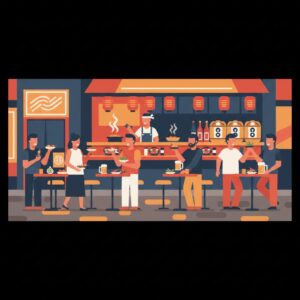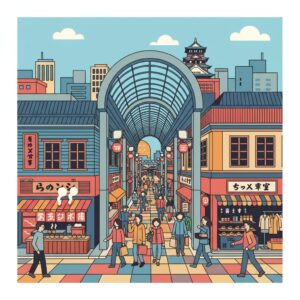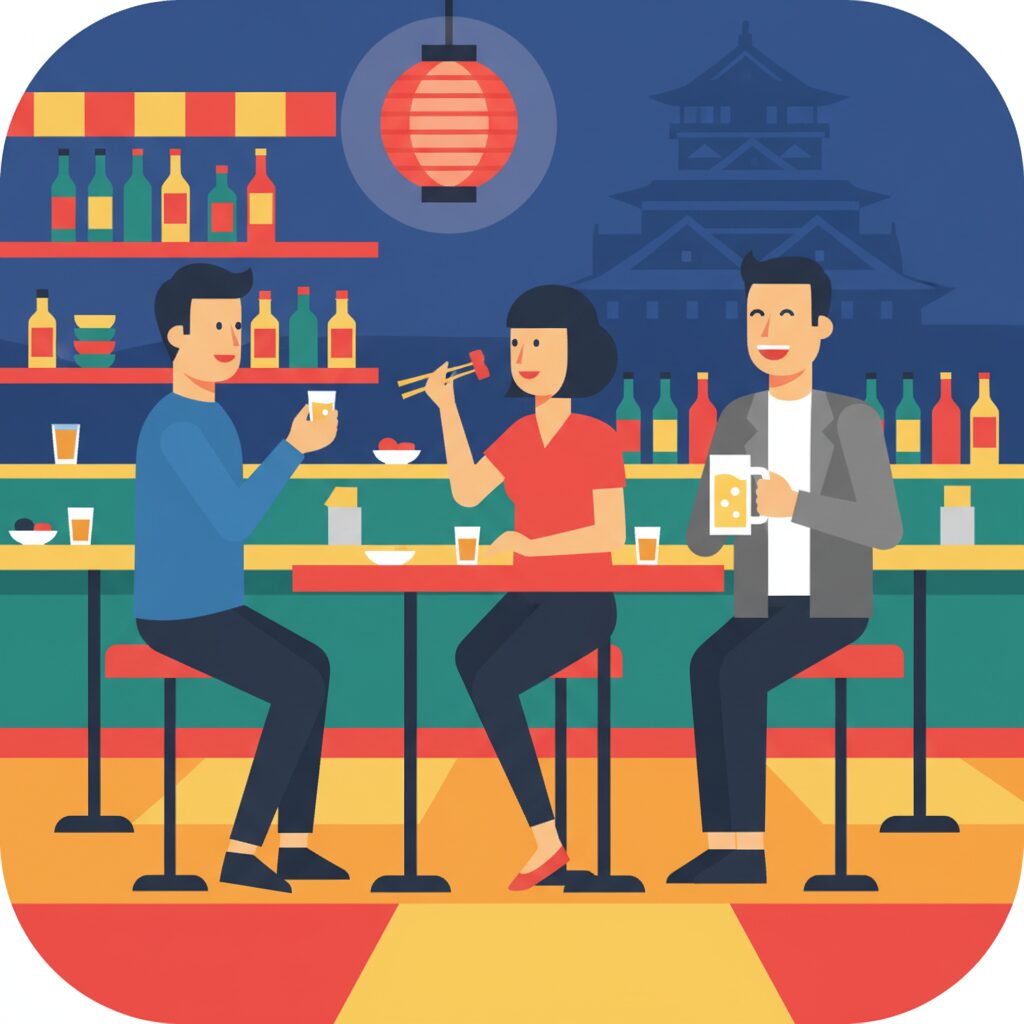
Step off the train at Kyobashi station after six in the evening, and you don’t just walk out into the city. You wade into a river of sound and steam. It’s a current of tired shoulders in wrinkled suits, the clatter of pachinko parlors, and the rich, savory smoke of grilled meat that clings to the humid air. Dive into one of the narrow shotengai arcades that splinter off from the main concourse, and you’ll find them. They’re tucked under the rumbling train tracks, squeezed into spaces barely wider than a doorway, glowing with the warm, yellow light of a single lantern. These are the Tachinomi, Osaka’s standing bars, and they are the city’s beating heart, its confessional, its communal living room. From the outside, they can look intimidating. A crowd of bodies, mostly men, pressed shoulder to shoulder against a worn wooden counter. There are no chairs, no tables, just a sliver of personal space you carve out for yourself. Laughter erupts in sharp bursts, conversations overlap into a low roar, and the air is thick with the scent of cheap beer, dashi, and cigarette smoke. For a newcomer, especially someone from a culture where striking up a conversation with a complete stranger is an anomaly, the scene begs a question: What is going on in there? It’s not just drinking. It’s a complex social ritual, a performance, and to understand it is to understand a fundamental truth about what it means to live in Osaka. This isn’t the polite, reserved Japan you see in guidebooks. This is something else entirely. It’s a world where the physical barriers are so low that the social ones crumble along with them, where a shared plate of doteyaki can forge a bond stronger, for a fleeting twenty minutes, than years of formal acquaintance. This is where Osaka’s soul comes to unwind, to grumble, to boast, and to connect, one quick drink at a time.
This intense social lubrication is as much a part of navigating the city as understanding the unspoken rules of cycling in Osaka.
The Anatomy of a Standing Bar: Not Just a Bar Without Chairs
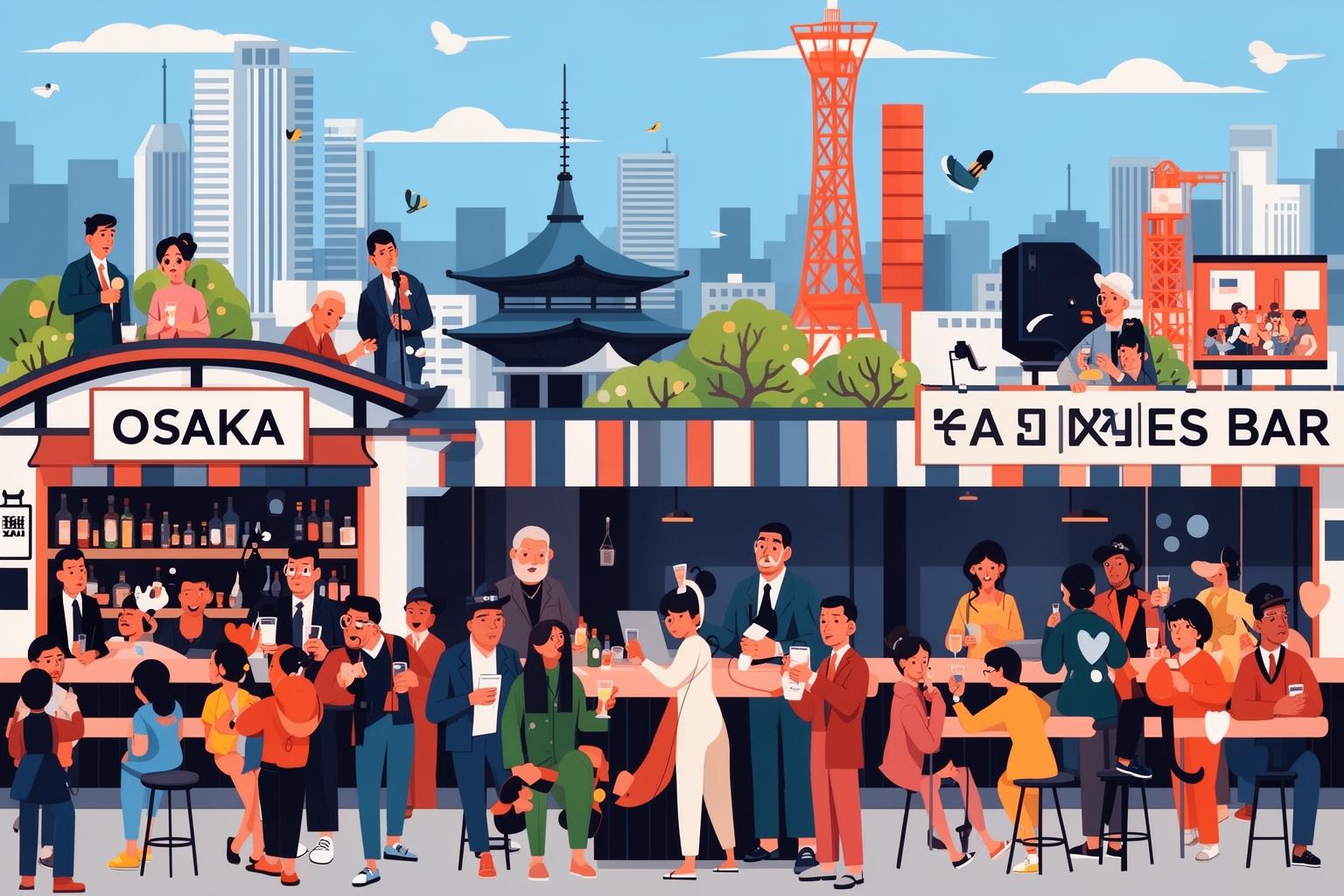
At first glance, a tachinomi is defined by what it lacks. There are no chairs, no private tables, no cozy corners to linger in for a long evening. This absence is intentional; it’s the very essence of the concept. The design of a tachinomi is a masterclass in social engineering—a physical space carefully shaped to foster a particular kind of human interaction: brief, efficient, and surprisingly intimate. The lack of seating is the most noticeable feature and sets the pace for the whole establishment. You’re not meant to get comfortable. You come to have a drink, maybe two, grab a quick bite, and then move on. This transitory nature is embedded in the architecture itself. It keeps the crowd moving, ensuring a steady flow of new faces, new conversations, and fresh energy cycling through the space. Living in Osaka, you soon realize that this ethos of efficiency permeates everything—from the way people walk down the street to how they socialize. Time is a valuable resource, and the tachinomi honors that. It delivers a concentrated burst of socializing and refreshment—a brief pause for the soul on the way home from a long day at work.
Physical Space and its Social Logic
The heart of the tachinomi is the counter. It’s more than just a surface for placing drinks; it’s a communal stage. Often marked by cigarette burns and stained from decades of spilled sake, it stands as a testament to countless fleeting encounters. By compelling everyone to stand side by side along this single shared plane, the tachinomi erases the invisible barriers that usually separate strangers in a city. You’re inevitably in each other’s space. You can’t help but overhear the conversation beside you, glimpse what the person on your left is eating, or notice the brand of sake ordered by the person to your right. This enforced closeness acts as a powerful icebreaker. In any other setting, this level of proximity to a stranger might feel awkward or intrusive. But here, it’s the accepted norm. The tight quarters foster an instant, unspoken sense of shared experience. We’re all together in this small, noisy space. This physical intimacy breaks down psychological walls, making the transition to verbal interaction feel natural, almost unavoidable. The counter turns into a shared table, and everyone standing there becomes, for a brief moment, part of the same group. You might see a salaryman point to his plate of sashimi and say to the young couple next to him, “The tuna is good here today.” This isn’t a pick-up line or an effort to spark a deep friendship. It’s simply sharing useful information, acknowledging a mutual reality. It’s a social gesture that costs nothing yet opens the door to a fleeting connection.
The Economic Engine: Cheap, Fast, and Efficient
Beneath the entire tachinomi culture lies a strong economic logic. Above all, these places are affordable. A draft beer might cost 300 or 400 yen. A small dish, from pickled veggies to grilled skewers, can be had for as little as 150 yen. This remarkably low entry cost is key to its social role. You can step in with just a single 1,000 yen coin and leave satisfied. This affordability turns going out for a drink from a planned event to an impromptu, everyday option. It’s not a major financial burden, which also means it’s not a heavy social commitment. Many tachinomi operate on a cash-on-delivery system called “kyasshu on.” You place your money in a small tray on the counter, and the staff deducts the price of each item as you order it. This system epitomizes Osaka’s merchant pragmatism: transparent, efficient, and it removes the awkwardness of splitting a bill at the end. It also subtly reinforces the transient nature of the visit; your shrinking cash pile in the tray serves as a tangible reminder of your time there. This economic setup directly shapes the social dynamics. Because the investment is low, the stakes remain low. You’re not tied to a long, pricey meal. If you’re not feeling it, you can finish your drink and leave without guilt. If a conversation doesn’t spark, there’s no pressure to keep it going. This freedom from obligation allows genuine, spontaneous interactions to happen. The economic model creates a social space that is fluid, low-risk, and constantly renewing itself—much like the city of Osaka itself.
The Unspoken Rules of Engagement: How to Talk to Strangers in Osaka
While the atmosphere in a tachinomi may appear chaotic, it actually operates based on a sophisticated set of unspoken rules. Understanding these rules is essential to discerning the friendly spirit of Osaka from mere cluelessness. It’s a dance of proximity and timing, of interpreting subtle cues and knowing when to speak and when to remain silent. What seems like random chatter is often a series of carefully calibrated social maneuvers that enable smooth, enjoyable, and ultimately transient interactions. Foreigners frequently stumble here, mistaking the open environment for a free-for-all. However, there is a distinct grammar to these conversations, and learning it is a vital part of feeling at home within the city’s social fabric.
“Sore, oishisou ya na!” (That looks good!) – The Opening Gambit
Starting a conversation in a tachinomi seldom begins with personal questions like “Where are you from?” or “What do you do?” Such questions create an immediate sense of obligation and can feel like an interview. Instead, the golden rule is to be observational. The simplest and most common way in is through food and drink. A casual comment to a neighbor—“That looks delicious, what is it?” or “Is that sake dry?”—serves as a perfect, low-pressure opener. It functions as a compliment, a question, and a sign of shared interest all at once. The topic is neutral, public, and directly related to the shared setting. Another classic entry point is the television. Most tachinomi have a small TV mounted in the corner, usually tuned to a baseball game (preferably the local Hanshin Tigers) or a news program. A groan when the Tigers strike out or a laugh at a silly variety show segment is an open invitation for nearby patrons to join in. It’s a way of signalling, “I’m open to interaction,” without forcing direct one-on-one engagement. These opening lines are situational, rooted in the here and now of the bar. This grounds the conversation in a common experience, making it feel natural rather than forced. This technique encapsulates the broader Osaka mindset: be practical, be direct, and find common ground in the immediate world around you.
The Invisible Boundary: Reading the Room
Just because the space is crowded doesn’t mean personal boundaries disappear—they simply become more subtle. The most crucial skill for navigating a tachinomi is the ability to read the room. Before speaking, you must observe. Who is present? A group of coworkers unwinding, a couple on a date, or a line of solo drinkers? Solo drinkers are often the most approachable, but even then, you have to read their signals. Is the person actively looking around, making eye contact with the staff, and engaging with their environment? Or are they hunched over their phone, earbuds in, deliberately creating a bubble of isolation? The latter is a clear “do not disturb” sign. The concept of “maai” (間合い), a martial arts term referring to the optimal distance between opponents, is very relevant here. In a tachinomi, maai relates to social timing and spacing. You don’t just jump into a conversation. You might stand next to someone for a few minutes, order your own drink, establish your presence, then make your move. You wait for a natural pause, a moment of eye contact, or a shared glance at the TV. This attunement to the social rhythm distinguishes a welcome interaction from an unwelcome intrusion. It’s a subtle skill that many Osaka locals seem to have instinctively, shaped by growing up in a dense social environment where reading cues is a survival skill.
The Graceful Exit: The Art of Disappearing
Perhaps the most important and often misunderstood rule of tachinomi etiquette is the exit. Conversations are meant to be fleeting. There is no expectation to exchange phone numbers, become Facebook friends, or even meet again. The charm of the interaction lies in its self-contained nature. It happened in a moment and then it’s over. Trying to prolong it beyond the bar is a social faux pas. It breaks the unspoken contract of low-stakes, temporary connection. So, how do you end it? Usually, it’s simple and abrupt. When you finish your drink, you catch the staff’s eye and say “Okanjo, onegaishimasu” (Check, please). To the person you were just sharing with, you offer a nod and say “Ja, osaki ni” (Well, I’m heading out first) or “Gochisousama deshita” (Thank you for the meal/drinks). They nod back, say “Otsukaresama desu” (Thanks for your hard work), and immediately return to their drink or start a new conversation. There’s no long, drawn-out goodbye. The interaction dissolves as quickly as it formed. For some Westerners, this may feel cold or dismissive—you just had a great chat, and now they act like you don’t exist. But that’s a misunderstanding of the purpose. It wasn’t about forming a lasting bond, but sharing a moment of humanity to make the daily grind a little easier. The clear, no-strings-attached exit enables everyone to feel safe and unburdened, making them ready to do it all over again with a different stranger tomorrow night.
Osaka vs. Tokyo: A Tale of Two Drinking Cultures
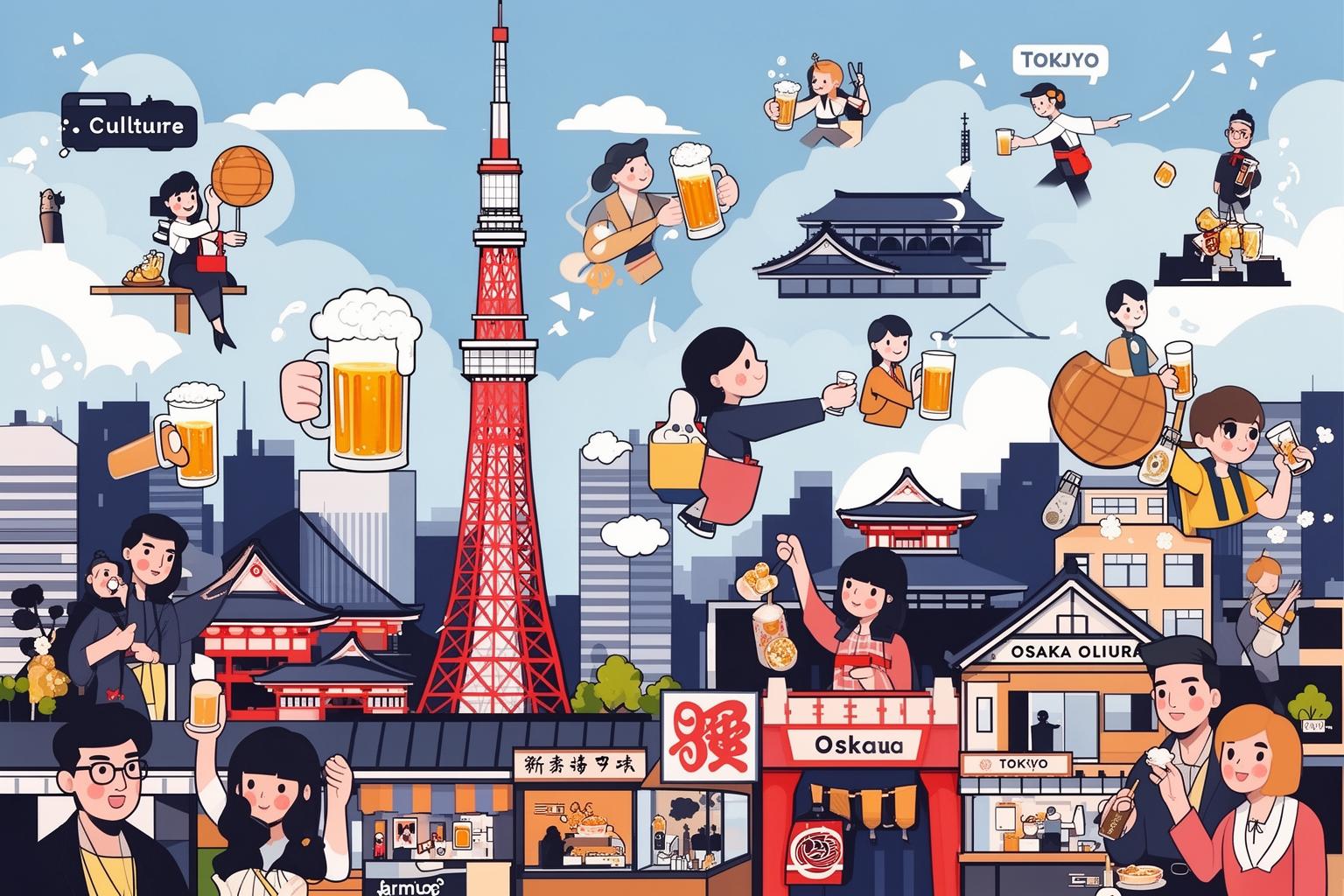
To truly understand the distinctiveness of Osaka’s tachinomi culture, one must compare it with its formidable rival, Tokyo. Although both cities offer standing bars, their purpose and atmosphere can be vastly different. The distinction goes beyond just the flavor of the beer or the menu offerings; it represents a deep reflection of the contrasting social fabrics of Japan’s two largest cities. Living in Osaka after spending time in Tokyo feels like moving from a carefully scripted play to an improvisational comedy. The social rules, especially in informal settings like bars, differ fundamentally. This comparison reveals a great deal about the character of Osaka residents and why life there feels so uniquely different.
The Tokyo Model: The Group and the Reservation
Drinking in Tokyo is generally a more organized experience. The typical social unit is an established group—coworkers, university friends, or club members. Evenings usually center around an izakaya with table seating, often reserved beforehand. Going to a bar alone is uncommon, and when it happens, it tends to be in a quieter, more formal place where one can converse with the bartender rather than other patrons. The social energy is focused inward, within the known group. Tokyo izakaya tables act like social islands, each enclosed in its own private conversation bubble. Trying to engage with people at adjacent tables would be unusual and likely met with polite bewilderment or suspicion. Such behavior could be seen as intrusive or suspect. This doesn’t mean Tokyoites are unfriendly; they are simply more reserved in public. Social circles are more clearly defined, and the boundary between public and private is more rigid. The standing bars in Tokyo often feel more utilitarian, functioning as quick stops for a pre-train drink, lacking the lively, cross-counter interactions that characterize Osaka’s scene.
The Osaka Exception: Why is it Different Here?
Why is Osaka so different? The answer lies in the city’s history, economy, and identity. Osaka has long been a city of merchants, known as the “Nation’s Kitchen” (天下の台所, Tenka no Daidokoro). Its prosperity was built by traders, artisans, and entrepreneurs rather than samurai or aristocrats. This fostered a culture that values pragmatism, straightforward communication, and rapid rapport-building. In business, one had to assess quickly, connect, and close deals efficiently. This mentality extended into social life, where conversation acts as a transaction—a way to build social capital, even momentarily. This explains why Osaka people often appear more direct. They’ll ask questions that a Tokyoite might find too blunt, but it stems from genuine curiosity and the desire to find an immediate connection. Additionally, Osaka is Japan’s undisputed comedy capital. The culture of “boke” (the funny fool) and “tsukkomi” (the sharp straight man) extends beyond the stage into daily conversation. Banter is treated like a sport. Playful teasing or witty comebacks are forms of social currency, making conversations less formal exchanges and more collaborative performances. People are more open to engaging with strangers because it offers a chance to hone their wit, enjoy a laugh, and be entertained. In a tachinomi, this is constantly evident: an elderly man cracks a silly joke, with a younger man swiftly responding with the perfect tsukkomi. This playful, almost theatrical style of communication makes the social scene more fluid and welcoming than Tokyo’s, which is a major reason Osaka appeals to those seeking greater spontaneity and human connection in everyday life.
What Foreigners Often Misunderstand: It’s Not About Friendship
One of the biggest challenges for foreigners trying to adapt to life in Osaka is adjusting their understanding of local social norms. The city’s reputation for being “friendly” can be a double-edged sword. It’s a simplistic label that masks a far more complex and nuanced reality. Interactions in a tachinomi provide a perfect example. A newcomer might have a fantastic, hour-long conversation with a local, swapping stories and laughing like old friends, leaving with the thought, “Wow, I made a new friend!” Yet the next day, they might see that same person on the street and receive little more than a brief nod or perhaps no acknowledgment at all. This can feel confusing, even hurtful. Was the friendliness insincere? Was I being mocked? The answer is almost always no. The misunderstanding arises from trying to interpret the experience through a Western idea of friendship, where such an interaction would typically form the basis of an ongoing relationship. Here, it is something entirely different.
The “Friendly” Trap
The friendliness in Osaka is real but often situational. It serves as a mechanism to ease social friction and foster a pleasant atmosphere in a specific time and place. Think of it as “contextual friendliness.” Within the context of the tachinomi—a shared, temporary space devoted to relaxing—the social rules call for an open and outgoing attitude. The aim is to make the collective experience enjoyable for everyone involved. You play a role: the friendly patron. The person beside you plays the same role. Together, you create a fleeting bubble of camaraderie. But once you leave that context, the roles may vanish. The person you shared a drink with is no longer a fellow patron; they become just another anonymous face in the crowd. The absence of recognition on the street is not a personal slight. It reflects adherence to a different set of social rules governing public spaces. They are not dismissing the person they spoke to; they are simply ending the performance that took place. Grasping this distinction is crucial. The warmth was sincere in the moment, but the moment was all it was ever intended to be. It’s not about superficiality; it’s about social efficiency and clearly defining different social spheres.
A Community of Transience
The tachinomi offers something sorely needed in modern urban life: a sense of community without the heavy demands of obligation. It’s a “third place,” separate from the structured hierarchies of home and work, where people can connect on a purely human level. The community it nurtures is one of transience. Its members continuously change, conversations shift constantly, and bonds are purposely temporary. This is its strength. You can be entirely yourself because there are no stakes. You can vent about your boss, share a wild dream, or reveal a minor frustration, knowing that your audience is both temporary and anonymous. It’s like chatting with a stranger on a plane; the shared, enclosed space creates temporary intimacy that encourages surprising candor. The value lies not in forming future relationships, but in the release of the present moment. The tachinomi acts as a social safety valve for the pressures of city life. It allows people to feel a sense of belonging, to be acknowledged and heard by fellow citizens, without adding another name to their list of social responsibilities. It is a community based on the mutual understanding that everyone will eventually disappear. And within that shared disappearance, there exists a strange and beautiful kind of freedom.
A Practical Guide to Your First Tachinomi Experience
Understanding the theory is one thing, but stepping into the warm, noisy chaos of a tachinomi for the first time can still feel intimidating. The key is to start simple and be a keen observer. Don’t feel the need to become the life of the party on your initial visit. The charm of these places is that they welcome everyone, from the lively conversationalist to the quiet solo drinker. Choosing the right location, knowing a few essential phrases, and understanding your role as a participant can make all the difference—turning what could be an overwhelming experience into one of the most authentic and enjoyable parts of living in Osaka.
Finding Your Spot: From Gritty to Gourmet
Tachinomi are far from uniform. They cover a wide range, so finding one that fits your style is the first step. For a classic, no-frills experience, try the spots under the train tracks in neighborhoods like Kyobashi, Tenma, or Shinsekai. These are old-school joints, often with concrete floors and menus handwritten on yellowed paper strips taped to the walls. The clientele tends to be older, working-class men, and the atmosphere is straightforward and unpretentious. The food is simple but tasty: doteyaki (beef sinew stewed in miso), kushikatsu (deep-fried skewers), and fresh sashimi. At the other end of the spectrum, you have the modern, stylish standing bars, often called “Bal” (from Spanish Bar). These can be found in trendier neighborhoods like Fukushima or the expansive underground malls of Umeda. They often specialize in wine, craft beer, or inventive Italian-inspired dishes. The crowd is younger, with more women and couples. These spots can be a great entry point, as their vibe is generally a bit less intense and more welcoming to newcomers. For example, Umeda’s Whity underground shopping center hosts several clean, accessible tachinomi perfect for first-timers. Start there, get a feel for the rhythm, and then you can confidently explore the grittier, more traditional places.
The Language of the Counter
Fluency in Japanese isn’t necessary, but learning a few key phrases will smooth your experience and show your effort. When you find a spot at the counter, your first order will probably be a drink. The universal magic word is “Nama” (draft beer). Simply catch the staff’s eye and say, “Nama hitotsu, kudasai” (One draft beer, please). To order food, you can point at the menu or at something someone else is eating and say, “Kore, onegaishimasu” (This, please). When ready to leave, say “Okanjo, onegaishimasu” (Check, please). If it’s a cash-on-delivery bar, just gather your change and go. Don’t forget basic courtesies—a simple “Arigatou gozaimasu” (Thank you) to the staff goes a long way. If you’ve been chatting with neighbors, “Osaki ni” (I’m leaving first) is a polite way to signal your departure. The staff are experts at multitasking in chaotic settings; speak clearly and be patient—they’ll attend to you. Don’t hesitate to ask, “Osusume wa nan desu ka?” (What do you recommend?). They’re usually happy to guide you toward the best offerings of the day.
Your Role as a Participant
On your first visit, think of yourself as an anthropologist. Your main task is to observe and learn. Find a spot at the counter where you can watch without getting in the way. Nurse your drink and take in the scene. Notice how people order, make space for newcomers, and how conversations ebb and flow. Quiet observation is a perfectly valid way to enjoy a tachinomi; there’s no pressure to socialize. If you want to engage, remember the unspoken rules: wait for a natural opening, comment on the baseball game, or compliment someone’s food. Keep it light and situational. One of the best things you can do is be a good listener. Ask a simple question and let the other person talk. People come here to unwind and often appreciate a friendly ear. As a foreigner, you have a built-in conversation starter—people will be curious about you. Answer their questions simply, then steer the conversation back to them. Most importantly, play the role of a respectful patron. Don’t take up too much counter space. Keep your voice at a moderate level (unless everyone else is shouting, then match their energy). Pay promptly. By following these simple courtesies, you demonstrate respect for the culture, making locals far more likely to welcome you into their temporary community.
The Deeper Meaning: Why Tachinomi Endures in Osaka
In an era dominated by curated social media experiences and increasingly isolated urban lifestyles, the tachinomi feels like a throwback. It is a messy, analog, and profoundly human institution. Its resilience and sustained popularity in Osaka reveal something meaningful about the city and its inhabitants. More than just a spot for an inexpensive drink, it serves as an essential part of the city’s social fabric—a cultural landmark embodying the fundamental values of Osakan life. These standing bars are not mere remnants of a past time; they are vibrant, living spaces that address a deep and contemporary need for casual, genuine human connection.
A Social Safety Valve
Japanese society, despite its many strengths, is marked by rigid social hierarchies, intense pressure to conform, and a culture divided between “tatemae” (public facade) and “honne” (true feelings). The tachinomi acts as a vital pressure release for these constraints. Within its confines, if only temporarily, strict rules of rank and formality are eased. A junior employee can stand beside a company executive and vent about work. Strangers from vastly different social backgrounds can share a laugh over a spilled drink. It is a democratizing environment. Your status outside the bar matters less than your ability to engage in conversation or suggest a good dish. This offers a crucial outlet for frustrations and loneliness that can build up in a hyper-modern, competitive society. It allows people to shed their public masks and simply be human for an hour. The tachinomi provides a setting to express one’s “honne” without fear of lasting social consequences. It is a collective catharsis, a way for the city to breathe out after a long day. Without these venues, the social pressure cooker of urban life might just overflow.
The Living Embodiment of Osaka’s Spirit
To grasp the essence of Osaka, one need only look at its food and drink culture. The city’s identity is deeply tied to the concept of “kuidaore” (to eat oneself into ruin) and its renowned “kona-mon” (flour-based) dishes like takoyaki and okonomiyaki. This culinary culture is guided by core principles: it must be affordable, tasty, and unpretentious. It prioritizes substance over style, flavor over formality. The tachinomi is the liquid manifestation of this very philosophy. It reduces drinking and socializing to their essentials. It does away with the unnecessary costs and formalities of seating, private tables, and elaborate service. The focus rests on the core offering: good, affordable drinks and food served quickly. This practical approach is often mistaken by outsiders for a lack of sophistication, but for Osakans, it is a source of pride. It represents intelligence. Why spend more on things you don’t need? This mentality, sometimes seen as “kechi” (stingy) by others, is locally revered as “ken’yaku” (thrifty and wise). The tachinomi stands as the ultimate expression of this smart, pragmatic approach to enjoyment. It delivers maximum social and culinary satisfaction for the minimum investment of time and money. It perfectly distills the clever, no-nonsense merchant spirit that built this city and continues to shape its character.
Living in Osaka means learning a new social language, and the tachinomi is one of its key classrooms. It teaches that community can be transient, that friendliness can be performative, and that connections don’t have to last forever to be deeply meaningful. Standing shoulder to shoulder at a crowded counter, sharing a laugh with a stranger you’ll never meet again, you are doing more than just having a drink. You are engaging in a ritual that reinforces the city’s core values: pragmatism, humor, and a steadfast belief in the simple, restorative power of a brief encounter. It is here, amidst the elbow-to-elbow buzz of the standing bar, that you can truly sense the noisy, chaotic, and wonderfully human heartbeat of Osaka.