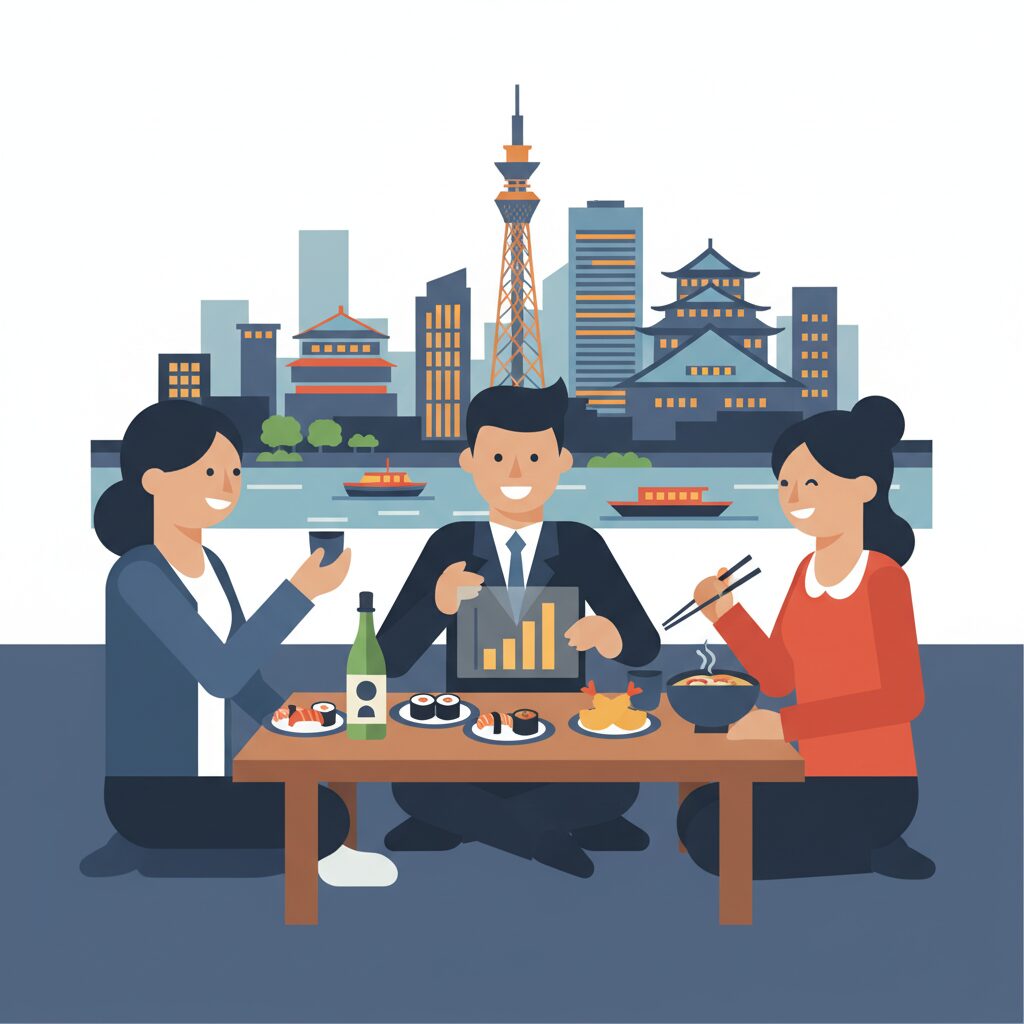
It was a Tuesday night in Tenma, the kind of evening where the air is thick with the smell of grilled skewers and the sound of laughter spilling out of doorways. I was sitting in a crowded izakaya, wedged between a salaryman loosening his tie and a bubbling tank of live squid, nursing a highball. Across the tiny table, Tanaka-san, a potential client I’d only ever met on Zoom, was passionately explaining the subtle differences between Kagoshima and Miyazaki sweet potatoes. He wasn’t talking about our project. He wasn’t talking about deadlines or deliverables. He was talking about terroir, starch content, and the best way to roast them to achieve a perfect, caramelized skin. For forty-five minutes, our “business meeting” was a deep dive into root vegetables.
My American brain, conditioned by agendas and action items, was short-circuiting. Was this a test? A bizarre filibuster? It wasn’t until he paused, took a long sip of his beer, and said, “You know, Johnson-san, someone who appreciates the details in a good potato is someone who appreciates the details in business,” that it all clicked. The potato monologue wasn’t the preamble to the meeting. It was the meeting. The real transaction wasn’t about my company’s services; it was about whether I was the kind of person he’d want to share a plate of potatoes with. This, I’ve learned, is the essence of business in Osaka. It’s a place where the lines between the personal and professional, the public and private, don’t just blur; they’re often erased entirely, a concept the Japanese call Kōjū Kondō (公私混同).
While the term Kōjū Kondō often carries a whiff of scandal in the rest of Japan—think politicians using public funds for private dinners—in Osaka, it’s simply the operating system. It’s the unofficial philosophy that you can’t truly do business with someone until you understand them as a person, and you can’t understand them as a person without sharing time, a meal, and probably a few too many drinks. For the growing ranks of remote workers, freelancers, and foreign transplants drawn to Osaka’s vibrant energy and affordability, this presents a fascinating paradox. How do you integrate into a business culture built on physical presence and social ritual when your office is your kitchen table? How do you navigate a world where a contract might be sealed not with a signature, but over a shared plate of takoyaki in a basement bar? Forget everything you know about corporate Japan from a Tokyo perspective. Here in the nation’s kitchen, your professional life is about to get personal.
This focus on building relationships through shared experiences is also reflected in the strategic, long-term growth of the region’s hospitality sector.
The Osaka Mindset: Business is Personal

To truly understand Osaka, you must recognize its origins as a city of merchants rather than samurai. While Tokyo (formerly Edo) was the political hub governed by a strict warrior class, Osaka served as Japan’s economic powerhouse, where success depended not on noble lineage but on intelligence, reputation, and the ability to build trust. This merchant heritage remains deeply embedded in the city’s character, fostering a pragmatism and emphasis on human connections that sharply contrast with Tokyo’s formal, hierarchical culture.
In Tokyo, business often resembles a meticulously choreographed performance. You exchange business cards (meishi) following exact etiquette, bow at precise angles, and address others by their correct titles. Your identity is tied to your company—the name on your card, the logo, and the corporate history serve as your currency. Meetings take place in sterile, beige conference rooms focused on efficiently conveying information and moving toward the next pre-planned stage. It’s professional and orderly, but can feel impersonal; you could be replaced by someone with the same title and the meeting would likely proceed unchanged.
Osaka discards that script entirely. While your company’s name may open the door, it’s you whom they want to do business with. They seek to know your character, sense of humor, and values. Can you hold a conversation, tell a good story, or laugh at yourself? These qualities aren’t merely secondary; they are the primary basis of assessment. The Osakan merchant spirit holds that a deal stands or falls on the person behind it. A contract is just paper; the true bond lies in the human connection, the ningen kankei.
Beyond the Business Card: The Importance of Ningen Kankei
Ningen kankei, meaning human relationships, is everything here. From the moment you meet, an Osaka businessperson is evaluating you—not on your presentation skills but on your authenticity. They’re trying to answer one vital question: “Can I work with this person for the next ten years?” This long-term mindset changes everything. Short-term, transactional relationships hold little appeal. They seek partners, not just suppliers. Partners aren’t found by analyzing spreadsheets in a boardroom, but by sharing experiences.
This explains why initial “meetings” can be confusing for foreigners. You might be invited to what seems like a casual coffee at a kissaten in Namba, only to spend an hour discussing your hometown, favorite baseball team (it’s best to say the Hanshin Tigers), and the best ramen you’ve had in the city. You might leave puzzled, thinking, “We never even talked about the project.” Yet you did—the project was you. The entire conversation served as a due diligence process, a vibe check on a corporate scale. They were determining if you were trustworthy, straightforward, someone they could call on a weekend for a favor.
I once spent an entire afternoon with a potential distributor wandering through Kuromon Ichiba Market. Without a notebook or laptop, the agenda was a stick of grilled scallops, fresh tofu samples, and green tea. He observed how I interacted with vendors, how I handled the food, whether I showed genuine curiosity. As we parted, he clapped me on the shoulder and said, “Okay, send me the proposal. You understand quality. We can work together.” That market walk was the real interview; the proposal was merely a formality. This is ningen kankei in action—inefficient, unscalable, but the essential way business happens.
Hon’ne and Tatemae Through a Different Lens
Students of Japanese culture study hon’ne (true feelings) and tatemae (public facade). Across much of Japan, especially corporate Tokyo, tatemae dominates communication. People must read the air (kūki o yomu), interpret subtle cues, and avoid causing anyone to lose face. Direct refusals are replaced with indirect phrases like, “That might be a little difficult,” or “We will consider it internally.” It’s a complex dance of indirectness that can frustrate outsiders.
Osaka has its own version, but the pace is faster and the approach more straightforward. Locals pride themselves on honesty and on revealing their hon’ne sooner than those in Tokyo. They view Tokyo’s prolonged posturing as a waste of time. Why spend three meetings hinting at a problem when you can say it directly and start solving it? But this openness is not unrestricted; it’s a privilege earned through the social customs of Kōjū Kondō.
The place where tatemae is willingly set aside for good-natured fun is the nomikai, or drinking party. Unlike Tokyo’s often rigid, hierarchical gatherings, Osaka’s nomikai are lively, chaotic, and crucial for building the trust that allows hon’ne to surface. As beer and sake flow, formal titles fade. The boss may be teased, a quiet junior staffer might reveal karaoke talents, and honest opinions, criticisms, and brilliant ideas emerge.
A business partner in Osaka might bluntly say, “Your price is way too high. Are you crazy?” Such a comment would be shocking and almost rude in Tokyo, but in Osaka, it often signals respect. It means, “I see you as a genuine partner, not just someone I must be polite to. I’m showing you my hon’ne. Now let’s negotiate like honest merchants and find a fair price.” The nomikai’s social bonding creates the safe space for this candor. Without it, those words would insult, but with it, they open the door to a real, productive dialogue.
Welcome to Your Office: The Izakaya, the Kissaten, and the Tachinomi
If Osaka’s business foundation lies in personal relationships, then its structure is shaped by the city’s extensive and diverse array of restaurants, bars, and coffee shops. For a remote worker, it’s essential to realize that the idea of a fixed “workplace” here is highly flexible. Key decisions are seldom made in a cubicle or conference room; instead, they happen in what sociologists refer to as “third spaces”—the communal areas between home and the traditional office. In Osaka, these third spaces function as the true headquarters.
This cultural dynamic is rooted in the city’s physical and economic past. Osaka is a dense, compact city where, for centuries, homes were small and businesses operated out of storefronts with families living upstairs. The boundary between domestic life and commerce was literally a staircase. Public places such as bathhouses, teahouses, and local eateries served as informal living rooms and meeting spaces for the community. It was in these venues that information was shared, reputations built, and deals made. That tradition continues today. To experience Osaka’s business scene, you need to step out of your apartment and take a seat at the counter.
The Third Space as the Primary Office
Step into a classic kissaten in neighborhoods like Umeda or Honmachi on a weekday afternoon, and you’ll see it right away. The air is thick with the subtle aroma of roasted coffee and toasted bread. In one booth, a group of elderly men in sharply tailored suits are reviewing blueprints, their voices a soft murmur interrupted by the clink of ceramic cups. Nearby, a young entrepreneur enthusiastically pitches an idea to a potential investor over a towering parfait. This is far more than a coffee break; it’s the daytime engine driving Osaka’s commerce. The kissaten, with its cozy seating, quiet ambiance, and attentive but discreet service, offers the perfect neutral ground to cultivate business relationships. It’s less formal than an office, yet more focused than a bar. Numerous multi-million yen deals have been sketched out on paper napkins here.
As evening approaches, the scene moves to the izakaya, the true boardroom of Osaka. These Japanese-style pubs, ranging from shiny modern venues to dimly lit, lantern-adorned dens, are where meaningful relationship-building takes place. Sharing food and pouring drinks is a powerful ritual that breaks down barriers and fosters camaraderie. The menu, focused on small, shareable dishes, encourages interaction and cooperation—you have to talk to decide what to order, pass plates, and ensure everyone’s glass is filled. It’s essentially a team-building exercise with alcohol.
I’ve attended izakaya meetings where the first hour was spent debating the qualities of various sashimi, followed by a lively discussion about the Hanshin Tigers, with the business talk occurring only in the final moments before departure. And when it does come, it’s swift and conclusive: “Alright, about that proposal. We’ll go with your plan. Send the paperwork tomorrow.” All the negotiation, deliberation, and decision-making took place non-verbally throughout the meal, with the final words confirming the trust established.
Then there’s the tachinomi, or standing bar—these are the quick stops of Osaka’s business world. Often tiny spots tucked in train station underpasses or narrow alleys, they’re designed for brief, efficient socializing. You might drop in with a colleague for one beer and a plate of pickles on your way home. In those fifteen minutes, standing shoulder-to-shoulder, you can have a more candid and productive conversation than in an hour-long formal meeting. It’s a moment to check in, share gossip, or float an idea without the pressure of a structured environment.
“How’s Business?” — The Art of the Casual Check-in
This fluid work-life approach is perfectly reflected in a phrase unique to the Osaka dialect: “Mokari makka?” Literally, it means “Are you making a profit?” Elsewhere, asking a business associate about profits would be highly rude. In Osaka, it’s a common greeting, equivalent to “How’s it going?” It playfully acknowledges the city’s merchant spirit and the shared hustle.
The typical response is just as important: “Bochi bochi denna,” loosely meaning “So-so, can’t complain.” You never say business is booming (which would seem boastful) nor that it’s terrible (which would sound like complaining). “Bochi bochi” represents a humble, steady, and hopeful middle ground. This exchange is more than a greeting; it’s a cultural password. Using it instantly shows you grasp the local mindset, opening the door to genuine conversation—an interaction between two fellow merchants on the same path rather than a stiff corporate dialogue. From “Mokari makka?” the chat can flow anywhere—personal or professional, often blending the two seamlessly. It’s the ideal verbal tool for a culture where boundaries are always blurred.
The Remote Worker’s Dilemma: Navigating Kōjū Kondō from a Laptop
For a foreigner who has relocated to Osaka to work remotely, the deeply rooted culture of face-to-face, food-and-drink-centered business presents a major challenge. The very concept of remote work—location independence, asynchronous communication, and a distinct separation between living space and workspace—clashes with the Osaka way. If trust is established over shared plates of okonomiyaki and business strategies are honed during the third round of highballs, how can one compete when communication happens through Slack and email? This is the core dilemma for the digital nomad in Naniwa (the historic name for Osaka). Simply logging in is not enough; you have to show up.
The initial barrier is a conceptual one. Many Westerners are conditioned to view work and life as separate. We protect our evenings and weekends, prize efficiency, and believe a well-run meeting should have a clear agenda and a set end time. The idea of a three-hour “meeting” in a smoky izakaya, filled with more talk about baseball than business, can seem wildly inefficient, a waste of time, or even an unwelcome intrusion on personal life. The first step to success is to completely reframe this mindset. In Osaka, socializing is the work. Relationship-building is the deliverable. That three-hour dinner isn’t taking you away from work; it is the most important work you’ll do all week.
Can You Build Trust Through a Screen?
The short answer: not really. At least, not in the deep, resilient way Osaka business demands. Digital tools excel at exchanging information, managing projects, and maintaining existing relationships, but they’re poor at forming new ones from scratch in this cultural context. A Zoom call can’t replicate the shared vulnerability of trying unfamiliar food together. A Slack message can’t convey the warmth of someone pouring you a drink. An email can’t capture the laughter after a terrible karaoke performance. These small, human data points are how Osakans build a complete picture of you—and they’re almost entirely lost in digital translation.
I’ve witnessed foreign freelancers fail here, not from lack of skill or poor work, but because they relied solely on transactional interactions. They sent polite, professional emails, delivered high-quality work on time, then wondered why repeat business or referrals never came. Despite following Western professional norms, they failed the unspoken Osaka test—they never made the professional relationship personal. Their clients might have been satisfied with the work but never felt a connection. And in Osaka, without connection, there is no loyalty. When a new proposal arose, clients chose the person they’d shared a laugh with the week before, even if the portfolio wasn’t as polished.
This can be deeply frustrating, feeling as if you’re judged by arbitrary social skills rather than professional merit. And in a way, you are. Because in the merchant’s mindset, social skills are professional merit—indicators of your reliability, character, and long-term potential as a partner.
Strategies for the Digital Nomad in Naniwa
So, what should a remote worker do? The key is adopting a hybrid approach. Use digital tools to be efficient and professional, but also actively and strategically create chances for real-world, Kōjū Kondō-style interactions. You must be the one to bridge the digital divide.
First, take the initiative. Don’t wait for invitations that might never come. When communicating with a local client or collaborator, be proactive. After a few successful email exchanges, propose an in-person meeting. But phrase it in the local language of social activity. Don’t say, “I’d like to schedule a meeting to discuss our Q3 strategy.” Instead, try, “I’ve heard great things about a new coffee shop near your office. Would you be free to grab a coffee there next week?” Or, “I’m still exploring the food scene here. Do you have any recommendations for a good izakaya in Namba? Perhaps we could go sometime.” This lowers the stakes, making it feel like a social invitation rather than a corporate demand, aligning with the local culture of shared discovery and food appreciation.
Second, utilize your surroundings. Don’t remain confined to your apartment. Join a co-working space, even if only for a day or two each week. These places are hubs for local entrepreneurs, freelancers, and small business owners. The goal isn’t just fast Wi-Fi—it’s to be visible, to become a familiar face. Spark conversations in the kitchen, ask what people are working on, offer help with small problems, and participate in community events. This is how you begin to build a local network from scratch. Casual acquaintances can become friends, and friends can become your most valuable business connections.
Third, when you receive that sought-after invitation to lunch, dinner, or drinks, accept it. Even if you’re tired, busy, or it feels like a chore. That invitation is never “just lunch.” It’s a test, an opportunity, and an invitation to cross from being a mere vendor to a trusted partner. During these outings, your main role isn’t to discuss business—it’s to listen, ask questions, share stories, and be a genuine, engaging person. Business conversations will happen naturally, but you must let them emerge organically. Allow your host to lead the discussion. If they want to talk about fishing for two hours, you talk about fishing. It’s in these moments that the true, durable bonds of ningen kankei are formed.
Common Misunderstandings and Unspoken Rules
Navigating Osaka’s world of blurred boundaries is like learning a new language, one where most of the essential grammar remains unwritten. For foreigners, it’s easy to misinterpret signals—mistaking genuine friendliness for a business offer, or a business proposal for simple friendliness. Grasping these unspoken rules is the key to thriving in Osaka rather than constantly feeling like an outsider who doesn’t quite understand the joke.
“They’re Just Being Friendly” vs. “This is a Negotiation”
The most frequent and risky misunderstanding for newcomers is misreading the nature of an interaction. People in Osaka are generally very outgoing, curious, and friendly. It’s entirely possible to strike up a conversation with a stranger at a bar and spend the entire night sharing stories and laughter. Sometimes, that’s genuinely all it is: a pleasant social exchange. But if that person is connected to your professional field, you should always assume it could mean more.
I once knew a foreign designer who met the owner of a small boutique at a local event. The owner was charming and enthusiastic, praising the designer’s work and sharing her own dreams for her shop. In the following weeks, they met for coffee, went out for drinks, and became fast friends. The designer was delighted to have made an authentic local connection. Then one day, the owner messaged her: “I spoke with my friend at the department store, and we think your designs would be perfect. We need the first batch in six weeks. Can you handle that?” The designer was stunned. In her mind, they were just friends. But for the boutique owner, the entire friendship had been an informal, multi-week vetting process. She was assessing the designer’s passion, reliability, and personality. The friendly conversations were the negotiation; the final message was simply the confirmation.
The unspoken rule is this: every social interaction with a potential business contact is also a potential business meeting. You need to stay open and friendly but also professionally alert. Pay close attention to the questions they ask. Notice when they return to topics related to your work. The atmosphere might feel casual, but you should never let your guard down completely. The friendly shop owner asking about your production process over a beer isn’t just making small talk; she’s gathering information.
The Bill, the Banter, and the Business
Many crucial social cues are embedded in the rituals around eating and drinking, especially when the bill arrives. The dance over who pays is a complex form of social theater. In a Western context, splitting the bill is common and efficient. In Osaka, it can signal distance. If one person invites, they will almost always insist on paying, and resisting this too much is seen as rejecting their gesture of hospitality. This act creates a small social debt. The other person is then expected to reciprocate by inviting them out in the future. This back-and-forth of treating each other establishes and sustains relationships over time. It’s a way of saying, “I am invested in this relationship beyond just this one meal.”
Humor is another essential tool. Osaka is famous for its comedy culture, and the quick, witty exchanges of manzai comedy are echoed in everyday conversation. Teasing, gentle mockery (tsukkomi), and self-deprecation are not signs of disrespect but of intimacy. If a business partner starts joking about your choice of tie or your awful singing at karaoke, it’s actually a good sign. It means they feel comfortable enough to let down their formal guard. Learning to play along, to respond with a little humor without offending, is a crucial skill. Someone who is too stiff or takes themselves too seriously will be seen as difficult to work with. They want partners who can share a laugh, even in serious discussions.
Finally, the most unspoken rule of all is that the real conclusion of a meeting often takes place after the meeting has officially ended. It happens during the walk to the train station, the shared taxi ride, or the “one last drink” at a tiny bar on the way home. This is when people truly let their guard down, and the most honest conversations occur. A client might say, “Between you and me, the real problem is…” or “Forget what I said earlier, here’s what we actually need.” These “off the record” moments are invaluable. They provide the unvarnished truth, the key information that can make or break your project. In Osaka, the meeting doesn’t end when you leave the table; it ends when you say goodnight at the station ticket gate.
So, Is This Work-Life Blend a Good Thing?
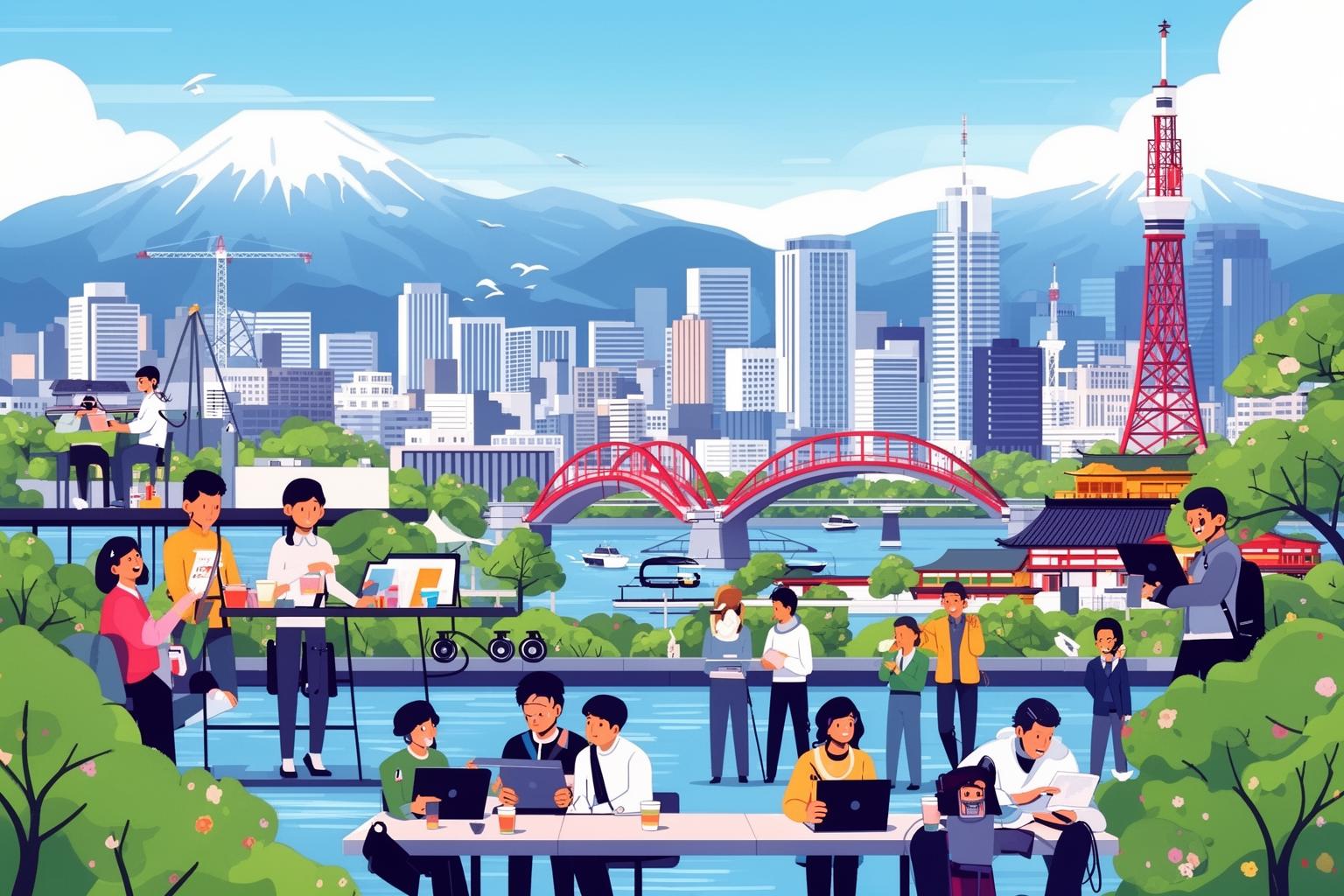
For anyone contemplating a professional life in Osaka, the key question is whether this deeply integrated work-life model is a benefit or a drawback. Is the expectation of Kōjū Kondō an opportunity to forge a richer, more connected career, or is it an exhausting demand on your personal time and energy? The reality is, it’s both. Its value depends entirely on one’s perspective, and your success here hinges on your personality and willingness to adapt to a fundamentally different approach to the role of work in your life.
The Pros: Freedom, Flexibility, and Stronger Connections
For those who embrace it, the Osaka model can be liberating and fulfilling. First, it disrupts the dull routine of a traditional nine-to-five corporate job. Your “work” might include discovering a hidden restaurant gem, learning about sake brewing from a client, or spending an afternoon exploring a historic district. It adds adventure and authentic human connection to what might otherwise be a string of transactional tasks. Your professional growth becomes intertwined with your personal development and your exploration of the city. You’re not just building a career; you’re building a life.
Second, the focus on ningen kankei creates exceptionally strong, resilient business relationships. When your client is also a friend—someone you’ve sang karaoke with or asked about their family—your relationship rises above mere commerce. It’s built on mutual trust and loyalty. This means they are more forgiving of small mistakes, more willing to collaborate in problem-solving, and much less likely to switch to a competitor offering a slightly lower price. In a world dominated by impersonal gig economies and transactional client relationships, the Osaka approach presents a chance to cultivate something deeper and longer-lasting.
Finally, this system offers a unique kind of flexibility. While it may feel like you’re “always on,” it also means work isn’t confined to a rigid schedule. A productive conversation can arise spontaneously over a brief coffee, and major decisions may be reached in a relaxed, informal setting. For remote workers already outside traditional structures, this can be an ideal fit. It prioritizes results and relationships over performative “busyness” and sitting at a desk for hours.
The Cons: The “Always On” Culture and Blurred Boundaries
Conversely, the drawbacks are substantial and should not be overlooked. The most evident is the erosion of personal boundaries. When your clients are friends and your office could be an izakaya, it often feels like you’re never truly off duty. A text at 10 p.m. on a Saturday might be a friend sharing something funny or your biggest client with an “urgent” request disguised as a casual question. The expectation of social availability can be emotionally and physically draining, particularly for introverts or those who cherish quiet, private time.
This culture can also seem opaque and unfair. It relies heavily on unwritten rules and subtle social cues. If you’re not skilled at navigating these, or if you simply dislike constant socializing, you risk being excluded. The best opportunities often go to those within the “in-group” that drinks together weekly, regardless of professional competence. It can feel like playing a game without knowing the rules, with constantly shifting goalposts. This can be especially difficult for those from cultures valuing direct communication and clear, contractual agreements.
Moreover, pressure to join the drinking culture can be challenging. Although relationships can be formed without alcohol, much of the essential social bonding occurs where drinking is central. For those abstaining for personal, health, or religious reasons, this presents an additional barrier. They must work harder to discover alternative ways to build equally strong rapport.
Ultimately, living and working in Osaka calls for a deliberate reevaluation of your relationship with your career. The city challenges the conventional idea of “work-life balance” and offers a different model: “work-life integration.” It’s not about neatly separating time between two worlds, but about weaving them into a single, cohesive fabric. This model isn’t for everyone. It demands social energy, cultural adaptability, and genuine curiosity about your colleagues. But if you’re ready to embrace the unpredictability, to accept that a conversation about potatoes might be the most important business meeting of your week, you’ll find a professional life here that is richer, more human, and more deeply interconnected than any sterile boardroom experience. In Tokyo, you build a resume. In Osaka, you build a community. Which is more valuable is your choice.