They told you to come here. Before your plane even touched the tarmac at Kansai International, before you’d even figured out the Namba subway maze, the advice was already ringing in your ears. “You have to go to Kuromon Market,” they said. “It’s the Kitchen of Osaka.” The phrase echoes with a sense of profound, unshakeable truth. It sounds essential, foundational, the kind of place that holds the city’s culinary soul in its hands. So you go. You walk from Nipponbashi Station and the energy shifts. The air gets thicker, heavy with the scent of grilled eel, sizzling wagyu, and the salty tang of the sea. You step under the iconic arched gateway, and the world dissolves into a glorious, chaotic symphony of food.
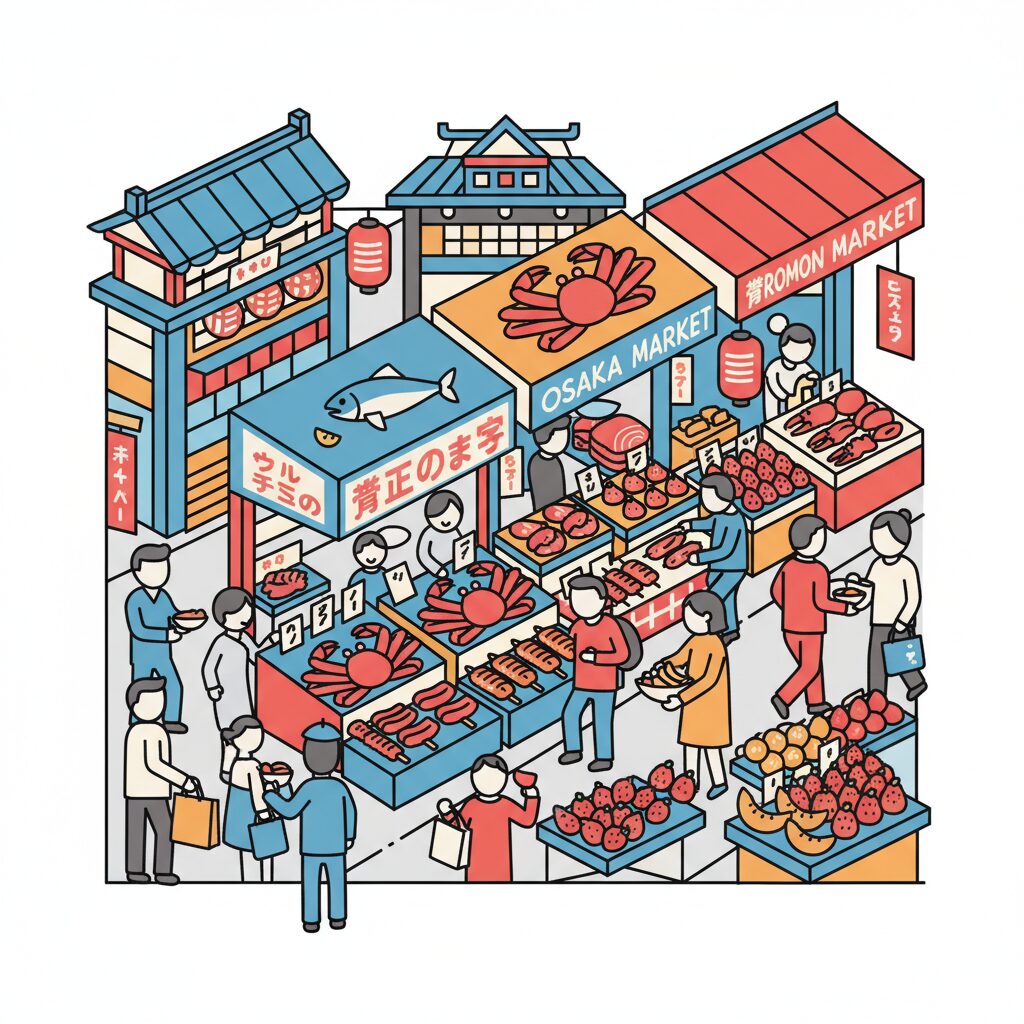
It’s a river of people, a slow-moving, wide-eyed current flowing past stalls piled high with treasures. Fat, glistening scallops are blowtorched to order, their sweet meat caramelizing before your eyes. Tiny, glowing orange octopuses, their heads stuffed with a quail egg, stare up from their skewers like cartoon aliens. Uni is cracked open on the spot, its golden lobes presented in their spiky black shell, a taste of pure ocean brine. Strawberry mochi, impossibly white and dusted with flour, gleams next to towers of perfectly marbled Kobe beef ready for the grill. Everything is immediate. Everything is an experience. You buy a skewer of fatty tuna for a price that would get you a full lunch set menu elsewhere, but it melts on your tongue and you understand. This is it. This is kuidaore—to eat yourself into ruin—in its most concentrated, spectacular form. You are, without a doubt, in the Kitchen of Osaka.
But then, a strange thought trickles into your mind, a quiet question that whispers beneath the roar of the blowtorches and the excited chatter in a dozen different languages. You look at the people around you. They are tourists, just like you were on your first visit. They hold up their phones, framing the perfect shot of a giant crab leg. They point, they marvel, they pay with fresh yen notes for a single, perfect morsel. You look at the vendors, skilled and practiced in their performance, their Japanese punctuated with English, Mandarin, and Korean pleasantries. What you don’t see, however, are the people this kitchen is supposed to be for. Where are the Osakans? Where are the grandmothers with their shopping carts, haggling over the price of daikon? Where are the local restaurant chefs, their white coats crisp, carefully selecting the day’s catch? If this is the city’s kitchen, why does it feel like none of the residents are actually here to cook? That simple, nagging question is the key that unlocks a much deeper story about Osaka—a story of pragmatism, performance, and the powerful, unseen currents that separate daily life from the grand spectacle.
To truly understand the pragmatic, everyday side of Osaka that contrasts with the tourist spectacle of Kuromon, one must look to the city’s vibrant retail job scene for foreigners in Shinsaibashi.
The Ghost of the Kitchen Past: What Kuromon Used to Be
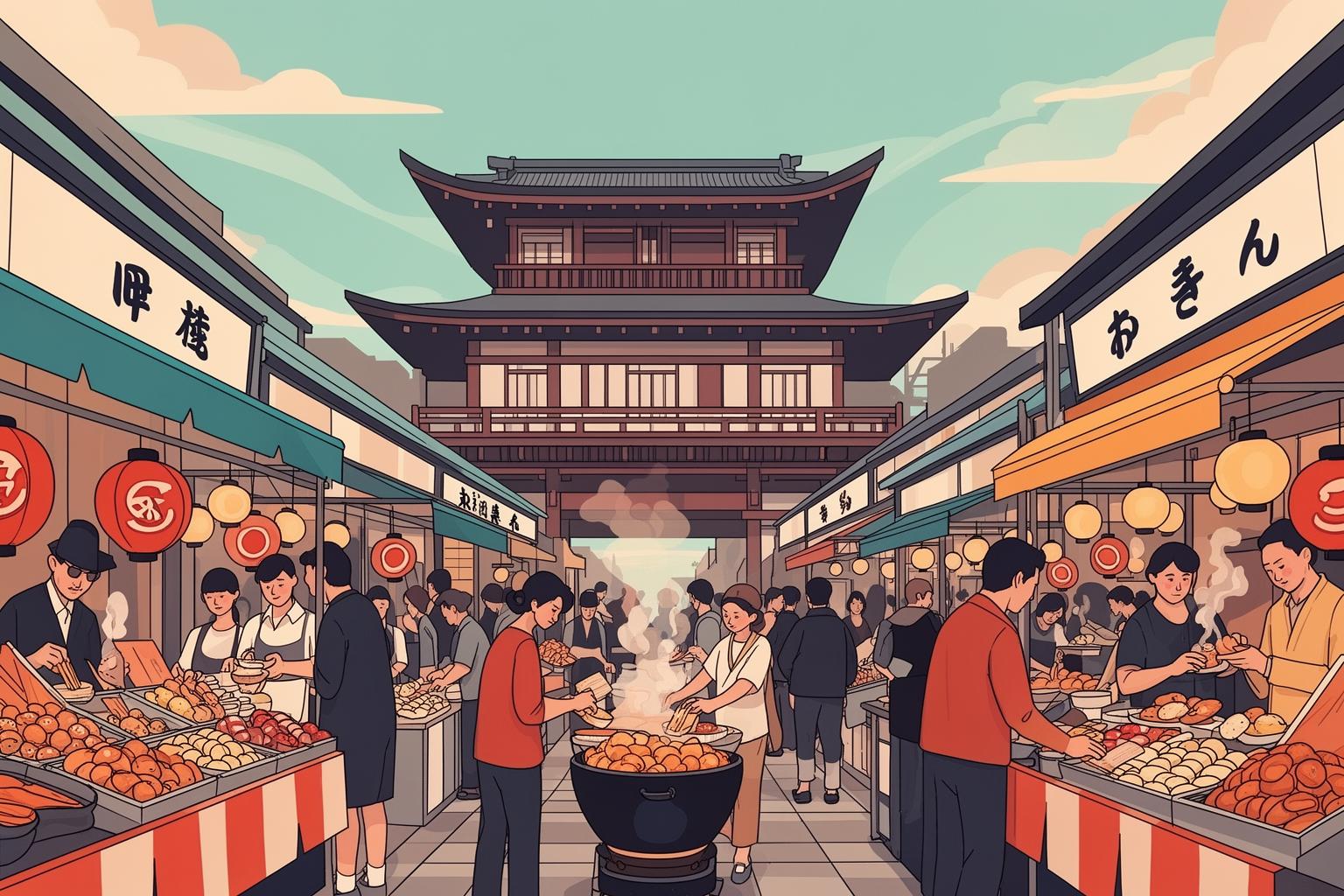
To truly grasp the Kuromon of today, you must first imagine the Kuromon of yesterday. Though not so distant in time, a decade in the life of a market can feel like an eternity. Prior to the surge of inbound tourism that now defines Japan’s major cities, Kuromon Ichiba fulfilled a clear and essential role. It wasn’t a stage for show; it was a workshop in action. It pulsed as the heart of Minami’s restaurant district, the powerhouse fueling the thousands of kitchens—from modest izakayas to upscale ryotei—that surrounded it in Namba, Shinsaibashi, and Dotonbori. The market’s pace was set by the demands of professionals, not the fancy of tourists.
The day began early, under harsh fluorescent lights that prioritized clarity over atmosphere. The air was filled with the scent of clean, cold saltwater, the iron-rich blood of freshly butchered fish, and earthy vegetables still dusted with soil. This was a place of business, of shobai, a concept embedded deeply in Osaka’s culture more than nearly anywhere else in Japan. Shobai goes beyond mere commerce; it represents a way of life. It’s about forging relationships, trust built over years rather than moments. A chef didn’t simply buy fish; he bought from his fishmonger, someone who understood his restaurant’s standards, set aside the finest cuts, and could tell at a glance what was exceptional that day versus what was just good.
Conversations were sharp, efficient, conducted in the thick, rapid rhythm of Osaka-ben. It was a practical language of weights and prices, freshness and quality. There were no single-serve skewers or Instagram-ready displays. You didn’t buy one scallop—you bought a kilogram. You didn’t receive a slice of tuna; you took home a whole block, a saku, to be expertly carved in your kitchen. The focus was unwaveringly on the raw ingredient, on the honma mon—the authentic article. This obsession runs deep in Osaka, where there’s a profound disdain for things that offer style without substance. People demanded quality, and they wanted it at a fair price. Kuromon was the epicenter of this ethos. It was also a haven for discerning home cooks, those who pursued their craft with seriousness. They came for items unavailable at typical supermarkets: rare seasonal mushrooms, live eels, and specific pickles made by the same family for three generations. This was a market serving a city that embraces food not as a pastime, but as a vital pillar of its identity.
The Tsunami of Tourism: How “Experience” Replaced Groceries
Then the world discovered Japan, and more specifically, Osaka. Once regarded as Tokyo’s rougher, less refined counterpart, the city suddenly rose to prominence as a premier destination. Central to Osaka’s appeal was its vibrant food culture, epitomized by the motto kuidaore. Tourists arrived eager to savor the authentic flavors of this legendary culinary hub. Naturally, they flocked to Osaka’s Kitchen. What followed serves as a perfect illustration of Osaka’s defining trait: its sharp, no-nonsense, and impressively quick-witted commercial pragmatism.
Picture yourself as a third-generation fishmonger. For fifty years, your family has sold whole fish to local chefs. It’s a respectable trade, but profit margins are slim. You work hard, nurture relationships, and make a living. Suddenly, a new kind of customer appears. This buyer doesn’t want a whole sea bream for their restaurant, doesn’t know how to prepare it, and doesn’t even have a kitchen. Instead, they want a single, perfect bite of something delicious, immediately. They’re willing to pay 800 yen for two pieces of grilled scallop that, as raw ingredients, cost only a fraction of that. They want to watch you blowtorch it, snap a photo, and enjoy an experience. From a strictly shobai (business) perspective, the choice is clear. Why sell a whole fish for a 30% markup when you can sell it piece by piece at a 300% markup? It’s not greed; it’s simply smart business. And in Osaka, good business is a virtue.
So the market adapted, stall by stall, almost organically. Wooden crates used for wholesale deliveries gave way to gleaming refrigerated display cases. Slabs of fish were pre-sliced for sashimi. Skewers appeared everywhere. Grills and blowtorches became standard gear. The vendors, already masters of their craft, became masters of a new skill: culinary theater. They learned key phrases in English and Chinese. They perfected dramatic sears and photogenic presentations. The entire market shifted from a supplier mindset to a destination mindset. The product ceased to be merely food; it became a consumable, shareable, and memorable event. This transformation embodies the spirit of Osaka. While a city like Kyoto might have agonized over preserving tradition, forming committees to protect the market’s authenticity, and Tokyo might have imposed regulations, creating designated eating areas and formal procedures, Osaka simply spotted the profit and pivoted rapidly. It’s the essence of the akindo, the merchant, who doesn’t lament the past when there’s money to be made in the future.
The Price of Paradise: Why Locals Pulled Back
The most immediate and obvious reason locals withdrew is one that governs everything in Osaka: price. The concept of kosupa—cost performance—is almost a religion there. Osakans possess an uncanny ability to sense when they’re being overcharged. It’s a point of pride to know the fair market value of everything, from a head of cabbage to a cut of yellowtail, and to never pay a yen more than necessary. The rise of a “tourist price” in Kuromon acted like a cultural repellant for locals.
To be specific, a local might see a small tray of otoro (fatty tuna) priced at 3,000 yen. For a tourist, this is a bargain compared to what it costs in a high-end restaurant back home—it’s a taste of luxury. But the Osakan sees something different: they know that down the street, at their local fishmonger or a good supermarket, they can get a comparable, if not better, quality block of tuna for half that price. The extra 1,500 yen at Kuromon pays for ambiance, the convenience of having it sliced on the spot, and the “experience.” For an Osakan doing regular shopping, paying for an experience is nonsensical. They’re not there to be entertained; they’re there to buy dinner.
Beyond the price, there’s the impracticality. Daily life demands efficiency. Grocery shopping is a mission, not a leisurely stroll. Navigating a crowded Kuromon aisle at noon on a Saturday with a shopping trolley is impossible. Walkways are clogged with people standing, eating skewers, taking photos, oblivious to the functional flow of a working market. The space is now designed for browsing, lingering, and on-site consumption—fundamentally incompatible with the get-in, get-out rhythm of someone buying ingredients for a week’s meals. What excites the visitor infuriates the resident trying to get their shopping done. The shift was subtle but absolute: Kuromon ceased to be a place to buy food and became a place to eat it. For local shoppers, that simple change rendered it obsolete.
So, Where is Osaka’s Real Kitchen? The Soul of the Shotengai
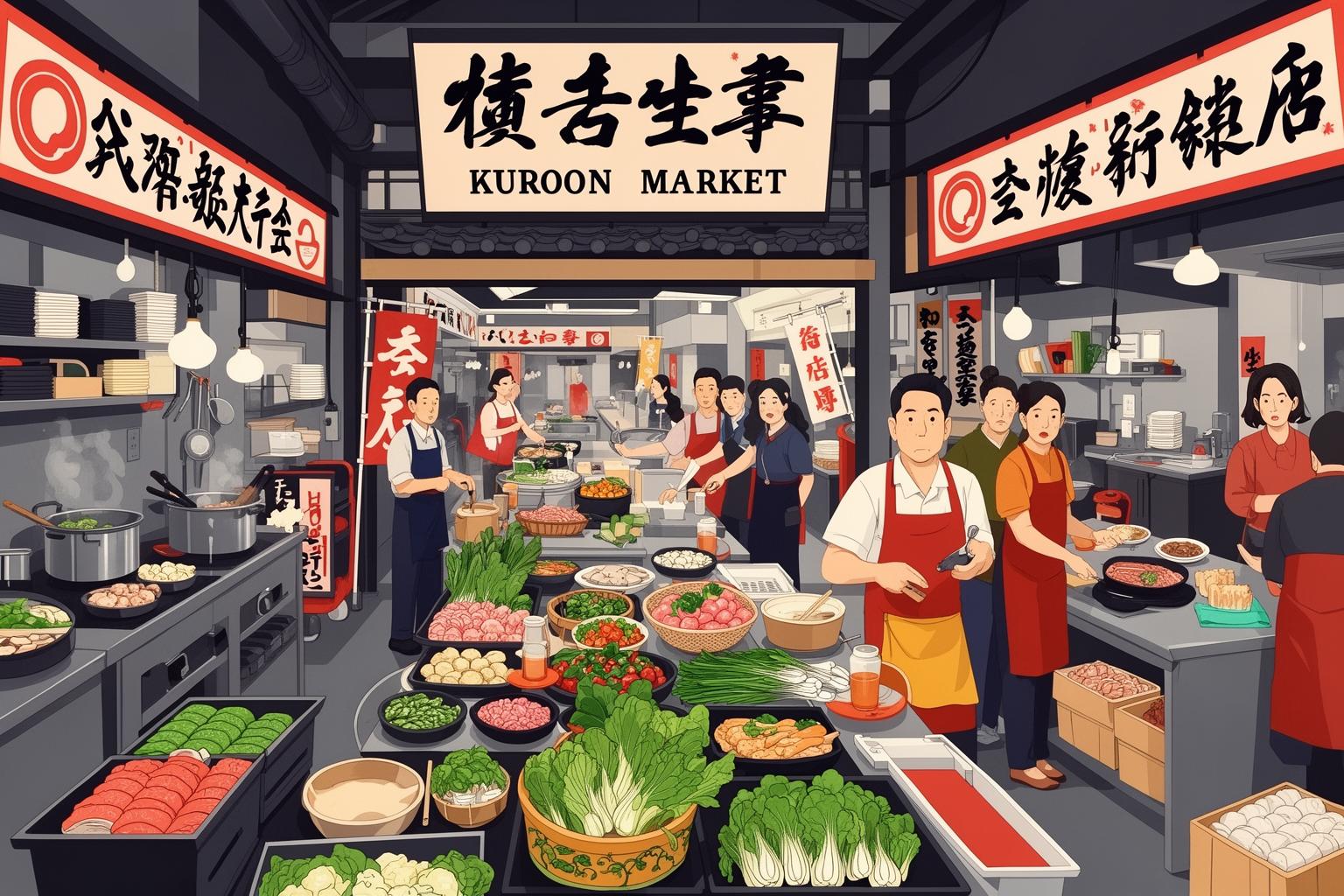
If Kuromon is no longer the city’s bustling kitchen, then where has the heart of Osaka’s food culture gone? The answer is: it hasn’t moved at all. It remains exactly where it has always been—in the thousands of neighborhood shotengai that weave through the city like arteries. These covered shopping arcades are the genuine, unpretentious, and deeply cherished kitchens of Osaka. They include places like the Tenjinbashisuji Shotengai, the longest in Japan, a seemingly endless marketplace. They’re also the smaller, unnamed arcades anchoring every residential area, those you won’t find in any travel guide.
Step into one of these, and the difference is felt immediately. The atmosphere is distinct—not the excited chatter of tourists, but the steady rhythm of daily life: the clatter of steel shutters, the call-and-response greetings between shopkeepers and customers, the jingling of bicycle bells, the constant, looping music from a local pachinko parlor. The lighting is dimmer, and the displays are simpler. It’s not about showmanship; it’s about the product. A fruit stand might keep its goods in the original cardboard boxes, the prices handwritten on scraps of cardboard with a thick black marker. It’s beautifully, refreshingly un-Instagrammable.
Here, the unspoken rules of Osaka commerce are fully in play. The relationship between vendor and customer is key. After a few visits to the local butcher, he’ll start to recognize you, ask what you’re cooking for dinner, and recommend a certain cut. He might even add a little extra fat for flavor—a small freebie known as omake—as thanks for your loyalty. This is the authentic “friendliness” Osaka is known for. It’s not just an abstract welcoming feeling but a tangible, transactional form of community building. It’s about mutual respect based on repeated business. You trust the shopkeeper to provide good products at fair prices, and they trust you to return. In these arcades, the passion for kosupa is a communal pastime. You’ll see shoppers carefully comparing the prices of green onions at two vegetable stands only five meters apart. Finding the best deal isn’t just saving money; it’s winning a minor victory, proving you’re a savvy shopper. This daily hustle and joy define life in Osaka.
The Supermarket Sweep: The Modern Osaka Household
Of course, it’s important to be realistic. The nostalgic image of everyone shopping daily at a traditional shotengai is incomplete. Modern Osaka households, like those everywhere, also rely heavily on supermarkets. Yet even here, Osaka’s unique character shines, especially in the form of a local institution: Super Tamade.
To understand Tamade is to understand the Osaka spirit. A typical Tokyo supermarket, such as Kinokuniya or Seijo Ishii, is a temple of curated taste: calm, elegantly lit, with tastefully arranged displays and high-quality, often expensive goods. Super Tamade is the exact opposite. It is a sensory explosion. The storefronts blaze with gaudy neon lights, flashing and buzzing around the clock. Inside, aisles are narrow, shelves piled high, and a relentlessly upbeat, fast-tempo jingle blares through the speakers. Everything shouts “CHEAP!” And it is. Tamade is famous for its unbelievably low prices, especially its legendary “1 yen sales,” where select items sell for a single coin with a minimum purchase.
Its aesthetic is pure Osaka: loud, proud, and unconcerned with polished appearances. It values substance—in this case, low prices—over style. The very success and popularity of Tamade highlight a contrast with Tokyo’s refinement. It shows that in Osaka, value is the highest form of beauty. A local family’s shopping habits blend these worlds. They might visit Tamade or another supermarket like Life for weekly staples—milk, eggs, cleaning products, packaged goods. But for the important items where quality truly matters, they make separate trips to trusted vendors in the shotengai. Fish from the fishmonger, tofu from the tofu maker, croquettes fresh from the butcher every afternoon. This layered approach to shopping is the true rhythm of Osaka’s kitchen.
The Kuromon Paradox: Is It Still “Osaka”?
Looking at Kuromon Market today, it’s easy to feel a sense of loss and see it as a place that has traded its soul for tourist dollars. Many locals share this sentiment, recalling the “old Kuromon” with deep nostalgia. They complain about the prices and the crowds, often avoiding it altogether, except perhaps during the hectic year-end rush to buy special ingredients for New Year’s osechi ryori. Yet, here lies the paradox: in its current, highly commercialized state, Kuromon may actually reflect Osaka’s core identity more than ever before.
Osaka has always been a city of merchants. It was the commercial center of feudal Japan, the nation’s rice exchange, a place where status was earned through business skill rather than birthright. The city’s spirit is one of relentless, unapologetic commercialism. It embraces change, spotting opportunities and seizing them enthusiastically. Viewed in this way, Kuromon’s transformation is not a betrayal of its identity; it is its ultimate expression. The vendors didn’t sell out—they cashed in. They assessed the changing economic landscape and made a pragmatic, profitable choice. They adapted their business model to suit new demands. What could be more Osaka than that?
This sharply contrasts with its cultural rival, Kyoto. Faced with a similar tourism surge, Kyoto often doubles down on tradition and preservation, sometimes becoming exclusive and commercially rigid. Osaka’s response was to throw open its doors and find ways to capitalize on the crowds. The result is a place that feels less like a market museum and more like a vibrant, loud testament to the city’s merchant spirit. Amid the stalls selling blowtorched wagyu and glossy fruit mochi, a few old-timers still endure: a tiny shop selling only katsuobushi (dried bonito flakes), shaved to order; a pickle vendor whose vats seem unchanged for a century. These quiet corners are relics of the past, but now the exception rather than the rule. They exist in tension with their flashier neighbors, embodying the market’s—and the city’s—ongoing evolution.
Navigating the Two Kuromons: A Guide for the Resident
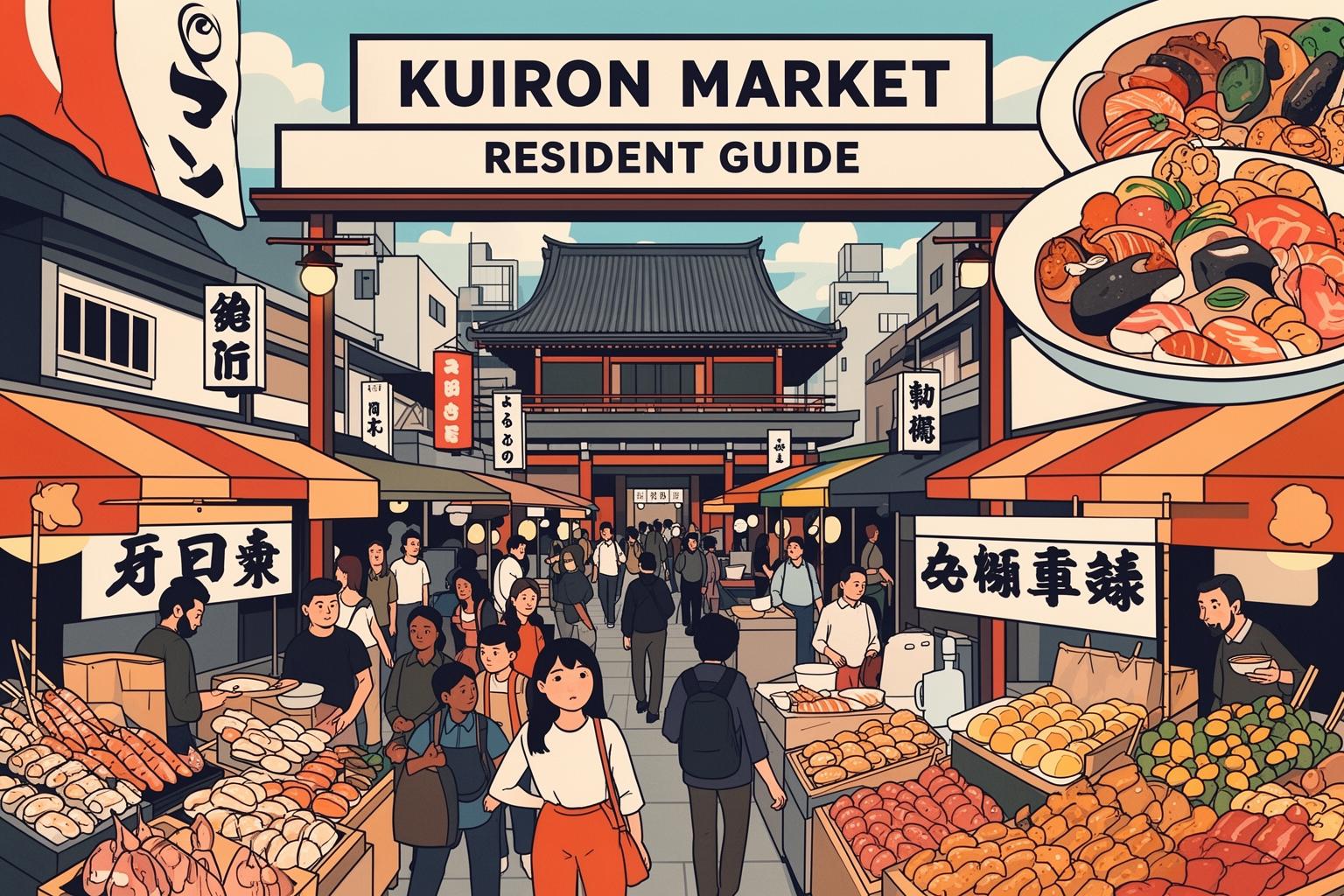
So, what does all this mean for you, a foreigner living in Osaka, trying to build a life here and understand the city on its own terms? It means you need to learn to see Kuromon in two different ways. You have to grasp that the market exists simultaneously in two distinct dimensions: the dimension of spectacle and the dimension of everyday life.
First, accept Kuromon for what it is today. Don’t go there expecting to do your regular grocery shopping. Don’t go searching for bargains. Instead, treat it like any major tourist attraction. Visit when friends or family come to town. Let them experience the sensory overload, the thrill of eating fresh uni straight from the shell. Splurge on an overpriced skewer of fatty tuna because it’s delicious and enjoyable. See it as a theme park of Japanese seafood, a lively, ever-changing food festival. Appreciate the performance, enjoy the hustle, and recognize that the high prices are your ticket in. In this sense, Kuromon is an amazing experience and a dazzling showcase of Osaka’s energy and flair.
But then, on a quiet Tuesday morning, leave the spectacle behind. To discover the city’s true kitchen, head in the opposite direction. Find your own neighborhood shotengai. It might seem modest at first—slightly worn, a little quiet. But walk its full length. Notice which fruit stand has a line. Observe the butcher locals chat with. Buy tofu from the shop that sells only tofu. It will be the best tofu you’ve ever tasted. Ask the fishmonger what’s fresh today. Even if your Japanese is imperfect, your gesture will be appreciated. This is where you’ll find the soul of Osaka: in small, everyday interactions, in the search for quality at fair prices, in the community built around a shared love of food. Kuromon is the city’s dazzling storefront, its brilliant advertisement to the world. But the shotengai is its heart, and recognizing the crucial difference between the two is the real key to feeling at home in the incredible, complex, and endlessly captivating city of Osaka.