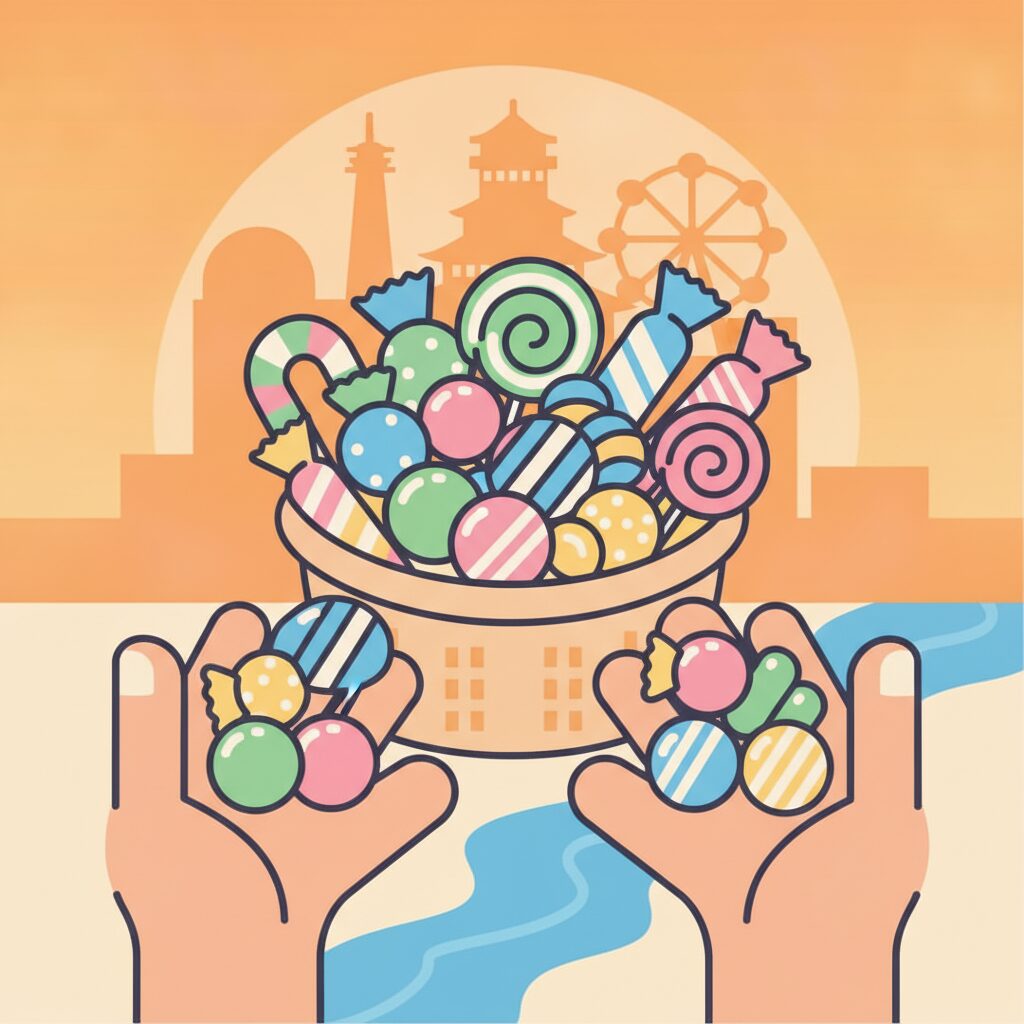
The first time it happened, I was genuinely confused. I was standing on a crowded platform at Umeda Station, trying to decipher the kaleidoscopic train map, feeling very much like a foreigner in my own country after a long stint away. An elderly woman, her hair a perfect silver perm, tapped me on the shoulder. I turned, expecting a question about directions. Instead, she pushed a small, brightly wrapped candy into my hand, gave a decisive nod, and said, “Kore, tabe.” Eat this. Before I could process the exchange, she was gone, swallowed by the river of commuters flowing onto the Hankyu line. I stood there, staring at the little pineapple hard candy in my palm, and thought, “What just happened?” This, my friends, is your formal introduction to one of the most fundamental, heartwarming, and utterly baffling social rituals of my city: the culture of ‘Ame-chan.’
In Osaka, ‘ame’ means candy, but adding the affectionate suffix ‘-chan’ transforms it into something more. It’s not just a confection; it’s a tool, a gesture, a language all its own. This small, sugary offering is a key that unlocks the city’s entire operating system. It’s a stark contrast to the silent, invisible walls you often feel between strangers in Tokyo. There, an unsolicited gift from a stranger would likely be met with suspicion. Here, it’s as natural as breathing. Understanding the why and how of Ame-chan is to understand the very pulse of Osaka—its history, its humor, and its uniquely human approach to urban life. This isn’t just about candy. It’s about a philosophy of connection, a daily practice that keeps the gears of this massive, bustling city lubricated with small, consistent acts of goodwill. For anyone trying to figure out what makes Osaka tick, the trail starts here, with a crinkle of cellophane and a shared moment of unexpected sweetness.
If you’re curious to understand how playful exchanges weave through everyday life in Osaka, you might consider exploring Osaka humor for a fresh perspective on local interactions.
What Exactly is ‘Ame-chan’ Culture?
To those unfamiliar, it’s simply candy. But for an Osakan, Ame-chan represents an entire institution wrapped in a tiny piece of plastic. It’s a social phenomenon rooted in unspoken understanding, a ritual performed daily on trains, in shopping arcades, and on street corners throughout the city. Grasping this concept is your first significant step toward decoding the local culture and genuinely feeling at home here. It’s less about the sugar rush and more about the complex web of social cues and community spirit it embodies.
More Than Just Sugar
First, let’s clarify what Ame-chan typically is. We’re not referring to gourmet chocolates or artisanal caramels. Classic Ame-chan is a simple hard candy, individually wrapped for convenience and hygiene. Think fruit drops, milk candies, herbal throat lozenges, or the traditional Kuro-ame (black sugar candy). Its charm lies in its simplicity and readiness for sharing. The act of giving is spontaneous, almost automatic. An Osaka ‘obachan’—a term for a middle-aged or older woman, but here symbolizing community caretaking—might see a child about to cry on the train. Out comes an Ame-chan. She might overhear someone coughing. Out comes a minty throat lozenge. There’s no elaborate ceremony. Often, it comes with a simple, straightforward phrase like “Ame,いる?” (Ame, iru? – Want a candy?) or “Kore, ageru” (Kore, ageru – I’ll give you this). The gesture itself is the message. It’s an icebreaker, a peace offering, a small burst of cheer, and a quiet way of saying, “I see you, and we’re in this together.” It serves as social lubrication, easing the friction of daily life in a densely populated city—a small exchange that reaffirms shared humanity between complete strangers.
The Arsenal in the Handbag
To truly understand the Ame-chan phenomenon, you must peek inside the handbag of a seasoned Osaka obachan. It’s a marvel of logistical readiness, a mobile command center for managing minor everyday crises. Along with a wallet, keys, and a foldable fan for the sweltering summer humidity, you’ll almost always find a small pouch or a special pocket filled with a variety of Ame-chan. This isn’t a random handful grabbed on the way out the door. It’s a carefully curated collection. There will be something sweet for children, something soothing for sore throats, perhaps a slightly sour one for a quick pick-me-up, and a classic crowd-pleaser for general distribution. This isn’t merely about kindness; it’s about preparedness. It reflects a deeply ingrained mindset of proactive care and community responsibility. The obachan is the unofficial quartermaster of her immediate surroundings. Her handbag holds the solution to a dozen minor problems, and Ame-chan is her most versatile tool. This readiness is a core principle of the Osaka spirit—a practical, no-nonsense approach to looking out for one another. It’s an unspoken agreement with society that says, “I’ve got this covered,” one little piece of candy at a time.
The ‘Why’ Behind the Candy: Decoding Osaka’s Mindset
The act of sharing Ame-chan isn’t just a random habit. It’s a behavior deeply embedded in the historical and cultural fabric of Osaka. To understand why a stranger might offer you candy on the subway, you need to look back at what shaped this city. Unlike Kyoto or Tokyo, Osaka wasn’t the political capital; it was the nation’s kitchen, a hub of commerce, and a city built by merchants. This commercial spirit nurtured a unique set of values that emphasize direct communication, pragmatism, and the skill of forming quick, effective relationships. The Ame-chan is a contemporary embodiment of these centuries-old traditions.
Communication is King (and Candy its Messenger)
In a merchant city, survival hinges on your ability to engage with others. You must haggle, persuade, build trust, and close deals, often within minutes. This necessity created a culture where quickly breaking down social barriers is not just polite but essential. The formal, hierarchical communication styles influenced by the samurai class, dominant in Tokyo, were less practical here. In Osaka, you had to get straight to the point, find common ground, and foster a positive atmosphere. Ame-chan serves perfectly for this purpose. It’s a disarming gesture that immediately lowers defenses. It’s impossible to stay formal or detached when someone offers you their personal candy stash. It’s a small negotiation that says, “Let’s be friendly.” This gesture skips multiple steps of formal introduction and moves directly to mutual goodwill. It initiates contact without the risk of verbal rejection. You’re not demanding someone’s time or attention; you’re simply offering a small gift. This act of service, a personal and informal ‘omotenashi,’ epitomizes Osaka’s people-centered approach to life. It’s about creating a connection, however brief, because in a merchant city, the next valuable relationship can come from anywhere.
Practicality Over Formality: The Osaka Way
If one word captures the Osaka mindset, it’s ‘practical.’ Osakans are renowned for their pragmatism. They prioritize results over process. Does it work? Does it make sense? Is it efficient? This sharply contrasts with Tokyo’s often meticulous and formal social culture. In Tokyo, social interactions are governed by a complex set of unspoken rules about politeness, distance, and propriety. Offering candy to a stranger on the Yamanote Line would break many of those social norms, likely causing confusion and discomfort. In Osaka, the logic is simpler: if a child is crying and disturbing everyone, a piece of candy will probably calm them down. The most practical solution is to offer the candy. Problem solved. This direct, outcome-focused mindset applies across the board. Why waste time on stiff formalities when a simple, warm gesture can achieve the same—or better—result? Ame-chan perfectly embodies this philosophy. It’s a low-effort, high-impact way to improve the immediate social environment. It’s not about following rules; it’s about using common sense to make life a bit easier and more pleasant for all. This is the heart of the Osaka way: discover the shortest, most effective path to a positive human connection.
The Economics of Generosity
Let’s discuss money, because in Osaka, conversations about value are never far away. Osakans are reputed to be financially shrewd—the stereotype is ‘kechi’ (stingy), but ‘kenjitsu’ (down-to-earth and pragmatic) is more accurate. They love a good bargain and hate waste (‘mottainai’). So how does this align with giving things away freely? It’s because the Ame-chan exchange is a social economic masterpiece. The cost of a single hard candy is minimal, maybe just a few yen. But the return on that investment is immense. For a tiny monetary outlay, you generate immediate goodwill, cultivate a positive social atmosphere, and build a fleeting yet real sense of community. It’s the ultimate low-risk, high-return social investment. This isn’t a cold calculation; it’s an intuitive grasp of value coming from the city’s merchant heritage. You learn to see that life’s most valuable things—trust, kindness, a shared laugh—can often be nurtured through the smallest gestures. Ame-chan teaches a lesson in value creation. It shows that generosity isn’t about the gift’s price, but the intent and impact behind the act itself.
Navigating the Ame-chan Exchange: A Foreigner’s Field Guide
So, you’re living in Osaka, and the moment has finally arrived. Whether you’re on the train or waiting in line at the post office, a complete stranger extends a small, crinkly object toward you. This is your chance. How you respond in the next five seconds will decide if you seamlessly become part of this charming local tradition or create an awkward moment. Don’t worry. There’s a straightforward protocol to follow that will make the exchange smooth, positive, and a highlight of your day.
The Offer: How to React
Your primary rule is: unless you have a severe allergy, always accept the Ame-chan. Think of it like a handshake or a friendly nod. It’s a social gesture, and refusing it can come across as cold, distrustful, or simply unfriendly. It’s not a serious offense, but it does halt the intended connection. So, how do you proceed? First, make eye contact and smile. A warm, genuine smile is universally appreciated here. As you take the candy, give a slight bow of the head—not a deep, formal bow, just a small nod of acknowledgment. Then, say thank you. A simple “Arigatou gozaimasu” is perfectly appropriate and well understood. To truly impress and show your local knowledge, use the local dialect: “Ookini.” This simple word often brings a big, pleased grin from the giver. It shows you’re not just a visitor but someone who respects local customs. Hold the candy briefly, acknowledge it, then put it in your pocket or bag. You don’t have to eat it right away. The key is the act of giving and receiving, not immediate consumption.
The Follow-Up Conversation (or Lack Thereof)
What happens next can vary. Sometimes, the Ame-chan exchange is complete in itself—the candy is passed, thank yous are exchanged, and you both continue on your way. The gesture stands alone, a complete little story in two parts. Don’t feel pressured to start a conversation if it doesn’t arise naturally. The purpose has been fulfilled by the exchange itself. However, often the candy serves as an opener, a way to break the silence between strangers. Be ready for a few follow-up questions. Common starters include: “Doko kara kitan?” (Where are you from?), “Atsui naa!” (It’s hot, isn’t it!), or comments about something you’re wearing or carrying. The chat will likely be light, simple, and brief. Engage warmly; answer their questions and maybe ask a simple question in return. This is at the heart of Osaka’s communication style—small, friendly, low-pressure conversations that foster a sense of shared space. It’s not an interrogation but a neighborly gesture, even if your ‘neighborhood’ is just a shared bench for ten minutes.
Should You Carry Your Own Ame-chan?
This is a more advanced question. As a non-Japanese resident, no one expects you to fully participate in Ame-chan culture. You’re generally expected only to be a grateful recipient. You won’t lose face or offend anyone by not carrying candy to offer back. However, if you want to dive deep into Osaka life, carrying your own Ame-chan can be transformative. It sends a clear signal that you truly understand the local culture. It shifts you from passive observer to active participant. Imagine the delight on an obachan’s face when she offers you candy, and not only do you accept with a perfect “Ookini,” but you also open your bag and say, “Watashi mo, douzo.” (I have some too, please have one.) This simple reciprocation can spark genuine connection and mutual appreciation. It’s also handy to have on your own. See a tired parent with a fussy child? Be the friendly stranger with a small distraction. Want to thank the local shop owner? An Ame-chan is a perfect, low-key gift. Carrying candy isn’t required, but it’s an invitation to fully embrace the warm, giving spirit of your adopted city.
Common Misunderstandings and Cultural Pitfalls
For anyone new to Osaka, especially those from more reserved cultures, the Ame-chan habit can be quite confusing. The straightforwardness and unsolicited generosity may trigger alarm bells if you’re unprepared. It’s easy to misinterpret this gesture through the lens of your own cultural background. Confronting these potential misunderstandings directly is essential to truly appreciating the custom for what it is: a simple, genuine act of community building. Overcoming these initial challenges is key to enjoying a more relaxed and fulfilling life in this unique city.
“Is This a Scam? Are They Trying to Sell Me Something?”
This is likely the most common concern among newcomers. In many countries, a stranger offering a free gift often precedes a high-pressure sales pitch, a request for donations, or a scam. It’s important to realize this almost never applies to Ame-chan. The culture behind it is not commercial or transactional. There are no strings attached. The person giving you candy expects nothing in return—not money, time, or a signature on a petition. The only ‘payment’ is your smile and acceptance. This act stems from genuine goodwill without hidden motives. It may take time to adjust your skepticism, but learning to accept this kindness as-is is an important cultural reset. When an Osaka obachan offers you candy, your stranger-danger instincts can be safely set aside. What you’re witnessing is a purely social exchange, not a commercial one.
“Why Me? Am I Being Singled Out?”
When you stand out as a foreigner, it’s easy to feel singled out. In some ways, you might be, but not negatively. Sometimes an Osakan offers you Ame-chan precisely because you are not Japanese. It’s their way of extending a warm welcome, a silent message saying, “We’re glad you’re here, welcome to our city.” This gesture is an act of hospitality, driven by curiosity and a sincere wish to make you feel at ease. However, it’s a mistake to think this only happens to foreigners. If you spend time on a local bus, or in a neighborhood park, you’ll see it happen frequently among Japanese people too. An obachan might give candy to a bus driver. Two women waiting for a shop opening might share a bag. A grandfather might offer one to a teenager who gave up their seat. You are not being singled out oddly; you are being included in a universal local custom. Viewing it this way transforms the perspective—it’s not exclusion but inclusion.
The Tokyo vs. Osaka Divide: A Sweet Metaphor
The Ame-chan custom serves as a perfect edible metaphor for the deep cultural differences between Osaka and Tokyo. Tokyo embodies a formal, stylized social order. If Tokyo were a gift, it would be a box of exquisitely crafted chocolates from a prestigious department store like Mitsukoshi. The packaging is flawless, the gift expensive, and it’s given only on specific, socially prescribed occasions, such as seasonal greetings (o-seibo) or as a return gift (o-kaeshi). The exchange is elegant, polite, and follows strict rules. Osaka, by contrast, is like the handful of assorted hard candies pulled from a purse. The value lies not in the gift itself—which is humble and inexpensive—but in the gesture. The packaging is purely functional, not ornate. The timing is spontaneous, driven by the moment and mood, not social convention. The interaction eschews formal politeness in favor of warmth, practicality, and direct human connection. Tokyo’s gift-giving reinforces social hierarchy and obligation, while Osaka’s Ame-chan breaks down social structures, creating brief moments of equal, shared humanity.
Living the Ame-chan Life: What This Means for Your Daily Routine
Understanding Ame-chan culture is more than just an interesting tidbit; it’s a practical guide to living well in Osaka. This small custom reflects a much broader social philosophy. Embracing its spirit can fundamentally transform your daily experience, making the city feel less like a collection of strangers and more like an extensive, interconnected neighborhood. It calls for a shift in mindset, an openness to interaction, and a willingness to engage in the casual, friendly rhythm of the city. Living the Ame-chan way means living like a true Osakan.
The Permeable Social Bubble
In many large cities, people go about their day enveloped in a strong, invisible social bubble. You avoid eye contact, keep to yourself, and minimize interaction with strangers. In Osaka, however, that bubble is much more permeable. The Ame-chan is a prime example of how easily that barrier can be broken. This openness extends to many other parts of daily life. The butcher at your local market might ask about your weekend plans. The woman at the dry cleaners will remember your name and comment on your new haircut. People are simply more inclined to engage with you. For someone used to urban anonymity, this can feel somewhat intrusive at first. But once you adjust, it begins to feel like a safety net. It fosters a sense of belonging and mutual recognition. You’re not just a faceless person in the crowd; you become a known part of your local ecosystem. This atmosphere, nurtured by countless small interactions like sharing a candy, makes the city feel smaller, warmer, and more human.
Embracing the “Nori”: Getting in on the Joke
A key concept in Osaka culture is called ‘nori.’ Although hard to translate directly, it refers to a shared atmosphere, a vibe, or being on the same wavelength. It’s about joining in, playing along, and contributing to a lighthearted, often humorous social rhythm. Good ‘nori’ is like a successful comedy improv scene where everyone knows their role. The Ame-chan exchange perfectly illustrates everyday ‘nori.’ The giver starts a friendly scene, and by accepting with a smile and a thank you, you play your part flawlessly. You demonstrate that you have good ‘nori’—you get the joke and understand the vibe. This quality is highly valued in Osaka. Life here is more enjoyable when you stop taking everything so seriously and just go with the flow. Join the banter, laugh at the jokes, and accept the candy. Embracing this playful spirit is key to not just surviving in Osaka, but thriving.
A Lesson in Small Joys
Ultimately, living in a city that thrives on Ame-chan teaches you to find and cherish joy in the small, mundane moments of your day. It’s a constant, gentle reminder that community isn’t built on grand, dramatic gestures, but on the accumulation of thousands of tiny, seemingly insignificant acts of kindness. It’s the obachan on the train, the shopkeeper who adds an extra orange, the ramen chef who gives you a knowing nod. These moments, like the candies themselves, are small, sweet, and fleeting. But together, they create the rich, satisfying flavor of life in Osaka. This city recalibrates your sense of social connection. It encourages you to look up from your phone, acknowledge those around you, and be open to the possibility of a pleasant surprise. It’s a city that hasn’t forgotten the simple, profound power of sharing something small to brighten someone’s day a little. And that, in the end, is a pretty sweet way to live.