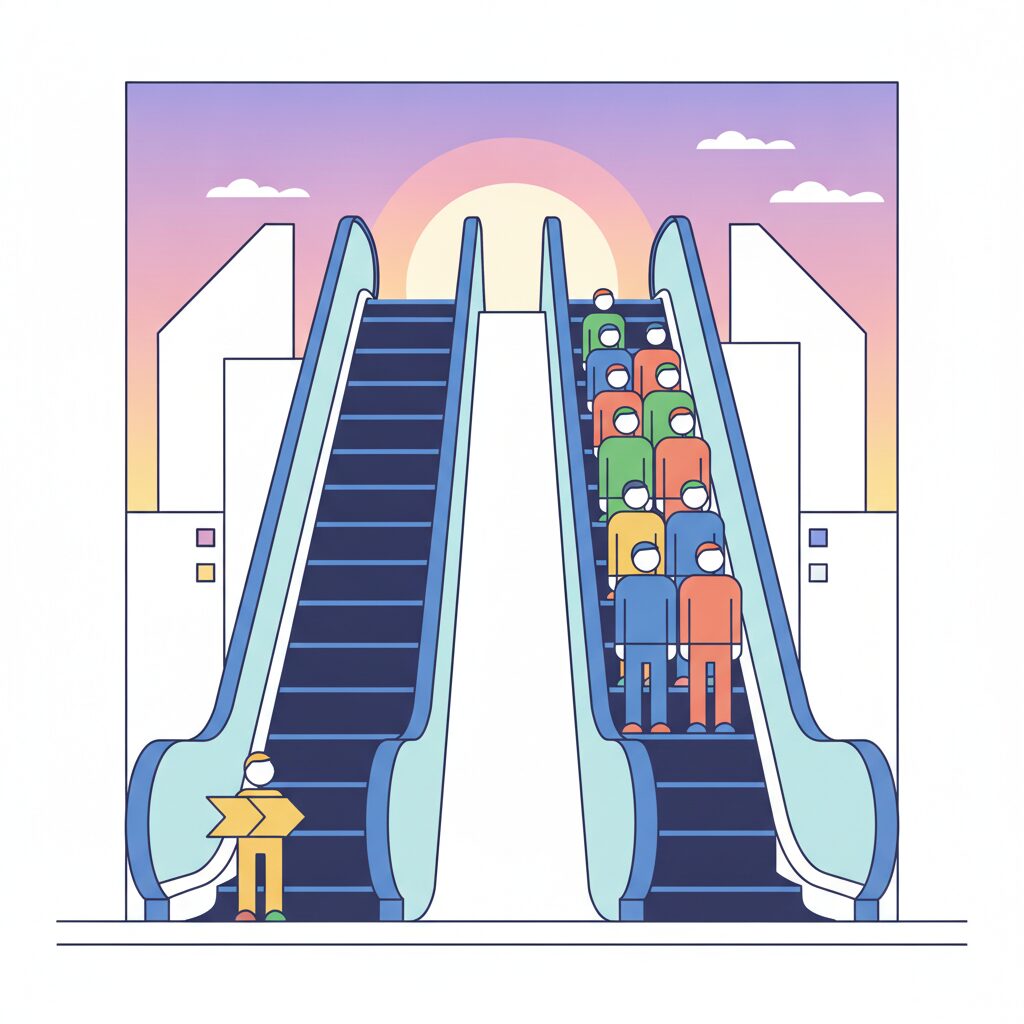
Hey, I’m Megumi. As an event planner from Tokyo, my job is all about reading the room, understanding the flow of a crowd, and making sure everything runs smoothly. But the first time I stepped off the Shinkansen at Shin-Osaka Station for a project, I felt like I’d forgotten how to walk. I drifted onto an escalator, instinctively moving to the left to let people pass on the right, just like I’ve done a million times in Shibuya or Shinjuku. Almost immediately, I felt a kind of human traffic jam forming behind me. A gentle but firm pressure on my shoulder, a chorus of soft ‘tch’ sounds, and an older woman in a leopard-print blouse who simply said, “Anata, migi,”—You, right side—while pointing. I had committed the cardinal sin of Osaka transit: I stood on the left.
It sounds like a tiny detail, a quirky regional difference. But that moment was my real introduction to Osaka. It wasn’t about the castles or the food; it was about the fundamental rhythm of the city, a rhythm that beats to a different drum than Tokyo’s. Why does virtually all of Japan stand on the left, while Osaka and the surrounding Kansai region defiantly stand on the right? The answer isn’t just a historical footnote. It’s a window into the soul of this city—its pragmatism, its rebellious streak, and its uniquely human approach to public life. If you’re thinking of living here, or just want to understand what makes this place tick, forget the tourist guides for a second. Let’s talk about the escalator, because it reveals more about the daily reality of Osaka than you could ever imagine. This isn’t just about which side to stand on; it’s about understanding the very current that powers this incredible city.
Understanding the unique pulse of Osaka goes beyond transit quirks, as exploring Osaka shotengai budgeting reveals practical insights into managing everyday expenses in the city.
The Great Escalator Divide: Right vs. Left
First, let’s set the record straight. In Osaka, you stand on the right side of the escalator. The left side is the express lane, reserved for those who want to walk, stride, or sprint up or down. This is the absolute, non-negotiable, unspoken rule of the city. It’s not written anywhere. There are no official signs enforcing this. It’s something you sense, something you pick up by observing the constant, fluid movement of people in major train stations like Umeda, Namba, and Tennoji. Get it wrong, and you become a human dam blocking a fast-flowing river. You disrupt the nagare, the flow, and in Osaka, the flow is everything.
This sharply contrasts with Tokyo. Step onto any escalator on the Yamanote Line, and you’ll see a neat line of people standing close to the left handrail. The right side is left open as a pathway for hurried salarymen and students. This left-side custom is the norm across most of Japan. It’s so deeply ingrained that it feels as natural as breathing. So why is Osaka different? Why go against the current of an entire nation? The question itself reveals Osaka’s character. The city has never been one to follow the capital’s lead without a reason. Conforming for the sake of conformity just isn’t the Osaka way.
Unraveling the ‘Why’: A Mix of History and Practicality
Explore the origins of Osaka’s right-side rule, and you’ll uncover an intriguing mix of corporate strategy, historical circumstances, and a strong sense of local pride. It wasn’t a mere accident; it was a deliberate choice, and that choice reveals a lot.
The Hankyu Railway Theory
The most commonly accepted explanation highlights a major local player: Hankyu Railway. In the late 1960s, as escalators became widespread in the expansive Umeda Station—the core of Hankyu’s network—the company reportedly initiated a campaign. Passengers were asked to “please leave the left side open.” This request was based on existing pedestrian habits. At that time, the general practice in Osaka was to keep to the right when walking, a pattern that some say reflected international norms and made sense in a port city with many foreign visitors. By having people stand on the right, the left lane remained free for walking, aligning naturally with foot traffic flow on platforms and concourses. This was a classic example of Osaka pragmatism: don’t create a new rule, just formalize the one that’s already effective. A private railway, rather than the government, shaped public behavior because it made practical sense for their passengers.
The Expo ’70 Effect
A few years later, Osaka hosted the 1970 World Exposition, a monumental event that thrust the city onto the global stage. Expo ’70 attracted millions of visitors worldwide. To handle the massive crowds and make international guests more comfortable—since standing on the right is common in many Western countries—the “stand right” rule was heavily emphasized. The Expo served as a catalyst, solidifying the Hankyu-led practice into a city-wide, and later region-wide, norm. It was a conscious adaptation for global efficiency, and the habit endured long after the pavilions were dismantled. It became part of Osaka’s modern identity: an international city with its own distinct way of doing things.
The ‘Anti-Tokyo’ Mindset?
Now to the more culturally intriguing explanation. It’s impossible to discuss Osaka without mentioning its centuries-old rivalry with Tokyo. Tokyo is the center of government, refined formality, and top-down rules. Osaka has always been the city of merchants, lively commerce, and grassroots innovation. There is a deep-rooted pride in this identity, a playful yet persistent desire to stand apart, to show the Osaka way is just as valid—if not superior. So, when people say Osakans stand on the right “just to be different from Tokyo,” it’s a simplification, but it holds some truth. It’s not out of spite, but from a strong independent spirit. It’s a subtle, everyday statement that Osaka sets its own standards. The city looks eastward and says, with its characteristic grin, “You do you, we’ll do us.” This mindset is woven into the city’s fabric, and the escalator is just one of the most visible expressions.
What the Escalator Tells You About Osaka’s Soul
The escalator rule is more than just a historical curiosity. It serves as a living, breathing demonstration of the core values that shape daily life in Osaka. If you grasp the logic behind the escalator, you’re well on your way to understanding the city itself.
Efficiency Above All: The Merchant’s Mentality
Osaka was built on trade. It was the nation’s kitchen—the place where rice was gathered, stored, and sold. The spirit of the shounin (merchant) remains vibrant today. Time is money. Efficiency rules. Deals won’t wait for you, nor will your train. The walking lane on the escalator is not a polite suggestion; it’s a vital artery. People in Osaka are often described as sekkachi—impatient or hurried. But this isn’t anxious energy; it’s purposeful energy. There’s a destination to reach, a goal to achieve, and the path must stay clear. In Tokyo, public spaces often prioritize harmony and order, even if it slows things down. In Osaka, the focus is on maximizing efficiency for the collective. A blocked escalator lane is inefficient and wastes everyone’s time. Therefore, it must be cleared. This practical, results-driven mindset influences everything from business negotiations to how you queue for takoyaki.
Direct Communication, Osaka-Style
My experience of being corrected on the escalator exemplifies the Osaka communication style perfectly. In Tokyo, if I made the same mistake, I’d likely face silence, passive-aggressive sighs, or someone awkwardly trying to squeeze past me. The focus there is on avoiding direct confrontation. In Osaka, things are different. That woman didn’t yell at me or show anger. She was direct, clear, and efficient. She spotted a problem (a clueless Tokyoite blocking the flow) and gave a simple verbal solution. Outsiders might mistake this directness for rudeness, but it’s rarely meant that way. It’s practical. Why waste time on subtle hints when you can just say what needs to be said? This approach applies to compliments, jokes, and criticism alike. Osakans tend to speak their minds openly but with warmth and humor that soften the edges. Their intent isn’t to offend but to connect straightforwardly.
An Example from the Subway
Imagine Umeda Station interchange at 6 PM—a swirling vortex of humanity. But watch the escalators. On the right side, people stand packed in, scrolling through phones or resting their eyes. On the left, it’s a blur of motion. Salarymen with briefcases, students with backpacks, shoppers with bags—all moving briskly and steadily. There’s no pushing or shoving, just a shared, unspoken understanding of the goal. The energy is tangible—a low hum of a city in constant motion. Now compare that with Shinjuku Station in Tokyo. It’s just as crowded, maybe more so, but the atmosphere feels different. The lines are stricter, the mood more subdued, the movement more regimented. In Osaka, the chaos follows a logic. It’s an organized, high-speed dance, and once you learn the steps, it feels incredibly freeing.
Beyond the Escalator: Other Unspoken Rules
This mindset of pragmatic efficiency and straightforwardness extends beyond escalators. It’s reflected throughout the rhythm of daily life in Osaka.
Jaywalking with Purpose
Stand at a crosswalk in central Tokyo, and you’ll often find crowds patiently waiting for the light to change, even if no cars are visible for miles. It’s about obeying the rules and maintaining public order. In Osaka, the calculation is different. If the street is empty and safe to cross, people will go ahead. It’s not about reckless lawbreaking; it’s about risk assessment and efficiency. The unspoken rule is: look both ways, confirm it’s clear, and don’t hesitate. Spending ten seconds waiting at an empty intersection just doesn’t make sense in the local logic. It’s a small expression of personal autonomy that values common sense over blind rule-following.
The Art of the Bicycle Weave
Bicycles, especially the sturdy mamachari (mom’s bike), are the heartbeat of Osaka’s neighborhoods. They’re everywhere, and they seem to follow their own rules. Cyclists weave through crowds on shopping streets with an instinctive grace that can be daunting for newcomers. But it’s not chaos. There’s a shared language of bells, subtle shifts in weight, and eye contact. Pedestrians avoid sudden moves. Cyclists anticipate the pedestrian’s route. It’s a fluid, high-stakes dance of mutual awareness. The core principle, once again, is efficiency. The shortest path between two points is a straight line, and both pedestrians and cyclists in Osaka excel at navigating those lines on the fly.
Talking on the Train (with a Caveat)
The rule against talking on your cell phone on the train is strict throughout Japan, and Osaka is no exception. Yet the general atmosphere inside a train car can feel different. The famed silence of the Tokyo Metro is truly distinctive. Conversations are rare and whispered. On the Osaka Loop Line or Midosuji subway line, you’re more likely to hear friends chatting, families laughing, and people speaking at a normal, respectful volume. It’s not a party, but the public space feels more… public. It reflects a culture where the boundary between private and public life is a bit more blurred, a bit more relaxed. People are less shielded from each other, contributing to the city’s reputation for being friendly and approachable.
How to Navigate Osaka Like a Local
So, how do you adjust to this distinctive urban rhythm? It’s easier than you might expect. It involves less memorizing rules and more embracing a certain mindset.
Stand Right, Walk Left. This is the first and most crucial rule. Commit it to memory. When unsure, simply observe what others are doing. The flow will guide you.
Don’t Confuse Directness with Rudeness. If a shopkeeper tells you that a color doesn’t suit you, or someone loudly points out that you’ve dropped something, take it at face value. It’s information, not an insult. Often, it indicates they feel comfortable enough to be honest with you.
Be Spatially Conscious. Life in Osaka moves fast. If you need to pause to check your map or send a text, step aside from the main flow of traffic. Stay close to a wall or find a quiet spot. Being mindful of the nagare is the greatest courtesy you can offer to fellow residents.
Embrace the Logic. Try to understand the city’s unspoken rules through the perspective of efficiency. Why are people acting as they do? Usually, it’s because it’s the quickest, most practical way to get things done. Once you grasp that underlying logic, the city’s seeming chaos transforms into a beautifully intricate, self-organizing system.
Final Thoughts: A City in Motion
That simple escalator ride taught me more than any book ever could. The right-side rule serves as a symbol. It signifies a city confident in its own identity, one that values practical efficiency over strict formality, and embodies a unique, powerful rhythm. Living in Osaka means learning to sense that rhythm. It means recognizing that directness is a form of kindness and that speed is a way of respecting everyone else’s time.
This is a city unafraid to differ from its larger, more famous sibling to the east. It has forged its own path, its own rules, and its distinctive way of life—one escalator step at a time. When you find yourself standing on the right without even thinking about it, feel the flow of people passing on your left, and realize you’re part of that current, you’ll know you’re no longer just visiting Osaka. You’re beginning to truly understand it.