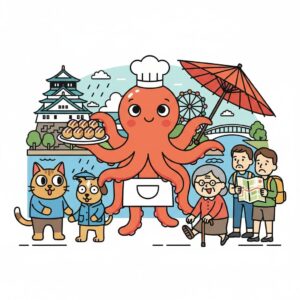
Osaka. The name itself hums with a vibrant, electric energy. It’s a city built on the love of food, a place where the term kuidaore—to eat oneself into ruin—is a badge of honor, not a warning. For dreamers from across the globe, the neon-drenched alleys of Namba, the sophisticated streets of Umeda, and the bohemian corners of Nakazakicho whisper a seductive promise: open a place of your own. Imagine it. Your very own café, the air thick with the aroma of freshly ground coffee beans sourced from your favorite roaster. Or a cozy bar, where the gentle clinking of ice in a glass provides the soundtrack to whispered conversations and newfound friendships. It’s a beautiful, intoxicating vision, a fantasy nurtured by a city that seems to welcome bold flavors and bolder personalities. This isn’t just about business; it’s about becoming part of the very fabric of Japan’s Kitchen, weaving your own unique thread into its rich culinary tapestry. But between the dream and the reality, between the first sketch on a napkin and the first customer walking through the door, lies a complex, often daunting labyrinth of bureaucracy, cultural nuances, and financial hurdles. This is the unglamorous, unfiltered truth about turning that dream into a tangible, thriving business in the heart of Kansai. It’s a journey that demands more than just a great concept and a passion for hospitality; it requires resilience, meticulous planning, and a deep understanding of the system you’re about to enter. Before you start scouting locations in Shinsaibashi or pricing out espresso machines, let’s pull back the curtain and look at the real, tangible steps and challenges that await.
Understanding these challenges is crucial, especially as the broader hospitality landscape in Osaka evolves, driven by factors like the current hotel industry boom fueled by inbound tourism.
The First Gatekeeper: Your Visa Status

Before you even start considering the color of your walls or the style of your menus, you must face the single most challenging hurdle: your legal right to operate a business in Japan. You can’t simply arrive on a tourist visa and begin signing leases. The Japanese government requires a specific residence status, and for most aspiring entrepreneurs, this means obtaining the Business Manager visa (経営・管理ビザ, Keiei Kanri Biza). This visa category is your golden ticket, but acquiring it is a marathon, not a sprint. The process demands extensive preparation, documentation, and, most importantly, proof that your venture is not merely a passion project but a viable, sustainable business that will contribute to the Japanese economy.
Breaking Down the Business Manager Visa
The core requirements for this visa may sound straightforward, but the details are where the challenge lies. First, you need to establish a company in Japan. This isn’t just a theoretical concept; you must legally incorporate a business, typically as a Kabushiki Kaisha (K.K., a joint-stock corporation) or a Godo Kaisha (G.K., a limited liability company). This step requires navigating the Legal Affairs Bureau (Homukyoku), drafting articles of incorporation, and officially registering your company seal (inkan).
Second, you must secure a physical office space. This is a crucial point that trips up many applicants. A virtual office, P.O. box, or shared co-working desk will not be accepted. Immigration demands a distinct, tangible space dedicated exclusively to your business operations. It must have a door displaying your company name, a desk, a phone, a computer—it needs to appear and function like a real office. For a cafe or bar owner, this often means leasing your actual commercial property before the visa is approved. This poses a significant financial risk, as you might be paying rent on an empty space for months while awaiting immigration approval. It’s a classic chicken-and-egg problem that requires a leap of faith and a solid financial cushion.
Third, perhaps the most well-known requirement is the capital investment. You must prove an investment of at least 5 million yen (roughly $45,000 – $50,000 USD, depending on exchange rates) into the business. This is not just a figure on paper. You must trace the origin of the funds and show clear documentation of their deposit into your company’s Japanese bank account. This capital is intended to cover initial operating costs, salaries, and other expenditures, demonstrating that your business has financial stability. While 5 million yen is the minimum, immigration officials will assess whether this amount is realistic for your particular business plan. A small coffee stand might be sufficient, but a full-service bar and restaurant in a prime location will likely require a significantly larger demonstrated investment to be credible.
Fourth, a meticulously detailed business plan (jigyo keikakusho) is essential. This document is your guide. It must be written in Japanese and cover every aspect of your venture comprehensively. This includes a thorough market analysis, projected profit and loss statements for several years, pricing strategy, marketing plan, supplier details, and staffing plan. It must be professional, realistic, and compelling, convincing a skeptical immigration officer that you have thoroughly prepared and that your business has a genuine chance of success. A vague or overly optimistic plan will be rejected outright. This is where professional assistance becomes invaluable. An experienced immigration lawyer (gyoseishoshi) or business consultant can help you produce a plan that meets the authorities’ strict requirements.
The Great Property Hunt: Finding Your Space in Osaka
Once you embark on the monumental task of applying for a visa, the search for the ideal location begins. In Japan, this process is complicated by distinctive customs and financial requirements that can confuse foreigners. Osaka is a city made up of unique neighborhoods, each with its own personality and commercial pace. Rent in popular, high-traffic areas like Shinsaibashi or Namba will be extremely expensive, while quieter, residential neighborhoods such as Tenma or Fukushima offer a more local atmosphere and more affordable leases. Your choice of location will shape your customer base, ambiance, and budget.
Understanding Japanese Real Estate Terminology
When working with Japanese real estate agents, you’ll encounter many terms that have no direct equivalent in most Western countries. The upfront costs of leasing can be overwhelming, often totaling six to ten times the monthly rent. First, there’s the rent (yachin) itself. Then comes the security deposit (shikikin or hoshokin), usually refundable after deducting repair costs upon move-out. Next is reikin, or “key money,” a non-refundable gift to the landlord as a token of gratitude for renting the property. This can be equivalent to one or two months’ rent and represents a pure expense. Additionally, you may have to pay renewal fees (koshinryo) to extend your lease, as well as a real estate agent’s commission (chukai tesuryo), typically equal to one month’s rent plus tax.
Moreover, many landlords require a guarantor company (hoshogaisha). You’ll need to pay this company a fee, often between 50% and 100% of one month’s rent, to co-sign your lease. This is especially common for foreign tenants who do not have a Japanese individual willing to act as a personal guarantor. Altogether, for a property with a monthly rent of 300,000 yen, your initial move-in costs could easily exceed 2,000,000 yen before you’ve even bought a single cup of coffee.
The ‘Inuki’ Benefit
While searching for properties, you will often find listings labeled as inuki (居抜き), which are former restaurants or cafes rented with the previous tenant’s equipment and furnishings included. This can be a huge advantage, potentially saving millions of yen in renovation and equipment expenses. You might inherit a fully equipped kitchen, counters, tables, chairs, and even the air conditioning system. However, you must be thorough in inspecting the equipment to ensure it is in good working condition. You will also need to pay a transfer fee (joto-ryo) to the previous owner for these assets. The alternative is a “skeleton” property—a bare concrete shell that you must build out completely. Though this allows total creative freedom, the costs of plumbing, electrical work, gas installation, ventilation, and interior finishing can be enormous and will require navigating a complicated maze of building codes and permits.
The Labyrinth of Licenses and Regulations
Securing your visa and your location are just the initial steps. Next comes the complex negotiation with local government offices to obtain the necessary licenses for legal operation. For any establishment serving food or beverages, this is mandatory. The two key authorities involved are the public health center (hokenjo) and, if you plan to serve alcohol late at night, the police department.
The Health Permit: Your Pass to Serve
To acquire your food and beverage business permit (飲食店営業許可, inshokuten eigyo kyoka), you must meet the requirements set by the local hokenjo. This process starts by appointing a Food Sanitation Manager (食品衛生責任者, shokuhin eisei sekininsha). Every food business in Japan must have a certified individual on staff responsible for maintaining hygiene standards. To get certified, you or a trusted employee must complete a one-day training course and pass a simple exam. The course is conducted entirely in Japanese, so a strong command of the language is necessary. If your Japanese skills are insufficient, you will need to hire a Japanese national who either already holds the certification or is willing to obtain it.
Once a manager is appointed, your physical location must pass a thorough inspection. The hokenjo enforces very specific, strict regulations regarding kitchen layouts. For instance, you are often required to have at least two sinks—one dedicated to dishwashing and another for handwashing—with prescribed dimensions and placements. Your kitchen must feature smooth, easily cleanable surfaces on walls and floors, proper ventilation, adequate refrigeration equipped with thermometers, and pest control measures. An inspector will visit your premises prior to opening to verify that every detail meets their standards. If even a single element is out of compliance, your permit will be denied, and you cannot open until the issue is resolved. This system does not allow for rule-bending or special favors; compliance is absolute.
The Bar Challenge: Managing Late-Night Service
If you envision a bar that remains open past midnight, you face an entirely different set of regulations. Serving alcohol until midnight generally falls under the standard restaurant permit. However, to operate between midnight and dawn, you must obtain a Late-Night Business Permit (深夜酒類提供飲食店営業営業開始届, shinya shurui teikyo inshokuten eigyo kaishi todoke) from the local police department. This is not a straightforward application; it is a comprehensive notification procedure requiring submission of detailed floor plans of your establishment. The police focus heavily on the layout, visibility, and prevention of “immoral” activities. Your establishment cannot have private rooms smaller than a certain size, and internal lighting must reach a minimum brightness. Seating and floor plans must be arranged so staff can see all customer areas easily. Strict zoning laws also apply: you cannot obtain this permit if your business is located too close to schools, hospitals, or within designated residential zones.
An officer from the local police station will inspect your bar to measure everything and verify that your provided floor plans are accurate to the millimeter. They will assess lighting levels, chair back heights, and the transparency of partitions. Any inconsistency may result in rejection of your application. This process highlights a fundamental aspect of doing business in Japan: rules are adhered to precisely, with no room for interpretation.
The Culture of Commerce in Osaka
Beyond the clear-cut legal and financial requirements lies the nuanced, gray area of Japanese business culture. This is especially true in Osaka, a city celebrated as Japan’s historic merchant capital. The local business philosophy, known as akinai, is founded on relationships, trust, and a long-term outlook. It’s not merely about making a quick sale; it’s about cultivating a community around your business.
Building Your Network of Suppliers
You cannot operate a café or bar in isolation. You will need a trustworthy network of suppliers for everything from coffee beans and fresh produce to craft beer and spirits. In Japan, these connections are rarely just transactional. Business is often based on long-standing relationships and introductions. As a foreigner, you are an outsider. You can’t simply cold-call a renowned local coffee roaster and expect to receive their best beans. An introduction from a mutual contact may be necessary. You will be expected to show respect, exercise patience, and demonstrate commitment to quality. Building this trust takes time, involving face-to-face meetings, punctuality, and genuine appreciation for their craft. However, once you earn their respect, Japanese suppliers tend to become incredibly loyal, reliable, and supportive partners for your business.
Understanding the Customer: The Art of Omotenashi
Omotenashi is the Japanese concept of hospitality—a profound, selfless desire to anticipate and meet a guest’s needs before they are even voiced. This goes beyond politeness; it forms the foundation of Japan’s service industry. Customers in Osaka, while famously friendly and direct, hold very high expectations for service. They anticipate a clean environment, meticulous attention to detail, and staff who are attentive without being intrusive. Your staff must be trained to recognize these subtle cues. For example, water glasses should be refilled without prompting, and a customer scanning the room should be kindly approached with, “May I help you?” This level of service is the expected norm, not a luxury. As a foreign owner, you must either master this skill yourself or hire and train staff who embody it. A stylish interior and unique menu will matter little if your service does not meet local standards.
The Power of the ‘Joren-san’
A primary goal for any small Japanese establishment is to nurture joren-san—regular, loyal customers. These patrons become the foundation of your business. They visit several times a week, know your name, and bring their friends. Building this base demands more than just quality coffee or cocktails; it requires fostering a sense of community and belonging. Remember people’s names and their usual orders. Engage in friendly conversation, but also recognize when to give them space. In Osaka, this is particularly important. Osakans are known for being warm, open, and talkative. They appreciate business owners with personality. Creating an environment where people feel comfortable and recognized is key to long-term success in a city overflowing with food and drink options at every corner.
Financial Realities: The True Cost of Your Dream
The 5 million yen for your visa is merely the starting point. It serves as a down payment on your dream, not the entire cost. The actual expense of opening a small cafe or bar in Osaka can easily be two to three times that amount, so it’s essential to have a realistic budget from the beginning. Let’s break down the potential costs you need to prepare for, far beyond the initial capital required for immigration.
The Initial Surge: Opening the Doors
- Property Costs: As mentioned, this is a major expense. Expect to pay 6-10 months’ rent upfront. For a modest space costing 300,000 yen/month, that amounts to 1.8 to 3 million yen before you even begin renovations.
- Renovation and Construction: If you’re starting with a bare property, this will be your biggest cost. Fully outfitting a small cafe can easily run 5 to 10 million yen or more, depending on complexity. This includes plumbing, electrical work, gas lines, ventilation, flooring, walls, lighting, and building your bar or kitchen counter.
- Equipment: The core of your operation. A commercial espresso machine alone can exceed 1 million yen. Along with grinders, refrigerators, freezers, ice machines, ovens, dishwashers, and a POS system, budgeting 2 to 4 million yen for essential equipment is reasonable.
- Licenses and Professional Fees: Account for company registration fees, visa application assistance from a gyoseishoshi, real estate agent commissions, and various permit fees. This can total several hundred thousand yen.
- Initial Inventory: You must stock your shelves before selling anything. This includes coffee beans, milk, alcohol, mixers, syrups, and food ingredients. Initial inventory can easily cost between 300,000 and 500,000 yen or more.
The Long Haul: Operating Capital
It’s a universal truth in the restaurant business that you likely won’t turn a profit immediately. Building a customer base and gaining word-of-mouth takes time. Having a significant working capital buffer to cover the first six to twelve months is absolutely critical. This fund covers rent, utilities, staff salaries, and inventory replenishment while your revenue grows. Running out of operating capital is one of the primary reasons new businesses fail. You should aim to have at least six months’ worth of total operating expenses saved in the bank after covering all initial setup costs. This is your lifeline—without it, a few slow weeks could crush your dream.
Final Words of Advice: Navigating the Journey
Opening a cafe or bar in Osaka is a significant challenge. It involves navigating bureaucratic hurdles, financial risks, and cultural adjustments. This path is not suited for the faint-hearted or ill-prepared, but it is achievable. Success depends on following a few essential principles.
First, thoroughly research the process. Spend months, or even years, understanding the system. Engage with other foreign business owners and absorb as much information as possible. Gain a clear understanding of the visa procedures before committing any money.
Second, enlist professional assistance. Don’t attempt to handle the visa, company registration, or licensing processes alone. The fees paid to a skilled immigration lawyer, accountant, and a real estate agent familiar with foreign clients are investments that save time and prevent costly errors.
Third, make an effort to learn the language and culture. While perfect fluency is unnecessary, showing dedication is crucial. Being able to manage basic conversations with suppliers, landlords, and local customers in Japanese greatly helps in building trust and important relationships.
Lastly, remain realistic and resilient. Your initial business plan will evolve, and you will encounter unforeseen difficulties. There will be moments of doubt. The dream of serving drinks under Osaka’s night sky is a strong motivator, but it’s the persistent daily efforts—the careful planning, humble service, and prudent budgeting—that transform that dream into a lasting success. The journey is tough, but for those who persevere, the reward is invaluable: a place to call your own, a community you’ve fostered, in the heart of one of the world’s most vibrant and flavorful cities.