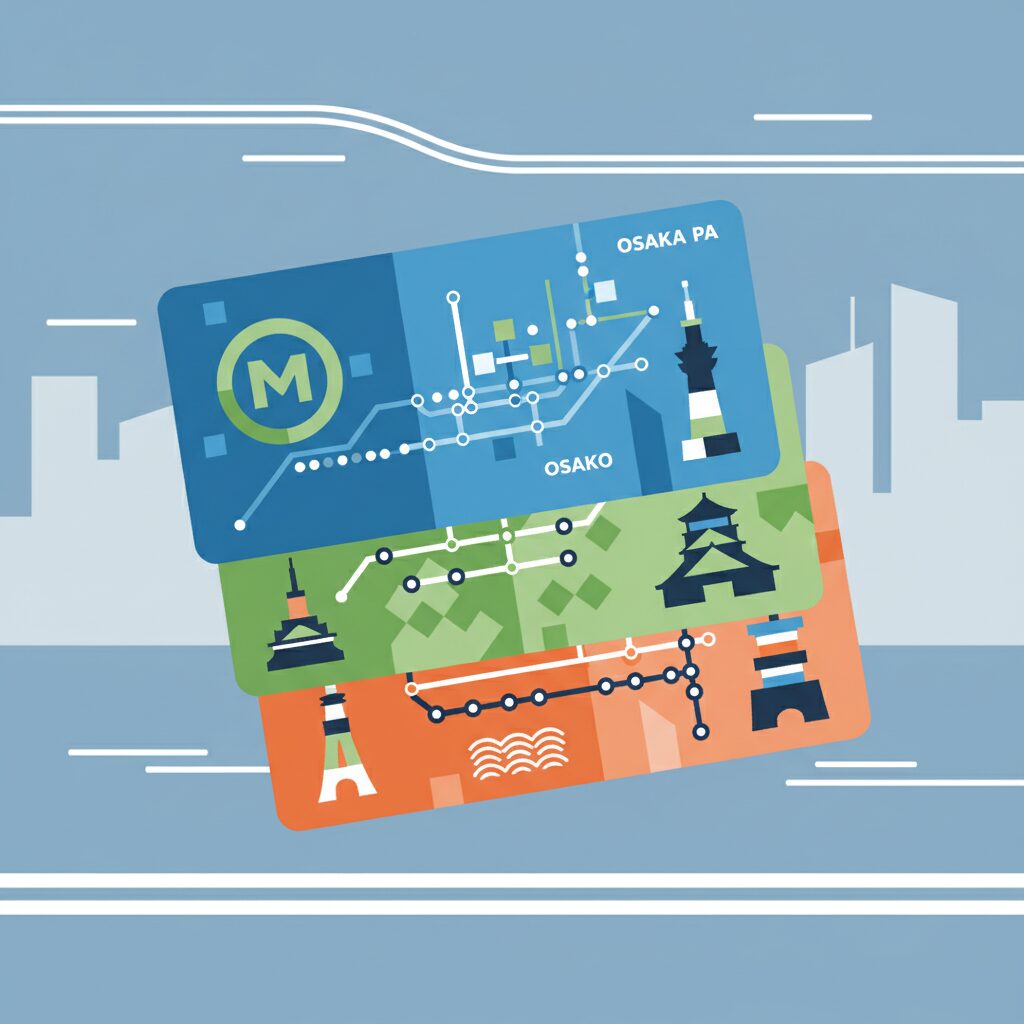
So you’ve moved to Osaka. You’ve navigated the visa process, found an apartment, and maybe you even bought a Japan Rail Pass on your first exploratory trip here. You saw the commercials, the blogs, the endless travel vlogs. The JR Pass, a golden ticket to ride the sleek Shinkansen from one end of the country to the other. It feels like the ultimate key to Japan. But now you’re living here. You’re not a tourist anymore. Your daily life isn’t about bullet trains to Tokyo; it’s about the morning rush from your neighborhood in Sakai to your office in Umeda. And you quickly realize that paying for every single trip with your ICOCA card is draining your bank account with a relentless series of tiny, digital chirps. The JR Pass is a tourist’s tool. For the resident, for the person truly living the rhythm of the city, there is a far more powerful, more intricate, and more culturally significant key to unlock Osaka. It’s called the `Teiki-ken`—the humble commuter pass. And understanding it isn’t just about saving money. It’s about understanding the very soul of this city: its pragmatism, its fierce loyalties, and the invisible lines of identity that carve up the urban landscape.
Embracing every aspect of Osaka life means not only mastering commuter passes but also understanding local rental nuances, so consider learning more about navigating the guarantor system to ease your transition as a resident.
The Teiki-ken Mindset: More Than Just a Ticket to Work
At its essence, a `Teiki-ken` is straightforward: a pass, typically valid for one, three, or six months, that grants unlimited travel between two designated stations. Suppose you live near Tennoji Station and work near Umeda Station. You purchase a `Teiki-ken` for that route on the Osaka Metro Midosuji Line. This pass becomes your lifeline. It isn’t a “travel anywhere” pass like the tourist-focused JR Pass. It’s a statement. It declares, “This is my core. This is the route my life revolves around.”
This highlights a key aspect of life in Japan—routine. For millions of students and office workers, life is a steady, predictable commute. The `Teiki-ken` is the tangible expression of that daily ritual. But in Osaka, it’s more than mere routine; it’s a savvy financial choice rooted in a culture that values being `kane ni shibui`, or frugal with money. This isn’t about being cheap. It’s about being shrewd, recognizing value, and optimizing every single yen. While a Tokyoite might view their Suica pass as a convenience, an Osakan sees their ICOCA loaded with a `Teiki-ken` as a finely crafted tool for economical efficiency.
It’s a source of pride. People openly discuss the cost-effectiveness of their pass. “I went for the six-month one,” a colleague might say, “the upfront price is steep, but the monthly average is much lower. Plus, now my weekend trips to Shinsaibashi are nearly free.” This discussion, this ongoing evaluation of value, is pure Osaka. The `Teiki-ken` isn’t just a purchase; it’s a victory over wastefulness, a small but meaningful win in personal finance played out on the vast stage of public transit.
Picture a university student from a quiet suburb along the Kintetsu line. Their pass links their tranquil hometown to the bustling campus near Namba. That pass defines more than just their school commute. It shapes their entire social landscape. Their world centers on that Kintetsu line. They know every ramen spot near the station, every hidden bookstore, every shortcut to beat the crowds. The pass grounds them, fostering a deep, almost familial connection to a particular part of the city. It’s a commitment, and in Osaka, commitments are serious matters—especially when they save you money.
Cracking the Code: Choosing Your Golden Route
This is where many foreigners feel overwhelmed. Osaka’s rail system isn’t a simple, unified network but a chaotic, overlapping web crafted by competing railway empires. There’s JR, naturally. Yet the real influence belongs to private companies: Hankyu, Hanshin, Keihan, Kintetsu, and Nankai, as well as the city’s own Osaka Metro. Each operates within its own territory, with its own history and unique culture. A single commute from a suburb to a downtown office often involves transferring between two of these private giants.
This makes the choice of where to live a monumental strategic decision, with the `Teiki-ken` at its core. While a newcomer to Tokyo might prioritize apartment size or proximity to parks, an Osaka newcomer quickly realizes the crucial factor is the train line. The first question when viewing an apartment isn’t “How large is the kitchen?” but “Which line is it on, and does it go directly to my workplace?”
I witnessed a friend navigate this process. He found a beautiful, spacious apartment at a great price in the eastern part of the city, but it was on a minor JR branch line. To reach his job in Honmachi, he’d have to take JR to Kyobashi, transfer to the Keihan line, then transfer again to the Osaka Metro. This required a `renraku teiki`, a special—and more costly—connecting pass covering two or even three different companies. After calculating the costs, he realized the expensive pass canceled out the benefit of cheap rent. He ultimately chose a smaller, slightly older apartment in Toyonaka. Why? Because it was on the Hankyu Takarazuka line, offering a direct, single-company route to his second job in Umeda, making his `Teiki-ken` cheaper and his life much simpler. This is the Osaka equation. Lifestyle revolves around commuter pass logic.
The search for the “Golden Route”—a direct line from an affordable residential area to a major work hub—is a vital quest for any Osakan resident. It’s a puzzle of geography, finance, and personal convenience. Cracking this code feels like being let in on a local secret, marking the shift from thinking like a visitor to thinking like a resident.
The Unspoken Rules of the Commuter Pass Kingdom
The true brilliance of the `Teiki-ken` system, and what most newcomers overlook, lies in the unspoken freedoms it offers. It’s not just about traveling from A to B; it’s about everything in between.
The “Free Ride” Zone
This is the golden rule, the secret handshake among daily commuters. Once you hold a pass from Station A to Station B, you can board and alight at any station along that specific route as many times as you like, at no extra cost. This simple rule fundamentally changes your relationship with the city. Your designated route ceases to be a mere transit corridor; it becomes your personal playground.
Let’s consider a concrete example. Suppose you have a Hankyu pass from Kawanishi-Noseguchi in Hyogo to the terminal hub of Osaka-Umeda. That’s your work commute. But now it’s Saturday—you don’t have to go to work. Yet you still possess this magical pass. What can you do? You can hop on the train and get off at Ikeda to visit the Cup Noodles Museum. You can stop at Hotarugaike to explore the area around the airport. You can get off at Juso, a gritty, vibrant neighborhood known for its affordable eats and lively bars. Each of these stops, these small adventures, costs you exactly zero yen in additional train fare. The `Teiki-ken` encourages local exploration and builds a strong loyalty to your chosen train line. It becomes your line. Its stations become your stations. This explains why so many shops, restaurants, and services cluster around train stations here—they cater to a captive audience of pass holders who can visit whenever they like.
The Art of `Norikoshi Seisan`
So what happens when you need to travel beyond your pass’s destination? You don’t pay the entire fare from your starting point. Instead, you engage in the subtle art of `norikoshi seisan`, or fare adjustment. At your arrival station, you find a fare adjustment machine, insert your ticket or tap your IC card, and it calculates only the difference owed from the last station covered by your pass.
This may seem like a minor detail, but it reflects a particular mindset. The system assumes you’ve already paid your share for the main part of your trip. It’s fair, efficient, and deeply embedded in the local mindset. People in Osaka are experts at this. Social plans often revolve around it. You’ll frequently hear remarks like, “Let’s meet in Namba; it’s on my `teiki`,” or “I can get to Tennoji for free, so from there it’s only a cheap ¥190 ride to your place.” Friends compare passes to determine the most economically smart meeting point. It’s a shared language of travel and cost. This intricate dance of minimizing the `norikoshi` fare is a daily ritual, a small, satisfying puzzle that underlines the Osakan focus on getting good value.
Private Lines, Private Identities: How Your Pass Defines You
This is perhaps the most significant difference between Osaka and Tokyo. Tokyo’s character is largely defined by the expansive JR Yamanote loop line and the two major subway operators, giving it a more centralized feel. In contrast, Osaka was developed by its private railways, which were not merely transportation companies but visionary urban planners. They constructed the rail lines and then established department stores, baseball stadiums, theaters, and residential neighborhoods at the line termini. They created entire lifestyles. Consequently, your commuter pass is more than just a ticket; it signifies loyalty. Your train line becomes part of your identity.
Hankyu People
If you possess a `Teiki-ken` for the Hankyu Railway, you are often seen as somewhat more sophisticated or refined. The signature maroon trains traverse affluent residential areas like Ashiya, Nishinomiya, and Takarazuka—the home of the renowned all-female theater troupe founded by Hankyu’s creator. Hankyu developed its own upscale department stores at its Umeda terminal, and its brand is closely associated with an aspirational, upper-middle-class lifestyle. A Hankyu pass feels like a membership card to this curated world.
Hanshin People
By contrast, there is the Hanshin Electric Railway. Its tracks run parallel to Hankyu’s, linking Osaka and Kobe, but its atmosphere is entirely different. It has a more working-class, down-to-earth vibe. It passes through industrial zones and most importantly, stops at Koshien Stadium, the sacred site of the beloved and often tragic Hanshin Tigers baseball team. Riding the Hanshin line means being part of that passionate, loud, and fiercely loyal fan community. A Hanshin `Teiki-ken` is a badge of honor, connecting you to a culture of gritty resilience and deep local pride.
Kintetsu People
Kintetsu is the giant, the largest private railway in Japan. Its extensive network stretches from Osaka to Nara, Kyoto, Mie (home of the Ise Grand Shrine), and Nagoya. Kintetsu pass holders are often long-distance commuters with strong ties to the broader Kansai region. They might live in a Nara suburb and commute to the city, their daily journey a reminder of Osaka’s role as the central hub for a vast, interconnected population. Their identity is less tied to a specific Osaka neighborhood and more about belonging to this wider Kansai community.
Nankai People
Nankai Railway rules the south. Its lines extend from the Namba terminal to Kansai International Airport (KIX), the industrial city of Sakai, and the sacred Buddhist mountain of Koyasan in Wakayama. Carrying a Nankai `Teiki-ken` usually means your life revolves around the southern part of the prefecture. You have the easiest access to the airport, the beaches, and the historic heartland of old Japan. It’s a different rhythm, somewhat apart from the central Osaka-Kobe-Kyoto corridor.
This train line identity is genuine. People jokingly, and sometimes seriously, defend their railway. They often shop at their line’s department store. They feel a sense of home the moment they board their familiar, color-coded train. The `Teiki-ken` in their wallet serves as a constant, tangible reminder of which tribe they belong to.
What Foreigners Often Misunderstand
Navigating this system for the first time can be intimidating, often resulting in some common and costly mistakes.
Misunderstanding 1: “It’s too complicated, I’ll just pay per ride.”
This is the biggest financial mistake a new resident can make. The sticker shock of a one-month pass (often ¥10,000 or more) can be off-putting, but the math is clear. Consider the Umeda-to-Tennoji commute on the Midosuji line. A single trip costs ¥290, so a round trip is ¥580 per day. Working a standard 21 days a month means spending ¥12,180. A one-month `Teiki-ken` for that route costs ¥10,480. You’re saving money even before factoring in weekend trips to Namba or Shinsaibashi, which become free. The pass usually pays for itself within 17 or 18 days of commuting. The numbers speak for themselves, and in Osaka, numbers are everything.
Misunderstanding 2: “The JR Pass covers everything.”
It’s important to emphasize: the Japan Rail Pass is intended for temporary visitors using long-distance trains. For residents, there is the JR West Commuter Pass, but it is only valid on JR lines. If you live on the Hankyu line and work somewhere accessible only by the Osaka Metro, a JR pass is useless in your daily life. You must purchase a pass for the specific companies you use. Understanding this decentralized system is the most important lesson for newcomers aiming to navigate efficiently.
Misunderstanding 3: “I can buy one pass for all of Osaka.”
This may seem ideal, but it’s not reality. Unlike some city-wide transit passes in other countries, the `Teiki-ken` is route-specific. You cannot simply buy an “Osaka Pass” to ride everywhere. You must specify your primary route. Although some day passes exist for tourists, they are rarely cost-effective for residents. The system is designed around the logic of a daily, point-to-point commute. Accepting this logic is the first step toward mastering life in the city.
The Commuter Pass as a Life Philosophy
When you really think about it, the `Teiki-ken` is more than just a piece of plastic or a QR code on your phone. It encapsulates the Osaka way of life. It’s a system founded on unshakable principles that define this city.
It’s about cost performance (コスパ – kosupa). It means the relentless pursuit of maximum value. Why pay per ride when a fixed cost offers so much more? This isn’t merely about saving money; it’s the intellectual satisfaction of discovering the smartest, most efficient solution. It’s the same mindset that leads an Osakan to walk an extra two blocks to a supermarket with slightly cheaper vegetables.
It’s about structure and freedom. The pass outlines the rigid lines of your daily routine: from home to work, and from work to home. Yet, within that very structure, it grants you remarkable freedom—the freedom to explore every corner of your route, to be spontaneous, to turn a mundane commute into an exploration of your own neighborhood. This balance of discipline and opportunity is a fundamental aspect of Japanese life.
And finally, it’s about local identity. In a sprawling metropolis, your train line is your village. It’s your tribe. It connects you to a shared history, a shared culture, and a shared set of experiences. The `Teiki-ken` is your passport to that village.
So when you eventually approach the pink-or-green ticket machine to purchase your first three-month `Teiki-ken`, loading it onto your ICOCA card, take a moment. That transaction is more than just financial. It’s a rite of passage. It’s the moment you stop being a visitor and start becoming a participant in the complex, frustrating, and ultimately rewarding daily life of Osaka. You’ve just obtained the true key to the city.