

So you’ve heard the story, the one repeated in guidebooks and whispered by seasoned expats. Tokyo is polished, reserved, a metropolis of silent efficiency. Osaka, on the other hand, is its loud, friendly, and slightly chaotic sibling. It’s a convenient binary, a neat little box to put two of the world’s most sprawling urban centers into. But when you live here, when the Shinkansen ride is no longer a novelty and the daily commute becomes your reality, you realize that narrative is paper-thin. It’s not about “friendly” versus “cold.” That’s a massive oversimplification. It’s about two entirely different philosophies of public space and interpersonal communication, forged in the fires of history and commerce. Tokyo’s reserve isn’t a rejection; it’s a form of respect. And Osaka’s forwardness isn’t just simple friendliness; it’s a complex, transactional art form. To truly understand life in Osaka, you have to look past the caricature of the laughing, food-obsessed local and see the sophisticated social mechanics humming just beneath the surface. This isn’t a city of simple smiles; it’s a city of intricate, rapid-fire social contracts, and learning to read them is the key to feeling at home.
Amid Osaka’s intricate social dynamics and the broader urban renewal across the region, savvy visitors increasingly explore Kansai hotel and vacation rental market innovations to gain fresh insights into evolving local hospitality trends.
The Merchant’s Soul: Transactional Intimacy in Osaka
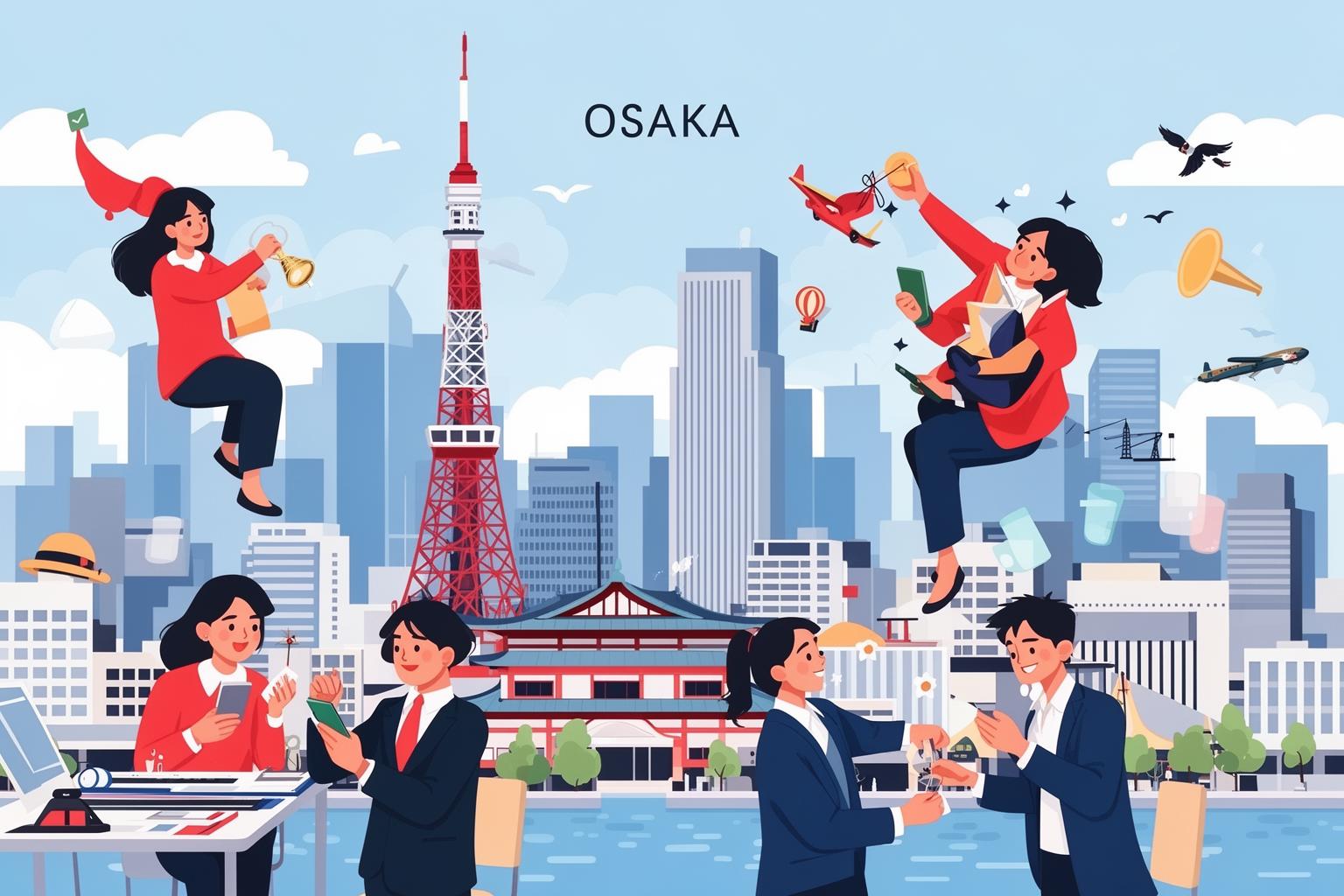
To truly understand Osaka, you need to turn back the clock. Tokyo, formerly Edo, was the center of the samurai government. It was a city founded on hierarchy, protocol, and the stoic reserve of the warrior class. Rules were strict, maintaining face was crucial, and social interactions followed a carefully choreographed routine. Osaka, by contrast, was known as Tenka no Daidokoro—the Nation’s Kitchen. It was Japan’s commercial hub, a city full of merchants, artisans, and deal-makers. For an Osakan merchant, waiting for a formal introduction simply wasn’t feasible. Success relied on quickly building rapport, sizing people up, and sealing a deal. This background isn’t merely a historical detail; it’s embedded in the very fabric of Osakan communication.
The Performance of Openness
What outsiders might interpret as simple “friendliness” is often a well-practiced form of transactional closeness. When a shopkeeper in the Tenjinbashisuji Shopping Arcade asks where you’re from, praises your Japanese, and then smoothly tries to sell you a bag of rice crackers, it isn’t insincere. It’s the merchant’s craft in action. The aim is to quickly bridge the gap between stranger and customer, creating a brief bubble of familiarity that eases a pleasant and efficient exchange. The interaction itself—the banter, the joke, the shared laugh—is as much the product as the goods being sold. It’s a performance, and you’re invited to participate. The warmth is genuine, but also functional, designed to facilitate the smooth flow of social and economic life.
Public Banter as Social Currency
This attitude extends beyond the marketplace into everyday life. On the Midosuji subway line, you’re far more likely to overhear lively, loud conversations between strangers than on Tokyo’s Yamanote Line. It could be two older women chatting about the price of cabbage, or a young man teasing an elderly gentleman wearing a Hanshin Tigers cap. This isn’t viewed as intrusive or disruptive. It’s a form of public recognition, a way of saying, “We’re all here together.” These exchanges rarely delve deep; they are brief, situational, and affirm shared humanity in a crowded environment. The currency exchanged isn’t personal details, but the willingness to engage momentarily. A quick joke at a crosswalk or a light comment to the person next to you at a ramen counter are small social gestures that make the city feel vibrant and welcoming.
The Famous “Ame-chan”
A classic example is the ame-chan, a piece of candy that an older Osakan woman, an obachan, might press into your hand for no obvious reason. A Tokyoite might be puzzled, even wary. Is this some kind of trick? What does she want? But in Osaka, it’s understood as a simple, wordless social gesture. It’s a token of goodwill, a conversation opener that needs no words. It means, “I see you. Have a nice day.” In its own way, it’s a small transaction: she offers you candy; you accept it with a smile and thanks. The exchange is complete. A positive social loop closes without friction. It’s the merchant’s efficiency applied to everyday kindness.
Tokyo’s Public Anonymity: The Etiquette of Non-Interference
Fly from Itami to Haneda, and the change is immediately noticeable. The energy doesn’t simply quiet down; it shifts entirely. What might feel “cold” or “distant” in Tokyo is, from a local viewpoint, a sophisticated and deeply rooted social contract based on the principle of non-interference. With nearly 14 million people packed within the official city limits, public space is a valuable and shared resource. The accepted etiquette is therefore designed to minimize one’s own impact—auditory, physical, and psychological—on everyone else.
Harmony Through Respectful Distance
On a Tokyo train during rush hour, the silence can be striking. It’s not a tense or sad silence. It is a focused, intentional quiet. Each individual actively contributes to a collective sense of calm by staying within their own bubble. To start a loud conversation with a friend, or worse, a stranger, would break this contract. It would be viewed as selfish, an imposition of your personal world onto the shared public tranquility. This is why people stare at their phones, read books, or close their eyes. They are not being anti-social; they are being ideal citizens of a megacity, honoring the unspoken rule that public space requires public anonymity. Your personal dramas, your loud joys, your conversational needs—those belong in private spaces, with your uchi (inside) group.
Service as a Flawless System
This philosophy extends to customer service. In a Tokyo department store, the service you receive will be impeccable. It will be polite, precise, and carried out exactly according to protocol. The staff will use honorific language perfectly. They will bow at the proper angles. However, they will usually not ask where you’re from or joke about your T-shirt. Their role is not to be your friend; it’s to deliver a seamless, efficient, and respectful service experience. The professionalism is the warmth. In Osaka, a clerk might say, “Wow, you’re buying a lot! Having a party?” In Tokyo, such a remark might be seen as intrusive, a breach of the customer’s privacy. One system emphasizes human connection; the other emphasizes systematic perfection. Neither is inherently superior, but they reflect fundamentally different views on the role of a service interaction.
Deconstructing Communication: Proximity vs. Privacy
The fundamental difference between Osaka and Tokyo communication lies in their distinct cultural definitions of personal boundaries. Osaka functions on an assumption of closeness, whereas Tokyo operates on an assumption of privacy. This straightforward contrast accounts for many social behaviors that often perplex outsiders.
The Osakan Shortcut to Connection
In Osaka, people frequently ask questions that may seem very direct, or even intrusive, by Western or Tokyo standards. Within moments of meeting you, someone might inquire about your job, salary, marital status, or political views. This is not nosiness but a method of assessment. They aim to quickly establish common ground. Are you a student? A business professional? A fellow baseball enthusiast? By collecting these data points, they can rapidly categorize you socially and determine the best way to interact—often using humor. It’s a shortcut to familiarity. They aren’t attempting to pry into your private life; they’re simply trying to bypass awkward small talk to reach livelier conversation.
Tokyo’s Layered Approach to Relationships
In Tokyo, such direct questioning of a new acquaintance would be considered a major social mistake. Relationships develop gradually, with trust built over time. Conversations begin with safe, neutral topics—the weather, work, hobbies—and personal questions remain off-limits until a strong mutual comfort level is reached. The default belief is that one’s private life remains private, and access is only granted through implicit invitation. This explains why business meetings in Tokyo often feel formal and stiff. It takes time to unravel these layers. Tokyo’s social boundaries are high and protective, but once you gain entry, loyalty and deep connection are profound. Osaka, in contrast, has a low fence surrounding a lively courtyard; it’s easy to enter but you may never be welcomed into the house’s private rooms.
Humor as Osaka’s Swiss Army Knife
One of the most misunderstood aspects of Osakan communication is humor, specifically the dynamic between boke (the silly fool) and tsukkomi (the quick-witted retort). This is not limited to professional comedians; it is a conversational rhythm embedded in everyday life. Teasing is a primary way of showing affection and engagement. If someone makes an error, the expected reaction is a sharp, witty correction—the tsukkomi. Responding with silence or polite sympathy may be seen as a lack of interest. Engaging in this verbal volley signals that you are attentive, involved, and familiar with the social code. To outsiders, this can appear aggressive. A store clerk might tease you about your souvenir choice, or a stranger at a bar could joke at your expense. The appropriate response is to laugh along or, if confident, return a light-hearted jab. This is how rapport is established. It’s a test of social nimbleness. In Tokyo, such public banter would likely be considered potentially embarrassing and disruptive to group harmony.
A Foreigner’s Field Guide to Social Navigation
So, how can a non-Japanese resident navigate these two deeply ingrained yet distinctly different social systems? It involves understanding the context and adjusting your expectations accordingly.
Reading the Room in Osaka
When in Osaka, know that the invitation to engage is almost always extended. The “friendliness” is a public-facing gesture, and the appropriate response is to join in the performance. Accept the ame-chan with a smile. Laugh at the shopkeeper’s joke, even if it’s not entirely clear to you. If a stranger on the train starts a conversation, engage briefly. You are not committing to a lifelong friendship; you are simply acknowledging and validating the local communication style. This simple act of participation will earn you considerable goodwill. On the other hand, responding with a cool, Tokyo-style reserve may be perceived not as politeness but as arrogance or a snub—essentially, a refusal to play the game.
The Fluidity of Uchi-Soto
The classic Japanese concept of uchi-soto (inside/outside group) is crucial. In Tokyo, the boundary between these groups is a high, solid wall. You are either inside or outside, and it takes time to be accepted. In Osaka, the boundary resembles a permeable, shimmering curtain. People invite you into a temporary uchi state for the duration of an interaction. The bartender, the person next to you, the shopkeeper—for those few minutes, you are “in.” You are treated with the familiarity and directness reserved for insiders. But once the interaction ends, you become soto again. The mistake is assuming this temporary intimacy grants permanent insider status. It does not. It is a situational, functional, and enjoyable connection for that moment alone, and that is its whole purpose.
Beyond the Friendly Façade
Living in Osaka requires unlearning the simple binaries we use to understand the world. It’s not about friendly versus cold. Rather, it’s a culture of performative, transactional intimacy contrasted with a culture of reserved, harmonious distance. Both approaches are highly effective strategies for navigating dense urban life. Osaka’s approach emphasizes social lubrication, immediate connection, and the sheer joy of shared, fleeting moments. It relies on humor and directness to break down barriers and get on with the business of life. Tokyo’s approach prioritizes collective peace, personal privacy, and energy preservation. It employs reserve and protocol to ensure the smooth, frictionless functioning of a massive, complex society.
For the foreigner choosing where to live, the question isn’t “Which city is nicer?” but rather “Which social philosophy aligns with my own?” Do you thrive on spontaneous interactions and public energy, or do you prefer anonymity and a clear boundary between public and private self? Understanding this fundamental difference is the first step not just to surviving, but truly thriving in the vibrant, complex, and deeply human city that is Osaka. The stereotypes are merely the cover of the book; the real story is far more fascinating.








