Living in Osaka is a full-contact sport for the senses. You’re baptized in the neon glow of Dotonbori, elbow your way through the Shinsaibashi shopping arcades, and learn to tune your ears to the constant, rhythmic symphony of train announcements, shop jingles, and the boisterous laughter that echoes through every izakaya. The city thrums with a relentless, commercial energy. It’s a place of motion, of deals being made, of another round being ordered. After a few months here, you start to wonder, where’s the off-switch? When the concrete and the crowds become too much, where do the people of this vibrant, chaotic metropolis go to find a pocket of peace? The answer, I discovered, isn’t in some far-flung, expensive retreat. It’s a short train ride north, to a place that feels like it belongs to a different era, a different mindset entirely: Nose-Myokenzan, the city’s quiet, spiritual attic.
This isn’t Kyoto. There are no perfectly manicured bamboo groves swarming with tourists in rented kimonos. This isn’t Tokyo’s version of an escape, which might involve a sleek express train to a polished resort town. This is an Osaka escape—practical, a little rough around the edges, and profoundly real. It’s a journey to the northernmost tip of the prefecture, a place that technically shares the same administrative space as the pulsing heart of Umeda but feels a universe away. It’s a trip that reveals the city’s other face, the one that’s often hidden behind the mask of the loud, food-obsessed merchant. It’s where Osaka goes to breathe.
For those seeking to truly unwind from the urban frenzy, why not try a spiritual weekend hike in Nose-Myokenzan that offers both serenity and adventure?
The North-South Axis: A Mental Map of Osaka
To grasp the significance of a trip to Nose, you first need to understand Osaka’s internal geography, which is less about compass directions and more about cultural pull. Every city has its invisible divides. In Tokyo, it’s the old-world charm of the eastern Shitamachi versus the polished modernity of the western Yamanote. In Osaka, the defining boundary runs north to south. The south, or ‘Minami,’ anchored by Namba and Shinsaibashi, is the historical center of entertainment and commerce. It’s loud, flashy, and where you find the giant crab signs and the bold energy that shapes the city’s stereotype. It’s unapologetically, fundamentally Osaka.
The north, or ‘Kita,’ centered around Umeda, shows a different side. It’s more corporate, more connected, with department stores that feel somewhat more refined and a pace that’s brisk rather than chaotic. For many Osakans, traveling north from Umeda is symbolic. You’re leaving the dense urban core behind. Train lines, like the Hankyu Takarazuka Line that begins your journey to Nose, start to pass through residential neighborhoods that quickly give way to green hills and bamboo groves. The further north you travel, the more the city’s frantic energy fades, replaced by a slower, more deliberate rhythm.
This isn’t just a change of scenery; it’s a necessary psychological release. The pressure of life in a city as competitive as Osaka is immense. There’s an unspoken expectation to be constantly working, hustling, and socializing. Escaping to nature isn’t a luxury; it’s a vital part of the weekly routine. But the Osaka approach to this is characteristically pragmatic. You don’t need a fancy onsen resort. You need a place you can reach within an hour, offering the maximum spiritual return for minimal time and money. Nose-Myokenzan fits the bill perfectly. It’s the city’s pressure valve, a local secret known to those in the know, a spot to reset before diving back into the fray on Monday morning.
A Cable Car That Time Forgot
The journey itself is a gradual process of unwinding. You transfer from the main Hankyu line to the Nose Electric Railway, a quaintly local route where the train cars are shorter and the stations seem largely unchanged since the Showa era. The final stretch of the climb truly sets this apart from any other day trip. You reach the base of the Myoken Cablecar, a stunning piece of vintage engineering that feels like stepping into another era. This is not a sleek, futuristic ropeway typical of major tourist spots. The cars are small, painted in a retro color scheme, and they ascend the extremely steep 22.3-degree incline with a determined, mechanical groan.
Inside, the atmosphere is quiet. Elderly couples hold hands, gazing out the window at the rushing forest canopy. Families point out landmarks to their children. The ride is brief, only about five minutes, but it has a profound effect. It physically lifts you out of the everyday world. This cable car perfectly embodies a certain Osaka mindset. In Tokyo, something this old might have long been replaced with a newer, faster, more efficient version. The prevailing ethos there is one of constant renewal, tearing down the old to make way for the gleaming new. But in Osaka, there is a strong respect for things that are functional, durable, and full of character.
There’s a saying, mottainai, which expresses a sense of regret over waste. It’s a Japanese concept, but in Osaka, it feels less like a philosophical notion and more like a fundamental business principle. Why replace this perfectly good cable car? It gets you from bottom to top. It works. The paint may be slightly faded, and the motor a bit noisy, but it has integrity. This appreciation for the sturdy and reliable over the shiny and new is a key difference you notice when living here. Osaka doesn’t feel the same pressure to constantly reinvent itself. It’s comfortable in its own skin, even if that skin is a little worn and weathered. The Myoken Cablecar isn’t just a means of transportation; it’s a moving monument to Osaka’s pragmatic, unpretentious spirit.
Not Kyoto’s Polish, But Osaka’s Heart: The Temple on the Mountaintop
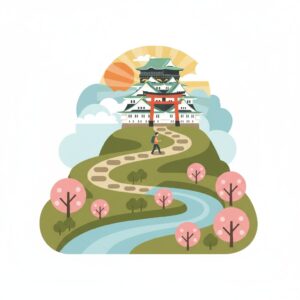
At the summit, after a brief walk or a ride on a similarly charming single-seat chairlift, you arrive at Nose-Myokenzan Betsuin. This temple of the Nichiren school of Buddhism is dedicated to Myoken Bosatsu, the deification of the North Star. As a deity of guidance and protection, it’s easy to understand its appeal to Osaka’s merchants and businesspeople navigating the often-treacherous currents of commerce. The temple complex is beautiful but in a very different way from its famous counterparts in Kyoto. It’s not a sprawling, perfectly preserved museum piece; it’s a living, breathing place of worship.
The buildings are scattered across the mountaintop, linked by paths winding through ancient cedar trees. You won’t encounter large tour groups led by a guide waving a flag. Instead, you’ll see local families lighting incense, business owners in suits praying for success, and dedicated hikers pausing for reflection before continuing their journey. The air is dense with the scent of cedar and burning incense, while the only sounds are birdsong and gentle chanting from within the main hall. Visiting a famous temple in Kyoto can sometimes feel like a performance—you observe its beauty, photograph it, and appreciate it from a respectful distance as an artifact to be admired.
Here, the experience is one of participation. You’re not merely a spectator; you step into a space actively integrated into people’s lives. You might spot a monk tending the grounds or a local parishioner carefully cleaning a statue. The formality is lower, the connection more immediate. This reflects a core element of the Osaka spirit. Osakans tend to be more direct, less concerned with ceremony, and more focused on the substance of interactions. Their spirituality is similar—it’s less about aesthetic perfection and more about a genuine, personal connection. This temple doesn’t seek to impress with grandeur; it simply stands as a steady, reliable beacon, much like the North Star it venerates.
The Sacred Horses and Star Worship
One of the temple’s most unique features is its connection to horses. Several beautiful sacred horses are kept in a stable on the grounds. They are regarded as divine messengers and treated with great care and reverence. Seeing these majestic animals against the backdrop of the ancient temple buildings enhances the otherworldly atmosphere. It recalls a time when the bond between nature, spirituality, and daily life was more tangible. The entire temple is oriented around stars and celestial navigation, with zodiac signs carved into its structures and a small affiliated shrine dedicated to the star gods. This emphasis on destiny and guidance feels especially poignant. In a city where fortunes can be won or lost in an instant, the idea of looking to something constant and unchanging in the heavens for guidance offers a powerful sense of comfort and stability.
The Sound of Silence (and a Distant Train)
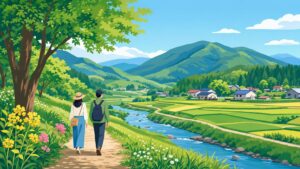
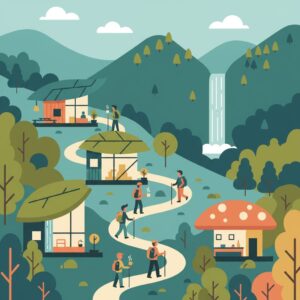
Beyond the temple itself, the mountain features a network of hiking trails that meander through the dense forest. This is where you find the true retreat. Walking beneath the towering cedar trees, the city’s noise doesn’t just fade away; it feels as if it never existed. The silence here differs from the quiet of an empty room. It’s a living, breathing stillness, filled with the rustle of leaves in the breeze, the call of a distant bird, the gentle hum of insects. It’s a silence that finally allows your mind to relax.
What many foreigners often misunderstand about Osakans is that their love for noise and crowds represents only one side of the story. They are not perpetually “on.” That energetic persona demands an equally important period of rest. Time spent in nature is not idle leisure; it’s crucial restoration. On the trails, this becomes evident. You might pass an elderly man sitting on a tree stump, quietly gazing out at the view of the Osaka plain below. You might see a young couple walking side by side in comfortable silence, their shoulders barely touching. These moments truly define the quality of life here. It’s the ability to access such a profound sense of peace with ease.
From certain vantage points on the mountain, the urban sprawl is just barely visible in the distance. It appears as a faint haze on the horizon, a reminder of the world you’ve stepped away from. You might even catch the faint echo of a train whistle carried on the wind. That connection matters. This isn’t about rejecting the city; it’s about finding the right distance from it. It’s about viewing it for what it is—a vibrant, exciting, yet ultimately demanding place—from a position of calm and perspective. You are not fleeing Osaka; you are simply recharging your capacity to thrive within it. The silence of Nose-Myokenzan stands as the necessary counterbalance to the noise of Namba.
What This Teaches You About Living in Osaka
A weekend trip to Nose-Myokenzan does more than just clear your mind; it reshapes your perception of Osaka itself. It challenges you to move beyond the familiar clichés of takoyaki, comedy, and boisterous friendliness. It uncovers the city’s hidden duality: a place bursting with urban energy yet deeply connected to a serene, unpretentious natural world. To truly live here—not merely visit—is to learn how to navigate between these two realms.
Many foreigners arrive with a fixed notion of Osaka, often defined in contrast to Tokyo. Osaka is loud, Tokyo is reserved. Osaka is cheap, Tokyo is expensive. Osaka is chaotic, Tokyo is orderly. While these comparisons contain some truth, they overlook the subtle reality. The real distinction lies in how each city approaches life’s essentials—work, play, and rest. A Tokyoite might seek refuge in a meticulously curated, visually pleasing spot like a designer cafe in a mountain town, where presentation is as important as substance. The Osaka escape, as exemplified by Nose-Myokenzan, values function over form. It’s practical, accessible, and profoundly personal.
This journey reveals that the essence of Osaka is more than its bustling marketplace. It’s found in the quiet resolve of the old cable car, the heartfelt prayers at the mountain temple, and the deep tranquility of the cedar forest. Grasping this duality is key to gaining a fuller appreciation of the city. Life in Osaka is a steady balancing act between hustle and hush, between the worldly and the spiritual, between crowded trains and silent mountain trails. Learning to walk this line is what it truly means to call this place home.