Close your eyes and picture Osaka. What do you see? I bet it’s a flash of neon, a river of people flowing past the Glico Running Man, steam rising from a takoyaki stand. You probably hear the clatter of a pachinko parlor, the rumble of the Midosuji subway line, the boisterous laughter spilling out of an izakaya in Tenma. That’s the Osaka of postcards and viral videos, the city that wears its heart on its sleeve, a glorious, chaotic, non-stop engine of commerce and consumption. For the first year I lived here, I thought that was the entire story. I thought Osaka was a city you survived, a thrilling urban landscape you wrestled with, but never a place you’d associate with words like ‘calm,’ ‘quiet,’ or ‘escape.’
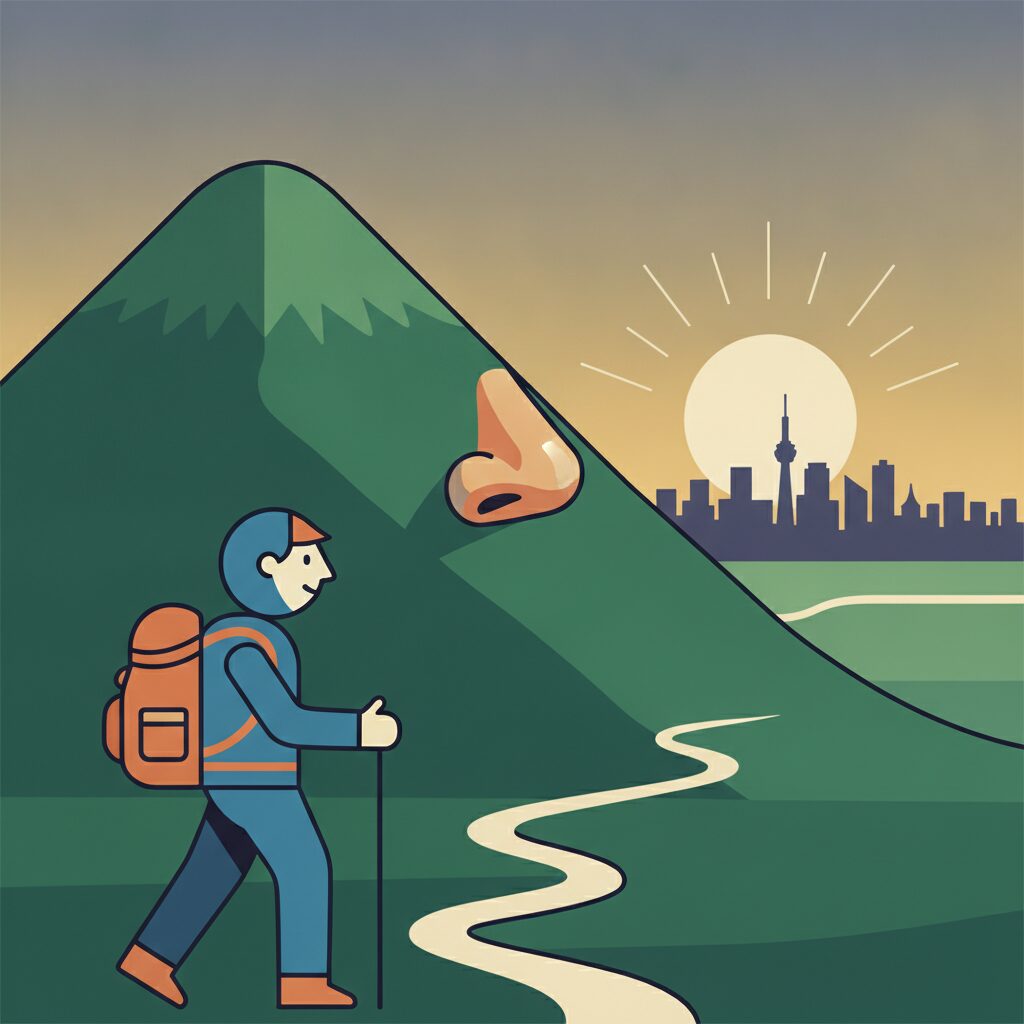
But then the city’s relentless energy starts to wear on you. The concrete begins to feel less like a playground and more like a cage. You start wondering, where do Osaka people go to breathe? When the noise of Namba becomes too much, where is the off-switch? I asked a friend, a born-and-bred Osakan with a Kansai-ben accent as thick as okonomiyaki sauce. I expected him to say Kyoto, or maybe Nara, or perhaps a beach trip to Wakayama. He just laughed. “Why go so far?” he said, with that classic Osaka pragmatism. “We have Nose.” Nose? The name didn’t register. It sounded like a body part, not a destination. He explained it’s the northernmost town in Osaka Prefecture, a place of mountains, farms, and forests. It’s still Osaka, but an Osaka I couldn’t possibly imagine. This isn’t just a travel tip; it’s a key that unlocks a deeper understanding of the city’s soul. To truly grasp the Osaka mindset, you have to see not just where they work and play, but where they go to escape from it all. You have to see the other side of the coin, the quiet, green yin to the city’s loud, bright yang.
Those eager to trade the city’s constant buzz for a serene retreat can experience a nature-filled weekend escape in Nose that highlights Osaka’s hidden rural charm.
The Great Osaka Contradiction: City Hustle and Country Calm

Living in Osaka is a full-body experience—you feel the city deep in your bones. At Umeda Station, you aren’t just a person; you become a particle in a human river, swept along by a current so powerful that resistance is impossible. The air is thick with the scent of kushikatsu frying oil, department store perfumes, and a faint, metallic hint from the train tracks. Your ears are filled with a symphony of sounds: the electronic jingle signaling a train’s departure, rapid-fire announcements from station staff, and overlapping conversations among a million people on the move. It’s exhilarating. It’s the pulse of a city that has always been a hub of commerce, where standing still means getting left behind. For many foreigners, this is the Osaka they came for—dynamic, raw, and unapologetically itself.
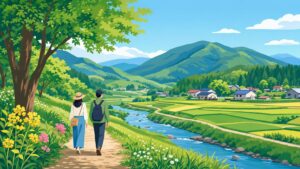
Then you head to Nose. The journey itself becomes a form of decompression. You board a train from the heart of the urban beast, perhaps the Hankyu line from Umeda, and watch as towering clusters of high-rises give way to smaller apartment buildings, then to single-family homes with neat little gardens. The train cars gradually empty. The frenetic energy fades. Eventually, you transfer to a local bus winding its way up into the hills. When you step off, the first thing you notice is the silence—not an absence of sound, but an entirely different kind of sound. You hear leaves rustling in the wind, the distant caw of a crow, and the chirping of insects. The air no longer carries the smell of concrete and fried food; instead, it’s filled with damp earth, pine needles, and woodsmoke. The pace of life slows to a leisurely walk. Elderly men tend their vegetable patches. Strangers on the street make eye contact and nod. Technically, this is still Osaka Prefecture, under the same administrative umbrella as the noisy crowds of Shinsaibashi—but it feels like an entirely different world.
This is the great Osaka contradiction that many newcomers completely miss. For most foreigners, the mental map is confined within the major train loops. Osaka means Umeda, Namba, Tennoji, and the spaces in between. The idea that the same jurisdiction includes vast forests, terraced rice paddies, and quiet mountain villages is a genuine revelation. It challenges the monolithic image of Osaka as merely a gritty, urban sprawl. It reveals the prefecture’s hidden depth and balance—something its residents have recognized and cherished for generations. The “real” Osaka isn’t just the city; it’s the relationship between the city and its rural hinterland. It’s the ability to be engulfed in urban life on a Friday and stand on a silent mountain peak by Saturday. This duality is essential to what makes living here sustainable and, for many, preferable to Tokyo’s endless urban expanse.
Why Nose? The Pragmatic Osaka Approach to a Weekend Off
With Kyoto, Nara, and Kobe all just a short train ride away, why do so many Osakans prefer to escape within their own prefecture? The answer lies at the core of the Osaka spirit—a mindset grounded in practicality, convenience, and a focus on value. In Japanese, this is expressed as jitsuyou-teki (practical) and tegaru (easy or simple). These aren’t mere words; they are fundamental life principles.
Consider it from an Osaka viewpoint. Although Kyoto is geographically near, visiting there often requires a mental adjustment. You’re entering a realm of high culture, refined aesthetics, and a somewhat formal atmosphere, often crowded with tourists. It feels like a performance. A trip to the mountains of Wakayama or the beaches of the Seto Inland Sea is lovely, but demands more planning, expense, and a bigger time commitment. It’s a full-fledged vacation. Nose takes a different approach. Nose is the weekend getaway—simple and fuss-free. You can decide to go on a Saturday morning, catch a train, and be enjoying fresh air in just over an hour. It offers maximum mental and physical refreshment with minimal hassle and cost.
This practical attitude toward leisure stands in stark contrast to Tokyo’s equivalent. Escapes from Tokyo often come with a sense of spectacle and status. People talk about weekends spent in upscale resort towns like Karuizawa or Hakone, involving costly Shinkansen tickets and stays at fashionable hotels. It’s not just about relaxation; it’s about presenting oneself as relaxing in the “right” way, in the “right” place. The Osaka mindset trims through that. The question isn’t “Where can I go that’s most impressive?” but “Where can I get a good rest without breaking the bank or losing half my weekend to travel?” The answer often lands on Nose. Casual conversation captures this perfectly: “Nose de ee ya n!”—a charming, dialect-rich phrase meaning “Nose is good enough!” or “Nose will do just fine!” It’s not faint praise; it’s the highest form of compliment in Osaka’s value-driven language. It means it fulfills the purpose perfectly, without unnecessary extras.
This same reasoning permeates much of Osaka life. It explains why people will queue for a 500-yen bowl of udon that surpasses a 2,000-yen offering elsewhere. It’s about the quality of the experience, not the price or prestige. An Osakan finds just as much, if not greater, joy in a simple picnic with onigiri from a local Nose farmer’s market as a Tokyoite might in a gourmet lunch at a resort. It’s the pure, straightforward value of the experience itself: fresh air, tasty food, peace and quiet. Everything else is just costly, unnecessary packaging.
Hitting the Trails: More Than Just a Walk in the Woods
A hike up one of Nose’s local peaks, such as Mt. Myoken, serves as a microcosm of Japanese social dynamics viewed through an Osaka perspective. The moment you set foot on the trailhead, you step into a social contract different from the one governing the city streets. In the anonymous bustle of Umeda, you keep your head down, avoid eye contact, and remain cocooned in your own world. On the trail, that bubble bursts. Every person you encounter, from serious hikers decked out in full performance gear to elderly couples with walking sticks, will look you in the eye and offer a warm “Konnichiwa.”
This custom of greeting fellow hikers is common throughout Japan, but within the context of Osaka, it feels especially meaningful. It highlights a capacity for situational awareness and community that challenges the stereotype of Osakans as brash individualists. While on crowded city streets everyone pursues their own mission, on the mountain path, everyone shares a collective goal: to appreciate nature and navigate the trail safely. This shared circumstance creates a temporary, unspoken community. You are no longer strangers but fellow hikers. The “Konnichiwa” represents recognition of this mutual space and effort. It means, “I see you. We’re in this together.”
Watching the trail users provides further insights. You see a variety of gear, but the prevailing aesthetic prioritizes function over fashion. People dress for the weather and terrain rather than to make a statement, reflecting Osaka’s preference for substance. It’s less about appearances and more about using the right tools for the task. You also notice small acts of kindness: a faster hiker pauses at a wide spot to let you pass, someone points out a tricky root ahead, and an older woman might offer you a kyarameru (caramel candy) from her pocket—a classic gesture of encouragement from Japan’s hiking elders.
This represents another side of the well-known Osaka directness. In the city, that bluntness sometimes appears as an obachan (middle-aged or older woman) telling you off for holding your umbrella wrong or standing on the wrong side of the escalator, which can feel abrasive to newcomers. But on the mountain, the same impulse to engage and correct transforms into something supportive and communal. The obachan who might scold you in the city will be the first to warn about slippery rocks on the trail. It’s the same underlying social dynamic—a belief in straightforward, honest communication for the group’s benefit—but operating in a different environment. It’s not about being rude or overly polite; it’s about being practical and ensuring smooth functioning, whether on a crowded train platform or a narrow mountain path.
The Unspoken Etiquette of the Mountain Path
Looking closer, you discover a whole set of unspoken rules governing trail behavior. These rules are rarely posted on signs but are universally understood and observed. The key rule is yielding to those hiking uphill. This is both a matter of physics and courtesy: the climber is exerting more effort and has less momentum, so those descending step aside. Ignoring this is a major breach of etiquette. Likewise, when taking a break, you move well off the path to avoid blocking others. And the cardinal rule—one that speaks more about your character than any other—is to carry out everything you brought in. Leaving behind a granola bar wrapper or a plastic bottle is seen as a profound disrespect to the mountain and fellow hikers.
This strict adherence to a shared, unwritten code might seem at odds with the image of Osakans as rebellious rule-breakers, known for jaywalking when no cars are around. But this is a fundamental misunderstanding of the Osaka mindset. Osakans aren’t against rules; they’re against inefficiency. They will cross against a red light if the street is empty because waiting is pointless. It’s a pragmatic choice. However, in situations where rules exist for the collective good and the smooth functioning of shared spaces—such as a train queue, escalator etiquette (stand on the right!), or a mountain trail—they follow them with surprising rigor. The system works; it’s efficient and demonstrates omoiyari, or deep consideration for others. Mountain trail etiquette exemplifies this perfectly. The rules exist to ensure everyone can enjoy the space safely and peacefully, so they are respected. This reveals a profound communalism beneath the city’s surface-level chaotic individualism.
The Taste of the Land: Farmers’ Markets and Rural Cuisine

After a long hike, the exploration of Nose’s culture continues at the michi no eki (roadside station) or one of the numerous local farmers’ markets. These spots embody the spirit of rural Osaka. They are lively, bustling, and refreshingly unpretentious—temples devoted to the prefecture’s kuidaore (“eat till you drop”) philosophy, but in its most fundamental form.
Forget the polished, curated food halls of department stores in Umeda. Here, vegetables often still carry traces of the dark, fertile soil from which they were freshly harvested that morning. Twisted daikon radishes, vibrant green spinach, and glossy eggplants are heaped in simple plastic crates. Their shapes are irregular, their sizes varied—clear evidence they came from a farm rather than a factory. Alongside the produce, you’ll find handmade items: jars of pickles fermenting in brine, fresh mochi coated in kinako (roasted soybean flour), bottles of locally brewed sake, and packages of wild boar meat, a regional specialty.
This is where Osaka’s celebrated passion for food reconnects with its roots. The city’s renowned cuisine didn’t emerge from nowhere; it was nurtured by the agricultural richness of the surrounding Kansai plain. A visit to a Nose market serves as a reminder of this. Here, the focus isn’t on elaborate cooking techniques or Michelin stars; it’s on the pure, undeniable quality of the ingredients themselves. You’re buying a story, a connection to the land. Interactions with the vendors are an essential part of the experience. The farmers, often elderly men and women with sun-kissed faces and earth-stained hands, take immense pride in their produce. They are not simply cashiers; they are experts. Ask one how to prepare the unusual gourd you’re holding, and their face will light up. They’ll share a detailed recipe, suggest complementary flavors, and explain why theirs is particularly sweet this season. It’s a conversation, a sharing of knowledge—not just a sterile transaction at a barcode scanner. This direct, personal connection to the source of one’s food offers a powerful antidote to the anonymity of city life, fulfilling a deep-seated craving that drives many Osakans out of the city and into the countryside on their days off.
A Different Kind of “Moukari Makka?”
The typical Osaka greeting, especially among businesspeople, is “Moukari makka?” meaning “Are you making a profit?” The usual response is “Bochi bochi denna,” or “So-so.” It’s a cliché, but one rooted in the city’s history as a merchant center, where commerce was the common language. In the rural environment of Nose, this business spirit seems to shift. No farmer greets you with “Moukari makka?”
Yet, the underlying principle—an interest in fairness and value—is still present. It’s simply defined differently. Conversations at the farmers’ market aren’t about profit margins; they revolve around the harvest’s value, weather hardships, and soil quality. The “business” is a partnership with nature. The value exchanged isn’t merely money for a vegetable. It’s an appreciation for the hard work behind its cultivation. When you pay the farmer, you are directly rewarding that effort. It feels more tangible and genuine than buying a perfectly polished apple from a multinational supermarket chain. This illustrates the remarkable adaptability of the Osaka mindset. The core concept of “value” is always active, but its definition depends on the context. In the city, it might mean finding the tastiest takoyaki at the best price. In the countryside, it’s about the intrinsic worth of fresh, locally grown produce and the human labor behind it.
Beyond the Stereotypes: Finding the “Quiet” Osakan
This is perhaps the most important lesson a place like Nose can offer to a foreigner trying to understand Osaka. The city is well-known for its personality: loud, funny, direct, and somewhat wild. We see this in the comedians on TV, the vendors at Kuromon Market, and the fans at a Hanshin Tigers baseball game. This image is not inaccurate—that personality is indeed a very real and vibrant part of the city’s identity. However, it is incomplete.
To assume that every one of the millions of people in Osaka fits this mold is a significant misunderstanding. Living here, you quickly learn that the loud, outgoing persona is often a social tool, a kind of public-facing interface shaped by centuries of life in a competitive merchant city. It serves to break down barriers, build relationships quickly, and facilitate commerce and community. It’s a performance, one that many Osakans have perfected.
But what happens once the performance ends? People go home. And on weekends, they visit places like Nose. There, you see a different side of Osakans. You find quiet families having picnics, young couples holding hands as they stroll through the forest, solitary hikers sitting on rocks, simply enjoying the view. These people aren’t cracking jokes or bargaining over prices. They are recharging, introspective, quiet. And they are just as authentically Osakan as the boisterous shopkeeper in Namba.
Nose reveals that Osaka is not a city of only extroverts. It is a city of millions of individuals who, like people everywhere, have multiple facets to their personalities. The urban environment demands and rewards a particular kind of energy, while the rural environment allows another side to surface. Understanding this is essential to moving beyond the caricature and recognizing the real, complex human beings of the city. The city doesn’t just contain loud people; it contains people who know when to be loud and when to be quiet.
So, What Does This Tell Us About Living in Osaka?
Ultimately, the presence of a place like Nose within Osaka Prefecture is a crucial element for anyone thinking about making a life here. It highlights a fundamental, often overlooked advantage of living in Osaka: balance. You have access to one of the most vibrant, exciting urban centers in the world, complete with a wealth of career opportunities, entertainment, and convenience. Yet, you also have an easily accessible escape route—a built-in way to prevent urban burnout.
This stands in sharp contrast to Tokyo. Although Tokyo offers nearby natural retreats, the sheer size of the metropolis often makes truly getting away a longer, more costly, and more complex process. In Osaka, the closeness of genuine, deep countryside like Nose makes this balance a regular, attainable part of weekly life, rather than a rare treat. It helps make the city’s intensity sustainable over time. You can immerse yourself fully in the urban hustle Monday through Friday, knowing that the peaceful quiet of the mountains is just an hour away on the weekend.
To fully grasp Osaka, you need to look beyond the city’s borders. You must realize that the city’s identity is deeply tied to the surrounding land. Its food culture is connected to local farms, the practical mindset is linked to the availability of homegrown resources, and the character of its people reflects a mix of urban savvy and a quiet bond with the nature close at hand. When you stand on a trail in Nose, gazing down at the patchwork of fields and homes, with the distant city lights softly glowing on the horizon, you aren’t witnessing a contradiction. You’re seeing the full picture. You’re seeing Osaka not just as a city, but as a complete, functioning ecosystem. And in that moment, you gain a much deeper understanding of its people.