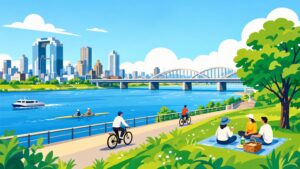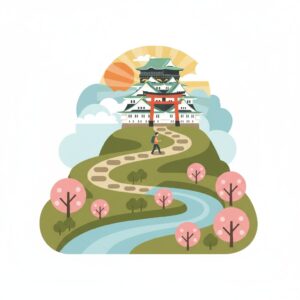
Ask anyone, Japanese or foreign, to paint a picture of Osaka, and the canvas fills with predictable colors. You’ll get the electric blues and neon pinks of Dotonbori’s Glico sign, the fiery orange of sizzling takoyaki grills, and the chaotic, brilliant swirl of a million people moving at a pace that feels just a little faster, a little louder, than anywhere else in Japan. Osaka is the city of commerce, of comedy, of an unapologetic, in-your-face energy that either charms you instantly or sends you running for the hushed temples of Kyoto. It’s a concrete kingdom where the hustle never truly stops, where conversations are rapid-fire, and where the prevailing soundtrack is a mix of train announcements, bicycle bells, and the hearty laughter of its residents. That’s the Osaka everyone thinks they know. But it’s only half the story, and maybe not even the most important half.
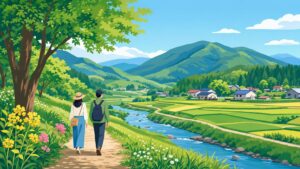
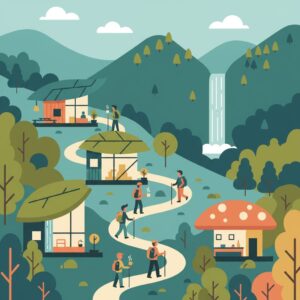
What if I told you that just an hour’s drive from the controlled chaos of Umeda Station lies a different Osaka? An Osaka where the dominant color is a deep, soothing green, where the loudest sound is the rustle of wind through cedar trees, and where the frantic pace of the city melts away into a rhythm dictated by seasons, not train schedules. This isn’t a fantasy, nor is it another prefecture. This is Nose, the northernmost town in Osaka Prefecture, a rural heartland that exists in stunning contrast to the urban sprawl just to its south. Escaping to Nose for a weekend isn’t about getting away from Osaka; it’s about getting to the very core of it. It’s about understanding the deep-seated duality that defines this place and its people. Unlike Tokyo, where the city seems to stretch into an infinite horizon of suburbs, Osaka’s urban core has a clear edge. Cross it, and you’re in another world—a world that provides the crucial balance, the grounding force, that makes the city’s relentless energy possible. A trip here unravels the stereotype of the fast-talking, money-obsessed Osakan and reveals a character that is also profoundly connected to the land, to community, and to a quieter, more fundamental way of life.
Embracing a quieter pace, visitors can also immerse themselves in the region’s soulful character by exploring the spiritual charm of Nose Myokenzan, which offers a serene counterpoint to Osaka’s urban dynamism.
The Great Urban Illusion: Why Osaka Feels Different

More Than Just a Concrete Jungle
The image of Osaka as a vast urban sprawl is a compelling one, reinforced by countless movies, anime, and travel blogs that focus solely on the Namba-Shinsaibashi-Umeda corridor. For many foreigners living here, daily life revolves around this dense web of train lines, shotengai shopping arcades, and towering apartment complexes. It’s easy to think that’s all there is. The very notion of “nature in Osaka” might seem like a joke, something that requires a lengthy Shinkansen trip to Nagano or Hokkaido. Yet this is one of the biggest misconceptions about life in the Kansai region. Osaka Prefecture, geographically, is one of the smallest in Japan. Its compact size is its secret advantage. It means the shift from city to countryside is not gradual, but sudden and striking. One moment you’re weaving through the crowds at Hankyu Umeda Station; the next, you’re riding a local bus through terraced rice fields and quiet villages.
This is a key difference from Tokyo. Living in Tokyo and craving a true nature escape often requires a considerable investment of time and money. You board a train, and for an hour or more, you pass through what feels like an endless stretch of satellite cities and residential suburbs—Saitama, Chiba, Kanagawa—that all blend into the greater metropolis. The concrete feels unavoidable. In Osaka, that sense of being trapped couldn’t be more different. The mountains are always visible on the horizon, a constant reminder that wilderness is close by. This accessibility isn’t just a geographical quirk; it shapes the Osakan way of life and mindset. People don’t need to escape the city for long vacations because a restorative dose of nature is always accessible on weekends. It fosters a balanced life. You can be a high-powered office worker in a Nakanoshima skyscraper during weekdays, and on Saturday morning, be harvesting potatoes in a community garden or hiking a trail in Nose. This seamless, easy flow between urban and rural life defines the lifestyle here. It keeps the city grounded and prevents it from being lost in its own hype.
The “My Pace” Mentality of Rural Osaka
Heading north from the city, a distinct change occurs. It’s not only the scenery that transforms; the whole energy shifts. The air itself seems to slow down. In downtown Osaka, life is ruled by the principle of `sekkachi` (せっかち)—a word meaning impatient, hurried, always rushing. People walk fast, talk fast, and expect quick service. It’s the engine behind the city’s commercial drive. But in Nose, this urgency fades and is replaced by its opposite: `my pace` (マイペース). This isn’t about laziness or inefficiency; it’s a deliberate choice to live at a human-centered rhythm.
You feel it most clearly in everyday interactions. Stop at a `michi no eki` (roadside station) to buy local produce. In a city supermarket, transactions are swift and impersonal, a beep of a barcode scanner. Here, the elderly woman running the stall will likely disregard the line forming behind you. She’ll hold up a misshapen cucumber with a broad smile and launch into a detailed story about why it’s the sweetest of the lot. She’ll ask where you’re from, what you’re cooking for dinner, and offer unsolicited but helpful tips on pickling the daikon radish you’re eyeing. This isn’t a sales tactic. It’s the default mode of communication. Human connection comes first; commerce comes second. For someone used to the city’s relentless efficiency, it can initially feel almost jarring. You might find yourself glancing at your watch, wondering why it’s taking so long. But then you settle into it. You realize this conversation is the real point. This unhurried, sincere interest in another person offers a glimpse into the community fabric that holds a place like Nose together. It’s an aspect of the Osaka character that the `sekkachi` city stereotype completely obscures.
Nose’s Unspoken Rules: Community and Connection
The Art of the Roadside Stand
Nowhere is the distinct character of rural Osaka more apparent than in the tradition of the `mujin hanbaijo` (無人販売所), the unmanned vegetable stand. They can be found throughout Nose, scattered along winding country roads. Often, they are little more than a simple wooden shelf or small hut, stacked high with whatever was harvested that morning: shiny eggplants, earthy potatoes, bags of glossy chestnuts, or bunches of bright greens. Beside the produce, there’s a modest wooden or metal box with a slot on top. A hand-painted sign lists the prices, typically a nicely rounded 100 or 200 yen per item. The system is straightforward: you select what you want, calculate the total yourself, and place the exact change into the box. There are no staff, no security cameras, no locks—only trust.
This concept often intrigues, and sometimes puzzles, foreigners. In a world filled with QR codes and electronic monitoring, the unmanned stand feels like a throwback to a simpler era. Yet in Nose, it remains a living, integral part of the local economy. It also reveals much about the local mindset. Osaka is known for its savvy merchants and bargain hunters. The stereotype holds that an Osakan will passionately negotiate for a 10-yen discount (`meccha kechi` means “super stingy,” often worn with a peculiar pride). However, just a few kilometers away, the entire system of local commerce rests on the honor system. This shows that the Osakan spirit isn’t about being cheap; it’s grounded in a deep belief in fairness and honest exchange. The unmanned stand exemplifies this perfectly: “Here is my produce, grown by my own hands. I trust you to pay the fair price I ask.” Taking something without paying isn’t just theft; it’s a profound personal betrayal, breaking the unspoken social contract that binds the community. It offers a compelling lesson in a different kind of value system—one that prioritizes mutual respect over profit margins.
It’s Not Just About Vegetables
Buying from a `mujin hanbaijo` is more than just acquiring food. It’s a form of communication. Often, the farmer leaves a handwritten note: “The cucumbers are a bit crooked today, but they taste great!” or “First batch of shiitake mushrooms this year. Enjoy!” You feel a direct, personal connection to the grower of your meal. It’s the complete opposite of the sterile, impersonal experience of grabbing plastic-wrapped vegetables under fluorescent supermarket lights. You are not merely a consumer; you’re part of a local cycle. This fosters a deep appreciation for seasonality and place. You don’t go to Nose searching for asparagus in December. You eat what the land provides, when it provides it. This mindset, this respect for the natural rhythm of things, is a core part of the Kansai identity often lost amid the city’s noise. You might even find charcoal, firewood, or handmade crafts sold under the same honor system. It’s a testament to the belief that the community as a whole is fundamentally good and trustworthy. It stands as a quiet yet powerful expression of the kind of society that people in Nose wish to live in.
The “Real” Osaka Lifestyle: A Balancing Act
Weekend Warriors and U-Turns
Spend a weekend in Nose, and you’ll quickly notice that the population is a captivating blend. Yes, you’ll encounter the multi-generational farming families who have tended this land for centuries. Their presence gives the town its foundation, a profound sense of history and continuity. But you’ll also come across a surprising number of younger people, many of whom are newcomers. For instance, a young couple from central Osaka who left their cramped apartment to restore a hundred-year-old farmhouse—a `kominka` (古民家)—and open a trendy little bakery. You’ll meet artists and craftspeople drawn here by the clean air, tranquility, and affordable studio space. And you’ll find families with young children who have deliberately chosen to raise their kids surrounded by nature rather than concrete.
This mirrors a wider trend in Japan called the “U-turn” and “I-turn” phenomena. A “U-turn” describes someone who grew up in the countryside, moved to a major city for education or work, and then decides to return home. An “I-turn” refers to someone with no prior ties to a rural area who chooses to relocate there from the city. For a long time, the dream was to leave the countryside for the big city’s opportunities. Now, many Osakans aspire to have the best of both worlds. They appreciate the city’s economic dynamism and cultural vibrancy but also desire the quality of life that a place like Nose offers: more space, a slower pace, a tighter-knit community, and a direct link to nature. This isn’t about rejecting city life; it’s about redefining what success looks like in Osaka. It’s a balancing act—a hybrid lifestyle that takes advantage of the prefecture’s unique compactness. This trend is energizing places like Nose with fresh enthusiasm, new ideas, and new enterprises, ensuring it remains not just a place of the past but a lively part of Osaka’s future.
Why This Isn’t a Tourist Trap
A common misconception among foreigners exploring Japan is expecting a curated, polished version of culture. They seek the famous temples, manicured gardens, and top-rated attractions from travel guides. Approaching Nose with this mindset will leave you thoroughly puzzled. There is no “Nose-land” theme park, no main street crowded with identical souvenir shops selling mass-produced keychains. Its charm lies in its genuine, unpretentious authenticity. Nose is a working town. Its main industries are agriculture and forestry. The real attractions are the landscape itself and the small, independent businesses it supports.
Instead of a major landmark, you’ll find a tiny family-run soba restaurant in a converted farmhouse, where noodles are hand-made fresh each morning. Instead of a sprawling commercial onsen complex, there might be a simple public bathhouse beloved by locals. Instead of a gift shop, you’ll discover a farm-direct store selling jams made from local berries or bread baked with locally milled flour. The appeal of Nose is that it doesn’t try to be charming. It simply is. This reflects a key aspect of the Osaka mindset. Osakans generally have little patience for pretension. They prioritize substance over style and practicality over polish. Nose perfectly embodies this spirit. It’s a place to be lived and experienced, not just visited. The aim isn’t to tick off a list but to slow down, wander quiet lanes, breathe mountain air, and connect with people living lives that are both distinctly different from yet intimately linked to the urban world just nearby.
What This Teaches You About Osaka

Beyond the `Manzai` Stereotype
So, what can a weekend spent in the quiet hills of Nose reveal about the loud, boisterous city of Osaka? It shows that the stereotype, while not entirely inaccurate, is dangerously incomplete. The image of the Osakan as a fast-talking, joke-cracking comedian (`manzai` being the term for Japanese stand-up comedy rooted in Osaka) reflects one facet of their public persona. In the competitive commercial world of the city, this communication style—direct, efficient, and often sprinkled with humor—is a tool for survival. It’s how things get done. But it’s just a persona, a way of operating, not the whole person.
The presence of Nose and other rural areas within the prefecture demonstrates that there is a quieter, more reflective, and deeply grounded side to the Osaka identity. The same individual who might fiercely haggle over electronics prices in Den Den Town on a Friday could spend their Saturday patiently tending a vegetable garden, attuned to the subtle changes of the seasons. These are not contradictions; they are two sides of the same coin. The Osakan identity is a blend of merchant and farmer—the ability to navigate the complexities of a modern megacity while maintaining a fundamental connection to the land. This duality is perhaps the most defining trait of all. Unlike other major cities that have entirely severed ties to their agricultural roots, Osaka has preserved them. The city and countryside exist in constant dialogue, each shaping and balancing the other.
A Practical Mindset, Rooted in the Earth
Ultimately, a visit to Nose reveals the underlying code of the Osaka mindset. The city’s renowned pragmatism, its focus on `cos-pa` (cost-performance), and its straightforward attitude all stem from this agrarian foundation. It’s a mindset born from the earth, where waste is considered a sin and value is measured by tangible, useful outcomes. A farmer isn’t concerned with fancy packaging; they care about whether the crops are healthy and abundant. A merchant isn’t interested in flowery language; they care about whether the deal is fair and the product is good.
This ethos is clearly reflected in both worlds. In the city, it shows as a relentless pursuit of the best quality at the most reasonable price. In the countryside, it appears in the simple, unembellished honesty of the unmanned vegetable stand. Both express the same core value: rejecting the superficial in favor of what is real. So don’t view a trip to Nose as an escape from Osaka. See it as a pilgrimage to its roots. It’s where you can peel away the neon, the noise, and the stereotypes to grasp the full, complex, and deeply human character of this remarkable place. You’ll return to the city with fresh eyes, recognizing the frantic energy of the streets not as chaos, but as the vibrant counterpart to the quiet stillness of the nearby mountains, always reassuringly just a short journey away.