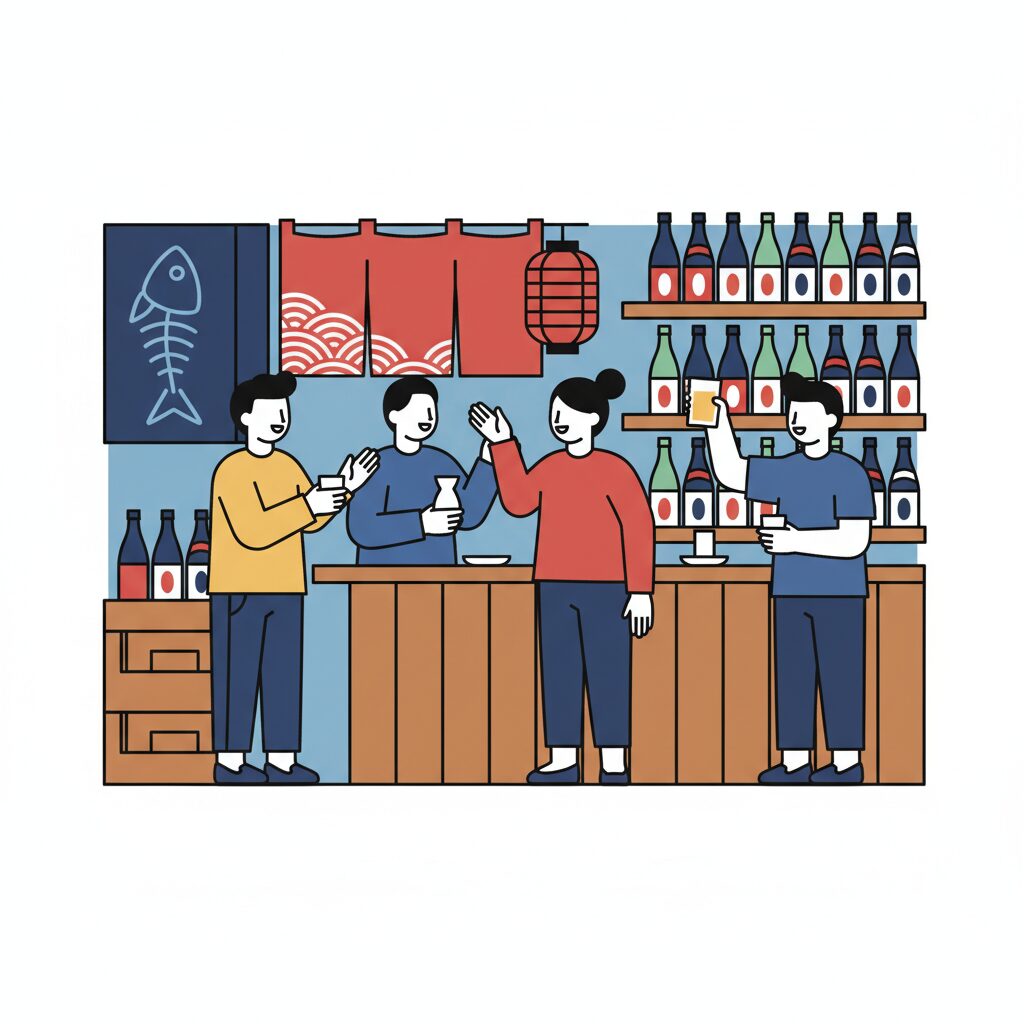
You see them tucked away, these curious little spaces, hiding in plain sight. From the outside, it’s just a liquor store, a sakaya, with shelves of sake bottles and crates of beer stacked high. But peer through the glass, and you’ll see a scene that doesn’t quite fit. A group of men in work jackets, laughing over a shared bottle of Kirin. A woman in an office blouse, quietly sipping a glass of sake. An old man, a newspaper tucked under his arm, staring into the middle distance. They’re all standing, clustered around a makeshift counter, drinking right there amidst the merchandise. This isn’t a bar. It’s not really a store anymore. It’s a kaku-uchi, and it might just be the most potent, unfiltered shot of pure Osaka culture you can find.
The first time I stumbled into one, I was completely lost. Was I interrupting something? Was this a private club? The concept feels foreign, even a little intimidating. Kaku-uchi, which translates to “corner striking,” harks back to an era when sake was sold from large casks and measured into square wooden boxes called masu. Patrons would drink directly from the corner of the box, hence the name. Today, the name sticks, but the function has evolved. It’s a standing-room-only drinking spot operating inside a licensed liquor store. It’s a place that strips the act of drinking down to its bare essentials: good company, cheap booze, and zero pretense. To understand the kaku-uchi is to understand the soul of Osaka itself—its pragmatism, its love for a good deal, its boisterous and unpretentious approach to life. This isn’t about fancy cocktails or curated playlists; it’s about community, connection, and the simple pleasure of a chotto ippai—just one quick drink—on the way home.
This raw charm of kaku-uchi mirrors a broader trend in Osaka where eccentric supermarkets also celebrate affordable living and resourceful traditions.
What Exactly is Kaku-uchi? The Anatomy of an Osaka Institution

To someone unfamiliar, the kaku-uchi might appear to be just a chairless dive bar. However, it follows an entirely different logic, one deeply intertwined with the city’s merchant heritage. It’s a system designed for efficiency, value, and social interaction, and grasping its components is the first step to appreciating its brilliance.
More Than Just a Cheap Drink
The key distinction is this: a kaku-uchi is a liquor store that allows you to drink on-site, rather than a bar that happens to sell bottles. This difference isn’t merely semantic; it lies at the heart of its business model and cultural charm. Since the primary business is retail, they can offer drinks at remarkably low prices. You’re essentially paying a small premium over the retail price of a beer can or a sake glass. For Osakans, known for their legendary and often misunderstood frugality, this isn’t about being cheap; it’s about being savvy. Why pay 700 yen for draft beer at a trendy izakaya when you can grab a large bottle for under 400 yen here and share it with a new friend? It’s pure practicality. The value is unmatched, and in a city that prides itself on maximizing value, the kaku-uchi reigns supreme.
The physical space reflects this practical mindset. Forget elaborate interior design; the décor is the inventory. You’ll be surrounded by dusty premium sake bottles, vibrant cans of chuhai, and towering stacks of beer crates. The “bar” is often just a simple plank laid over some crates or a worn stainless-steel counter. Menus are practically nonexistent—you just point at what you want. The lighting tends to be harsh, fluorescent, and unyielding. It’s a place that clearly says, “We’re here for one reason only, and it’s not to admire the wallpaper.”
The Kaku-uchi Code: Unspoken Rules for Blending In
Because it’s not a typical bar, a kaku-uchi operates by a set of unspoken rules. Breaking them won’t get you kicked out, but following them shows you truly get it. It’s a subtle social dance, and learning the steps is essential to unlocking the experience.
First, this is a transient venue. You don’t stay for hours. The idea is a quick, refreshing stop. Have one or two drinks, a small snack, and be on your way within an hour, often even within 20 minutes. It’s a pit stop for the soul, not a destination. This fast turnover preserves limited space and respects the city’s working rhythm. People have trains to catch and families to reach. The kaku-uchi is a punctuation mark in the day’s story, not the entire chapter.
Second, transactions are direct and straightforward. The system is almost entirely cash-on-delivery, known locally as kyasshu on. A small plastic tray sits on the counter for your money. You place your cash in it when ordering. The owner—often the only staff member—takes the payment, brings your drink, and returns your change in the tray. No running tabs, no credit cards, no splitting bills at the end. It’s a clean, efficient, one-time interaction that keeps things moving smoothly and avoids awkwardness. You pay as you go and always know where you stand.
Finally, respect the space. It’s a communal environment, so you clear your own empties by returning bottles or glasses to the counter when finished. Don’t leave a mess. Keep your voice at a reasonable volume, though in Osaka “reasonable” has a flexible meaning. The atmosphere is friendly but not chaotic. You’re a guest in the owner’s shop and should behave accordingly.
The Soul of the City: Kaku-uchi as a Social Thermometer
A kaku-uchi is more than just a place to drink; it’s a living, breathing snapshot of Osaka society. It’s where the city’s strict social hierarchies momentarily fade, allowing people to be seen for who they truly are, rather than by the titles on their business cards.
The Great Equalizer: Where Salarymen and Grandpas Meet
Visit a kaku-uchi around 6 PM on a weekday, and you’ll encounter a diverse mix of people rarely found elsewhere. Standing side by side, you might see a construction worker with dust still on his clothes, a salaryman with his tie loosened, a retired gentleman who’s frequented the same spot for decades, and perhaps a young couple on a quirky date. Age, job, and social rank seem to vanish at the door. While Japan is known for its hierarchy, inside the cramped space of a kaku-uchi, that structure levels out.
Here, conversation acts as the great equalizer. Topics aren’t about business deals or corporate plans; they revolve around the Hanshin Tigers‘ latest game, the weather, the rising cost of eggs, or playful teasing over someone’s snack choice. It’s a place where a senior executive might get a lively earful from a plumber about baseball strategy, and both will part smiling. This is the authentic social fabric of Osaka, a city that prizes personality and straightforward talk over titles and formalities. It’s a reminder that everyone is simply a person unwinding after a long day.
“Nani Shitenno?”: The Art of Casual Chat
One of the biggest cultural surprises for foreigners, especially those from Tokyo, is how porous social circles are in Osaka. And nowhere is this more obvious than in a kaku-uchi. Don’t be taken aback if the person next to you starts a conversation out of the blue. A simple, “Nani nonderun?” (What are you drinking?) or a comment on your snack can open the door to a full conversation.
This isn’t considered intrusive; it’s the norm. It reflects a communal spirit that assumes strangers are just friends you haven’t met yet. This is what people mean when they call Osaka “friendly.” It’s not a vague politeness but an active, sometimes nosy, often humorous engagement. Of course, you’re under no obligation to participate. A nod and a smile work perfectly if you’re not in the mood. But being open to these spontaneous, fleeting exchanges lets you experience the city as locals do. It’s a communal ritual, a daily reaffirmation of shared identity through simple acknowledgment over a cheap glass of sake.
Kaku-uchi vs. Tokyo: A Tale of Two Drinking Cultures
Tokyo has its own unique standing bar culture called tachinomi. While they might appear similar at first glance—no chairs, quick service—their essence is completely different. The contrast between an Osaka kaku-uchi and a Tokyo tachinomi serves as a perfect metaphor for the cultural divide between Japan’s two major cities.
Efficiency vs. Aesthetics
Many of Tokyo’s tachinomi, especially the newer ones in areas like Ebisu or Shinjuku, reflect modern design and branding. They tend to be stylish, featuring carefully curated food menus, craft beers on tap, and a deliberately cool aesthetic. These bars choose to forgo chairs often to boost turnover and cultivate a trendy, high-energy vibe.
Conversely, the Osaka kaku-uchi arises from pure necessity and history. Its aesthetic is intentionally austere—essentially a liquor store setup. The arrangement is whatever is cheapest and simplest for the owner. The aim is not to create an ambiance but to enable straightforward, low-cost alcohol sales for on-site drinking. It prioritizes function over form, embodying a fundamental Osaka mindset. If a Tokyo tachinomi is a sleek, modern showroom, the Osaka kaku-uchi is the dusty, practical workshop behind the scenes where the real work happens.
Community Hub vs. Transient Stop
Although both are inherently transient, their roles in the community differ markedly. In Osaka, especially in older, residential areas, the local kaku-uchi acts as an essential community hub. The owner, or tenchō, is often a neighborhood fixture who knows every customer by name, remembers their favorite drink, and serves as a source of local news and gossip. Regulars come not just for a drink but to check in, connect, and be seen. It truly functions as a “third place.”
In Tokyo’s vast, sprawling metropolis, that deep, multi-generational community feel is more difficult to find. A tachinomi near a busy station may serve thousands of different patrons weekly, acting more like an anonymous, efficient pit stop for commuters. While intimate, local spots do exist in Tokyo, the culture is generally more reserved. The casual, cross-counter chatter and immediate familiarity typical of the Osaka kaku-uchi experience are much less common.
Navigating the Scene: A Practical Guide for Residents
Feeling ready to jump in? The charm of kaku-uchi lies in its accessibility. However, knowing where to go and what to order can help you ease into the scene and discover the perfect spot for you.
Finding Your Spot: From Gritty to Modern
Not all kaku-uchi are the same. The atmosphere can vary greatly depending on the neighborhood.
For the quintessential, old-school experience, head to Kyobashi. This neighborhood is the spiritual home of Osaka’s kaku-uchi. It’s rough around the edges, noisy, and unapologetically genuine. Establishments like Shimada Saketen are legendary, offering a direct window into the city’s Showa-era past. This is the deep end of the pool, and it’s fantastic.
For a slightly younger, more vibrant scene, check out Tenma. The area around Tenma Station is a labyrinth of restaurants and bars, where dozens of kaku-uchi and modern tachinomi hide. The lines blur here, but the spirit of affordable, fun, standing-room-only drinking is very much alive.
If you prefer a gentler introduction, the basements of the Umeda Ekimae Buildings (Daiichi, Daini, Daisan, and Daiyon) are an excellent place to start. These huge office buildings near Osaka Station hold a treasure trove of affordable drinking spots, including many clean, well-lit, and beginner-friendly kaku-uchi. They offer a slightly more polished version of the experience, ideal for dipping your toes in.
What to Order: The Holy Trinity and Beyond
Keep it simple. You’re not here for craft cocktails. The ordering process is all about speed and clarity.
The classic way to start is with a large bottle of beer—ōbin. Choose from the big three: Asahi, Kirin, or Sapporo. It’s the most economical choice and often acts as a social lubricant. Don’t be surprised if your neighbor offers you a pour from their bottle; the proper etiquette is to accept and reciprocate by offering a pour from yours.
For sake, you’ll generally order koppu-zake—a standard glass of house sake. Just point and say “sake, hitotsu” (one sake). The owner usually has a few options, ranging from dry (karakuchi) to sweet (amakuchi), and can help recommend if you ask.
Beyond that, highballs and shochu are always safe bets. They’re simple, refreshing, and inexpensive.
As for food, think simple snacks, or ate. Traditional kaku-uchi often have a variety of canned goods—kanzume—that you select directly from the shelf. You hand your can of mackerel, sardines, or yakitori to the owner, who will open it, maybe warm it up, and serve it on a small plate with chopsticks. Other staples include bags of chips, dried squid, peanuts, pickles, and in winter, a simmering pot of oden. It’s all about straightforward, salty bites that complement your drink without any fuss.
Why Kaku-uchi is the Key to Understanding Osaka
Ultimately, the kaku-uchi is more than just a spot for a cheap drink. It embodies a uniquely Osaka philosophy. It is a tangible expression of the city’s most treasured values: a sharp pragmatism that borders on artistry, a commitment to straightforward and unpretentious community, and a respect for uncompromising efficiency.
It quietly challenges the formality, hierarchy, and ceremony that often characterize much of life in Japan. It’s a place where you can be authentic and connect with fellow citizens on the most fundamental human level. For any foreigner seeking to truly grasp what drives this city, to look beyond the tourist attractions and clichés, the kaku-uchi is indispensable fieldwork.
Mastering this world, ordering with ease, sharing a laugh with a stranger over a can of fish—this is where you move from being an observer of Osaka life to becoming an active participant. It’s where the city ceases to be just a place you live and begins to feel like home.