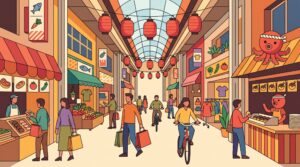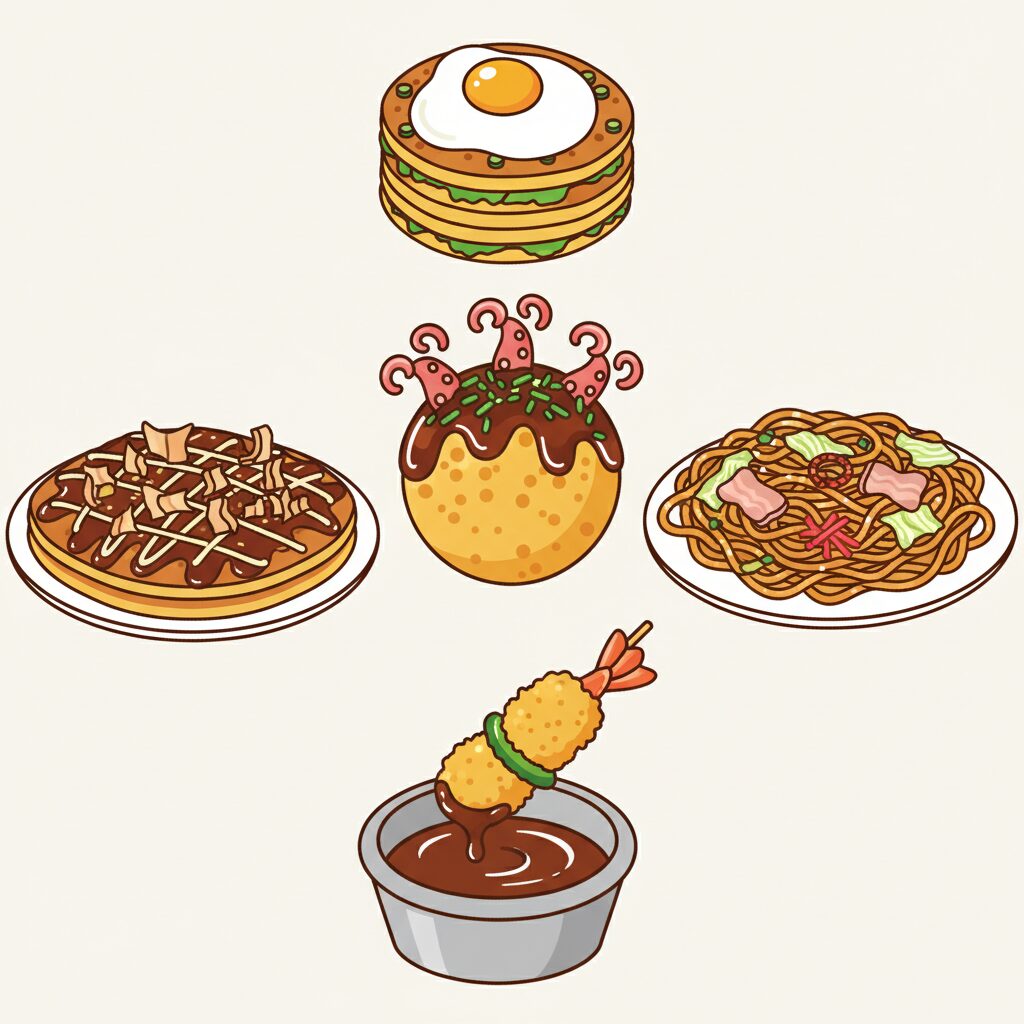
You’ve seen it. Maybe you’ve even been that person, standing in front of an okonomiyaki shop, watching your Japanese friend order a fresh, steaming pancake of cabbage and batter… along with a massive bowl of white rice. You feel a switch flip in your brain. Hold on. Aren’t they both… carbs? Isn’t that like ordering a bread sandwich with a side of bread? This moment, this beautiful, logical confusion, is your entry point into the real Osaka. It’s where the tourist trail ends and daily life begins. Because in this city, we don’t just eat flour-based foods, or konamon (粉もん). We live and breathe them. They’re not a snack; they’re the syntax of our daily conversations, the foundation of our social gatherings, and the delicious, steaming heart of our identity.
Forget the glossy magazine spreads for a second. This isn’t about chasing down the top-rated takoyaki stand in a guidebook. This is about understanding why the tiny, slightly grimy shop on your corner has a line of locals every day at 5 PM. It’s about cracking the code of Osaka’s soul, which is less about ancient castles and more about the sizzle of batter on a hot iron plate. Tokyo might have its Michelin stars and its elegant, refined culinary traditions, but Osaka has something more fundamental: a food culture built by merchants, for the people. It’s fast, it’s cheap, it’s unbelievably good, and it’s woven into the fabric of everything. To live here, to truly get the rhythm of this place, you need to understand the philosophy of flour. It’s more than just a meal; it’s a mindset.
Immerse yourself further in Osaka’s local lifestyle by exploring how Osaka’s hidden bars capture the city’s raw, after-hours energy alongside its beloved culinary traditions.
Konamon as a Way of Life, Not a Special Occasion
In many regions of Japan, and certainly in the West, foods such as pancakes or dumplings are considered treats. They’re typically a weekend brunch item or a special-occasion dish. In Osaka, however, this type of food is a daily staple. It serves as lunch, dinner, and an after-school snack. This isn’t just a quirky local custom; it’s a core element of the local diet, rooted in a practical mindset that defines the city.
The “Okazu” Philosophy: Flour as a Main Dish
Let’s revisit that plate of okonomiyaki served alongside a bowl of rice. This highlights a key cultural lesson. In traditional Japanese cuisine, a meal usually consists of rice (the staple) and okazu (おかず), the accompanying side dishes that enhance the rice’s flavor. These might include grilled fish, pickled vegetables, or simmered meat. In Osaka, konamon itself is regarded as okazu. That’s correct—the flour-based pancake is the side dish meant to accompany your rice.
To an outsider, it may seem like a carb-on-carb puzzle. To an Osakan, it represents ultimate efficiency. You enjoy the savory, saucy richness of okonomiyaki paired with the simple, satisfying comfort of rice. This combination delivers maximum energy and flavor at minimal cost. This approach stems directly from Osaka’s legacy as Akindo no Machi, the City of Merchants. For centuries, it was a hub of commerce, labor, and people who needed the best value for their money. Food wasn’t about delicate presentation; it was about fuel—cheap, filling, and delicious. The okonomiyaki-rice combo, or the okonomiyaki teishoku (set meal), embodies that merchant spirit in today’s world.
This stands in stark contrast to Tokyo. In the capital, with its samurai and bureaucratic heritage, food culture often carries an air of formality and compartmentalization. Each dish has its specific role. Finding a restaurant in Tokyo that proudly serves flour alongside rice would be rare—it would be viewed as unsophisticated, even somewhat coarse. But in Osaka, such a meal is a badge of pride. It declares, “We don’t care for pretension. We care about what works. And this works.”
Your Neighborhood Konamon Joint: The Real Social Hub
Forget trendy cafes or upscale bars. The true social center of an Osaka neighborhood is the local okonomiyaki or takoyaki shop. These spots are usually small and unpretentious, often accommodating only a few people at a counter, the air thick with the scent of sizzling batter and sweet-savory sauce. The decor is functional at best, centered on the large teppan (iron griddle) tended by the master, the ochan or obachan.
These shops are essential to the local community. Schoolchildren stopping by after school grab a small tray of six takoyaki for a couple of hundred yen. A salaryman in a suit might pick up a modan-yaki to take home for dinner. Two elderly ladies might sit at the counter sharing an order of tonpeiyaki (pork and egg omelet) while catching up on neighborhood news. Transactions are quick, food is hot, and the interactions are sincere.
This is where the cliché “Osaka is friendly” truly comes to life. It’s not about strangers embracing on the street but rather these low-stakes, frequent encounters. The shop owner knows your order, asks if you want extra ginger, comments on the weather. It’s a simple, repeated ritual of recognition that creates a sense of belonging. In a vast metropolis, these konamon shops are beacons of familiarity. They’re the living rooms of the neighborhood, and the price of entry is just a few coins for something delightful.
The Holy Trinity: Okonomiyaki, Takoyaki, and Beyond
While the konamon family is extensive, a few key members lie at the heart of the Osaka experience. Understanding them goes beyond just knowing their ingredients; it’s about appreciating the various social contexts they inhabit. Each is a different tool for different purposes, all crafted from the same humble bag of flour.
Okonomiyaki: The Soul on a Griddle
Okonomiyaki literally means “grilled as you like it.” This name alone reveals much about the Osaka mindset: it’s adaptable, customizable, and unpretentious. The typical Osaka style involves mixing everything—flour batter, dashi, egg, heaps of shredded cabbage, and your choice of protein (usually pork belly, squid, or shrimp)—into one beautiful concoction and pouring it onto the griddle.
The debate between Osaka-style and Hiroshima-style okonomiyaki (which is layered and includes noodles) is a serious point of local pride. In Osaka, the emphasis is on the harmony of the mixed ingredients and the fluffy texture of the pancake held together by the batter. It’s a culinary democracy; no single ingredient takes center stage. It’s the collective that counts.
More than just restaurant fare, okonomiyaki is a domestic ritual. Many, if not most, Osaka families own a portable electric hot plate. An “okonomiyaki party” is a weekend tradition. Everyone gathers around the table, chopping ingredients, mixing the batter, and trying their hand at flipping their own creations. It’s messy, it’s boisterous, and it’s deeply communal. It’s a meal that’s also an activity, breaking down formality and bringing people together. It teaches that food doesn’t have to be perfectly plated to create a meaningful social experience.
Takoyaki: The Street-Corner Staple
If okonomiyaki is the sit-down family meal, takoyaki is its restless, on-the-go cousin. These piping-hot balls of batter filled with octopus are the city’s quintessential street food. But seeing it simply as a snack misses the point. It’s a precision craft in disguise as simple fare.
Every Osakan has an opinion on the perfect takoyaki. The gold standard is soto-kari, naka-toro—crispy on the outside, molten, creamy, and almost lava-like on the inside. Achieving this texture demands skill and a perfectly seasoned cast-iron pan. Watching a takoyaki master expertly flick and turn dozens of balls with a single pick is mesmerizing street theater.
Like okonomiyaki, takoyaki also acts as a social catalyst at home. The takopa, or takoyaki party, is a rite of passage for young people and a popular gathering for families. Friends gather around the special pan, experimenting with fillings beyond traditional octopus—cheese, sausage, mochi, even chocolate. The party isn’t just about eating; it’s about the shared act of creating, failing (the first batch is always a disaster), and laughing together. It perfectly captures Osaka’s love for interactive, unpretentious fun.
Udon & Kushikatsu: The Extended Konamon Family
The flour empire stretches well beyond the griddle. Osaka’s udon, for example, is a different creature from what you might find elsewhere. The noodles tend to be softer and gentler, designed to absorb the star of the show: the dashi. Osaka’s broth is a thing of beauty, a light, golden liquid made primarily from high-quality kombu (kelp). This reflects the city’s history as Tenka no Daidokoro (The Nation’s Kitchen), where the best ingredients from across Japan came together. A bowl of kitsune udon (topped with sweet fried tofu), a dish invented in Osaka, is the city’s ultimate comfort food. It’s a simple, soulful expression of konamon culture’s subtler side.
Then there’s kushikatsu, deep-fried skewers of meat, vegetables, and seafood. The konamon element is the light, crispy batter that coats each bite. Widely found in the gritty, nostalgic neighborhood of Shinsekai, kushikatsu comes with its own strict social contract: the communal pot of dipping sauce. The one and only rule, posted in every shop, is “NO DOUBLE-DIPPING.” This isn’t merely a suggestion; it’s an unbreakable law. This rule perfectly symbolizes Osaka’s social fabric. We’re all sharing this space, all in it together, so you follow the rule for the good of the group. It’s trust and shared responsibility, served up on a stick.
The Konamon Economy: Why Flour Dominates the Cityscape
Why did flour, of all things, come to symbolize the culinary identity of Japan’s third-largest city? The answer lies in economics and a particular local mindset refined over centuries. Konamon is the edible expression of Osaka’s commercial spirit.
“Akindo no Machi”: The Merchant’s Mentality
Osaka has always been a city driven by commerce, not government. Its heroes are merchants and innovators rather than samurai or shoguns. This fostered a culture of intense practicality and a keen sense for value. This is the essence of cospa, or “cost performance,” a term you’ll hear often in Osaka. It’s the ultimate standard of worth. Is it good? Yes. Is it affordable? Yes. Then it has excellent cospa.
Konamon reigns supreme in cospa. Flour is cheap. Cabbage is cheap. Eggs are cheap. By combining these ingredients on a hot griddle, you get a meal that is satisfying, sufficiently nutritious, and incredibly flavorful—all for just a few hundred yen. It’s a business model and a meal rolled into one. This reasoning applies to everything in Osaka. People aren’t impressed by flashy labels or extravagant presentation if the price doesn’t match the quality. A Tokyoite might pay a premium for a restaurant’s ambiance; an Osakan will calculate the cost per gram of meat on the plate. It’s not about being cheap; it’s about being smart. And konamon is the smartest food there is.
The Flour Powerhouses: A Source of Local Pride
This passion for flour isn’t solely a grassroots trend; it’s an industrial phenomenon. Osaka is home to many of Japan’s food giants, many of whom built their empires on konamon. Nissin Foods, the inventor of instant ramen, was founded here by Momofuku Ando. Otafuku, the maker of the sweet and tangy brown sauce synonymous with okonomiyaki, originated in the region. These aren’t just companies; they are local legends.
This creates a strong feedback loop of local pride. People are fiercely loyal to their favorite brand of sauce, their neighborhood takoyaki stall, their family’s okonomiyaki recipe. These aren’t just casual likes; they are declarations of identity. The friendly debates over which shop in Tenma serves the best negiyaki are about more than just food. They affirm one’s place in the city and one’s connection to a shared, delicious culture. The success of these flour-based industries is seen as a triumph of the Osaka mindset: that simple, practical ideas can change the world.
How to Live the Konamon Life: A Practical Guide for Residents
So, you want to go beyond being a konamon tourist and become a konamon local. This means more than just eating; it means engaging. It means grasping the unspoken rules and embracing the culture right in your own kitchen.
Navigating the Social Codes of a Konamon Shop
Walking into a tiny, counter-only okonomiyaki shop for the first time can feel daunting. Don’t be. The gruff-looking owner has seen everything before. The key is to be confident and attentive. Observe what others are doing. Most interactions happen directly across the counter. When you order, don’t hesitate to customize. Asking for extra green onions or no mayonnaise shows you know your preferences, which is a respected quality.
The seating layout encourages casual intimacy. You’ll be elbow-to-elbow with strangers. It’s completely normal for the person next to you to comment on your order or for the owner to ask where you’re from. This isn’t nosiness; it’s friendliness. This is the famed Osaka warmth in its natural environment. Engage, smile, and savor the shared experience. The griddle is a great equalizer.
Stocking Your Osaka Kitchen
The best way to truly blend into Osaka life is to bring konamon culture into your home. Every supermarket here has a dedicated “konamon corner.” Stock up on the essentials: a bag of premixed okonomiyaki flour (which already contains dashi and raising agents), a jar of pickled red ginger (beni shoga), a bag of tempura scraps (tenkasu) for crunch, bottles of okonomiyaki sauce and Kewpie mayo, plus packets of bonito flakes (katsuobushi) and seaweed powder (aonori).
Consider buying a small electric takoyaki pan. It’s an affordable and fun appliance that unlocks a new social life. Inviting Japanese friends or neighbors over for a takopa is one of the easiest, most natural ways to build connections. It’s an instant sign that you’re not just living in Osaka, but living like an Osakan. It shows you get it.
The Unspoken Rule: Respect the Dashi
Among all the bold flavors of sauce, mayonnaise, and pickled ginger, it’s easy to overlook the quiet hero of Osaka konamon: the dashi. This savory broth, infused with umami from kelp and sometimes fish flakes, is mixed into the batter of nearly every takoyaki and okonomiyaki. It’s what gives the final dish its depth and soul.
While Tokyo’s dashi often features a strong, smoky bonito flavor, Osaka’s dashi traditionally emphasizes the more subtle, complex umami of kombu. Noticing this difference is a sign that you’re developing a refined palate for local taste. When at a high-end udon shop, take a moment to sip the broth on its own before adding anything else. If possible, compliment the owner on the dashi. It’s like praising a French chef for their mother sauce. It’s a small gesture that says, “I understand where the true flavor lies.”
Konamon, ultimately, tells the story of Osaka itself. It’s a story of practicality, community, and transforming simple ingredients into something joyful and sustaining. It’s why people here can seem so straightforward, unconcerned with appearances, yet so warm and inclusive. They are shaped by a culture that values substance over style, and community over formality.
So next time you see someone happily digging into a plate of okonomiyaki with a side of rice, don’t dismiss it as a mere culinary oddity. See it for what it truly is: a delicious declaration of independence. It’s the taste of a city that has always done things its own way. When you stop questioning it and start craving it, you’ll know you’re well on your way to becoming a true Osakan. You’re not just feeding your stomach; you’re embracing a philosophy. And it’s one of the most rewarding lessons you’ll ever learn.