
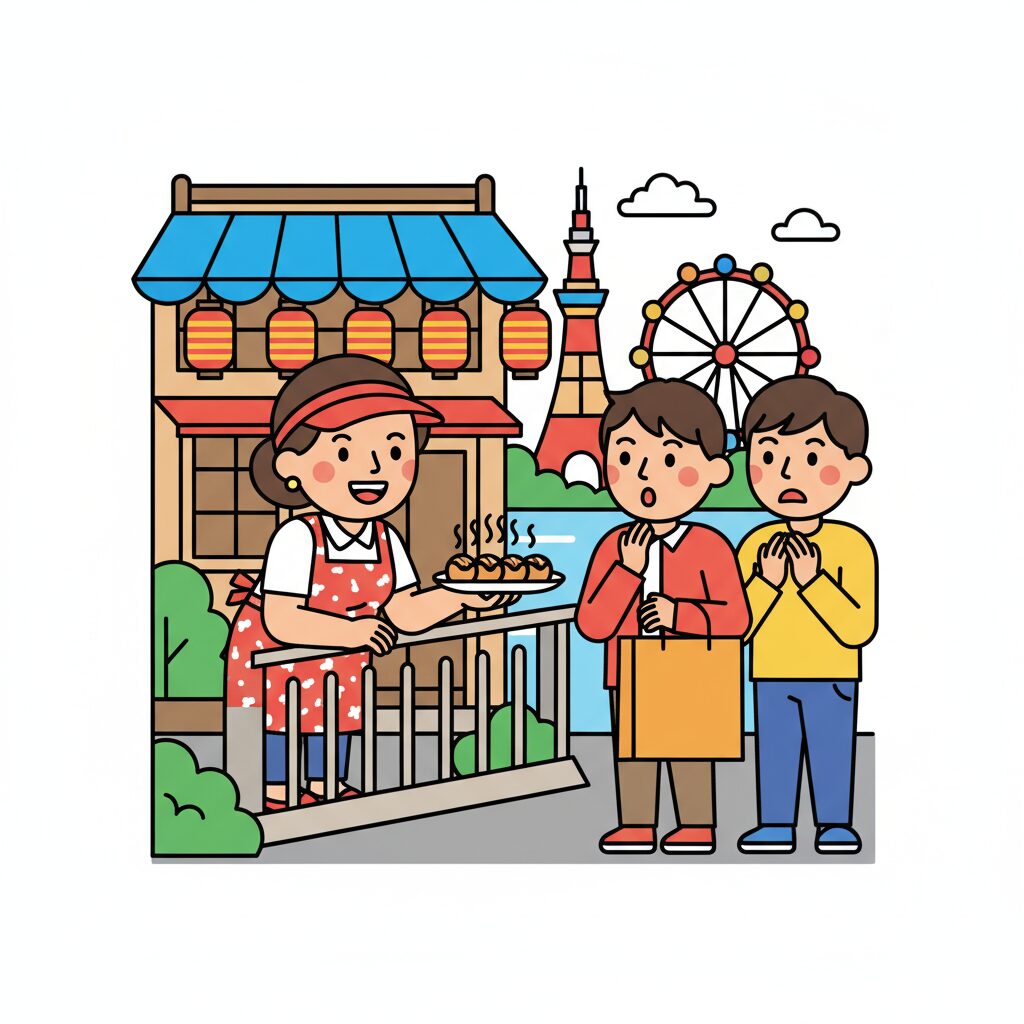
Ever been in a supermarket in Osaka, minding your own business, just trying to decide between two brands of soy sauce? Suddenly, a woman you’ve never seen before taps you on the shoulder. “Not that one, this one’s on sale,” she declares, pointing to a different bottle. “And you’re making sukiyaki? You need the sweeter one anyway. This one.” Before you can process what’s happening, she’s moved on, leaving you with a new bottle in your hand and a profound sense of confusion. Welcome to Osaka. You’ve just experienced ‘osekkai’.
This word doesn’t have a perfect English equivalent. It’s a mix of being nosy, meddlesome, and offering unsolicited help or advice. It’s the opposite of minding your own business. In Tokyo, a city that runs on polite distance and unspoken rules, this kind of interaction is almost unthinkable. There, social harmony is maintained by creating a bubble of personal space. In Osaka, social harmony is built by popping that bubble, repeatedly and with genuine enthusiasm. People get involved. They talk to you. They have opinions about your life, your lunch, and your questionable Japanese accent. This isn’t a city for the faint of heart or for those who treasure anonymity above all else. It’s a place of constant, vibrant, and sometimes overwhelming human connection.
For anyone thinking of moving here, or for those already here and feeling a bit bewildered, understanding ‘osekkai’ is not optional. It’s the key to unlocking how this city breathes. It’s the difference between feeling constantly judged and feeling warmly embraced. This isn’t about being “friendly” in a generic, tourist-brochure sense. It’s a specific, deeply ingrained cultural behavior rooted in the city’s history as a merchant town where communication was currency and community was survival. This guide is your deep dive into the beautiful, chaotic world of Osaka’s ‘osekkai’ spirit—who it’s for, who it’s not for, and how to navigate it without losing your mind.
For readers curious about alternative facets of local interaction, the vibrant role of Ame-chan culture further reveals how community dynamics shape everyday life in Osaka.
What ‘Osekkai’ Looks Like in the Wild
‘Osekkai’ isn’t an abstract idea; it’s a series of everyday ambushes. You’ll encounter it in shotengai shopping arcades, on train platforms, and even within your own apartment building. It’s the social fabric of the city, woven from countless small, unsolicited interactions. Here’s a guide to recognizing its most common forms.
The Supermarket Supervisor
This is the quintessential ‘osekkai’ experience. The supermarket aisles serve as the natural habitat of the Osaka obachan (a term for a middle-aged or older woman, used here affectionately and respectfully). She has a sixth sense for detecting someone who needs guidance, whether they realize it or not. You might be staring at a wall of daikon radishes, and she’ll suddenly appear beside you.
A Typical Encounter
“You’re buying that one?” she’ll ask, her voice a blend of concern and disbelief. “Look at the leaves, they’re not fresh. This one over here is much better—and cheaper today.” She’s not just offering advice; she’s saving you from making a costly radish mistake. She might then ask what you’re cooking and proceed to give you a step-by-step recipe, including suggestions for other ingredients you should buy. This isn’t about judging your cooking skills. It’s rooted in a deeply held belief in value, efficiency, and sharing practical knowledge within the community. In Osaka, a good bargain isn’t simply a personal win; it’s a piece of wisdom to be shared with the world—or at least with the foreigner in the produce aisle.
The Unofficial Language Tutor
If you’re learning Japanese, prepare for a city full of volunteer teachers. In Tokyo, people often praise your Japanese, no matter how broken it is, out of politeness. They’ll patiently try to understand you without making you feel self-conscious. In Osaka, they’ll correct you. On the spot. Without hesitation.
The Direct Approach to Language
You might order a coffee using the standard Japanese you learned from a textbook, and the barista, the old man next to you, or the teenager behind the counter might say, “Ah, you mean ko-hi. You’re saying it like a Tokyoite. Here, we say it with this rhythm.” Or they’ll correct your grammar, pitch accent, or word choice. It can feel jarring, even rude, as if your efforts are being publicly critiqued. But the real motive is usually inclusion. They’re treating you like a local-in-training. They’re saying, “You live here now, so you should sound like you belong.” It’s a form of tough love, a direct route to assimilation. They’re not just teaching you a language; they’re inviting you into their dialect and identity.
The Neighborhood Watch You Didn’t Sign Up For
Privacy is a flexible concept in many Osaka neighborhoods. Your neighbors don’t merely know you exist; they’re often keenly aware of your comings and goings. This can sometimes feel like an interrogation.
Life Under the Microscope
“Good morning! You were out late last night, eh?” “Is that a new bike? What happened to the old one?” “You haven’t been putting your trash out on the right day, you know.” These questions aren’t meant to be accusatory. They’re data points in a shared community ledger. In older, tight-knit areas, this is the social safety net in action. People look out for one another. If an elderly neighbor doesn’t pick up their newspaper, someone checks on them. If a young person seems to be struggling, someone offers them food. Your life becomes part of this ecosystem. For those used to urban anonymity, it can feel like a total invasion of privacy. But from the local perspective, not asking these questions would seem cold and uncaring. It’s their way of saying, “I see you. You belong here.”
The Roots of Osekkai: Why Osaka is Like This
Osaka’s ‘osekkai’ culture didn’t simply emerge out of thin air. It is the result of centuries of history, economics, and a deliberate choice to be everything that the capital, Tokyo, is not. To truly understand the nosy neighbor, you must grasp the city’s very soul.
Merchant City Mentality
For hundreds of years, Osaka was Japan’s kitchen and commercial powerhouse. It was a city of merchants, artisans, and traders. Success wasn’t defined by samurai codes or imperial edicts; it was rooted in street smarts, strong relationships, and the ability to close deals. In a marketplace, silence means failure. You have to talk, engage, persuade, and haggle. This fostered a culture where direct communication wasn’t merely appreciated; it was vital for survival. People learned to express their true feelings (honne) because concealing their intentions (tatemae) was bad for business.
From Marketplace to Daily Life
This merchant spirit continues to flow through the city’s veins. The focus on kosupa (cost performance), the passion for a good bargain, and the belief that discussing issues openly is the most effective way to resolve them are all legacies of this heritage. ‘Osekkai’ is the social embodiment of this attitude. Offering advice on which daikon to buy is a small exchange of value. Correcting someone’s Japanese is a practical way of helping them integrate into the system. It’s straightforward, purposeful, and aimed at achieving the best possible outcome, even if you didn’t ask for it.
Comedy is Connection
Osaka is Japan’s undisputed comedy capital. It is the birthplace of manzai, a fast-paced, back-and-forth comedic style performed by duos. This humor is based on the interaction between the boke (the funny man who says something absurd) and the tsukkomi (the straight man who corrects him, often with a light smack). This rhythm extends beyond the stage; it shapes everyday conversations in Osaka.
Life as a Manzai Routine
‘Osekkai’ frequently plays the role of tsukkomi. When someone points out that you’re acting oddly, they serve as the straight man responding to your perceived absurdity. It’s a form of engagement, a way to initiate a conversational exchange. A clever, witty comeback is often valued more than silent agreement. This turns routine interactions into chances for playful banter. The bluntness of ‘osekkai’ is usually softened by humor. The obachan who criticizes your grocery choices might do so with a wink and a laugh, inviting you to share in the joke. Recognizing this comedic foundation is essential. You’re not simply being criticized; you’re being invited to join a cultural performance.
The Anti-Tokyo Stance
A deep and enduring rivalry exists between Osaka and Tokyo. Tokyo represents formality, power, and politeness that can feel cold and detached. Osaka, in contrast, has crafted an identity as its opposite: warm, unpretentious, and fiercely genuine. Osakans often take pride in their bluntness, viewing it as more honest and human than Tokyo’s polished reserve.
A Declaration of Identity
‘Osekkai’ stands as a cornerstone of this identity. To be ‘osekkai’ is to reject the sterile anonymity of the capital. It’s a statement that “Here, we are all connected. We talk to each other. We get involved in each other’s lives.” For many Osakans, Tokyo’s habit of ignoring those around you feels sad and isolating. Therefore, meddling in your affairs isn’t just a personal quirk; it’s a subtle act of cultural rebellion. It’s a way of expressing and reinforcing the city’s core values of warmth, humanity, and community in opposition to what they perceive as Tokyo’s cold indifference.
Who Thrives on Osekkai Culture?
Osaka’s dynamic, interactive social scene can be a paradise for some and a personal challenge for others. Success and happiness here often hinge on how well your personality aligns with the city’s dominant cultural vibe. Certain individuals don’t just survive here; they truly thrive.
The Socially Fearless and Open-Minded
If you’re an extrovert energized by human interaction, Osaka will feel like an all-you-can-eat buffet. Do you enjoy initiating conversations with complete strangers? Do you see unsolicited advice not as criticism, but as an opportunity to chat? If so, you’ve found your tribe. The barriers to socializing here are incredibly low. You can speak to anyone, anywhere, about nearly anything. For those who find the silence and reserve of other Japanese cities isolating, Osaka’s constant buzz is a welcome change. It’s a city that rewards those who lean in, ask questions, and aren’t afraid to share a bit of themselves with the person next to them in line.
The Learner Who Wants to Go Local
If your aim in living in Japan is deep, authentic immersion, then ‘osekkai’ is the ultimate hack. You won’t be able to stay in a foreigner bubble for long. People will draw you into local life, whether you’re ready or not. Your language skills will improve at a rapid pace because you’ll receive constant, real-time feedback. You’ll discover the best places to eat, the cheapest spots to shop, and the unspoken rules of the neighborhood, all delivered to you by a network of self-appointed cultural guides. It’s an intense, immersive approach to assimilation that demands a thick skin and a willingness to be a lifelong student, but the reward is a level of integration that’s tough to achieve in more reserved cities.
Those Who Value Community Over Privacy
For people raised in cultures where the boundary between neighbor and family is blurred, Osaka’s communal spirit feels like coming home. If your default mode is to know your neighbors, share food with them, and feel collective responsibility for your block’s well-being, then ‘osekkai’ simply sounds like a vibrant community in action. Questions about your personal life won’t feel intrusive; they’ll feel like genuine care. The constant advice will seem like guidance from a village of elders. In a world where urban living often breeds profound loneliness, Osaka offers a strong, if sometimes noisy, remedy: a place where invisibility is almost impossible.
Who Might Find Osekkai Intrusive?
Just as certain personalities flourish in Osaka, others might find its culture a continual source of friction and stress. The very aspects that make the city feel vibrant and welcoming to some can come across as suffocating and intrusive to others. It’s important to be honest about where you stand on this spectrum.
The Private and Independent
If you highly value personal space, autonomy, and the ability to go about your day without others’ commentary, Osaka may prove challenging. The idea of keeping to yourself is nearly foreign here. If your goal is simply to buy groceries, listen to music, and retreat into your own world, the constant attempts at engagement can feel like a relentless invasion of your peace. The expectation that your life is open for public discussion can be exhausting. In Tokyo, you can remain a ghost, living for years without speaking to your neighbors. In Osaka, however, you become a cast member in an ongoing neighborhood drama, and your wish for a silent role will likely be overlooked.
The Sensitive and Easily Offended
Communication in Osaka is direct, blunt, and rarely softened by the polite cushioning common elsewhere in Japan. ‘Osekkai’ is expressed without much regard for your feelings. “You paid too much for that,” “Your Japanese is difficult to understand,” “That shirt doesn’t suit you.” These remarks are typically intended as helpful observations rather than personal insults. Yet if you are sensitive to criticism or tend to take blunt comments literally, you may feel as if you are constantly judged and found lacking. The humor often accompanying these statements can be missed, leaving only the sting of the raw comment. It takes ongoing mental effort to reinterpret these blunt words with their kinder, underlying meaning.
Those Seeking a Quiet, Predictable Life
Life in Osaka is performative, interactive, and loud. It’s a city full of exclamation points. ‘Osekkai’ is just one example of this broader cultural energy. If your ideal setting is one of quiet order, calm, and predictability, Osaka’s social chaos might exhaust you. Simple errands may turn into extended social encounters. Even a walk to the convenience store can involve multiple unexpected conversations. For those who find social interaction draining, this constant demand for engagement can be thoroughly overwhelming. You can’t simply opt out; the culture actively draws you in. It’s a wonderful place to feel connected, but a difficult one to be left alone.
How to Navigate Osaka’s Osekkai Culture
Surviving and even enjoying Osaka doesn’t require changing your core personality. Instead, it’s about developing a set of strategies to navigate the city’s social energy. It’s less about fitting in completely and more about learning to adapt. With the right attitude, you can learn to ride the wave of ‘osekkai’ rather than being overwhelmed by it.
Embrace the Humor
Your most powerful tool is a sense of humor. When the woman at the fish counter loudly declares that you have no clue how to pick a good mackerel, the best response is to laugh rather than get defensive. A smile and a classic Osaka phrase like “Honma ya, wakarahen!” (“You’re right, I have no idea!”) can instantly diffuse the tension and turn a critic into an ally. Offering a lighthearted tsukkomi in return, such as “Okan, chotto kibishii na!” (“Mom, you’re a little harsh!”) can earn you immediate respect. Viewing these exchanges as playful theater instead of serious criticism is the first and most important step.
Set Gentle Boundaries
You don’t have to accept every piece of advice offered. Knowing how to politely decline is essential. You don’t need a lengthy explanation—a simple, smiling “Daijoubu desu, arigato” (“I’m fine, thank you”) or a slightly non-committal “Ah, naruhodo. Kangaete mimasu” (“I see. I’ll think about it”) is usually enough to close the conversation without causing offense. For overly personal questions from neighbors, a vague but friendly reply works wonders. You can acknowledge the inquiry without revealing real details. The key is to stay warm and pleasant while gently steering the conversation elsewhere. It’s a dance, and mastering these steps will make your life much easier.
See the Intent, Not Just the Action
This final, vital shift in perspective is crucial. It’s easy to view ‘osekkai’ as intrusive, rude, or judgmental—and sometimes it may be. But most of the time, the intent behind it comes from a good place. It arises from a desire to connect, to help, to share knowledge, to ensure you’re alright, and to welcome you into the community. When irritation bubbles up as a stranger comments on your shopping cart, pause and take a breath. Consciously reframe the interaction. This person isn’t attacking you; they’re trying, in their own distinct Osakan style, to reach out. By focusing on the positive intent, you can turn an annoyance into a moment of genuine, if quirky, human connection. Ultimately, this is the secret to falling in love with the beautiful, frustrating, and endlessly fascinating city of Osaka.








