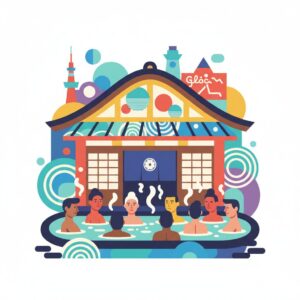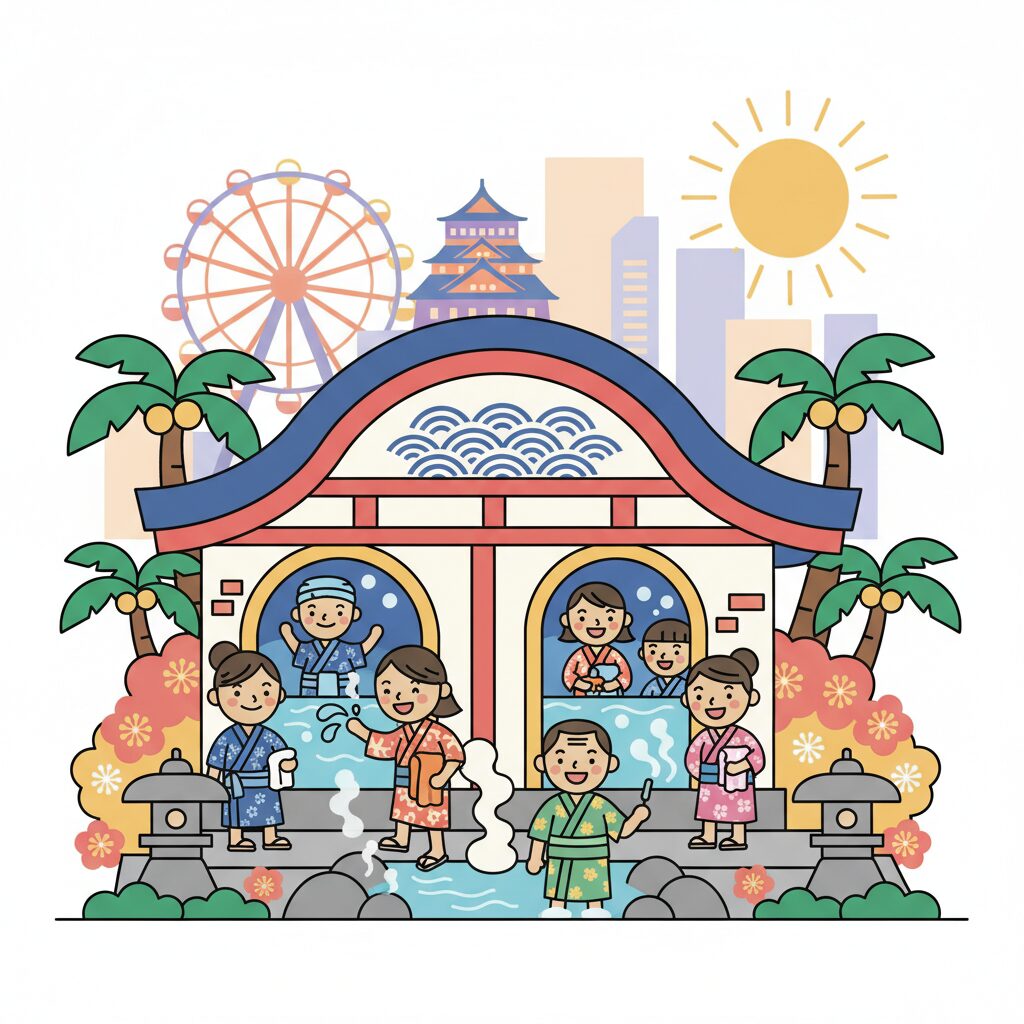
Walk down any residential street in Osaka, away from the neon glow of Namba or the towering offices of Umeda, and you’ll eventually see it. A tall, slender chimney reaching for the sky, a quiet plume of steam ghosting into the afternoon air. Below it, a building with a curved karahafu roof and sliding doors, a warm light spilling from its windows as evening falls. This is the neighborhood sentō, the public bathhouse. For many foreigners, the question is simple: Why? In a country of high-tech apartments, why would anyone leave their perfectly good home shower to go bathe with a crowd of strangers? It’s a fair question, but it misses the point entirely. In Osaka, the sentō isn’t about hygiene. It was never just about getting clean. It’s a community center, a social club, a therapist’s office, and a neighborhood living room all rolled into one. It’s where the city’s heart beats, stripped of all pretense, in a cloud of steam and boisterous chatter. To understand the sentō is to understand the unfiltered, unvarnished soul of Osaka itself, a soul that feels fundamentally different from the reserved politeness you might find in Tokyo. Here, getting naked is about getting real.
This community spirit extends beyond the steamy sanctuaries of the sentō, with many Osaka locals also embracing the charm of third place gatherings in their neighborhood kissaten.
The Neighborhood Living Room: Unspoken Rules and Rhythms
Push aside the noren curtain and step inside. The first thing that strikes you isn’t the heat, but the sound—a symphony of echoes: the clatter of plastic stools on tiled floors, the rush of water from chrome taps, and above it all, the murmur of conversation. This isn’t the hushed, almost sacred silence of a Kyoto temple; it’s the lively buzz of a place where people truly live and connect. The air is thick with the scent of soap and the rhythm of the Osaka dialect, a rapid-fire, musical language that fits perfectly in this setting. In Tokyo, visiting a sentō can be a solitary, meditative retreat. People keep to themselves, maintaining personal space even in a crowded bath. In Osaka, that bubble bursts the moment you walk in. Solitude feels suspicious. Silence is a void an Osakan feels obliged to fill.
The Social Warm-Up
The ritual starts in the datsuijo, the changing room. You’ll see rows of old wooden lockers and wicker baskets for your clothes. An ancient, dial-tuned television often hangs in a corner, blaring a Hanshin Tigers baseball game or a lively comedy panel show. This room is not just for undressing; it’s the pre-game lobby. Old men debate the Tigers’ starting pitcher. A group of obachan (aunties) discuss the price of daikon radish at the local market. Don’t be surprised if a stranger strikes up a conversation as you fold your shirt. It won’t be a profound inquiry, just a simple, genuine remark: “It’s gotten cold, hasn’t it?” or “That was some rain earlier.” This isn’t small talk for its own sake. It’s a social handshake, a recognition that for the next hour, you’re all part of the same temporary tribe. The unspoken rule is to engage, to respond. A nod and smile suffices; verbal agreement is better. It’s the price of admission to this community.
The Main Event: Bathing in Banter
Once inside the bathing area, the social etiquette continues. The basic rules of Japanese bathing apply everywhere: wash thoroughly on the low stools before entering the tubs. But in Osaka, there’s an extra layer. As you scrub, the person next to you might comment on your technique or recommend a particular soap. A foreigner might see this as intrusive or a criticism of their hygiene. It isn’t. It’s a gesture of inclusion, like offering you a piece of their snack. They’re drawing you into the group. The tubs themselves are social hubs. The scalding hot atsuyu bath is for veterans, who nod approvingly at newcomers brave enough to endure it. The jet bath, or denki-buro (electric bath), with its tingling current, often draws groans of delight and shared laughter. These are not silent retreats; they’re communal cauldrons where neighborhood news simmers and bonds grow. You’ll find out who just had a grandchild, whose son is taking university exams, and which local eatery serves the best lunch special—all without ever formally introducing yourself.
A Window into Osaka’s “Kamatte-chan” Culture
To truly understand the Osaka sentō experience, you need to grasp the concept of kamatte-chan. The literal translation is something like “attention-seeker,” which sounds negative in English. However, in the Osaka context, it refers to a cultural tendency to want to be involved, to meddle, to engage, and to connect with others—often in a nosy but well-meaning way. This attitude originates from a merchant culture where communication and relationships are highly valued. Osakans dislike seeing anyone left out. The sentō serves as the ultimate playground for the kamatte-chan spirit. It’s a place where social hierarchies dissolve: everyone is naked, placing a company president and a construction worker on equal footing. This equality encourages interaction.
Foreigners frequently become the focus of this friendly meddling. If you’re sitting alone, looking lost or confused, an obachan will almost certainly approach you. She might adjust your stool, show you the proper way to rinse, or emphatically point toward a particular bath. To a Western mindset, which values privacy and personal space, this can feel intrusive or even rude. But the intention is entirely opposite. It’s a maternal form of care. She’s not judging you; she’s adopting you, ensuring that you, a guest in her neighborhood’s living room, have the best possible experience. Responding with irritation or retreating will only create confusion. The appropriate response is a smile and a thank you. In that moment, you’ve been initiated.
This contrasts sharply with life in other Japanese cities. In Tokyo, the prevailing social contract often involves mutual, respectful non-interference: you don’t bother others, and they don’t bother you. This creates a smooth, efficient, but sometimes isolating urban experience. Osaka’s social contract is different. It’s built on mutual involvement. Though it can feel messy and chaotic, it is profoundly human. The sentō is where this philosophy is most evident—a public display of interdependence, reminding you that you are part of a community, whether you initially wished to be or not.
The Architecture of Community: More Than Just Hot Water
The physical design of a traditional sentō encourages social interaction, whether by intention or coincidence. Each feature serves a dual function: one practical, the other social. Grasping the layout helps you appreciate the culture it nurtures.
The Bandai: The Captain’s Bridge
Upon entering, you pay at the bandai, a raised platform where the owner—often an elderly man or woman—oversees both the men’s and women’s changing rooms. This is more than just a cashier’s station; it serves as the neighborhood’s nerve center. The bandai owner holds a wealth of local knowledge, knowing which families have frequented the sentō for generations. They often act as informal babysitters, watching kids while their parents bathe, and keep spare keys for residents locked out. They are the community’s unofficial historians, counselors, and concierges. Greeting the person at the bandai cheerfully with a “Konnichiwa” or “Gokuro-san” shows respect for their vital role.
The Tubs: Fluid Social Spaces
The assortment of baths encourages movement and mingling. There’s the main tub (shuhoku), usually large and moderately hot, plus specialty baths. The denki-buro (electric bath) offers a uniquely Japanese experience, where low-voltage currents flow through the water to soothe sore muscles—the initial shock often sparking conversation. The jetto-basu (jet bath) hits your back with high-pressure water streams. Sometimes, there’s a kusuri-yu, a medicinal bath infused with seasonal herbs like iris roots or yuzu citrus. People rarely choose one tub and stay put; instead, they circulate from hot to cool and from still to bubbling. This steady flow creates countless chances for brief, friendly exchanges as people yield space or comment on the water’s temperature.
The Post-Bath Ritual: The Real Social Hour
Arguably the most important part of the sentō experience happens once you’re clean. Back in the changing room, socializing really begins. Here, you find community staples resembling a neighborhood living room: old coin-operated massage chairs with intense vibrations, a scale, and a large communal television. The centerpiece, however, is the refrigerator stocked with small glass bottles of milk. Drinking milk after a bath is a sacred ritual. Classic flavors are coffee milk or fruit milk, their sweetness rewarding after soaking in hot water. Proper etiquette is to place one hand on your hip and down the bottle in a few quick gulps. But don’t rush off—this is the time to stay. People sit on wicker benches, towels wrapped around them, hair still damp, and chat. The shared experience of the bath seems to loosen tongues. Conversations become more relaxed and open. This is when friendships deepen, plans are forged, and the day’s events are discussed. Leaving immediately after bathing is like departing a party without saying goodbye. The post-bath milk serves as your social nightcap.
Why the Sentō Endures in Modern Osaka
Traditional sentō are disappearing across Japan at an alarming rate. Confronted with an aging population, rising fuel costs, and the fact that nearly every home now has a private bathroom, many owners are simply shutting down. Yet, despite this decline, the sentō tradition remains particularly resilient in Osaka. Several key reasons for this persistence reveal much about the city’s character.
First, there is the practical aspect. Osaka has a large concentration of older housing, including dense areas of pre-war wooden nagaya (row houses). Many of these traditional homes were built without dedicated bathing facilities or have very small, basic bathrooms. For a segment of the population, the local sentō is not a nostalgic luxury but a daily necessity. This ensures a stable, loyal customer base that keeps these institutions afloat.
Second, and more importantly, is the cultural value placed on community. Osaka was built by merchants. For centuries, success in this city depended not on your family name or samurai rank but on your network, your reputation, and your ability to build relationships (tsunagari). Business was conducted on the street, in the market, and over shared meals. This mindset influences every aspect of life. The sentō is a vital part of that social infrastructure. It’s a neutral ground where these essential community bonds are maintained in a relaxed, informal setting. It’s the great equalizer. In a city that prides itself on being unpretentious and down-to-earth, the sentō is the ultimate expression of that ethos.
Finally, the sentō serves as a powerful antidote to the loneliness of modern urban life. In a megacity, it’s easy to feel anonymous and go days without meaningful human interaction. The sentō provides a guaranteed point of contact. It’s a place where you are recognized, where people will notice if you haven’t appeared for a few days. For elderly residents who may live alone, it is a lifeline, a place to check in and be checked on. It offers a sense of belonging that a sterile apartment building or a scrolling social media feed simply cannot replicate. It is a deeply human institution in an increasingly digital world.
Your First Osaka Sentō: A Practical Guide to Fitting In
If you want to experience an authentic sentō visit, here are some helpful tips. This isn’t about the basic steps of bathing—you can find those easily online. Instead, it’s about navigating the social nuances like a local.
- Come Prepared: While towels and soap are available for rent or purchase, seasoned visitors bring their own items in a small plastic basket or waterproof bag called a furo-setto (bath set). It usually includes a small washcloth (tenugui), a larger towel for drying off, soap, shampoo, and sometimes a razor. Bringing your own set shows you’re not just a tourist but someone who respects the ritual.
- Master the Greeting: Upon entering, make eye contact with the attendant at the bandai and offer a clear, friendly greeting. A simple “Konnichiwa” (hello) or “Ojamashimasu” (excuse me for intruding) is perfect. When you leave, saying “Arigatou gozaimashita” (thank you very much) or “Gochisousama deshita” (a phrase usually said after meals but here expresses gratitude for the hospitality/bath) is appropriate. This small gesture shows respect for the space.
- Embrace the Chatter: Don’t be put off by the Osaka dialect or the seemingly constant conversations. You don’t need to be fluent to engage. If someone speaks to you, a smile and a nod go a long way. If you know a few words of Japanese, use them. Osakans are generally warm and patient with foreigners trying to speak their language. They’re not expecting perfect dialogue but are eager for a connection.
- The Washcloth Rule: Notice how people handle their small washcloth. It’s used for scrubbing in the washing area but should never touch the water inside the baths. Most fold it and place it on their heads. It may look odd, but this is proper etiquette and an easy way to show you understand the customs.
- Don’t Skip the After-Party: The post-bath ritual is essential for the full experience. Buy a bottle of fruit milk. Sit down in the changing room for at least five minutes. Watch the TV. Listen to the conversations. This is where the sense of community really takes hold. It’s the cool-down period that transforms a simple bath into a cultural immersion.
The Heartbeat of the Neighborhood
Ultimately, the sentō is far more than just a place to get clean. It serves as a living museum of a particular kind of community life that is disappearing in many parts of the world. It is a noisy, steamy, and unpretentious stage for everyday life. It captures the spirit of Osaka: practical, communal, straightforward, and deeply human. It’s a place where people shed their titles, uniforms, and inhibitions, connecting on the most fundamental level. If you truly want to grasp what makes Osaka tick, to feel the pulse of its neighborhoods and the warmth of its inhabitants, you must experience the sentō. Set aside the guidebooks and tourist spots for an evening. Locate a local bathhouse with a tall chimney, draw back the curtain, and step into the warm, inviting heart of the city.