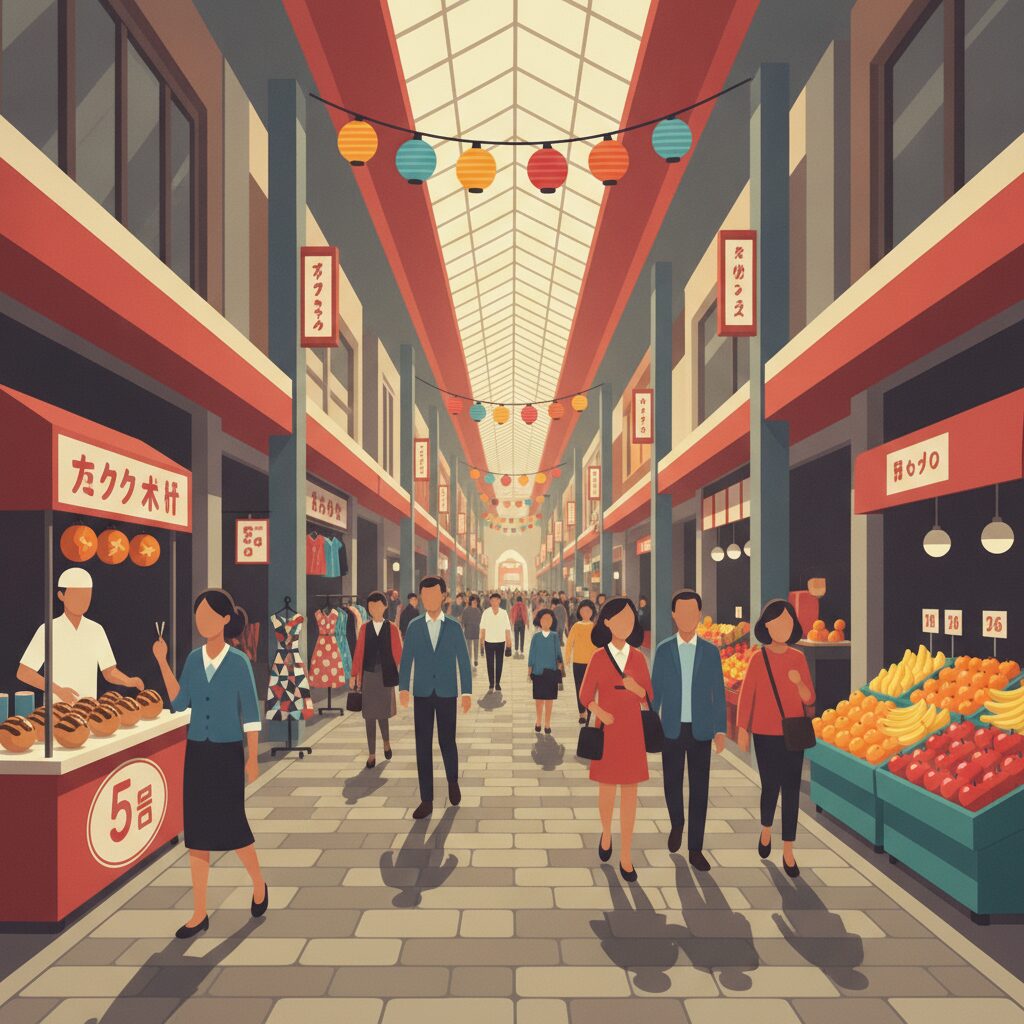
When you first move to Osaka, one of the most striking features of the urban landscape isn’t the towering skyscrapers or the neon-drenched entertainment districts. It’s something far more grounded, more human-scale: the shotengai. These covered shopping arcades, often stretching for kilometers, are a ubiquitous presence, weaving through neighborhoods like vital arteries. A newcomer, especially one accustomed to the sleek, sanitized commercialism of Tokyo or Western cities, might dismiss them as charmingly retro, slightly chaotic relics of a bygone era. You see the mismatched storefronts, the hand-painted signs, the cacophony of vendors hawking their wares, and you might think, “It’s an old-fashioned outdoor mall.” But to make that assumption is to fundamentally misunderstand Osaka. It’s like looking at a river and only seeing the surface, missing the powerful currents that shape the entire ecosystem. The shotengai is not just a place to buy your groceries. It is the public living room, the social switchboard, and the unwavering heartbeat of Osaka’s community life. To live in this city and not understand the role of the shotengai is to remain a perpetual tourist, forever on the outside looking in. These arcades are where the city’s famed personality—its directness, its humor, its obsession with a good deal, and its deep-seated warmth—is forged and displayed every single day. They are the stage upon which the unscripted drama of daily Osakan life unfolds. Forget the tourist guides for a moment. If you truly want to decipher the city’s soul, your education begins here, under the sheltering roof of the local shotengai.
This vibrant energy extends beyond the shotengai, as uncovering the intricacies of Osaka’s supermarket wars further reveals how local commerce fuels the city’s distinctive character.
The Shotengai is a Conversation, Not a Transaction
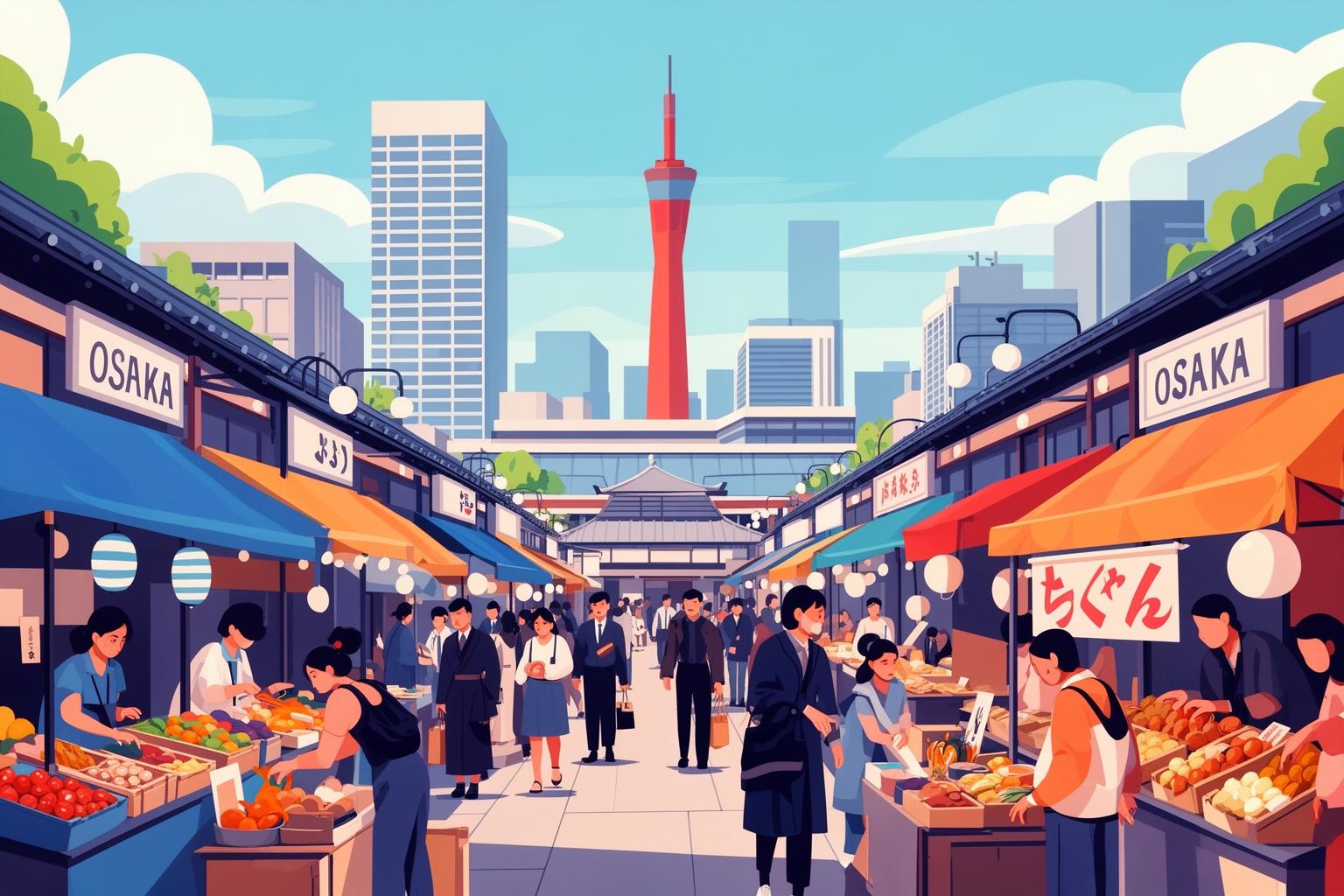
In most contemporary retail settings, the aim is efficiency. You pick your item, pay, and leave. Human interaction is scripted, minimized, and often filtered through a screen. This stands in stark contrast to the shotengai experience. There, the transaction serves only as a pretext for the real focus: the conversation. This is perhaps the most important distinction and one that often perplexes outsiders accustomed to anonymity. When you approach a fruit stand in the Tenjinbashisuji Shotengai, Japan’s longest arcade, you’re not merely a customer; you’re part of an ongoing dialogue.
The Currency of Banter
The shopkeeper won’t just weigh your apples. They’ll remark on the weather, inquire where you’re from, and share unsolicited but genuinely useful advice on how to pick the sweetest melons. “These mikan are great today, a little sour, just how you like them, right?” This isn’t a sales pitch; it’s a sign of recognition. They remember you. Your preferences are stored in a mental database shaped by repeated, casual exchanges. In Tokyo, such familiarity from a stranger might seem intrusive. In Osaka, it forms the foundation of commerce. It acts as a verbal handshake saying, “I see you. You’re part of this community.” The local dialect, Osaka-ben, perfectly conveys this. Its direct, playful, and sometimes blunt tone cuts through the formal layers of standard Japanese. The classic greeting between merchants, “Mokarimakka?” (Making a profit?), met with the usual response, “Bochi bochi denna” (So-so), exemplifies this. It’s a ritual unrelated to actual business accounting but entirely about maintaining social bonds. It’s a way to check in, share daily struggles and successes, and reinforce the idea that everyone is in this together.
Omake: The Unspoken Rebate
This conversational culture gives rise to the cherished practice of omake, the little extra a vendor adds for free. It might be an extra potato, a handful of spring onions, or a piece of candy for your child. Outsiders might interpret this as a random act of kindness or a clever marketing tactic. It is neither. Omake is the tangible expression of the relationship you’ve developed. It’s an earned reward on your social investment. You don’t receive omake on your first visit. It comes once you’ve become a kao-najimi, a familiar face. It’s the shopkeeper’s way of saying “Thanks for coming back,” “I appreciate your loyalty,” and “Let’s keep this relationship going.” It transforms buying into a reciprocal exchange, sharply contrasting with the cold impersonality of barcode scanners and loyalty point systems. In the shotengai, your loyalty is recognized with a real, human connection, not just an abstract digital point.
A Cradle-to-Grave Ecosystem
Stroll along a genuinely local shotengai, away from the tourist-filled centers, and you’ll be struck by the remarkable variety of businesses packed under one roof. It’s so much more than just butchers, bakers, and fishmongers. You’ll find a small clinic for your annual check-up, a dentist’s office, a real estate agent with faded photos of available apartments taped to the window. There’s a quiet bookstore, a cluttered stationery shop selling everything from calligraphy brushes to school notebooks, a barber who has been offering the same three haircuts for fifty years, and a dry cleaner who knows the story behind every stain. Further inside, you might discover a small daycare, an after-school cram school (juku), a legal office, and perhaps even a business arranging funeral services. This isn’t a random assortment of shops; it’s a carefully integrated, self-sufficient ecosystem designed to support residents through every stage of life.
Life on a Single Street
This concentration of essential services fosters a strong sense of place and continuity. Picture this: a child gets their first candies from the local dagashiya (old-fashioned snack shop). They buy their school uniforms at a clothing store a few doors down. When their eyesight deteriorates, they get glasses from the optometrist next to the butcher. As a teenager, they might take a part-time job at the local noodle shop. When ready to move out, they visit the real estate agent in the arcade to find an apartment just blocks away. They bring their own children back for check-ups at the same clinic where their parents once went. This generational loyalty is the bond that holds the shotengai—and by extension the neighborhood—together. It’s a life lived on a human scale, where major life events are accommodated within a few hundred meters of your front door. This stands in stark contrast to the suburban, car-dependent lifestyle common in many Western countries, or the more segmented, district-based structure of Tokyo, where different parts of the city must be visited for various needs. In Osaka, life is truly hyperlocal. The shotengai is the nucleus around which the entire neighborhood revolves.
The Practicality of Proximity
This design isn’t born from nostalgia; it emerges from Osaka’s merchant DNA, which values pragmatism and efficiency above all else. Why waste time traveling across town when everything you need is available in one convenient, weather-protected location? The covered roof of the shotengai isn’t just a charming architectural feature; it’s a practical response to Japan’s rainy seasons and humid summers, ensuring that commerce and community life continue uninterrupted regardless of the weather. It enables the elderly to shop daily without fear of heatstroke or a sudden downpour. It provides a safe, car-free space for children to walk home from school. The shotengai is a masterful piece of urban planning, developed organically from the daily needs of the people it serves.
The Unspoken Rules of the Arcade
Like any intricate social setting, the shotengai functions according to a set of unspoken rules and subtle etiquette. Navigating it means shifting from the mindset of a passive consumer to becoming an active member of the community. For a foreigner, grasping these nuances is essential to feeling genuinely integrated rather than merely an observer behind glass. Breaking these rules won’t get you expelled, but following them will unlock a richer, more authentic experience of Osaka life.
The Art of Acknowledgment
In a supermarket, you can stroll through aisles for an hour, head down, headphones on, without making eye contact. Trying this in a shotengai feels immediately unsettling. The shops are open-fronted, vendors are present, and their livelihood depends on engaging with passersby. The first rule is simple: acknowledge their presence. You don’t need to have a full conversation with every shopkeeper. However, as you browse, a subtle nod, a slight smile, or a quiet “Konnichiwa” is expected. This small interaction signals respect and mutual recognition. To pass a vendor, inspect their goods, and then walk away in silence is seen as cold and dismissive. It breaks the social contract of the arcade. This doesn’t mean you’re obliged to buy—simply to be a fellow human sharing the communal space.
The Power of a Home Base
Don’t try to befriend every shopkeeper all at once. Becoming a regular begins with choosing a “home base.” Select one or two shops for your regular needs—a particular butcher, a tofu maker, or a fruit stand. Make a habit of visiting them consistently. At first, your interactions might be brief and transactional, but over time, they’ll notice your loyalty. They’ll start anticipating your order. “The usual?” the baker might ask, already bagging your favorite bread. This marks the turning point. Once you’ve established this small foothold, your reputation as a “neighbor” begins to grow. The butcher will notice you chatting with the baker and be friendlier on your next visit. The tofu maker will nod in recognition. You are no longer an anonymous foreigner; you become “the person who always buys from Tanaka-san.” This network of relationships is how you become woven into the social fabric of the neighborhood.
Reading the Rhythm of the Day
The shotengai is a living entity with a unique daily rhythm. To use it well, you need to understand its pulse. Early morning, around 9 or 10 AM, is the domain of the neighborhood’s elderly and professional homemakers. It’s calm, focused, and the best time to get the freshest produce and enjoy leisurely chats with vendors. The lunchtime rush brings a chaotic energy, as office workers and shopkeepers grab quick meals from bento shops or noodle stands. Late afternoon, from 3 to 5 PM, is children’s time. The arcade fills with the sound of kids coming home from school, stopping for inexpensive snacks or playing in open spaces. This is followed by the evening rush, when commuters stop on their way home from the station to pick up ingredients for dinner. Knowing this rhythm lets you choose your timing. For a quiet, personal shopping experience, visit in the morning. To experience the full, vibrant energy of the community, come during the evening rush. Each time offers a distinct glimpse into neighborhood life.
Why Shotengai Thrive in Osaka (and Struggle Elsewhere)
Across Japan, traditional shotengai are facing a crisis. They are losing ground to large-scale, chain-driven suburban malls and the convenience of online shopping. Many have turned into “shutter streets” (shattā-dōri), with most storefronts permanently closed. Yet in Osaka, while not immune to these challenges, shotengai remain remarkably resilient and central to daily life. This resilience is no coincidence. Their survival is deeply connected to the city’s unique cultural and historical identity.
A Merchant’s Pragmatism
Osaka has been Japan’s commercial heart for centuries. It is a city built by merchants, not samurai or aristocrats. This has nurtured a deeply pragmatic and unpretentious mindset. While Tokyo might emphasize sleek design, brand prestige, and aesthetic perfection, Osaka values substance, quality, and above all, a good price (nedan). The shotengai perfectly embodies this value system. It’s not always attractive—the lighting can be harsh, the floors worn, and the sounds and smells overwhelming. But the fish is fresh, the vegetables affordable, and the shopkeeper honest. Osakans see this slight grittiness not as a flaw but as a mark of authenticity. It’s a place of real work and genuine commerce, not a curated consumer fantasy. This cultural preference for the authentic over the polished gives the shotengai a lasting strength it might lack in more image-conscious cities.
The Culture of “Kechi” vs. “Shimatsu”
People from other parts of Japan sometimes jokingly call Osakans “kechi,” meaning stingy or cheap. But Osakans have their own term: “shimatsu.” While it can mean frugal, it carries a deeper sense of resourcefulness, a dislike of waste, and skillful management of resources to maximize value. The shotengai is a temple of shimatsu. It’s where you can buy exactly three potatoes instead of a pre-packaged bag of ten that might go to waste. It’s where a butcher will give you the exact cut of meat you want, minimizing waste and cost. It’s where you can get your shoes repaired, knives sharpened, and clothes altered—a culture of mending and making do rather than replacing. This mindset fundamentally conflicts with the mass-consumption model of modern supermarkets or department stores. For foreigners accustomed to bulk buying, the shotengai offers a lesson in the Osakan art of purchasing only what you need, at a fair price, from someone you trust.
A Human-Scale City
Unlike the sprawling metropolis of Tokyo, which often feels like a collection of disconnected hubs, much of Osaka remains a network of walkable, tightly-knit neighborhoods. The city’s urban planning, historically focused on these pedestrian commercial streets, fosters a different way of living. It encourages daily walks, spontaneous encounters, and a genuine connection to one’s immediate surroundings. The shotengai serves as the neighborhood’s main corridor, linking the train station to residential areas and making it an integral part of daily commutes. This physical integration into the urban fabric ensures a steady flow of people and prevents the arcade from becoming an isolated destination that requires driving to reach. It is not an alternative to daily life; it is the very path along which daily life moves.
Not Just Nostalgia: The Modern Shotengai
It would be mistaken to see the shotengai as a perfectly preserved museum of Showa-era Japan. Doing so would overlook its dynamism and ability to evolve. The shotengai that thrives today is not one that has resisted change, but one that has skillfully merged the old with the new, maintaining its relevance for a new generation. While the longstanding tofu shop and family-run fishmonger remain as anchors, the surrounding ecosystem is constantly adapting.
Strolling through a lively arcade today, you’ll witness evidence of this evolution everywhere. Nestled between a traditional pickle shop and a dried goods seller, you might find a sleek, third-wave coffee stand operated by a young barista who carefully explains the origins of their single-origin beans. A few doors down, an old kimono shop may have been transformed into a craft beer bar, serving IPAs from local Osaka breweries. You’ll discover organic bakeries, stylish minimalist art galleries, and shared co-working spaces filling what were once empty storefronts. This infusion of new energy is vital. It prevents the shotengai from becoming a monoculture catering solely to an aging population and creates a multi-layered community where a grandmother buying daikon for dinner can meet a young graphic designer heading to a shared office, both feeling equally at home. This blend is what stops the shotengai from becoming just a tourist attraction and ensures it remains a functional, essential part of the modern neighborhood.
Moreover, shotengai associations are actively innovating to remain competitive. They organize seasonal festivals (matsuri), summer night markets, and street performances. They hold stamp rallies and local lotteries to encourage shopping within the arcade. Some have even developed their own delivery services or online platforms, combining digital convenience with local, personal service. They recognize they cannot compete with the vast scale of global e-commerce or the glitz of downtown malls on those terms. Instead, they emphasize their unique strength: a deep, unbreakable connection to the local community. They are selling not just products, but a sense of belonging.
Your Role in the Arcade
As a foreign resident in Osaka, the shotengai offers you a choice. You can treat it merely as a convenient shopping spot, a transactional space no different from a supermarket, and you’ll manage just fine. Alternatively, you can recognize it for what it truly is: an invitation. It is an open door to the heart of your local community, providing the quickest route to transforming yourself from a temporary visitor into a genuine neighbor. Engaging with the shotengai is the most effective way to practice your Japanese, appreciate the local culture, and build a network of friendly faces in your new city.
Your first step is simple: show up. Skip the supermarket for one of your weekly shopping trips and take a stroll through your nearest arcade. The second step is to pick your spot. As mentioned, don’t try to conquer the entire street at once. Find one vendor—the friendly man at the fruit stand, the woman at the bakery who smiles at everyone—and make it your goal to become their regular customer. Buy from them consistently. Use the little Japanese you know. Start with “Kore, kudasai” (This, please). Progress to asking “Kyo no osusume wa?” (What’s your recommendation today?). Ask for their name. Let them learn yours. This small, repeated effort is an investment that will bring great rewards. Soon, you’ll be greeted by name. You’ll receive your first omake. You will sense the subtle but powerful change from being an outsider to becoming part of the community.
Understand that every yen you spend in the shotengai is a vote. It’s a vote for a local family’s business over a faceless corporation. It’s a vote for preserving the unique character of your neighborhood. It’s a vote for a more human-scale, community-centered way of life. In a world growing increasingly anonymous and disconnected, the Osaka shotengai stands as a strong testament to the lasting value of face-to-face interaction, shared history, and the simple yet profound act of being a good neighbor. It is here, amid the noise and chatter, that you will discover the real, unfiltered soul of this magnificent city.