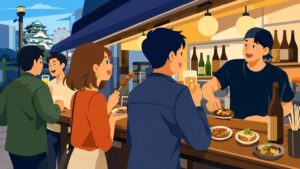
You’ve seen them, tucked away on the second floor of a weathered building in Tenma or nestled in a quiet alley just a stone’s throw from the neon chaos of Namba. A simple sign, often handwritten or glowing with the soft hum of a single neon tube, spells out a name in katakana: ‘Snack Tomoko,’ ‘Bar Midori,’ ‘Pub Ai.’ Below it, a heavy, sound-proofed door and a small, curtained window that reveals nothing. You might hear the faint, reverb-heavy strains of a karaoke ballad, a sound distinctly different from the high-energy pop blasting from the big, corporate karaoke chains. You pause, intrigued and a little intimidated. What exactly is a ‘snack bar’? Is it a restaurant? A private club? Is a foreigner even allowed to open that door? This curiosity is the entry point to understanding a fundamental layer of social life in Osaka, a layer that operates on a completely different set of rules from the transactional, efficient world of Tokyo. These are not just bars; they are the living rooms of Osaka’s neighborhoods, the proving grounds of its social dynamics, and a window into the city’s true heart. They are where the city’s famous friendliness is forged, tested, and performed every single night.
These intimate encounters offer just a glimpse of a broader urban tapestry, inviting readers to explore how Osaka okan culture weaves tradition with the city’s modern convivial spirit.
What Exactly is a ‘Snack Bar’? Unpacking the Misnomer
Your initial confusion probably stems from the name itself. The word ‘Snack’ implies food, perhaps a casual spot for a light bite. This is the primary and most frequent misconception. A snack bar, or sunakku (スナック) as it’s called in Japanese, is essentially not centered on the food. Focusing too much on the menu means missing the entire point. The concept is a charming remnant of the Showa era, a cultural relic that remains vibrant and alive in the backstreets of Osaka.
It’s Not About the Snacks
When you sit down at a snack bar, you will be offered some food. It’s almost always a small, simple dish called otsumami (おつまみ). This might be a bowl of kaki-pi (persimmon seed-shaped rice crackers mixed with peanuts), some pickled vegetables, or perhaps a handful of chocolates. This is the ‘snack.’ It’s not an appetizer; it’s included in the table charge and serves as a gesture of hospitality marking the start of the evening. The snack’s purpose is not to satiate your hunger but simply to exist. It acts as a prop in a social performance, a small anchor for the main event of drinking, talking, and connecting. In a city like Osaka, renowned for its exceptional food culture, the deliberate simplicity of the snack bar’s offerings makes a clear statement: “You are not here for your stomach. You are here for your soul.”
The Key Players: The ‘Mama’ and the ‘Master’
Every snack bar centers around a key figure, a sun in its own little solar system: the owner, typically standing behind the counter. If the owner is a woman, she’s affectionately called the ‘Mama’ or ‘Mama-san.’ If it’s a man, he’s the ‘Master.’ These titles are more than mere job labels; they are roles rich with decades of social tradition. The Mama-san is not just a bartender. She’s a confidante, a social director, a therapist, a matchmaker, and sometimes a stern yet loving matriarch. She knows her regulars’ preferred drinks, the names of their children, their work troubles, and which karaoke song will lift their mood. The Master usually has a quieter, more stoic presence, a calm anchor amid the nightly chatter, but fulfills the same vital role. The entire ambiance of the bar—its warmth, humor, and unique blend of chaos or calm—is a direct reflection of their personality. This is the complete opposite of the anonymous, interchangeable staff at a chain pub. You don’t visit ‘Snack Tomoko’; you go to see Tomoko-san. The relationship is the real product.
The Payment System: A Source of Confusion
This is where many foreigners feel uneasy—and understandably so. The pricing system in a snack bar is based on relationships and trust rather than a clear, itemized bill. First, there’s the ‘set charge’ (セット料金, setto ryōkin) or ‘table charge’ (チャージ, chāji). This cover fee grants you the privilege of a seat and typically includes the otsumami mentioned earlier, along with ice and water for your drinks. It can range from a couple of thousand yen to much more in upscale areas. Then come the drinks. While you can order by the glass, the authentic system that marks you as an insider is the ‘bottle keep’ (botoru kīpu, ボトルキープ). Here, you buy a whole bottle of spirits—usually shochu, whiskey, or brandy. The Mama-san marks your name on it, sometimes adding a flourish or the date, and places it on a shelf behind the counter—a visible trophy of your loyalty. On future visits, you pay only the set charge and any mixers you consume. This system cleverly turns you from a one-time customer into a regular. Your bottle is waiting for you. You have a reason to return. It’s an investment in a social home base, a concept perfectly suited to the pragmatic yet community-oriented Osaka mentality. For Tokyoites who are used to paying strictly for what they consume, this system might feel confusing and unclear. For Osakans, it’s a fair exchange for guaranteed good times with familiar faces.
The Social Stage: How Osaka People Use Snack Bars
To grasp the essence of Osaka, it’s important to recognize that social boundaries are drawn differently here. The strict divide between public and private life often seen in Tokyo is less pronounced. The snack bar perfectly exemplifies this fluid, intersecting social environment. It serves as a stage where the city’s character is enacted every night.
More Than a Bar, It’s a ‘Third Place’
Sociologists describe the ‘third place’ as a setting that is neither home (the first place) nor work (the second place). In many Western cultures, this could be a cafe, pub, or community center. In Osaka, however, the snack bar stands out as perhaps the most significant third place, especially for the generation that shaped the modern city. For many older salarymen, it feels like an extension of their living room—a spot to relax and leave behind the stiff formalities of corporate life. Yet it’s more than just a refuge. It’s where business ties are gently transformed into friendships, local gossip is shared, and a collective sense of identity is strengthened. It remains a profoundly communal space in an increasingly individualistic world.
The Unspoken Rules of the Counter
The most crucial fixture in a snack bar is the counter. This is not a dividing line between staff and patrons but a shared table, akin to a communal campfire. Sitting at the counter means you’re implicitly joining the group. Ignoring others by hiding behind your phone or only talking to your companion is socially frowned upon. The Mama-san, a skilled facilitator, will effortlessly draw you into the conversation. She might introduce you by saying, “Sato-san, this is Li-san. He’s from China but now lives in Osaka.” Just like that, you’re included. Sato-san will ask about your hometown, your thoughts on the Hanshin Tigers, and whether you can hold your whiskey. This dynamic fuels Osaka’s renowned friendliness. It’s not a vague, cheerful attitude but an active, engaged social norm. While in a Tokyo bar, sitting silently beside someone for an hour might be perfectly acceptable, in an Osaka snack bar that silence feels odd, almost unfriendly. The expectation is to connect, find common ground, and laugh at a corny joke. It’s about bridging the gap between strangers, a fundamental aspect of Osaka’s spirit.
Karaoke as Communication, Not Performance
Then there’s karaoke. Karaoke in a snack bar contrasts sharply with the private, soundproof rooms of a karaoke box. In a box, you perform for your friends. In a snack bar, you perform with everyone present. The song choices tend to favor nostalgic enka (sentimental ballads) and Showa-era pop classics. The goal isn’t technical perfection—far from it—but emotional expression. Singing a heartfelt, slightly off-key rendition of a beloved ballad is a way of showing vulnerability and sharing a piece of yourself with the group. In return, the room supports you; people clap, sing along, and warmly applaud regardless of how you sound. It’s a collective emotional release. By singing, you add your voice to the shared history and mood of the space. It’s communication through melody—a way of saying, “I’m one of you.”
Osaka vs. Tokyo: The Snack Bar as a Cultural Barometer
Nowhere are the contrasts between Osaka and Tokyo more vividly shown than in their distinctive snack bars. While both cities have them, the purpose, ambiance, and unwritten rules they follow differ greatly, mirroring the unique spirits of Japan’s two major metropolises.
Tokyo’s Polish vs. Osaka’s Patina
In Tokyo, especially in upscale areas like Ginza or Akasaka, snack bars tend to be refined and exclusive. They often carry a formal vibe, frequented by high-powered executives and politicians. The decor is sleek and modern, the Mama-san impeccably dressed and elegantly reserved. These places can resemble private clubs where membership hinges on status and connections. By contrast, Osaka’s snack bars embody aji (味)—a term meaning flavor, but here representing a rich, lived-in character, a patina of time and experience. Their decor may be dated, with slightly worn furniture and an atmosphere saturated with the ghosts of countless cigarettes from a bygone era. This is embraced as a sign of authenticity. Entry depends not on social rank but on your willingness to engage. Osaka prizes sincerity over polish, hearty laughter over polite smiles.
The Economic Undercurrent: Value for Money and Human Connection
Osaka’s merchant heritage—practical, straightforward, and always value-conscious—runs deep. The snack bar’s bottle-keep system perfectly reflects Osaka’s idea of kosupa (cost performance). Why pay for a single expensive drink when you can invest in a bottle that offers many nights of enjoyment? It’s a long-term investment in your own pleasure. Yet the ‘value’ Osaka customers seek goes beyond money. They are investing in human connection. The set fee covers more than just a seat and snacks; it’s the price of a few hours of community, the Mama-san’s attentive ear, and the companionship of regular patrons. In Tokyo, a transaction is often merely an exchange of money for a service. In Osaka, it marks the start of a relationship, with the snack bar serving as the perfect stage for this philosophy.
Direct Communication vs. Indirect Subtlety
Communication styles of the Mama-san also set them apart. An Osaka Mama-san tends to be loud, direct, and charmingly funny. She’ll tease you, offer unsolicited advice, and scold you like a beloved nephew if you drink too much. Her warmth is unmistakable and wholly unfiltered. This embodies Osaka’s famous tsukkomi culture—the sharp, witty retort that signals affection rather than offense. Conversely, a Tokyo Mama-san may prefer the subtle, indirect communication typical of the Kanto region. Her hospitality may manifest through quietly anticipating your needs rather than overt interaction. For foreigners, Osaka’s approach can be both refreshing and warmly inviting. It cuts through layers of politeness to reach the heart, making you feel part of the family, flaws and all.
A Foreigner’s Guide to Braving the Noren Curtain
So, here you are again, standing before that enigmatic door. You possess some knowledge now, but still feel hesitant. How can you step inside without offending anyone or making a mistake? The key is to remember these are semi-private spaces, where a bit of respect and humility goes a long way.
Reading the Signs (Literally and Figuratively)
First, recognize your fear—it’s a natural reaction to the unknown. But you can reduce the risk by searching for clues. The best indicator is a price list displayed outside. Look for the characters 明朗会計 (meirō kaikei), meaning ‘clear and transparent accounting.’ This signals the bar’s honesty and promises no surprises. Listen at the door: if you hear genuine laughter and cheerful, even if slightly off-key, singing, it’s probably a welcoming place. Be wary of venues with no windows, no price list, and especially those with touts trying to drag you in from the street—these could be more complicated establishments. Trust your instincts. You can often sense the atmosphere of a good snack bar just from outside.
Your First Visit: A Practical Script
If your Japanese is limited, the best approach is to go with a Japanese friend the first time. If you’re going alone, take a deep breath and muster courage. Don’t knock; instead, open the door slightly, peek in, and make eye contact with the Mama or Master. A simple, questioning “Ii desu ka?” (Is it okay?) works perfectly. Their response will tell you everything. Usually, you’ll receive a surprised but warm smile. Once seated, be honest: say “Hajimete desu. Shisutemu o oshiete kudasai.” (It’s my first time here. Could you please explain how your system works?). This shows respect and prevents awkward misunderstandings later. They will explain the set charge. Start by ordering a simple drink by the glass; avoid committing to a bottle on your first visit. When the otsumami arrives, accept it with a smile—it’s all part of the experience.
Embracing the Experience: Karaoke, Conversation, and Connection
Once you’re comfortable, aim to blend in. Observe the flow of conversation. When someone sings karaoke, put your phone away and join in with applause. When the songbook comes your way, don’t worry—even if you can’t read the Japanese titles, there are usually a few English favorites like ‘My Way’ or songs by The Beatles. Your singing ability doesn’t matter; your willingness to participate is what counts. A gesture that’s always appreciated is buying a drink for the owner. You can say to a staff member, “Mama ni ippai dōzo” (A drink for the Mama, please). This simple act shows you recognize that you are a guest in their space and appreciate their hospitality. When it’s time to leave, say a heartfelt “Gochisōsama deshita!” (a phrase normally used after a meal, but fitting here for the hospitality you received) along with a sincere “Mata kimasu” (I’ll come again), leaving a positive, lasting impression.
Why Snack Bars Are the Soul of Neighborhood Osaka
In an era marked by digital separation and algorithm-driven social interactions, the snack bar stands out as a bold act of analog community. It is a place that demands your presence, attention, and voice. These venues are more than mere remnants of a bygone time; they are vibrant, living institutions that uphold the social fabric of Osaka’s neighborhoods. They serve as guardians of a unique form of human connection—one that is intimate, unpretentious, and deeply tied to a shared sense of place. To regard them merely as dive bars or karaoke spots is to fundamentally misinterpret Osaka. The city’s renowned energy, warmth, and humanity are not only found in the bustling markets of Kuromon or the busy arcades of Shinsaibashi. They are cultivated and sustained within these small, dimly lit rooms, night after night. The snack bar offers insight into what Osaka’s people are truly like. They are individuals who believe that a shared song, a poured drink, and a conversation with a stranger at the counter are not trivial moments but the very core of a life well-lived. Opening that door is not just about finding a place to drink; it is about discovering a piece of the real Osaka.