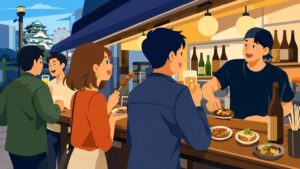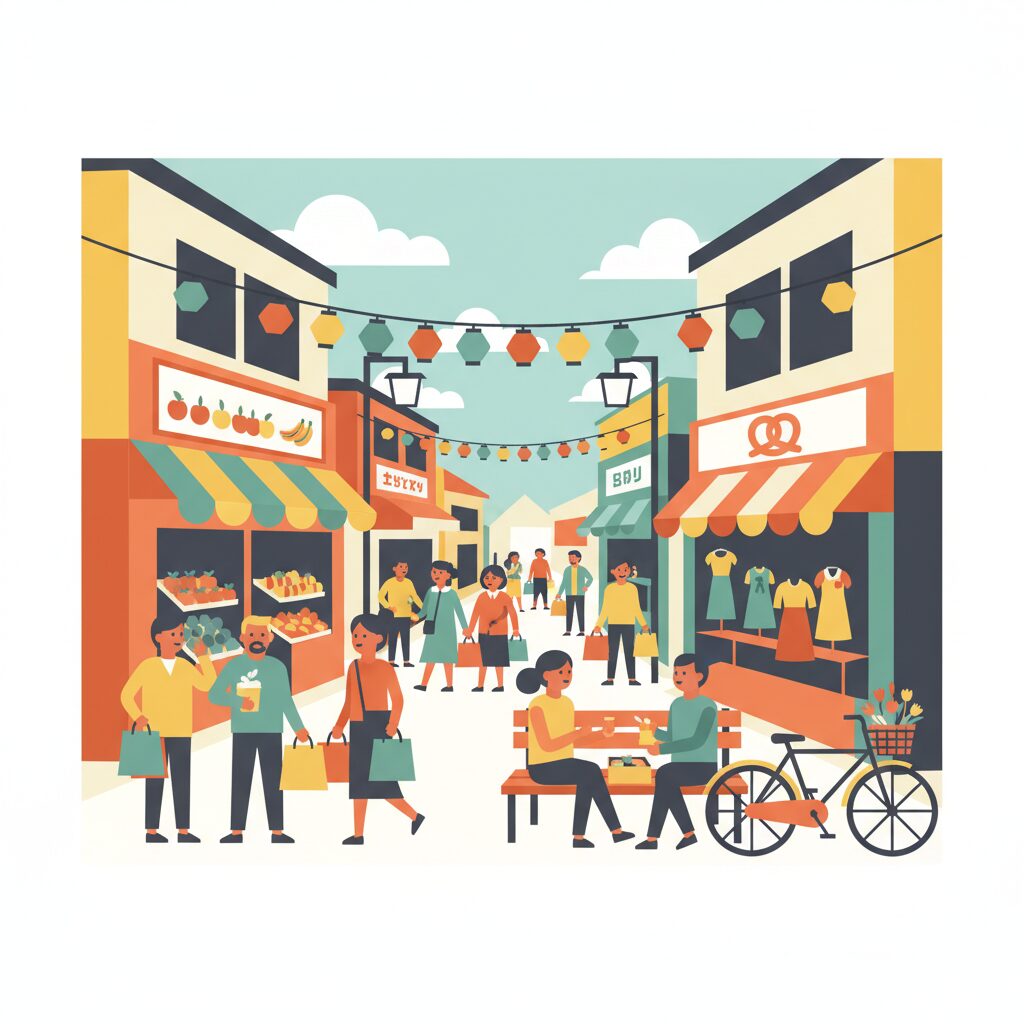
Step into any major supermarket in Osaka, and you’ll recognize the scene. It’s a universal temple of sterile efficiency. The floors gleam under fluorescent lights, the air is a neutral, refrigerated hum, and the music is a carefully curated soundtrack of blandly pleasant pop. You grab your basket, navigate the silent aisles with practiced precision, select your vacuum-sealed goods, and proceed to a self-checkout lane where your only interaction is with a synthesized voice telling you to please take your receipt. It’s clean, it’s fast, and it’s completely anonymous. You could be in London, New York, or a space station. Now, walk two blocks away, push past a pair of flapping noren curtains under a grand, arching sign, and step into a shotengai. The world changes instantly. The air is thick with the smell of grilled eel, sweet dashi broth, and freshly baked bread. The light is a chaotic dapple, filtering through a high, semi-transparent roof. The sound isn’t a curated playlist; it’s a symphony of human life. It’s the rumble of a delivery cart’s wheels on worn tile, the sizzle of oil in a tempura pan, the rhythmic chop of a butcher’s knife, and above it all, the cacophony of voices. Shopkeepers yell out daily specials, neighbors greet each other across the narrow lane, and children laugh as they chase each other around displays of fruit. This isn’t just a place to buy groceries. This is the city’s living room, its pulse, its social nervous system. It’s where Osaka’s true character isn’t just on display; it’s performed daily. For anyone trying to understand what makes this city tick, the shotengai isn’t just a shopping destination; it’s the textbook, and the daily lesson is about to begin.
Those drawn to the contrasting dynamics between clinical supermarket efficiency and the vibrant, unpredictable energy of Osaka’s neighborhood markets might enjoy reading our guide to Osaka’s eccentric supermarkets.
The Unspoken Currency: Conversation and Connection
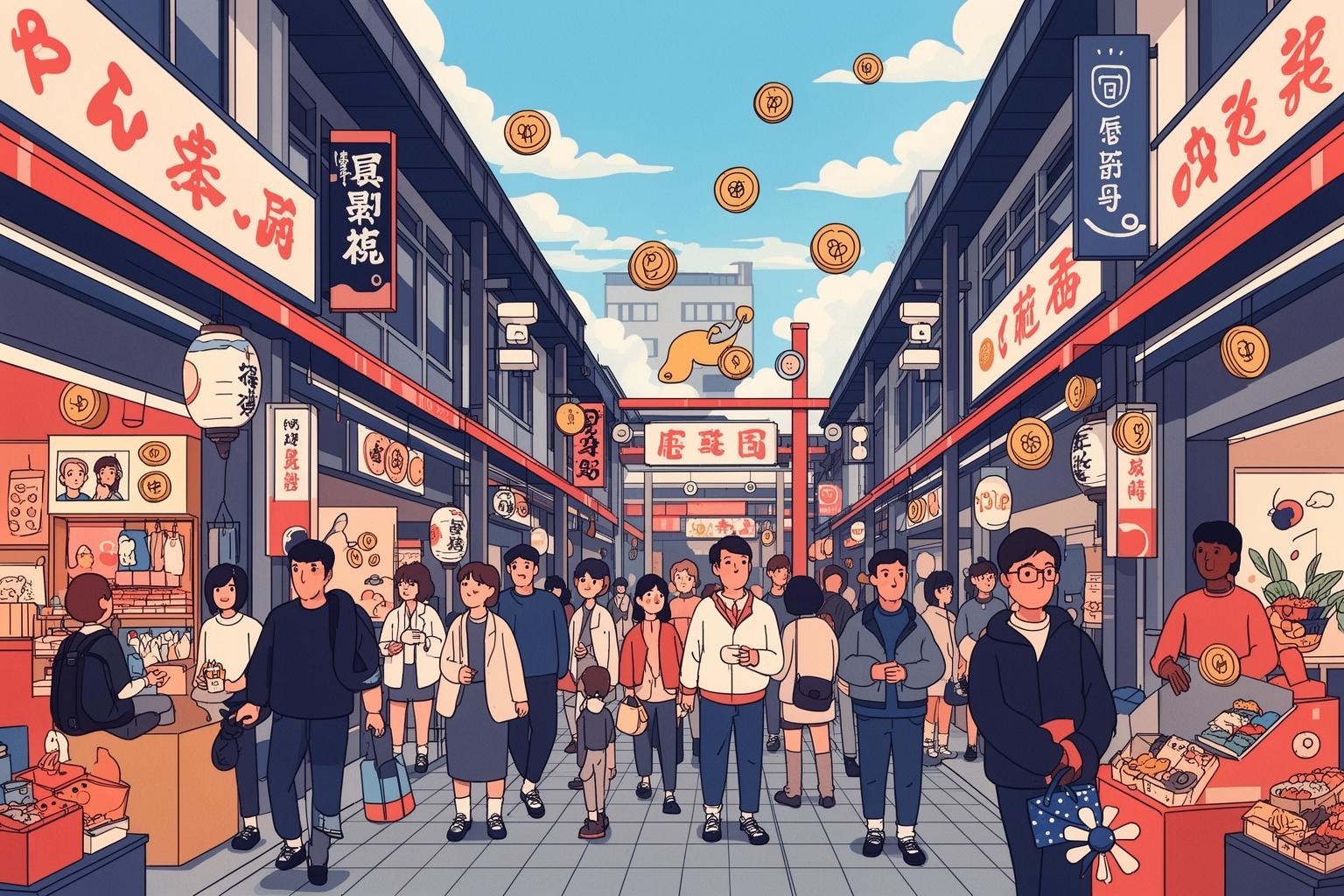
In a typical store, the currency used is yen, exchanged straightforwardly for goods and services. In the shotengai, however, yen takes a backseat. The primary currency here is conversation—recognition, relationship, and belonging. Without exchanging a few words, you’re not truly shopping; you’re merely a tourist passing through. This distinction can take time to understand because the interactions seem fleeting and casual, yet they form the fundamental basis of neighborhood life. It’s a world apart from the silent nod you might share with a cashier in Tokyo. Here, silence feels unusual, and engagement is the norm.
Your Daily Check-in
Your first visits to the local shotengai might feel like a performance, with shopkeepers eyeing you, the unfamiliar foreigner in their territory. You buy your tomatoes, pay, and leave. But keep at it. Visit the same vegetable stand a few times a week. Eventually, the woman running it—a formidable figure always in a white apron, with a voice that could cut through steel—will begin to recognize you. The transaction evolves; it’s no longer just about the tomatoes. One day, she’ll nod and say, “Kyō no tomato, amai de” (“The tomatoes today are sweet, you know”). This is your opening. You can ask whether they’re better for a salad or a sauce, and she’ll give you a straightforward, honest answer. The following week, she might ask where you’re from. The week after, she’ll notice if you seem tired. This isn’t prying; it’s community care. The shotengai acts as a low-key, informal surveillance network. People know who is new, who is ill, whose children are growing up. For an elderly resident living alone, a daily chat with the fishmonger or tofu maker might be their most meaningful social interaction of the day. It’s a check-in, a way of saying, “I see you. You belong here.” In an increasingly digitally isolated world, this analog form of connection feels profoundly human and essential. It starkly contrasts with the anonymity of a supermarket, where you could disappear for weeks without anyone noticing.
The Art of the “Maido” and “Omatase”
To grasp the rhythm of these exchanges, you need to attune yourself to the local language. Two words stand out: “Maido” and “Omatase.” When a shopkeeper greets you with a hearty “Maido!” it literally means “every time,” but its significance is much deeper. It’s a shortened form of “maido arigatou gozaimasu,” meaning “thank you for your continued patronage.” It’s a verbal handshake saying, “Ah, it’s you again. Welcome back, regular.” This single word acknowledges a shared history, however brief, setting you apart from a one-time visitor. Hearing it for the first time from the gruff butcher you’ve bought chicken from for a month marks a small but meaningful rite of passage—acceptance. Conversely, “Omatase” is a phrase of gentle politeness, translating to “sorry for the wait,” though it’s often said even if you haven’t waited at all. When you approach the counter, the owner looks up from their task and says, “Hai, omatase!” It acts as a conversational lubricant, softly acknowledging your presence and smoothly shifting their attention to you. These phrases are part of a shared script—a linguistic dance everyone in the shotengai knows. Learning the steps—responding with a nod, a smile, a simple “kore kudasai” (“this, please”)—is how you move from outsider to participant in the neighborhood’s daily life.
The Economic Logic of the Neighborhood Arcade
It’s easy to see a shotengai, with its traditional storefronts and what seems like inefficient specialization, and assume it’s an outdated relic—charming but bound to fail in the era of Amazon and mega-malls. However, this is a fundamental misunderstanding of its purpose and economic model. The shotengai doesn’t compete on the same terms as a supermarket. It doesn’t offer one-stop convenience or rock-bottom prices on bulk goods. Instead, it operates on an entirely different logic—one based on trust, specialized knowledge, and the powerful, unwritten rules of community reciprocity. It’s a system designed to cultivate loyalty, not just to draw customers.
More Than Just Cheap: The “Omake” Culture
One of the most distinctive aspects of the shotengai economy is the culture of omake, the small gift or extra item given for free. Buy three croquettes, and the shopkeeper might slip in a fourth. Mention you’re making a particular soup, and the vegetable vendor could toss a handful of green onions into your bag. This isn’t a discount. It’s not something you request, and a foreigner trying to haggle in the aggressive, transactional manner common in other countries would likely be met with confusion or mild disdain. Haggling is not the Osaka way in these everyday exchanges; the real prize is the relationship. The omake is a gesture—a tangible expression of the “maido” spirit. It says, “I appreciate your loyalty, so here’s a little extra.” It is a modest but meaningful investment in a long-term relationship. This is where the Osaka mindset diverges sharply from Tokyo’s more formal commercial culture. In Tokyo, a transaction is exact: you pay for 100 grams of fish and receive exactly that. In Osaka, you might get 110 grams, a pinch of salt, and advice on how to grill it perfectly. The omake system disrupts straightforward price comparisons. Is the fish cheaper at the supermarket? Possibly. But does supermarket fish come with a relationship and a bonus? Never. This subtle economic buffer strengthens the bond between shop and customer, weaving a network of mutual obligation and appreciation that large corporations cannot replicate.
A Symphony of Specialization
At first glance, the layout of a shotengai may seem inefficient. Why visit five different shops when you can get everything under one roof? But this specialization is its core strength. You don’t just go to “the store”; you go to the tofu maker, the fishmonger, the butcher, the rice seller, and the pickle specialist. Each shop owner is a master in their field. The tofu vendor doesn’t simply sell tofu; he often makes it right in the back of the shop. He knows which types work best for hiyayakko (cold tofu) and which hold up well in a winter nabe (hot pot). The fishmonger can tell you exactly where the fish was caught that morning and the best way to prepare it. This isn’t mere retail—it’s a consultation. You’re buying not just a product, but decades of distilled expertise. This encourages a consumer mindset grounded in trust rather than brand marketing. You trust the person, not the packaging. This deep specialization delivers a level of quality and freshness that large, centralized supermarkets struggle to match. The supply chains are shorter, products often hyper-local, and accountability is direct. If the fish isn’t good, you’ll be back the next day to tell the seller face-to-face. This direct feedback loop maintains high standards and reinforces the notion that commerce in the shotengai is a personal, human-to-human experience.
The Rhythm of the Day, the Pulse of the Community
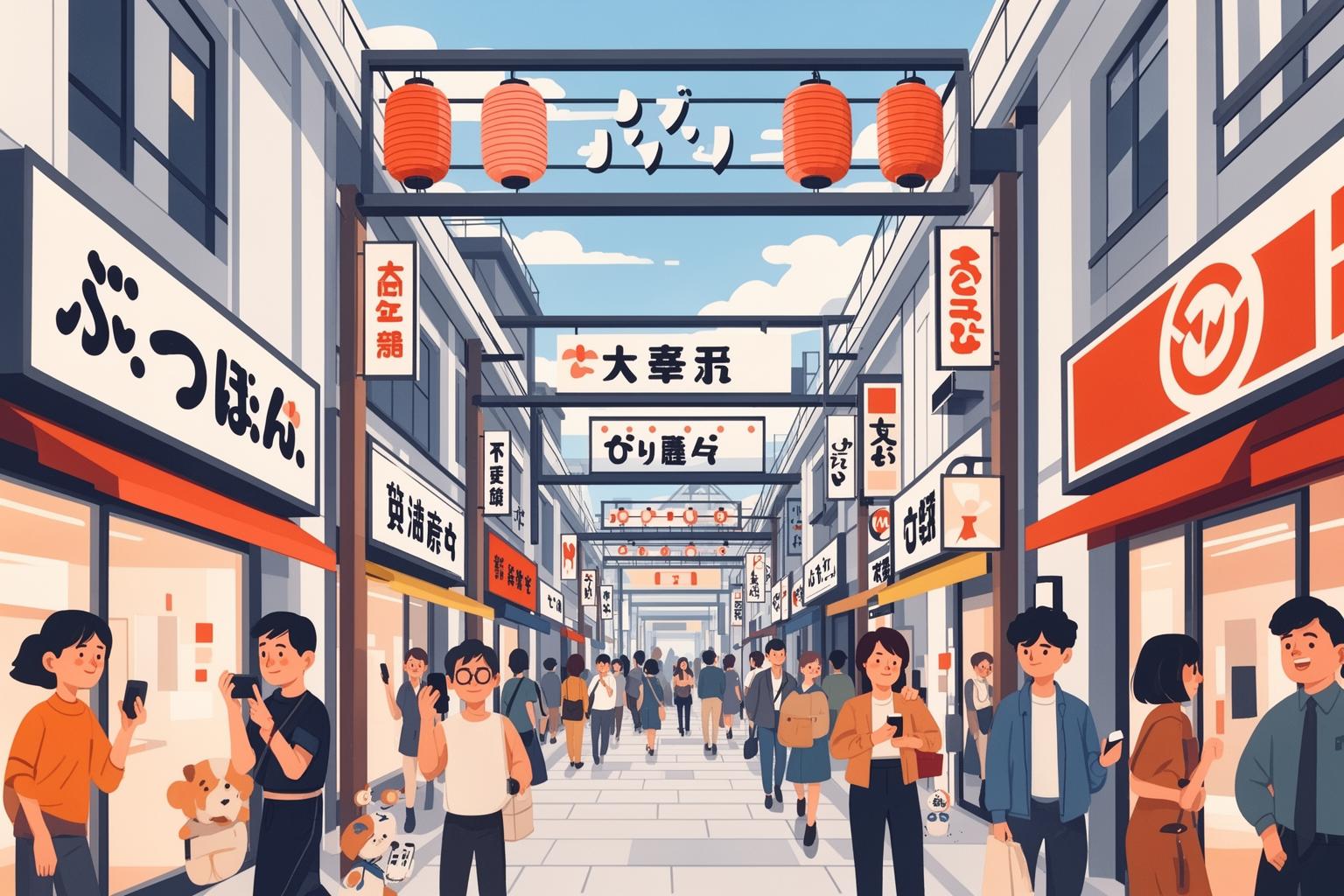
A shotengai is a living entity, with its mood and character shifting dramatically throughout the day. Its daily rhythm mirrors the flow of the surrounding neighborhood. To understand the shotengai is to grasp the temporal pattern of Japanese daily life, from the quiet murmur of morning preparations to the hectic energy of the evening rush. Each stage has its own distinct soundscape, cast of characters, and social role. Watching this daily drama unfold is like witnessing the city itself breathe.
Morning: The Opening Act
The day starts not with a bang, but with a metallic clatter. Around 9 AM, the sound of rolling metal shutters reverberates down the arcade. It’s a staggered, unsynchronized beginning, as each shop owner opens at their own pace. The air, still cool from the night, begins to fill with foundational aromas: the earthy steam from the rice shop, the yeasty warmth from a small bakery, the savory scent of dashi from a family-run udon restaurant. The first wave of customers are the elders. They move deliberately, pulling small wheeled shopping carts behind them. For them, this isn’t just an errand; it’s their morning ritual, their social hour. Their conversations are leisurely, the pace unhurried. They talk about the weather, their grandchildren, the quality of the day’s mackerel. They are the keepers of the community’s oral history, and their morning visitation to the shotengai is a custom as old as the shops themselves. This is the shotengai at its most peaceful, a gentle murmur of commerce and community before the city fully awakens.
Afternoon: The Lull and the Social Hour
After the lunchtime rush fades, a distinct lull settles over the arcade. This is the shotengai’s siesta. The crowds thin, and the energy shifts from business to socializing. Shopkeepers, no longer tied to their registers, might pull up a stool and chat with a neighbor across the lane. The pickle vendor might share a cup of tea with the greengrocer. This is when the arcade feels most like a communal backyard. Around 3 PM, a new energy arrives: children. Released from school, they flood the shotengai, their laughter and shouts echoing off the high ceiling. They are the arcade’s next generation of customers, and their daily routes are mapped into its geography. They know exactly which butcher sells the cheapest, freshest fried croquettes for an after-school snack. They know the old woman at the candy store who offers a friendly smile. For them, the shotengai is a safe, semi-enclosed public space, a pathway home that doubles as a playground and pantry. It functions as a de facto community center, a supervised and familiar environment for the neighborhood’s youngest residents.
Evening: The Final Rush
As the sun sets, the lights inside the arcade seem to brighten, and the pace quickens sharply. This is the final act: the evening rush. Commuters, worn out from a long office day, pour in from the nearest train station. Their goal is clear: get dinner. The shotengai adapts to meet their needs. The air fills with shouts of “Taimu sēru!” (“Time sale!”) and “Han-gaku!” (“Half price!”). The sozai-ya, or delicatessens, become the stars of the evening. Their counters brim with glistening heaps of tempura, golden-brown tonkatsu cutlets, assorted salads, and grilled fish. This is the shotengai’s practical brilliance. It understands the needs of the modern working family, providing the elements for a home-cooked meal without time-consuming prep. The focus is on speed and value. Conversations are shorter, more direct. Yet even in the hurry, a personal touch remains. The woman at the tempura stand remembers how you like your extra ginger, and the butcher has your usual chicken order ready. It’s the shotengai’s last vital service of the day: feeding its people quickly, affordably, and with a familiar face.
Decoding Osaka Through Its Arcades: What Foreigners Often Miss
For a visitor or a new resident, the shotengai can be an intense sensory experience, often mistaken for merely a chaotic, old-fashioned market. It’s easy to stroll through, snap a few photos of the vibrant displays, and overlook the intricate social system operating just beneath the surface. Many fundamental aspects of Osaka’s culture—its pragmatism, unique social norms, and key differences from Tokyo—are woven into the everyday life of these arcades. Learning to look beyond the surface is essential to grasping the city’s core.
It’s Not a Tourist Trap, It’s a Lifeline
Some shotengai, such as Kuromon Ichiba in Namba or the covered arcades in Shinsaibashi, have turned into major tourist destinations. They are polished, busy, and often pricey. It’s easy to assume from these examples that all shotengai are commercialized attractions for visitors. This is a crucial misconception. The vast majority of Osaka’s hundreds of shotengai are deeply local, modest, and absolutely vital parts of the neighborhood infrastructure. They serve as lifelines for their communities. For many elderly residents who may not drive, use the internet for online shopping, or want to walk long distances to a large supermarket, the local arcade is their main source of fresh food and daily essentials. It’s a walkable, accessible, and socially supportive space. The shotengai offers more than just products; it provides social interaction, a sense of security, and a physical gathering place for the community. It functions as a welfare system, community center, and marketplace all in one. To dismiss it as merely a tourist curiosity is to overlook its most important role.
The “Friendliness” Myth Deconstructed
The most common cliché about Osaka is that its people are “friendly.” While this isn’t untrue, the comment is often superficial and misses the deeper reason why this social dynamic exists. The shotengai is the ideal setting to observe how this friendliness functions. It’s not simply an innate, cheerful personality trait; it is a form of practical and functional social technology. In a dense, interdependent community marketplace, reputation means everything. A shopkeeper who is gruff, dishonest, or unhelpful won’t last long. A customer who is rude or demanding will quickly find their welcome cooling. The warm greetings, casual weather chats, the omake—these are all methods of building and sustaining social capital. This style of friendliness is straightforward, grounded, and mutual. It’s less about bubbly cheerfulness and more about a shared understanding that everyone depends on each other. The community and its micro-economy flourish through these positive, trust-based interactions. So, yes, people are friendly, but this friendliness stems from necessity and mutual gain—a social contract enacted daily over counters stocked with tofu and fish.
Navigating the Noise: Osaka-ben and the Direct Approach
The lively sounds of a shotengai can be overwhelming, especially the language. The local dialect, Osaka-ben, is faster, more direct, and features a more vivid intonation than the standard Japanese spoken in Tokyo. To the untrained ear, a normal exchange between a shopkeeper and customer might sound like a heated argument. The bluntness of the speech can also be misunderstood. A Tokyo shopkeeper might politely decline if you pick a less-than-ideal piece of fruit. An Osaka shopkeeper is more likely to seize your hand and say, “Akan, akan! Kotchi no hō ga umai de!” (“No, no! This one over here is way better!”). This isn’t rudeness; it’s a form of radical, practical honesty. There is a deeply rooted belief that pretense wastes time. This directness underpins the trust-based economy of the shotengai. You count on the butcher to tell you which cut of meat is best today, not which one they need to move. This linguistic style is a fundamental part of Osaka’s identity. It prioritizes honesty over delicate politeness, and efficiency over formal ceremony. Learning to perceive the warmth and pragmatism beneath the loud, fast-paced dialect is a key step in understanding the straightforward, no-nonsense nature of Osaka’s people.