
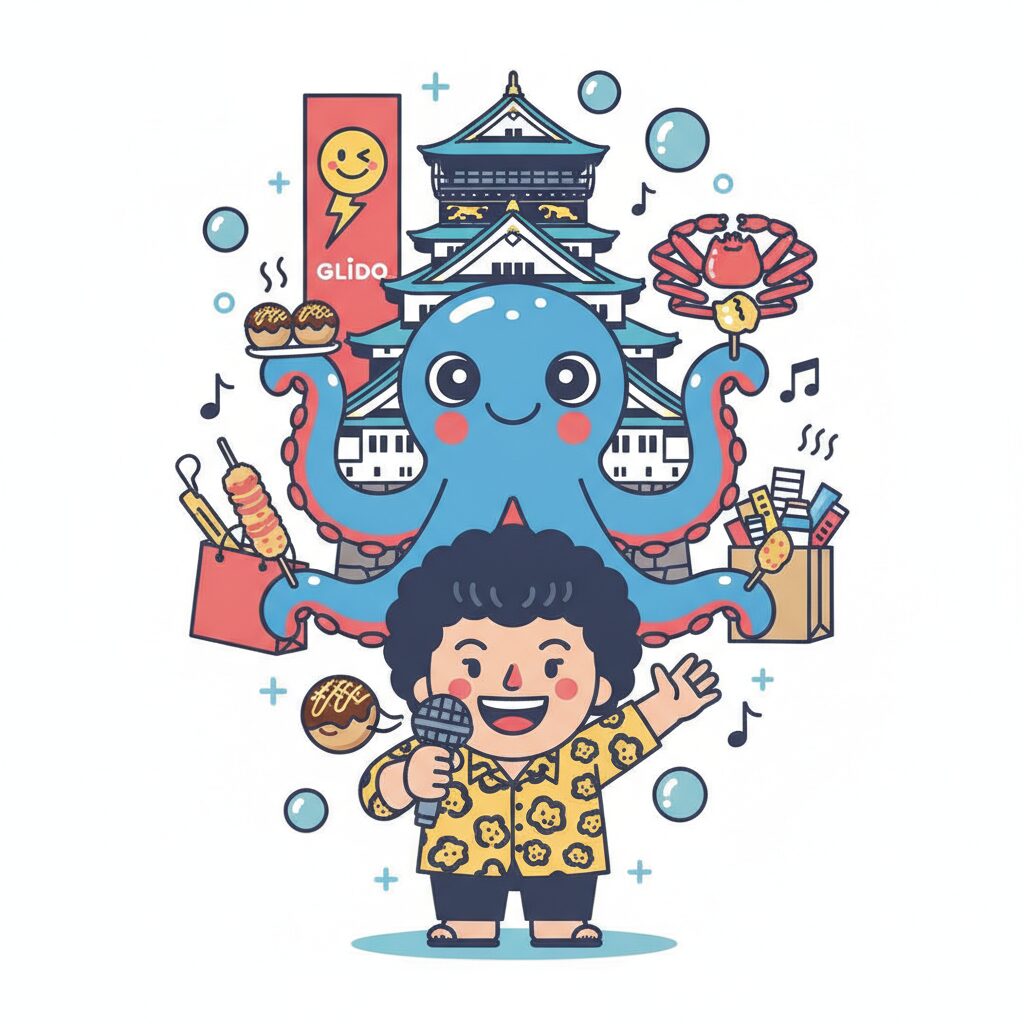
Walk into any souvenir shop from Shin-Osaka Station to Namba, and you’ll see her face. It’s plastered on keychains, printed on socks, and molded into cartoon figurines. She’s the Osaka Oba-chan, the city’s unofficial mascot. You know the look: a tight perm, often dyed a shade of purple or orange not found in nature. A blouse in a shade of leopard print so loud it vibrates. A voice that could cut through the clatter of a pachinko parlor. And in her purse, a secret stash of ame-chan, or hard candies, ready to be deployed at a moment’s notice to soothe a crying child or break the ice with a stranger. This image is Osaka’s most famous export, a caricature of raw, unfiltered energy that stands in stark contrast to the quiet, reserved elegance often associated with Japan. But as someone living here, navigating the crowded subways of Umeda and the quiet residential streets of Tennoji, you have to ask: Is any of this real? Do fleets of leopard-clad women really rule these streets? The answer, like most things in Osaka, is more complex, more interesting, and far more human than the stereotype suggests. The Osaka Oba-chan is not a myth, but she is a symbol. To understand her is to decode the city itself—its history, its humor, and its heart. She is the key to understanding why life in Osaka feels fundamentally different, not just from Tokyo, but from anywhere else in the world.
Moreover, the same vibrant spirit behind the Osaka Oba-chan phenomenon is driving innovation in the local hospitality sector, as seen in the rise of City Express hotels that are redefining the region’s travel experience.
The Anatomy of a Stereotype: Leopard Print and Perms
The visual identity of the Osaka Oba-chan is so distinctive that it almost feels like a costume. However, these elements didn’t arise from nowhere. They are artifacts of Osaka’s history as a merchant city, where practicality, individuality, and a touch of theatrical flair have always been valued. This look is a form of language, with each piece telling a story about the city’s spirit.
Where Did the Leopard Print Come From?
Let’s begin with the leopard print. In the West, it periodically reappears in high fashion, sometimes elegant, sometimes tacky. In Osaka, it remains a timeless classic. This trend traces back to the post-war economic boom. Osaka, historically Japan’s commercial powerhouse, rebounded fiercely. For the generation of women who built their lives and families during this era, animal prints symbolized newfound wealth and strength. They were exotic, costly, and boldly unapologetic. In a city where being a little loud helped make sales and a bit tough was necessary to run a business, wearing leopard print wasn’t just a fashion statement; it was a proclamation of confidence. It declared, “I’ve worked hard, I’ve succeeded, and I’m not afraid to be noticed.” This mindset stands in stark contrast to Tokyo, where fashion often rewards conformity and subtle, brand-led trends. A Tokyoite might wonder, “Does this brand make me look sophisticated?” An Osakan is more likely to ask, “Does this pattern make me unforgettable?” The aim isn’t to blend into a polished aesthetic but to stand out with a strong personal statement. Leopard print is the emblem of the independent, self-made Osakan woman.
The Perm and the Voice: More Than Just an Aesthetic
The hairstyle, often a tightly coiled perm known locally as a “panchi pāma” (punch perm), is another key element. While it appears elaborate, it’s grounded in practicality. It’s a durable, low-maintenance style that maintains its shape for weeks. For busy women juggling households and often family businesses, it was the most sensible choice. It’s a hairstyle that says, “I have more important things to do than fuss over my hair every morning.” This practicality also applies to the distinctive Osaka accent and its volume. The quick, direct, and often loud manner of speaking isn’t about hostility; it’s about effectiveness. In the lively, noisy setting of a shotengai (shopping arcade), speaking up is essential to be heard. Conversations are rapid exchanges of information, humor, and deals. There’s no room for the polite, indirect verbal subtleties typical in other parts of Japan. This straightforwardness reflects honesty. It’s the voice of a culture that values honne—your true feelings—over tatemae, the polite mask. A shopkeeper shouting a friendly insult, a neighbor asking a blunt question about your day, two friends laughing loudly on the train—this is the audible pulse of the city.
The ‘Ame-chan’ Philosophy: More Than Just Candy
If leopard print is the uniform, then ame-chan is the tool of engagement. It’s the most well-known and perhaps most misunderstood element of the Oba-chan persona. This small gesture unveils a significant cultural truth about life in Osaka.
“Ame-chan、いる?” (Got some candy?)
The phrase, commonly spoken as “Ame-chan, iru?” or more directly, “Ame-chan, taberu?” (Will you eat this candy?), is a famous icebreaker. An Oba-chan might offer candy to a fussy child on the bus, a weary student, or even a lost foreign resident. The act itself is simple but deeply meaningful. The candy acts as a bridge— a tangible token that breaks down social barriers and creates an immediate, temporary bond between strangers. It’s a way of saying, “I see you. You belong to this community space with me. Let’s make it a bit friendlier.” This active friendliness is what people mean when they say Osaka is “friendly.” It’s not passive politeness; it’s a deliberate, participatory effort to foster a shared social atmosphere. While Tokyo’s norm is to respect personal boundaries by keeping distance, Osaka’s default is to build rapport by gently crossing them with a sweet offering.
A Culture of Osekkai (Benevolent Meddling)
The candy opens the door to a deeper cultural concept: osekkai. There’s no exact English equivalent, but it lies somewhere between “meddling” and “motherly concern.” It involves getting involved in someone else’s matters, offering unsolicited advice, help, or comments, all with the assumption it’s for their benefit. For a foreigner, this can feel startling. An Oba-chan on the train might tap your shoulder to say you look cold and should button up. A cashier might comment on your grocery choices, recommending a cheaper brand of soy sauce. Someone overhearing your broken Japanese might step in to correct your grammar—not to be rude but out of genuine desire to help you improve. In many cultures, this would be seen as intrusive or disrespectful. In Osaka, it’s a form of social glue, showing that people are paying attention to one another. It signals that you are not an anonymous face but a fellow human whose well-being matters, even if only briefly, to those around you. Osekkai stands in cultural contrast to Tokyo’s “minding your own business.” In Tokyo, ignoring someone’s open backpack is polite to spare them embarrassment, whereas in Osaka, not telling them would be seen as cold and uncaring.
The Reality on the Ground: Is Every Oba-chan a Caricature?
So, after all this, you might expect to step off the train into a sea of leopard print. The reality, however, is more nuanced. The classic Oba-chan is not a city-wide phenomenon but rather an icon representing a particular generation and a specific community spirit.
The Generational Shift
To be clear: the woman depicted in the stereotype is generally in her late 60s, 70s, or older. She grew up in a very different Japan. Women in their 30s, 40s, and 50s in Osaka today are as fashion-conscious and stylistically diverse as their counterparts in any global city. They shop at Zara and Uniqlo, keep up with international trends, and are more often seen in minimalist black than head-to-toe animal print. The punch perm has given way to modern hairstyles and colors. Yet the Oba-chan spirit endures. That same straightforwardness, love of a good laugh, and underlying warmth can be found in younger generations, even if expressed differently. A young woman might not offer you an ame-chan, but she’ll likely be the first to start a conversation while waiting in line or provide enthusiastic and very direct directions if you look lost.
Where the Stereotype Lives and Breathes
Though not everywhere, the classic Osaka Oba-chan is far from extinct. You just have to know where to find her. You’re less likely to see her in the polished, high-fashion halls of the Grand Front Osaka mall in Umeda or the trendy boutiques of Horie. Instead, she’ll appear in her natural environment: the sprawling, covered shotengai. Places like the Tenjinbashisuji Shopping Street, Japan’s longest, or the more local arcades in neighborhoods such as Juso, Kyobashi, or deep in the city’s south. These areas are the heart of old-school Osaka, where community commerce thrives. Here, interactions are personal, prices negotiable, and personalities larger than life. Among fishmongers, pickle sellers, and discount clothing shops in these covered streets, the spirit of the leopard-clad matriarch is alive and well. The stereotype isn’t false; it’s a beautifully preserved snapshot of the culture that flourishes in these specific, vital community hubs.
What the ‘Oba-chan’ Tells Us About Osaka’s Soul
The enduring image of the Oba-chan, even as a caricature, reveals much about the values that Osaka cherishes. She is a living, breathing representation of the city’s fundamental principles, standing in sharp contrast to the restrained formality found in political and corporate Japan.
Pragmatism Over Polish
At its core, Osaka is a city of merchants. It developed through trade rather than samurai bureaucracy or imperial courts. This background has ingrained a strong pragmatism into its cultural fabric. The Oba-chan archetype embodies this pragmatism fully. Her fashion is both comfortable and expressive. Her hairstyle requires minimal upkeep. Her communication is straightforward. She is focused on value—not merely low prices, but securing a good deal, perfectly captured by the constant quest for meccha yasui (super cheap). This merchant mindset prizes substance over style and effective results over polished procedures. It emphasizes being practical, unpretentious, and concerned with the tangible. The Oba-chan has no patience for vague pleasantries; she wants the price, a laugh, and to move on with her day.
Humor as a Social Currency
Osaka cannot be understood without appreciating its connection to comedy. The city is the birthplace of manzai, the rapid-fire, two-person stand-up comedy that dominates Japanese TV. Laughter here is more than entertainment—it’s a vital means of communication. Being funny, or at least enjoying a good joke, is a social expectation. The Oba-chan, with her bold outfits and even bolder personality, often serves as a comedic figure who fully participates in the humor. She’s quick-witted and sharp with comebacks. Her somewhat eccentric appearance gives her a distinctive kyara (character), which is deeply valued. In Osaka, having a memorable personality is a positive attribute. Making someone laugh is one of the quickest ways to foster a connection. A deadpan, serious exchange is often perceived as cold or unfriendly. The Oba-chan, in all her lively splendor, skillfully uses humor and personality to navigate social interactions, turning a simple market visit into a vibrant piece of street theater.
Living with the Legacy: An Expat’s Perspective
For any foreigner making a life in Osaka, understanding the Oba-chan is a rite of passage. Initially, her energy can be overwhelming. The direct questions may feel intrusive. The osekkai can seem like an invasion of privacy. The sheer volume can be intimidating. It’s easy to dismiss the whole phenomenon as just a group of loud, nosy older women.
However, as you spend more time here, your perspective changes. You begin to see the system behind the noise. After a tough day, a woman at the bus stop hands you a candy, and suddenly that small act of kindness feels monumental. You get lost, and a shopkeeper walks you three blocks to your destination, chatting the whole way, making you realize her meddling was an expression of genuine generosity. You start to appreciate the boldness of a woman dressed in bright purple and tiger stripes, not because she’s a fashion icon, but because she is completely, utterly, and wonderfully herself.
The Osaka Oba-chan, in the end, isn’t someone you encounter on every street corner. She is an ideal. She embodies the spirit of a city that refuses to be silent, insists on connection, and believes a good bargain and a good laugh are two of life’s greatest joys. She serves as a reminder that beneath the surface of modern urban Japan flows a strong current of warmth, humor, and humanity. The caricature on the keychain is just the beginning of the story. The reality is a complex, loud, and deeply caring culture that, once understood, is among the most welcoming in the world.








