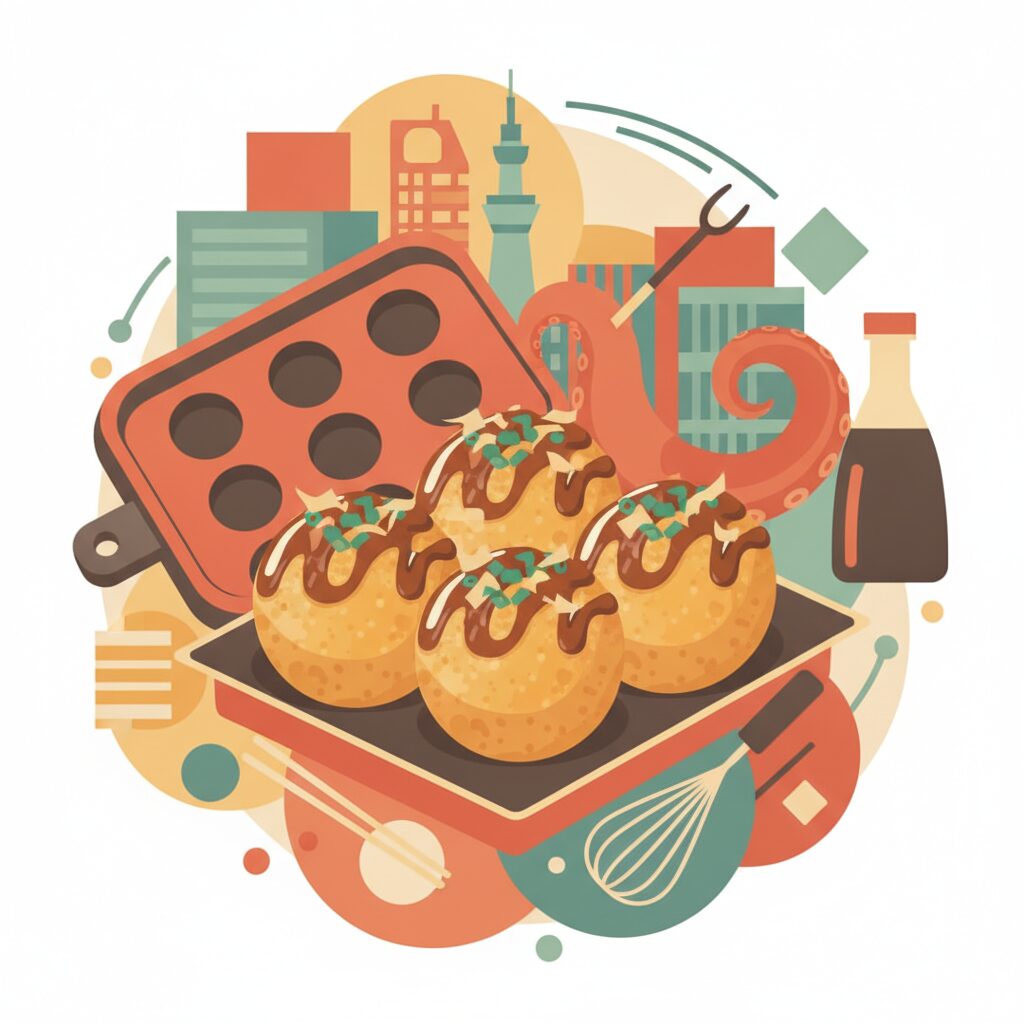
You see them on every corner in Dotonbori, steam billowing from under a red lantern, the rhythmic clack of metal picks against a cast-iron pan. Takoyaki. To the visitor, it’s the quintessential Osaka street snack, a quick, hot, delicious bite. You think you know it. You’ve had the octopus, the batter, the sweet brown sauce, the sprinkle of aonori. But you’re only seeing the surface. You’re watching the public performance. The real show, the one that tells you everything you need to know about how this city breathes, happens behind closed doors, in tiny apartments and bustling family kitchens. It’s called a ‘Takopa,’ a takoyaki party. And if you really want to understand Osaka, you need to understand that this isn’t just about food. It’s a social ritual, a battleground for opinions, and the truest expression of the city’s soul.
Understanding this unique culinary culture can be deepened by exploring how locals balance taste and cost through budget-friendly supermarket runs that reflect Osaka’s resourceful spirit.
The Sacred Tool in Every Osaka Kitchen: The Takoyaki Pan
Step into a home in Tokyo and you’ll typically see a rice cooker, a microwave, maybe a fish grill—standard appliances. But enter a home in Osaka, and I guarantee you’ll find all those things plus one more indispensable gadget: a takoyaki pan. This isn’t some quirky novelty brought out once a year. It’s an essential kitchen tool, as basic as a frying pan. The common saying is “一家に一台” (ikkai ni ichidai), meaning one per household. Yet honestly, that’s an understatement. Many families own two or three. There’s the inexpensive electric model for quick weeknight cravings, and then the serious cast-iron plate that sits perfectly on a portable gas stove, the kind that heats to screaming hot and produces that ideal crispy outer shell. Owning one is a point of pride, a badge of being a true Osakan.
This isn’t just about a fondness for octopus balls. The widespread presence of this utensil reflects a fundamental aspect of the Osaka mindset: a constant preparedness for casual social interaction. While a Tokyoite might schedule a dinner party weeks ahead, an Osakan can spontaneously decide on a Takopa at 4 PM on a Saturday and have a dozen friends over by 6 PM. The equipment is always ready. The social framework is built-in. The premise is that friends will gather, and when they do, you’ll make takoyaki together. It’s not a rare event; it’s simply… what you do. This easygoing, impromptu style of socializing contrasts sharply with the more formal, appointment-driven social life common in other parts of Japan.
“My Rules are the Best Rules”: The Unspoken Takoyaki Hierarchy
A Takopa is far from a quiet, polite gathering where the host graciously serves guests. No, it’s a lively, noisy, and passionately opinionated participatory event. The moment the batter hits the pan, the competition ignites. While the host may hold the title of ‘Taisho,’ or leader of the pan, everyone becomes a critic, an expert, or a self-declared master with their own strong beliefs about crafting the perfect takoyaki. The air buzzes with friendly disputes and unsolicited tips—a chaotic chorus of Osaka-ben.
It all begins with the batter. Should it be thin and crepe-like, using a precise dashi-to-flour ratio to create a melt-in-your-mouth creamy center? Or should it be thicker, more robust, following a recipe handed down from a grandmother who insisted on a secret ingredient? Then come the fillings. How much beni shoga (pickled red ginger) is excessive? Should tenkasu (tempura scraps) be mixed into the batter or sprinkled directly in the pan? These questions aren’t casual—they’re declarations of identity. Your takoyaki style reflects who you are. This is Osaka’s straightforwardness at work. People don’t shy away from opinions to be polite; they share them passionately because they care deeply. Food is not just sustenance; it’s a vital cultural subject, and everyone insists on their (right) opinion.
The Great Cabbage Debate
To spark a real argument at a Takopa, just mention the cabbage question. Should finely chopped cabbage be included in the batter or not? This issue draws a definitive line. Purists declare, with dramatic disdain, that cabbage belongs only in okonomiyaki—adding it to takoyaki is a culinary offense, a betrayal of the dish’s essence. It destroys the signature gooey interior, turning it into a disappointing savory muffin. They uphold the ‘toro-toro’ (melty, creamy) center as the sacred ideal. Meanwhile, cabbage supporters argue it brings subtle sweetness and a nice textural contrast. They claim it makes the takoyaki lighter and easier to eat in larger quantities. This is no mere ingredient squabble; it’s a clash of culinary philosophies revealing how deeply Osakans tie their local identity to their beloved soul food. There is a correct way—and it’s always my way.
Fillings Gone Wild: Beyond the Octopus
Though tradition fuels intense debates, Osakans also have a wonderfully pragmatic and playful side. After the first handful of classic octopus balls, the real experimentation begins. The motto: “If it fits and tastes good, why not?” The pan turns into a creative lab. Cheese is a favorite, melting into a rich, savory center. Kimchi and cheese combine for a spicy, tangy twist. Corn, sausage, mochi (rice cake), shrimp, even avocado chunks all find their way into the batter pockets. Some adventurous cooks even explore dessert territory, swapping savory batter for sweet pancake mix and stuffing the spheres with chocolate, banana, or custard. This creative chaos perfectly captures the Osaka spirit: honoring tradition while embracing innovation, adding fun, and never taking things too seriously. It stands in sharp contrast to the culinary reverence often seen in Kyoto, where tradition is preserved with museum-like care.
Takopa as Social Glue: It’s Not About the Food, It’s About the ‘Ba’
Ultimately, the takoyaki itself becomes almost secondary. The real purpose of a Takopa is to create ‘Ba’ (場), a Japanese concept that goes beyond simply meaning ‘place’ or ‘atmosphere.’ It’s the shared context, the energy, the feeling of a collective experience. A Takopa acts as a catalyst for generating ‘Ba.’ Standing shoulder to shoulder around a hot pan, everyone armed with a pick and focused on the shared goal of not burning the food, fosters an immediate sense of camaraderie. Formalities fade away. There’s no strict seating arrangement, no uncomfortable silences. The act of cooking together serves as the perfect icebreaker.
This setup is naturally low-cost and low-pressure, which is essential for its regular occurrence. As a guest, you aren’t expected to bring an extravagant gift. The unspoken rule is to bring drinks, perhaps some snacks, or an unusual filling to add to the experiment. The financial barrier is nearly nonexistent, making it accessible to all, from students to families. It’s a social leveler. The company president and the new part-timer stand on equal footing, both struggling to flip a stubborn takoyaki. The shared, slightly awkward activity removes titles and pretenses. You’re not networking; you’re simply hanging out, cooking, and laughing at each other’s blunders.
The Language of the Pan
The soundtrack of a Takopa is quintessentially Osaka. It’s loud, fast-paced, and filled with the local dialect. You’ll hear a nonstop stream of commentary: “Ah, akan! Kogeteru, kogeteru!” (Oh no! It’s burning, it’s burning!). “Mada hayai tte!” (It’s still too early to turn it!). “Umai koto marumetenaa!” (You rounded that one perfectly!). This is also where the classic ‘boke‘ (funny man) and ‘tsukkomi’ (straight man) dynamic of Japanese comedy, rooted in Osaka, plays out naturally. When someone makes a mistake, like accidentally flinging a half-cooked takoyaki across the table—that’s the ‘boke’ moment. Immediately, three different people will shout a ‘tsukkomi’ line like, “Nani shiten nen!” (What the heck are you doing?!). It’s never mean-spirited. This ongoing, good-natured teasing is a form of closeness. It’s how Osakans show they’re comfortable with you. They’re not just being friendly; they’re actively engaging you in a playful, verbal dance.
What Foreigners Get Wrong: It’s Not a Performance, It’s Participation
One of the most common mistakes a non-Japanese person makes when invited to a Takopa is standing back politely, watching, and waiting to be served, conditioned by social norms that label them as the ‘guest’ (‘o-kyaku-sama’). This is absolutely the worst approach you can take. In Osaka, especially at a Takopa, politeness does not mean passivity. Holding back, or what the Japanese call ‘enryo,’ can come across as disinterest or aloofness.
The unspoken rule at Takopa is simple: you must participate. You’re expected to grab a pick (‘kushi’) and jump in. No one expects you to be skilled—in fact, it’s often funnier if you’re clumsy. Your awkward efforts to turn the little batter balls, burning a few, or failing to make perfectly round ones—all of it adds to the shared experience. What counts is your willingness to join in. It signifies that you’re dropping the guest/host boundary and embracing the group. Making a mess is not only tolerated but actively encouraged. It shows you’re relaxed, enjoying yourself, and open to a bit of vulnerability. So when someone offers you a pick, don’t say, “Oh, no, I couldn’t.” Instead, say, “Okay, teach me!” and jump right in. That’s the key to forming a genuine connection.
The Takoyaki Pan Economy: From Local Shops to Global Brands
The Takopa phenomenon is so intricately embedded in the city’s identity that it sustains its own micro-economy. To experience the physical side of this culture, take a stroll down Doguyasuji Shotengai near Namba—a long street devoted entirely to kitchen and restaurant supplies. Here, you’ll find entire sections dedicated to takoyaki. There are heavy-duty cast-iron pans for professionals, copper plates valued for their excellent heat conduction, and numerous varieties of electric home models. You’ll see long metal picks, specialized oil brushes, batter pourers, and large bags of tenkasu. The presence of this specialized marketplace confirms that this is no passing fad—it is a serious, cherished craft.
Even major Japanese brands have tapped into this regional passion. Iwatani, known for its portable gas stoves, offers a line of best-selling ‘cassette gas’ takoyaki makers regarded as the gold standard for home use. They’re engineered to deliver the high, direct heat that enthusiasts say is crucial for achieving a crispy exterior and gooey interior. The fact that a major corporation devotes substantial R&D to a dedicated takoyaki appliance speaks volumes about its cultural and commercial significance in this area. It stands as proof of how a simple home-cooked meal has grown into an institution, a local business driver, and a symbol of civic pride.
The Takeaway: Your Invitation to the Real Osaka
So, the next time you enjoy takoyaki from a street vendor, remember that you’re only experiencing the prologue. The full story unfolds in living rooms and kitchens throughout the city. The Takopa perfectly reflects Osaka itself: pragmatic, a bit loud, unabashedly opinionated, highly social, and rooted in the belief that the best moments are shared moments. It’s where the formal layers of Japanese society are stripped away, revealing a warm, chaotic, and inviting core.
It’s where you stop being a visitor and become a participant. It’s where you realize that in Osaka, community is formed not through quiet agreement but through spirited debate over a shared meal. If you ever get the chance to be invited to a Takopa, your answer should be an immediate, enthusiastic ‘yes.’ Don’t worry about etiquette. Don’t worry about your flipping skills. Just show up with a six-pack of beer, grab a pick, and get ready to create a glorious mess. That is your genuine, hands-on lesson in what it truly means to live in Osaka.