Walk down any shotengai, any narrow back-alley in Osaka after five o’clock, and you’ll feel it. A certain energy starts to leak out from behind the split curtains, the noren, that hang in the doorways of tiny, brightly lit establishments. You’ll hear a low rumble of laughter, the sharp clink of glasses, the sizzle of something hitting a hot grill. This is the sound of the tachinomi, the standing bar, and it’s one of the truest heartbeats of this city. For a newcomer, a foreigner trying to decode the rhythm of Osaka life, these places can seem intimidating. They’re cramped, they’re loud, and they seem to operate on a set of rules that nobody ever wrote down. You might stand outside, peering in, wondering how you’re supposed to navigate that dense thicket of humanity just to get a beer and a stick of grilled chicken. You’re not just wondering how to get a drink; you’re wondering how to belong, even for just fifteen minutes. This isn’t a tourist trap or a performative cultural experience. This is the real, unfiltered daily life of Osaka, a city that prizes efficiency, directness, and a good laugh over just about anything else. Forget what you think you know about Japanese politeness and personal space. The tachinomi is a different universe with its own physics. It’s where the city’s unwritten social contract is on full display, and learning to read it is one of the most rewarding parts of understanding what makes Osaka tick. It’s a world away from the buttoned-up formality you might find in Tokyo. Here, the goal isn’t just to drink; it’s to participate in a fleeting, chaotic, and utterly human piece of urban theater. So, let’s push aside that noren together and dive into the beautiful, messy world of the Osaka tachinomi.
To truly understand this city’s unique social fabric, it’s also worth exploring the unspoken rules of Osaka’s neighborhood associations.
More Than a Bar: The Tachinomi as an Urban Stage
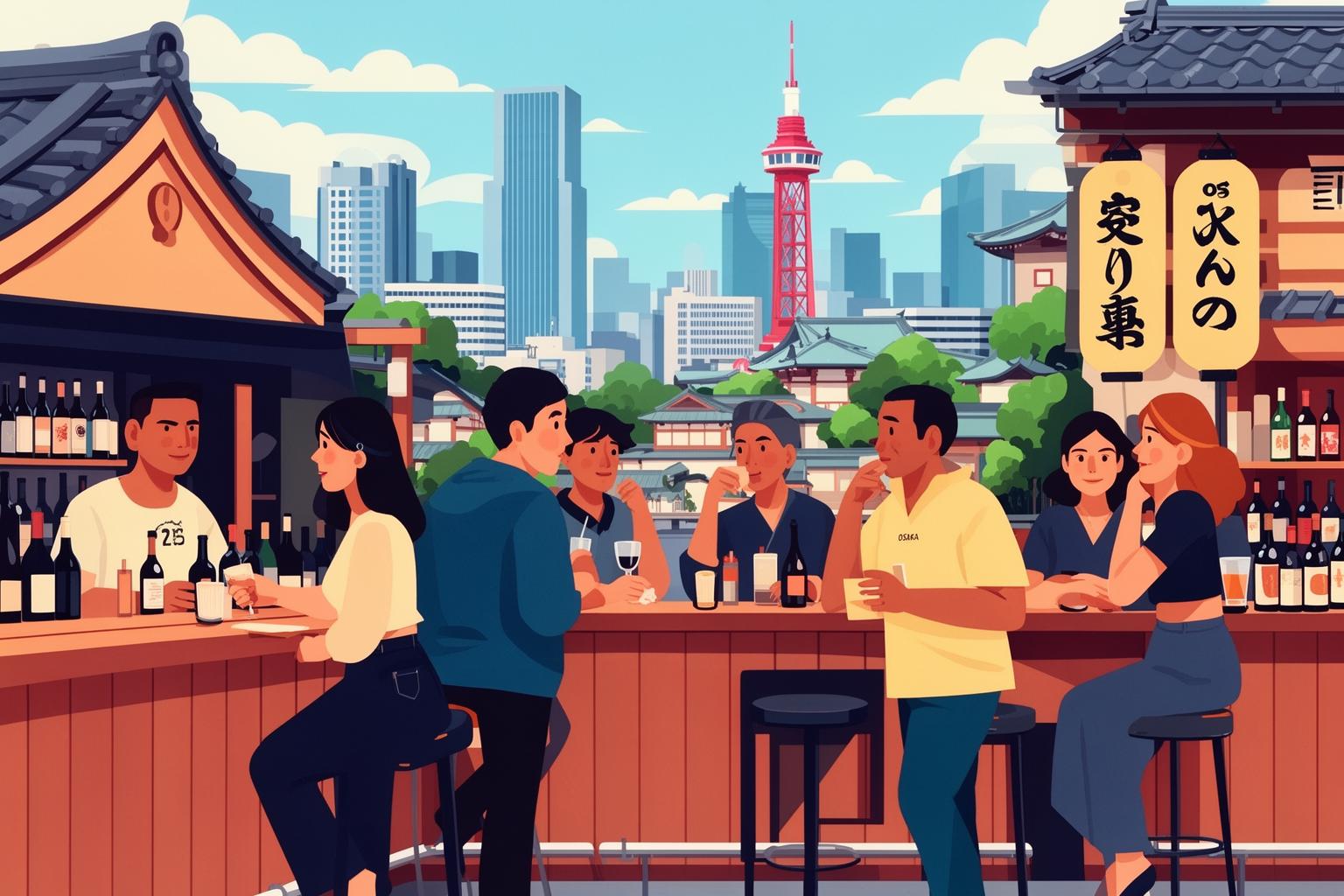
First, let’s clarify one thing. A tachinomi isn’t merely an izakaya without chairs. Seeing it that way misses the entire point. The lack of chairs isn’t about saving costs, though the lower prices are certainly a perk. It’s a philosophical statement. It fundamentally changes the social dynamics of the space. A chair suggests permanence. It encourages you to settle down, claim your spot, and create a private bubble for yourself and your companions. A chair says, “I’m staying a while.” No chair says, “I’m here just for the moment.” This subtle difference fosters a fluid, ever-shifting environment. People come and go like the tide. The whole experience revolves around speed, efficiency, and a continuous, low-key social negotiation.
In Tokyo, you’ll find many standing bars, but they often feel different. They can feel like extensions of the corporate world: sleek, modern spots for a quick, quiet, efficient drink before catching the last train home. Conversations tend to be more subdued, interactions more restrained. Personal space, even while standing, is more carefully guarded. The Osaka tachinomi, however, is something else entirely. It’s part community center, part comedy club, part confessional all rolled into one. It’s louder, messier, and infinitely more interactive. The air crackles with the Kansai dialect, a fast, musical language ripe for teasing and banter. The Osaka tachinomi isn’t a place for quiet reflection; it’s a place for active participation. The design forces interaction. When you’re shoulder to shoulder with a dozen others, you can’t help but notice them. You overhear their conversations, smell their food, feel the vibration of their laughter. This close proximity breaks down the usual barriers between strangers in a Japanese city. It’s an unspoken pact: for the next thirty minutes, we’re all in this small, crowded space together, so we might as well enjoy it.
This is often where foreigners get their first real taste of Osaka’s personality, which can be startling if you’re accustomed to the more formal interactions elsewhere. Osaka people are famously friendly. That’s true, but it’s a particular kind of friendly. It’s not the gentle, deferential warmth of a Kyoto shopkeeper. It’s an active, engaging, almost challenging friendliness. It’s the friendliness of someone who’ll start a conversation by commenting on your T-shirt or asking your thoughts on the Hanshin Tigers’ latest game. In a tachinomi, this behavior is intensified. The space itself acts as a social lubricant, even before the first drop of alcohol is drunk. It’s a stage where the city’s love of direct communication, value for money, and casual, no-frills spirit perform nightly.
The First Hurdle: Entering and Claiming Your Ground
Your tachinomi experience begins even before you step inside. It starts out on the street with a brief moment of observation. The entrance is usually shielded by a noren, a fabric curtain that serves as a symbolic barrier between the outside world and the self-contained realm within. You don’t just push through it—you pause, gently lift a corner, and peek inside. This isn’t sneaking; it’s politeness. You’re conducting a crucial two-second assessment.
Sizing Up the Scene Before Entering
What are you looking for? You’re checking the crowd density. Is it a solid wall of backs—a space so cramped a sardine would feel claustrophobic? Or is there a sliver of hope, a narrow opening at the counter no wider than your shoulders? You’re also taking in the atmosphere. Does it feel like a closed circle of regulars, or is the energy more open and inviting? Is the master (taisho) frantically busy, or is the flow manageable? This quick check tells you whether your entry will be a smooth fit or a disruptive intrusion. If it’s packed to the brim, the smart move is to walk away and try another spot. Forcing your way into a full tachinomi is a serious faux pas—it disrupts the delicate balance of the room. But if you spot that narrow gap, that potential opening, you can move on to the next step.
Mastering the Slide-In
This is a physical skill, a sort of urban ballet. You don’t announce your arrival; you slide in. You move deliberately but without force. As you pass through the noren, you make your body as compact as possible. If you have a backpack, swing it around to carry it in front of you. A coat should be draped over your arm, not worn. Your aim is to reach that gap with minimal disruption. A quiet “sumimasen” (excuse me) is your all-purpose phrase. You say it softly to those you must squeeze past—it’s a gentle apology, not a claim to passage. Once you reach your spot at the counter, make eye contact with the taisho or staff. A simple nod usually suffices. This is your silent agreement: “I’m here. I’m a customer. I won’t cause trouble.” The taisho will likely nod in return, silently acknowledging your place in the ecosystem. You’ve successfully claimed your few inches of space. Now you must hold it—not aggressively, but confidently.
Personal Space is a Luxury You Can’t Afford
Once inside, you immediately manage your belongings—this is essential. In such a tight space, a stray elbow or bulky bag becomes a hazard. Fold your coat neatly and hang it on a hook under the counter if available; if not, keep it draped over your arm. Put your bag on the floor, tucked tightly between your feet, or on an overhead shelf if you’re lucky. The counter in front of you is sacred but shared—it’s for your drink and maybe one or two small plates, not for your phone, keys, wallet, or guidebook. Keep your personal items contained. The unspoken rule is to minimize your footprint. You exist from the shoulders down as a vertical column. You learn the “tachinomi lean,” a way of angling your body to eat or drink without jabbing elbows into your neighbor’s ribs. This constant spatial awareness is part of the experience. It’s a dance of mutual respect among strangers. You grant your neighbors their tiny bubble of space, and they grant you yours. A slight, inevitable bump is met with a quick nod and another soft “sumimasen.” No apology in return is needed—it’s understood that contact is unavoidable. The apology acknowledges this shared reality. This is the foundation of tachinomi etiquette: a collective, silent agreement to make an uncomfortable situation comfortable through mutual consideration.
The Transaction: Ordering and Paying Like a Local
The economic engine of the tachinomi runs on a straightforward and efficient system. Grasping it is essential for a smooth experience. It’s designed for speed, clarity, and minimal fuss. Struggling with the transaction disrupts the bar’s rhythm and marks you as an outsider. But once you master it, you’ll feel like you’ve uncovered a fundamental secret of Osaka’s commerce.
Cash on the Counter: The Kyasshu-On System
In many of the most traditional and cherished tachinomi, you’ll find the kyasshu-on system, a transliteration of “cash-on-delivery.” This represents the purest form of tachinomi transactions. Upon arrival, you’ll notice a small tray or bowl on the counter before you. This serves as your personal bank for the evening. The first thing to do is place a 1,000 yen note (or maybe a 5,000 yen note if you plan to eat and drink more) in the tray. When you order your first drink, say a 400 yen beer, staff will bring it to you, take the 1,000 yen note from your tray, and return 600 yen in change to the same tray. When you next order, for example, a 200 yen skewer, they simply take 200 yen from the change in your tray. This continues throughout your visit. The brilliance of this system lies in its simplicity: no running tabs, no confusion over the final bill, and no lengthy payment process. It enables the staff to serve many customers efficiently. Your only task is to keep enough cash in the tray for your next order. Attempting to pay with a credit card here isn’t just inconvenient; it’s a cultural misstep—like trying to use a samurai sword to butter your toast. Cash, especially in small bills and coins, is the only currency spoken here.
Catching the Taisho’s Eye
Now, you’re settled with cash in the tray, ready to order. How do you get the taisho’s attention when they might be juggling five orders, pouring a beer, and telling a joke to a regular down the counter? Timing and subtlety are key. Don’t shout or wave your arms wildly. Wait for a pause—a moment when they glance across the counter. In that instant, make eye contact and raise your hand slightly, just a few inches off the counter. A soft but clear “sumimasen” or “onegaishimasu” (please) suffices. The most important thing is to be prepared—know what you want before signaling. The menu is often handwritten on paper strips pasted to the walls; take a moment to read it carefully before calling them over. Hesitation is the enemy of tachinomi. When the taisho’s attention is on you, place your order quickly and clearly: “Nama-biiru to doteyaki, hitotsu zutsu” (One draft beer and one doteyaki). Be concise and efficient. This respects their time and keeps the bar’s flow smooth.
The Currency of Speed
Everything about tachinomi is designed to minimize friction. The cash-on system, the quick ordering, even standing up—all contribute to a fast-paced, high-turnover environment. That’s why preparedness matters. Having your 1,000 yen notes and a handful of coins ready shows respect and understanding of the unspoken rules. You’re a participant, not just a customer. When it’s time to leave, there’s no fuss: you gather your things, give a nod and a quiet “gochisosama-deshita” (thank you for the meal) to the taisho, and slip quietly back into the night. Since you’ve been paying as you go, your departure is as seamless as your arrival. This efficiency embodies the Osaka merchant spirit—time is precious, hassle is avoided, and a good transaction is a swift one. By embracing this system, you’re not just enjoying a drink; you’re engaging in a vital part of the city’s culture.
The Main Event: The Unspoken Code of Social Interaction
This is where the true charm of Osaka tachinomi comes alive. In a bustling city with millions, these small bars become crucibles of fleeting community. They are places where the famously high barriers between strangers in Japan surprisingly soften. Yet this openness follows its own set of rules and a unique language. It’s a dance of approach and retreat, banter and observation. Mastering this social code is the final and most rewarding step to feeling like a genuine insider.
From Stranger to Neighbor in Sixty Seconds
How does it begin? Rarely with a straightforward “Hello, where are you from?” That feels too formal, too much like an interview. Conversations in a tachinomi arise naturally from the shared environment. It might start with a comment muttered to no one in particular. Someone beside you receives a plate of sashimi, and you might say, more to yourself than to them, “Uwa, oishiso…” (Wow, that looks delicious…). This is an opening — a gentle pitch they can either ignore or bounce back. A typical reply might be, “Kore, umai de. Tabete miru?” (This is great. Want to try some?). While you should politely decline food from personal plates—since sharing is intimate and uncommon among strangers—the conversational door is now wide open. Another common spark is the television, usually perched in a corner and often tuned to a baseball game (Go, Hanshin Tigers!) or the news. A dramatic play or a ridiculous story can trigger a collective groan or laugh, instantly connecting everyone in a shared moment. The key is to notice these shared reference points. The food at the counter, the game on TV, the music playing — these are neutral grounds where conversations take root.
The Language of Banter: Tsukkomi and the Friendly Jab
To grasp communication in Osaka, you must understand the comedic duo of boke and tsukkomi. The boke is the fool who says something silly or absurd. The tsukkomi is the straight man who responds with a sharp, witty retort. This dynamic forms the foundation of Osaka conversation and shines brightly in the tachinomi. It’s not about being harsh or aggressive; it’s verbal sparring that signals engagement and affection. As a foreigner, you often unintentionally become the boke. You might mispronounce a menu item or express surprise at local food. A regular might grin and say, “Nani言うてんねん, 兄ちゃん!” (What are you talking about, man!). This isn’t an insult—it’s an invitation. A playful jab that means, “I see you. I’m connecting with you.” The right response is not defensiveness but laughter. A simple, self-deprecating smile works perfectly. Trying to play the tsukkomi role yourself is more advanced, but appreciating the banter is already a big step. This mode of communication stands in contrast to the indirect, harmony-preserving style (tatemae) predominant in many Japanese social settings. The tachinomi represents a honne space, where people express their true, unfiltered thoughts, often through humor.
Reading the Signals: When to Engage, When to Step Back
Importantly, not everyone in a tachinomi is seeking companionship. Many come simply for a quiet, solitary drink after a long day. The skill lies in reading the signals. Is the person next to you seated squarely at the bar, focused intently on their phone or a small book? That’s a clear do-not-disturb sign. Are they making eye contact with others, watching the TV, or tapping to the music? That suggests openness to interaction. The flow of conversation matters, too. A brief exchange about the tuna’s quality is one thing. Launching into your life story is quite another. Conversations at a tachinomi are often as fleeting as the patrons themselves. They are light, situational, and rarely personal. Keep it that way. The aim is a pleasant, momentary connection—not a deep, enduring friendship.
The “One-Meter Rule”
Consider your social space in a tachinomi as a one-meter bubble. Your primary interaction partners are the people immediately to your left and right. Occasionally, you might exchange words with someone a seat over, but starting a conversation with someone at the other end of the bar violates social physics. It’s too loud, too disruptive. Interactions are by nature local and contained. You form a small conversational cluster, which might merge with another group or dissipate as people come and go. Respecting this invisible zoning is essential to maintaining the room’s harmony.
Topics of Conversation
If you find yourself in a chat, what should you talk about? Stick to safe, universal subjects. The weather remains a classic for good reason. Sports are gold, especially if you can say something positive about the Hanshin Tigers or Orix Buffaloes. Complimenting your food is always a winner, as it indirectly praises the taisho. Asking for recommendations on what to order is another excellent way to engage. Avoid diving into heavy, complex topics like politics, religion, or personal troubles. The tachinomi offers an escape from life’s weightiness. Its atmosphere is light, cheerful, and fleeting. Keep your conversation in that spirit, and you’ll fit right in.
Common Mistakes and How to Avoid Them

Exploring the tachinomi world is a learning experience, and despite good intentions, newcomers can sometimes make mistakes. These usually arise from applying incorrect cultural expectations to the situation. Grasping the reasoning behind local etiquette can help you avoid common errors and ensure your experience is smoother and more enjoyable.
The “Friendly” Misunderstanding
This is often the biggest source of confusion for Westerners. You might share a lively, laugh-filled twenty-minute conversation with a salaryman beside you—discussing baseball, your favorite foods, or even your hometown. You feel a genuine connection. Then, suddenly, he finishes his drink, says a quick “osaki ni” (I’m leaving ahead of you), and disappears without a handshake or exchanging names. To a Western perspective, this can seem cold or dismissive. But it isn’t. The friendliness in an Osaka tachinomi is intense but fleeting. It’s a form of social bonding meant only for that particular moment and place. It’s not an invitation to forge a lasting friendship. The goal is to create a warm, enjoyable atmosphere for everyone present. There’s no expectation of future contact. Attempting to exchange phone numbers or social media details can cause awkwardness, as it pressures the other person to extend a brief connection into something more permanent, which is not the intention. Embrace the transitory nature of these interactions. Enjoy the shared moment for what it is, and then let it pass.
The Pace Issue: Don’t Linger or Settle In
A tachinomi isn’t a lounge; it’s a busy, fast-paced environment. Its business model and social understanding rely on a continual flow of customers. The idea is to have a drink or two, enjoy some small bites, and then move along. This is why bar-hopping, or hashigo-zake, is popular in Osaka—you visit several different tachinomi in one evening, each offering its own atmosphere and specialties. Staying in one place for hours, especially during busy times, is frowned upon. It occupies valuable space that someone else could use. How do you know when it’s time to leave? While no strict rule exists, a typical visit lasts about 30 to 60 minutes. If you notice a line forming outside or people peering through the noren searching for a spot, take that as your signal to finish your drink and kindly give up your place. Being a considerate tachinomi guest means having good awareness of space and time. You are a temporary caretaker of your spot at the counter, not its owner.
The Treating Pitfall: Buying Drinks for Strangers
In many Western bar cultures, buying a drink for someone new is a common friendly gesture. But in a Japanese tachinomi, this can be a social minefield. Though well-meaning, buying a drink creates a sense of social obligation, or on. The person you treat may feel compelled to reciprocate and buy you a drink to balance the exchange. This is the idea of okaeshi, or returning a favor. It adds a layer of social complexity and obligation to what should be a simple, casual interaction. It shifts the dynamic from easy camaraderie to social bookkeeping. It’s much better to keep your transactions separate. The real currency in a tachinomi isn’t money; it’s laughter, good conversations, and mutual respect for the shared space. If you want to show goodwill, offer a sincere compliment to the taisho as you leave. That contribution is appreciated by everyone and doesn’t create any social debt.
What Tachinomi Tell You About the Soul of Osaka
To understand Osaka, you could read countless books about its history as a merchant capital or its rivalry with Tokyo. Alternatively, you could spend an hour in a packed tachinomi in Kyobashi or Tenma. These modest standing bars serve as living museums of the city’s spirit. They are microcosms where the essential principles of Osaka life are enacted every night. The focus on kosupa (cost performance) goes beyond affordability; it reflects a deep-rooted belief in receiving honest value, embodying a merchant’s pragmatism that favors substance over embellishment. The rapid pace of service and the cash-on-delivery system illustrate a culture that prizes efficiency and straightforwardness— a city founded on commerce where time equals money. The tight quarters and constant negotiation of space with strangers reveal a history of dense urban living, where people learned to coexist closely. Most importantly, the loud, lively, and interactive social atmosphere showcases the city’s greatest strength: its people. The ease of slipping into banter, the fondness for good-natured teasing, and the readiness to share a laugh with a stranger—that is Osaka’s renowned friendliness in its purest form. It is not a reserved, distant politeness but a contact sport; an active, participatory warmth that invites engagement. A tachinomi rejects tatemae, the public facade so important elsewhere in Japan. It is a space of honne, genuine feelings, where a grumpy old man might gripe about the government and a young office worker might celebrate a minor success at work, all within hearing range of each other. It serves as a temporary equalizer. For a brief moment, standing at that worn wooden counter, everyone is simply another Osaka citizen, sharing a drink, a story, and a small patch of space. This is the Osaka beyond tourist maps and Instagram hotspots. It’s a city that discovers its community not in grand public squares but in tiny, crowded rooms, finding harmony in the chaos and connection in the closeness.