Every major city has one. That singular, sky-piercing needle on the skyline, the place you go to see the metropolis sprawled out like a circuit board, a living map of the concrete jungle you call home. For a resident, not a tourist, these places aren’t just for photo ops. They’re a way to re-contextualize your life, to see the path of your daily commute from a god’s-eye view, to find your tiny apartment building in the vast urban expanse. In Tokyo, this place is the Skytree, a sleek, futuristic spear of glass and steel. Here in Osaka, it’s the Umeda Sky Building, a powerful, almost brutalist arch with a donut-shaped observatory on top. I’ve been to both, many times. And the difference between them tells you more about the fundamental gap between Tokyo and Osaka than any travel guide ever could. It’s not about which view is better. It’s about how you experience that view. One lets you look. The other makes you feel. And that, right there, is the soul of Osaka.
This isn’t a comparison of tourist attractions. It’s an exploration of civic philosophy, written in architecture. It’s about why living in Osaka feels like standing on an open-air deck with the wind in your face, while living in Tokyo can sometimes feel like observing a perfect, silent world from behind a flawless pane of glass. Before we ascend, let’s get our bearings on the ground.
To truly understand this ground-level philosophy, consider how the city’s layout itself, particularly the Umeda-Namba divide, shapes the daily lives and perspectives of its residents.
The Unfiltered vs. The Curated: A Tale of Two Decks
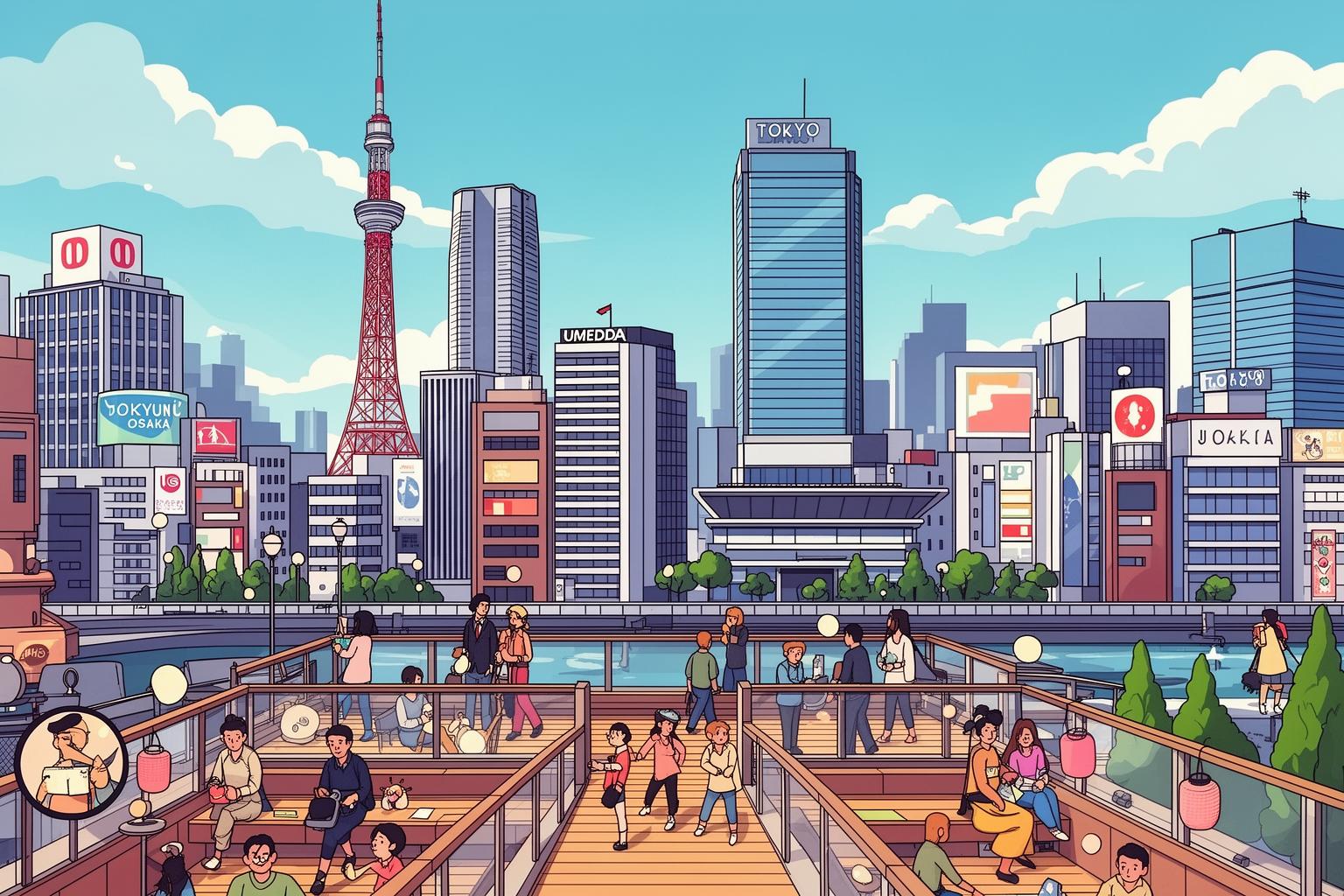
To truly grasp Osaka, you must first ascend. Stand on the Floating Garden Observatory atop the Umeda Sky Building. The ascent itself tells part of the story. You shoot upward in a glass elevator with a view of the city, then step onto a glass-enclosed escalator spanning the vast, open gap between the building’s two towers. It feels like a launch tube from a sci-fi film—thrilling, slightly disorienting, and completely exposed. There’s a palpable sense of mechanics and motion; you can feel the structure surrounding you.
Then, you arrive on the roof. The “Floating Garden” is a bit of a misnomer; it’s actually a concrete and steel ring open to the sky. The first thing that strikes you isn’t the view—it’s the wind. A strong, city-wide gust that whips your hair and makes you grip the railing. The second is the sound: the distant, blended hum of a million lives—the faint siren’s wail, the rumble of trains pulling into Osaka Station, the low drone of traffic. You can smell the city too—a mix of street food and rain-soaked pavement. You’re not only seeing Osaka; you’re breathing it in, hearing it, feeling it on your skin. The floor beneath your feet is a metal grate in some places, revealing the dizzying drop below. It’s unapologetically real. The experience is direct and unfiltered. The building seems to say, “This is the city—take it as it comes.”
Now, compare this with the Tokyo Skytree. The experience here is one of sublime, seamless perfection. The elevators, among the fastest in the world, are so smooth and silent that you barely notice the ascent. They’re themed with artistic light displays reflecting Japan’s seasons—a performance before the main event. When the doors open, you enter a hushed, climate-controlled space. The city unfolds before you in a breathtaking panorama, framed by enormous, flawlessly clean glass panes that curve up to meet the ceiling. There’s no wind, no city noise—only a soft murmur of visitors and perhaps gentle background music. The view is arguably broader, the height more vertiginous. On a clear day, Mount Fuji is visible. It’s a polished image of Tokyo, presented as an artwork in a gallery. A flawless, high-definition broadcast of the city, offering you the best seat in the house. Yet, you remain fundamentally separate. You are a spectator, shielded from the elements, observing the metropolis from a sterile, controlled environment. The building insulates you from the very world it displays.
This isn’t a criticism; it’s a reflection on philosophy. The Umeda Sky Building offers participation. The Tokyo Skytree offers presentation. One provides a raw feed; the other delivers a finished production. This distinction is key to understanding the contrasting characters of the cities they represent.
A City’s Soul, Written in Steel and Glass
This architectural contrast is deliberate. It physically embodies the historical and cultural DNA of each city. Osaka has always been a city of merchants, known as the `tenka no daidokoro` or “the nation’s kitchen.” It’s a place founded on commerce, practicality, and the straightforward exchange of goods and words. An Osaka merchant values `shoubai`—business—and at the core of good business lies a clear grasp of reality. No frills, no fuss. Does it work? Is it a good value? Is it genuine? This is the spirit of `jitsuri`, or practical benefit, that flows through the city’s veins.
The Open-Air Mindset
The Umeda Sky Building exemplifies this. Its design is bold, functional, and somewhat industrial. It doesn’t conceal its structure; it celebrates it. The exposed escalators, the open-air deck, the metal railings—all emphasize a direct, honest connection. This reflects the Osaka personality. Communication here is like the wind on the rooftop deck: it comes straight at you. People don’t always engage in the complex, layered dance of `tatemae` (public face) and `honne` (true feelings) that often characterizes Tokyo’s communication. An Osakan shopkeeper might bluntly say, “Ah, you don’t want that one; it’s overpriced for what it is. This one here is a much better deal.” This can be startling to someone used to Tokyo’s softer, more indirect style, where maintaining harmony often outweighs blunt truth. But in Osaka, this directness isn’t rudeness. It’s efficiency, respect, and a belief that clear, honest transactions—whether in words or money—are the most valuable. It’s the merchant’s ethos: let’s get straight to the point so we all benefit.
Living here, you feel this every day. It’s the grandmother on the bus who starts a conversation out of nowhere, asking where you’re from and what you had for lunch. It’s the supermarket cashier who cracks a joke while scanning your groceries. There are fewer barriers, less formal distance between strangers. The social atmosphere is, quite literally, more open-air.
The Polished Presentation of Tokyo
Tokyo, conversely, is the city of the samurai, bureaucracy, and the Imperial Court. It is the center of government and power. Its culture has been shaped for centuries by hierarchy, formality, and the importance of appearances. Precision, order, and presenting a flawless facade are paramount. The Tokyo Skytree embodies this perfectly. It is a monument to Japanese technological skill and aesthetic refinement. Everything about it is designed to be seamless, beautiful, and impressive. It shows an idealized version of the city—a perfect picture postcard. It represents the ultimate `tatemae`.
Life in Tokyo often mirrors this. Interactions can feel more scripted and formal. There is a correct way to do everything, from exchanging business cards to apologizing for minor mistakes. The city itself feels more curated. Districts like Ginza or Marunouchi showcase pristine architecture, impeccable service, and calm, orderly crowds. The chaos of human life is elegantly managed and contained. This creates an environment that is incredibly safe, efficient, and visually pleasing. Yet for some, it can also feel isolating, like living behind a pane of glass. It can be harder to break through the polite surface and make a genuine, unscripted connection. The city is a masterpiece to admire, but it doesn’t always invite you to disrupt it, to be loud, or to be unabashedly yourself.
What This Means for Life on the Ground
As a foreign resident, this distinction is not merely an abstract cultural concept. It influences the texture of your everyday life, from how you shop to how you form friendships. It’s the difference between living in a city that happens around you and one that you actively inhabit.
The Sound of the City: How People Connect
In Osaka, social interaction runs loud and lively. Walk through a `shotengai` (shopping arcade) like Tenjinbashisuji or Kuromon Market, and you’ll hear vendors shouting, laughing, and calling out to customers. It’s a vibrant blend of commerce and human connection. This is the `akiudo` (merchant) spirit at work. Business here isn’t a quiet, polite exchange; it’s a relationship, a dialogue, a performance. They aim to engage you, to draw you in. This extends beyond just transactions—people are more inclined to strike up conversations in public, offer assistance if you appear lost, and treat you as an active participant in the city’s daily flow.
Compare this with a stroll through a Tokyo department store. The service is impeccable, with staff bowing flawlessly, but the atmosphere remains subdued and respectful. Interactions are professional, precise, and often impersonal. This isn’t a shortfall; it reflects a different cultural emphasis. Tokyo’s system prioritizes smooth, frictionless efficiency, while Osaka’s encourages energetic, robust interaction.
This is frequently misunderstood by outsiders, including fellow Japanese. The Osaka dialect, with its distinctive rhythm and straightforward manner, can sound harsh or blunt. Its loud, boisterous humor and directness might be seen as lacking refinement. Yet what’s often overlooked is the warmth and sincerity beneath it. Osakans aren’t being rude; they’re being genuine. They break down barriers, closing the distance between you and them, inviting you onto an open, shared stage.
The Texture of the Streets: Urban Chaos and Charm
The physical design of the cities tells a similar tale. Tokyo is a marvel of urban planning, featuring gleaming skyscrapers, manicured parks, and an incredibly complex yet punctual transit system. It often feels like a city designed from the top down, a grand vision executed with meticulous precision. Everything has its designated place.
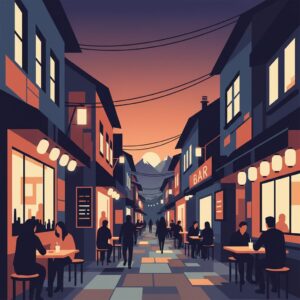
Osaka, meanwhile, though also a vast metropolis, feels more organic and bottom-up. It’s a city of delightful, chaotic contrasts. You might find a tiny centuries-old shrine nestled in the shadow of a gleaming office tower. A gritty, neon-lit alley full of standing-only bars stands beside a luxury brand flagship store. The city’s planning seems less focused on crafting a uniform aesthetic and more on adapting to the vibrant, messy, ever-evolving needs of its people. It reveals its workings, its history, its rough edges. It wears its patina. Like the Umeda Sky Building, it embraces its structure and inner workings. While this can make it seem less polished than Tokyo, it also renders it more approachable and human-scaled. You sense you can leave your own imprint on it.
The Misunderstanding: Is It Grit or Is It Guts?
For many foreigners, their first impression of Osaka can be perplexing, particularly if their only other reference points are Tokyo or the tranquil image of Kyoto. They notice the loud fashion in Namba, hear the boisterous laughter in an izakaya, and encounter the direct communication style, which they might label as “rough” or “less sophisticated.” This is a common foreigner’s error: evaluating one culture by the standards of another.
What may seem like a lack of refinement is actually an abundance of authenticity. Osaka culture is firmly grounded in the concept of `honne`, or true feelings. The city values what is genuine over what is merely attractive. It’s the contrast between a delicious, messy plate of okonomiyaki cooked on a hot grill before you and an exquisitely arranged, multi-course `kaiseki` meal in Tokyo. Both offer fantastic culinary experiences, but they serve different purposes. One focuses on communal, hearty satisfaction, while the other emphasizes aesthetic appreciation and sophisticated taste. In its food, architecture, and people, Osaka decisively favors the former.
Living here involves adjusting your expectations. It means recognizing that a question that sounds intrusive is actually a sign of friendly interest. It means understanding that straightforward advice reflects genuine care, not criticism. It means appreciating that the city’s chaotic energy is not a flaw but its greatest asset. It fuels the creativity, humor, and resilience that define this place. It’s the heart of the city, laid bare.
Choosing Your Vantage Point, Choosing Your Life
Ultimately, choosing between living in Osaka or Tokyo means choosing between two distinct experiences and philosophies. It boils down to the kind of connection you want with your adopted city. Do you prefer to admire a flawless, beautiful place from a comfortable distance? Or do you want to step out into the wind and truly feel the exhilarating, unpredictable, and sometimes overwhelming reality of a city deep in your bones?
Tokyo provides a world-class life marked by refinement, convenience, and limitless opportunities, all delivered with unmatched polish. It’s a city that showcases its greatness daily. It’s the Skytree: an awe-inspiring, carefully curated glimpse of an ideal world.
Osaka, on the other hand, offers a life of direct involvement, hearty laughter, practical kindness, and genuine authenticity. This city doesn’t perform for you; it welcomes you to become part of its vibrant, ongoing show. It’s the Umeda Sky Building: a place that not only reveals the city but lets you feel its heartbeat, hear its voice, and be swept up in its energy. It doesn’t offer a perfect view, but a real one. For many who call this place home, that makes all the difference.