So you’ve been in Osaka for a little while. You’ve mastered the train system, you can order your coffee without pointing, and you’ve even started to understand why people laugh so loudly on the subway. But there’s a question that still bubbles up, especially when you venture away from the polished glass of Umeda or the tourist-packed streets of Namba. Why is everything here so… intense? Why does every meal feel like a negotiation, every bar feel like a party you weren’t invited to but are suddenly the center of, and why is everyone so obsessed with how much things cost? In Tokyo, a quiet reverence for food and service prevails. In Osaka, it feels like a delicious, chaotic, and slightly deafening riot. To understand this, to truly get to the heart of Osaka’s boisterous, pragmatic, and fiercely proud spirit, you don’t need to visit a castle or a museum. You need to go to Tenma.
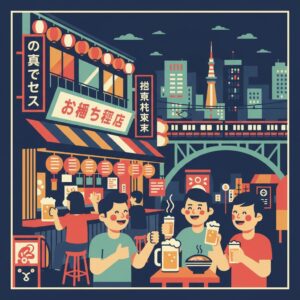
Tenma isn’t just a neighborhood; it’s an ideology. Nestled under the elevated tracks of the JR Loop Line, it’s a sprawling, bewildering labyrinth of narrow alleys, smoky standing bars, and tiny restaurants crammed so tightly together they seem to hold each other up. To an outsider, it can look intimidating. Gritty. A chaotic mess of red lanterns, handwritten signs, and the clatter of plates. But for those who live here, Tenma is the living, breathing, and very loud embodiment of the city’s two founding principles: kuidaore, the noble pursuit of eating and drinking until you collapse in a state of joyous bankruptcy, and the akindo shuhon, the unshakeable merchant spirit where value, wit, and a good deal are the highest virtues. This isn’t a place for quiet contemplation. It’s a place for participation. It’s where the soul of Osaka is laid bare, sizzling on a grill, and served up with a cheap beer and a hearty laugh. It is the absolute antithesis of Tokyo’s curated, serene dining experiences, and understanding why it thrives is the key to understanding Osaka itself.
To fully appreciate this contrast, consider how the city’s pragmatic merchant spirit manifests in its corporate culture, as detailed in our guide to working in Umeda.
The Tenma Mindset: More Than Just Cheap Eats
It’s easy to walk into Tenma and think, “Wow, everything is incredibly cheap.” A beer for 300 yen, a plate of fresh sashimi for 500 yen, skewers for just a hundred yen each. But reducing Tenma to mere price tags is like calling a symphony a jumble of sounds—you completely miss the point. The affordability isn’t the objective; it’s the outcome of a deeply rooted cultural mindset that values shrewdness, community, and a complete rejection of superficiality. Here, you witness the raw, unfiltered economic philosophy of Osaka unfold every single night. It’s not about being stingy; it’s about being clever. And in Osaka, being clever is the highest form of cool.
“Nebo-hiki” and the Art of the Deal
In much of Japan, especially Tokyo, the price on the menu is a fixed reality, a number to be respected. Haggling or questioning it would be seen as terribly rude. In Osaka, however, the price often marks the beginning of a conversation. While you won’t barter for a beer in an izakaya, the spirit of negi-ri (negotiation) and nebiki (discounting) fills the air. It’s a performance, a dance of mutual respect between the customer who understands value and the proprietor who delivers it. This philosophy is woven into the very fabric of Tenma’s establishments.
This isn’t about asking for a simple discount. It’s about the culture of ‘service,’ which in Osaka carries a meaning entirely different from the rest of Japan. In an upscale Tokyo restaurant, ‘service’ is flawless, quiet, and invisible. Your water glass is refilled without your noticing; the staff speak in hushed, polite tones. It’s a display of refined deference. In Tenma, ‘service’ is a loud, boisterous show of generosity. It’s the sushi chef noticing you enjoyed the tuna and cutting an extra piece for you, on the house, with a gruff, “Here, you look like you need it.” It’s the bar owner pouring your sake until it overflows the glass and spills into the saucer below—a practice known as mokkiri, symbolizing overflowing generosity. It’s the waitress spotting a regular and offering a free plate of edamame. This isn’t a mistake or a calculated marketing move. It’s a social transaction. It’s the shop saying, “I see you, I appreciate you, and we’re in this together.” This gesture builds a bond far stronger than any loyalty card program. It’s a spoken acknowledgment that your patronage matters, and in return, you’re expected to be a good, enthusiastic customer. It’s a cycle of mutual appreciation that feels worlds apart from the anonymous, transactional nature of Tokyo’s dining scene.
The Gospel of “Cospa”: Why Value Trumps Prestige
To grasp daily life in Osaka, one must understand the near-religious significance of cospa, a popular Japanese abbreviation for ‘cost performance.’ But in Osaka, it’s more than a buzzword; it’s a moral principle. An Osakan doesn’t boast about spending 20,000 yen on dinner. They brag about having a 5,000 yen meal that tasted like it was worth 20,000 yen. The triumph lies not in how much is spent, but in discovering incredible value. Tenma is the grand cathedral of cospa.
This is perhaps the most striking contrast to Tokyo’s foodie culture, which often centers on prestige, branding, and exclusivity. Tokyo celebrates the three-Michelin-star chef, the minimalist interior designed by a renowned architect, the reservation booked six months in advance. Osaka, and by extension Tenma, celebrates the opposite. The hero of Tenma’s food scene is the grizzled old man in a stained apron who has grilled perfect chicken skewers in the same smoky shack for forty years. His shop has no fancy sign, no website, and floors sticky with decades of spilled beer. Yet locals line up every night because they know his offerings represent the pinnacle of cospa: unmatched quality at an unbelievably low price.
Look around Tenma, and you’ll see this philosophy physically manifested everywhere. Money isn’t spent on decor. Stools wobble, tables are worn plywood, and menus are often handwritten on cardboard pieces taped to the wall. The investment is poured directly into what matters: ingredient quality and chef skill. Rent is low in these back alleys, overhead minimal, and those savings are passed straight to the customer. An Osakan seeing a sleek, minimalist, expensive-looking restaurant doesn’t think, “This must be good,” but rather, “I wonder how much of my bill is paying for their fancy lights.” In Tenma, you know your money is going straight into your meal. This pragmatic, no-frills approach captures the essence of the merchant city. Why waste money on appearances when the product itself is the star?
Navigating the Labyrinth: Unspoken Rules of Tenma’s Izakayas and Tachinomis
Entering the dense maze of Tenma’s alleys for the first time can feel like stepping into a completely different country, even for those familiar with Japan. The rules here are different. The pace is quicker, the noise level is higher, and personal space is noticeably tighter. This is not a place for hesitation. To truly appreciate Tenma, you need to grasp the unspoken rhythm of its social settings, especially the ever-present tachinomi (standing bars) and izakayas that make up its core.
The “Tachinomi” Ballet: Navigating the Standing Bar
The standing bar is a classic Japanese experience, but Osaka’s Tenma has refined it into an art form. To newcomers, the concept of standing to eat and drink might feel uncomfortable or hurried. However, it’s not merely about saving on chairs and floor space. The tachinomi is a finely tuned mechanism of social exchange and dining efficiency. Standing fosters a sense of temporary community and social fluidity that seating at separate tables can’t provide.
Watch a bustling Tenma tachinomi. It is a beautiful, chaotic dance. People stand shoulder-to-shoulder—office workers in suits, construction workers in uniforms, young couples, and elderly regulars alike. An unspoken spatial awareness prevails. As you slide into a small gap at the counter, others naturally shift a few inches to accommodate you. You place your order directly with the chef behind the counter, often yelling over the noise. Your food and drinks arrive shortly after. The payment system is a model of efficiency; many spots operate on a cash-on-delivery basis, where you leave your money in a small plastic tray on the counter and the staff deducts the cost of each item as it’s served. This keeps the flow smooth. There’s no waiting for a check at the end.
This setting acts as a great social equalizer. Your outside status doesn’t matter. For the hour you’re there, you’re simply people enjoying good food and cheap drinks. It’s very common for strangers to strike up conversations. Someone might ask what you’re drinking, suggest a dish, or share a joke with a nod and a laugh. This contrasts sharply with the more reserved atmosphere of Tokyo bars, where groups tend to stay isolated. The tachinomi format inherently breaks down social walls, encouraging quick, friendly exchanges, making it one of the easiest places in Japan to engage spontaneously with locals. The implicit understanding is: we’re all here for a quick, enjoyable time. We eat, drink, chat, and then make way for the next guest. It’s a beautiful, transient, and remarkably efficient social ecosystem.
“Torizara” and the Shared Plate Tradition
Sharing food is common throughout Japan, but in Osaka, it’s central to the dining experience, especially in Tenma. The usual practice is to order various dishes to share among the table. You receive a torizara, a small personal plate used to portion out food from the main dishes. This may seem simple, but it reflects the collectivist merchant spirit.
A meal in Tenma isn’t about individual servings; it’s a shared activity, a communal experience. This allows groups to sample a broader variety of the menu without anyone committing to one large dish. It’s a diversification strategy—maximizing the culinary adventure at minimal cost. It also keeps conversation flowing around the food: “Try this, it’s fantastic,” “What should we order next?” “Did you get enough tuna?”
The unspoken torizara etiquette is subtle. You shouldn’t take too much at once, which might seem greedy, but neither should you be overly hesitant, as that could signal disinterest in the food or the company. It’s a microcosm of Osaka’s social balance: be assertive but not selfish, be communal while preserving individuality. This philosophy fits perfectly with the Tenma nightlife, where a night is rarely spent at just one spot. You might share small plates at a sushi bar, then move on to yakitori skewers. The evening becomes a progressive, shared feast—a collective victory over boring, expensive meals.
The Ordering Language: Direct, Loud, and Friendly
One of the biggest culture shocks for foreigners—and even for Japanese from other regions—is how you get a server’s attention in a busy Osaka establishment. In Tokyo, you might press a call button, make subtle eye contact, or raise your hand quietly. Trying that in a noisy Tenma izakaya will leave you ignored and hungry for a long time. Here, communication is direct, efficient, and loud.
You need to project your voice. A loud, clear “Sumimasen!” (Excuse me!) is standard. But you’ll also hear more familiar, informal calls. Shouting “Onee-san!” (big sister!) to a waitress or “Onii-san!” (big brother!) to a waiter is common and friendly. If the chef or owner is behind the counter, a respectful “Taisho!” (master/chef!) or “Master!” will immediately get their attention. To outsiders, this can sound rude or demanding, but it’s quite the opposite. It shows respect and understanding of the environment. The staff are moving fast, managing dozens of customers in a tight space and don’t have time for subtlety. A loud, clear call helps them work efficiently. They appreciate it because it’s straightforward. The key is in the tone: it’s not an angry shout but a cheerful, energetic call, often paired with a smile and a nod when you make eye contact. You aren’t demanding; you’re joining the lively rhythm of the place. Mastering this small act is a big step toward fitting in. It shows you get it: in Tenma, efficiency and good-natured directness are the language of hospitality.
The Anatomy of a Tenma Bar Crawl: A Cultural Case Study

A night out in Tenma is rarely a stationary event. The very design of the neighborhood, with its dense cluster of specialized, affordable eateries, encourages movement. The quintessential Tenma experience is hashigo-zake, or ladder drinking—the Japanese version of a bar crawl. But this isn’t a haphazard stumble from one random bar to another. The Osaka-style hashigo-zake is a deliberate, multi-stage culinary mission, with each stop selected to maximize quality and value. It’s a journey that showcases the city’s passion for specialization and efficiency.
Round One: The “Senbero” Jumpstart
Many memorable Tenma nights start with the pursuit of senbero. The term combines sen-en (1,000 yen) and berobero (to get drunk). The concept is both a challenge and a proud tradition: to get pleasantly tipsy for just 1,000 yen. Numerous establishments in Tenma offer senbero sets, making them the perfect starting point for the evening. These sets aren’t merely loss leaders to draw you in; they represent a shop’s commitment to cospa.
A typical senbero set may include two or three drinks (usually beer, highballs, or chu-hai) and one or two small dishes (otsumami). You might enjoy a beer, a highball, and a plate of grilled chicken skin, all for a crisp 1,000 yen. For customers, it’s an unbeatable deal and a low-risk way to try a new place. For the establishment, it’s an opportunity to showcase their quality and hospitality. If their senbero set impresses, customers often stay to order more. Starting the night this way is more than just saving money—it’s a smart, strategic first move. It connects you with the local mindset from the outset. You’ve earned a victory of value before the night has even truly begun, setting a triumphant tone for the rest of the crawl.
Round Two: Specialization Rules
After the initial senbero warm-up, the true art of Tenma’s hashigo-zake emerges. You don’t linger in one izakaya serving a bit of everything—that’s inefficient. The expert approach is to hop between hyper-specialized shops. The neighborhood operates like a giant, deconstructed department store for food and drink. Each tiny shop is a different “department,” managed by a master of their specific craft.
Your crawl might go like this: you leave the senbero spot and head to a standing sushi bar. You don’t order a large platter; instead, you select two or three pieces of the freshest, seasonal fish recommended—perhaps a superb piece of fatty tuna (otoro) at a fraction of the price found in a formal sushi restaurant. You savor it, pay your 600 yen, and move on. Next, you crave something grilled and head to a smoky, closet-sized yakitori joint, the air thick with charcoal aroma. You order skewers of chicken thigh, heart, and gizzard, perfectly seasoned and expertly grilled. You wash it down with a beer and continue. Perhaps the next stop is a tiny tempura counter where the chef fries crisp shrimp and vegetables right before your eyes. Then, a wine bar specializing in affordable but surprisingly good Italian wines, paired with a small cheese plate. Each stop offers a focused, high-quality experience. You’re essentially curating your own multi-course tasting menu from the neighborhood’s best specialists.
This style reflects the essence of Osaka commerce. It’s a community of independent artisans and specialists, not a collection of generalist chain restaurants. Each owner takes great pride in their craft, whether perfecting gyoza or sourcing top sake. By hopping between them, you’re not just eating—you’re honoring an entire ecosystem of dedicated craftspeople. This contrasts sharply with many nightlife areas in Tokyo, which have more large, corporate-owned venues designed to keep you inside all night.
Reading the Signs: How to Spot a Winner
With hundreds of options packed into a few blocks, how do you choose? Forget online reviews. The best spots in Tenma often have the least online presence. You need to learn to read the local signals—the analog markers of quality.
First, follow the lanterns. The humble akachochin, the red paper lantern, is the universal sign of an unpretentious, affordable izakaya. The more worn and stained it looks, often the better. Second, look for handwritten menus. A printed, laminated menu with English translations may be convenient, but a menu scrawled in Japanese on paper or a blackboard suggests a place that changes offerings daily based on what’s fresh from the market. That’s a great sign. Third, and most importantly, observe the clientele. Is the place packed with lively middle-aged and older locals, especially men (oji-san)? If so, you’ve likely found a winner. These are some of the most discerning, value-conscious customers in Japan. They have been drinking in this neighborhood for decades and tolerate no bad food or poor cospa. Their presence is the ultimate seal of approval. Finally, trust your nose. A great Tenma spot should smell alive—charcoal, savory dashi broth, sizzling tempura oil, and soy sauce. It’s the aroma of food cooked with passion and in high volume. Rely on these analog signs over online star ratings, and you will be richly rewarded.
Beyond the Beer and Skewers: What Tenma Reveals About Osaka
To view Tenma merely as an inexpensive spot to eat and drink is to overlook its deeper essence. The neighborhood serves as a living museum of Osaka’s history and culture, where the city’s merchant heritage isn’t just remembered but actively lived every day. Its geography, atmosphere, and the way people interact there offer meaningful insight into what sets Osaka apart from its eastern rival, Tokyo. Tenma embodies a different way of life—rooted in pragmatism, community, and a healthy skepticism toward authority and pretension.
The Tenjinbashisuji Connection: A Merchant’s Artery
Tenma doesn’t exist in isolation. Its bustling, food-centered alleys are intimately connected both physically and culturally to the Tenjinbashisuji Shotengai, Japan’s longest covered shopping arcade. Stretching nearly three kilometers, this street serves as the neighborhood’s main artery—a lively marketplace where locals shop for everything from fresh vegetables and fish to clothing, medicine, and hardware. Here, the art of the deal is continuously refined. The shouts of vendors, the bartering over produce prices, and the persistent hunt for the best bargain fill the air.
The relationship between the shotengai and Tenma’s drinking alleys is mutually supportive. The shotengai represents daytime commerce and everyday practicality, while the alleys are its nighttime counterpart, where the day’s earnings and savings are cheerfully spent. Those drinking in the izakayas by night are often the same people who shopped and worked in the arcade during the day. This creates an authentic, unpretentious community feel. Tenma is not a polished entertainment district designed for tourists; it’s the local cafeteria and living room for neighborhood residents. This strong tie to daily commerce grounds the area in a reality that many tourist-centric nightlife spots lack. It’s not a show for visitors; it’s just another Tuesday night for locals. This authenticity stems precisely from that.
A Tale of Two Cities: Tenma vs. Tokyo’s Golden Gai
To fully appreciate Tenma’s unique character, it helps to compare it with a well-known Tokyo counterpart like Shinjuku’s Golden Gai. At first glance, they may appear similar—both are networks of narrow alleys lined with tiny bars dating back to the Showa era. However, their underlying philosophies differ profoundly, revealing much about the cultural gap between Osaka and Tokyo.
Golden Gai is about preservation and nostalgia. Its small, atmospheric bars maintain a deliberate aesthetic, resembling a carefully preserved film set. Many bars charge cover fees, drinks are pricier, and the clientele increasingly consists of international tourists seeking a curated “old Japan” experience. It’s a wonderful place but mainly designed for observing history and consuming an atmosphere. Golden Gai has been meticulously groomed to be accessible and atmospheric for outsiders.
In contrast, Tenma is about pure function. It doesn’t preserve an aesthetic but lives a philosophy. Its history lies not in maintained architecture but in the steady, pragmatic attitudes of its owners and patrons. There are no cover charges. The aim isn’t to conjure nostalgia but to offer good, inexpensive food and drinks efficiently. The neighborhood is loud, chaotic, and unapologetically present-focused. While Golden Gai can feel like a museum you can drink in, Tenma feels like a lively factory of fun still in full operation. This contrast reveals the fundamental difference in how the two cities approach their culture: Tokyo often packages and presents its culture for consumption, while Osaka openly lives its culture without pretense or polish. Tenma isn’t for show; it’s for real.
What Foreigners Often Misunderstand
Living in Osaka, I frequently hear newcomers’ impressions of Tenma shaped by common cultural misconceptions. One is that its loud, direct service style is rude or aggressive. In reality, directness here is a form of respect—it honors the customer’s time and the staff’s need for efficiency. It’s an inclusive energy, not an exclusive one. The noise conveys a vibrant, thriving environment; quiet would be a sign something’s off.
Another misunderstanding is equating the gritty, no-frills appearance of many shops with uncleanliness. It’s important to differentiate between the lived-in clutter of a busy, practical space and actual lack of hygiene. Japanese food safety standards are extremely high, regardless of appearances. Because of Tenma’s high customer turnover, ingredients move quickly—the fish you eat likely came from the market that very morning. What may seem like a disorganized kitchen often signals a bustling business, which is the best indicator of freshness. Learning to see past superficial messiness reveals a beauty in spaces optimized for function rather than design.
Finally, many non-Japanese speakers feel intimidated, fearing they won’t be able to communicate. Although English menus aren’t everywhere, Tenma is very welcoming to foreigners precisely because communication relies less on formal language and more on human connection. A smile, pointing at a delicious-looking dish someone else is enjoying, and saying a simple “Are, kudasai” (That one, please) suffices. Staff and customers are typically eager to help. Offering a genuine “Oishii!” (Delicious!) after your first bite usually brings smiles and perhaps even a new friend. The desire to share good food and good company is a universal language fluently spoken throughout Tenma.
A Practical Guide for the Tenma Newcomer

Equipped with an understanding of the Tenma mindset, you’re ready to dive in. However, some practical advice can make your initial explorations less daunting and more enjoyable. Think of this not as a strict plan, but as a toolkit to help you confidently navigate the vibrant chaos and uncover your own favorite spots.
Your First Steps: Where to Begin
The overwhelming density of Tenma calls for a simple approach. Begin at JR Tenma Station. The area just north and east of the station, beneath and alongside the train tracks, is the most concentrated part of the maze. Choose one of the main covered alleys, such as Tenma Ichiba, and start wandering. Resist the urge to plan your entire evening in advance; the true magic of Tenma lies in spontaneity.
Your aim on the first visit shouldn’t be to find the “best” place but to experience the flow. Wander down an alley that catches your eye. If you hear laughter spilling out of a tiny bar, peek inside. If the scent of grilled fish draws you in, make that your first stop. Let your senses, rather than a map, guide you. The worst approach in Tenma is to over-plan. Stay flexible. Be ready to abandon your original plan when you discover a spot with great energy. Embrace the chaos, and it will reward you.
Essential Etiquette Refresher
Although Tenma’s atmosphere is casual, a few key etiquette points will ease your experience and show respect for local culture. First, cash remains king. While some larger venues may accept credit cards, the vast majority of intimate, family-run places are cash-only. Bring plenty of 1,000 and 5,000 yen notes. Struggling to find a credit card in a cash-only tachinomi is a classic rookie error.
Second, be conscious of your time, especially in busy spots. The tachinomi culture depends on fast customer turnover. It’s not the place to linger over one drink for hours. The unspoken rule is: you enjoy affordable food and drinks, then give up your spot promptly when others are waiting. Eat, drink, soak up the atmosphere, and courteously move on. This keeps the ecosystem thriving.
Lastly, engage with your surroundings but learn to read the mood. The taisho (chef/owner) is the heart of the establishment. If they are busy, cooking and serving frantically, a simple nod and a clear, polite order suffice. When things are slower and more relaxed, they are often happy to chat, recommend dishes, or share stories. The same applies to fellow customers. Feel free to strike up a conversation, but respect those who prefer quiet. Also, smoking is still allowed in many traditional establishments; if sensitive, be prepared to navigate this.
Surviving and Thriving
The key to thriving in Tenma is coming with the right mindset: an empty stomach, a wallet full of cash, and above all, an open, curious spirit. Be adventurous. If something on the menu is unfamiliar, consider ordering it—it’s a great opportunity to try something new. Affordable prices mean culinary risks rarely cost more than a few hundred yen.
Don’t hesitate to use your most powerful tool: pointing. Indicate the bottle of sake another customer is enjoying, accompanied by a questioning look at the staff. Point to a plate of mysterious but appetizing stew on the counter and say, “I’ll have one of those.” This simple, universally understood method shows engagement and trust in the establishment and its patrons.
Ultimately, a night in Tenma is about more than satisfying hunger and thirst. It’s a cultural immersion. It’s participating, even briefly, in the vibrant, noisy, practical, and deeply human rhythm of Osaka life. You’ll leave not only with a full stomach and a lighter wallet but feeling like a guest at the city’s largest, most chaotic, and most welcoming dinner party. You’ll gain a deeper understanding of Osakans’ spirit—and already be looking forward to your next visit.