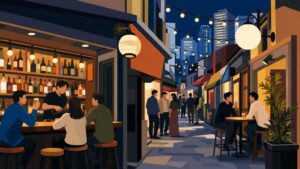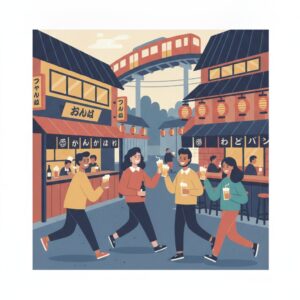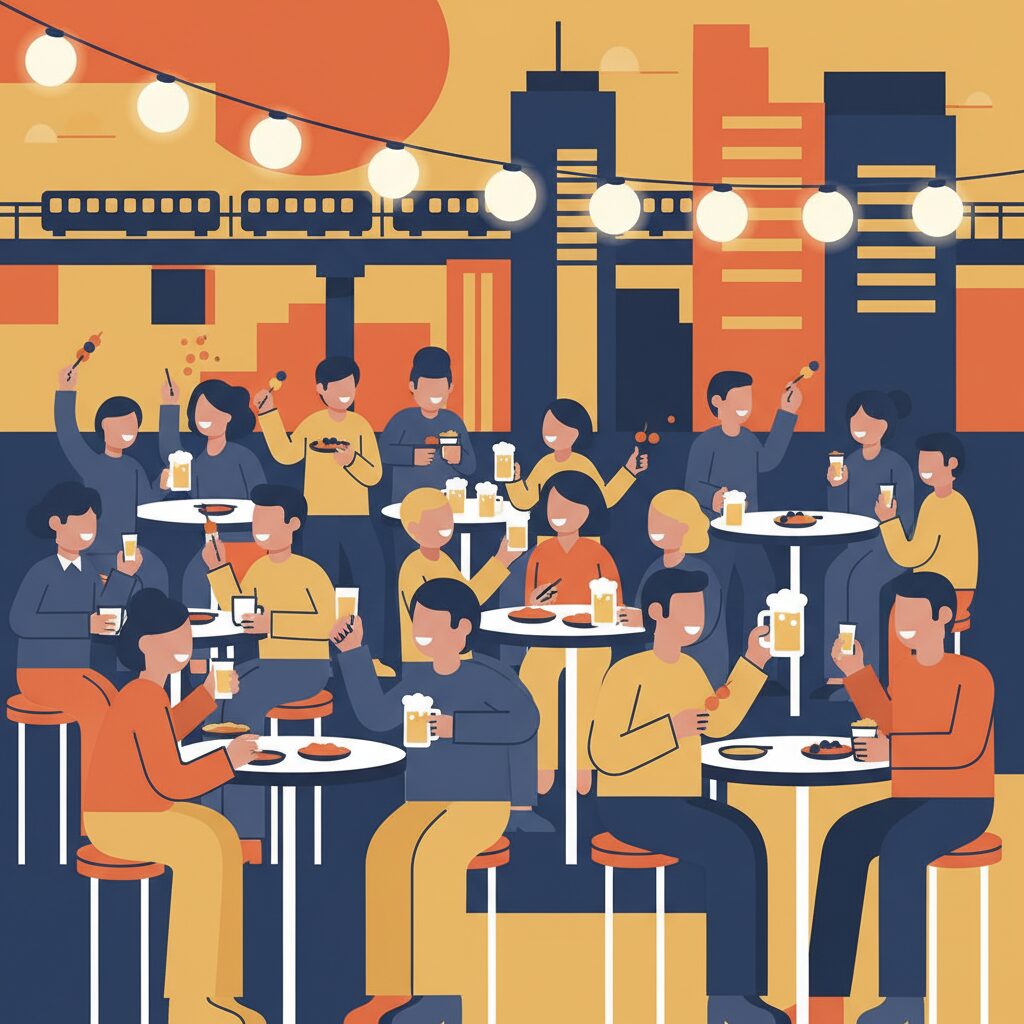
Walk through the gleaming canyons of Umeda after 5 PM. The air, thick with the day’s humidity, suddenly gets charged. It’s a river of people, a torrent of dark suits and determined faces flowing out of glass towers and into the subterranean labyrinth of Osaka Station. On the surface, Umeda is Osaka’s corporate face—polished, efficient, relentlessly modern. It’s a landscape of flagship stores, luxury hotels, and headquarters that project an image of global sophistication. But peel back one layer, dive under the train tracks or into the basements of the aging Ekimae Dai-ichi, Dai-ni, Dai-san buildings, and you find the district’s true heart, beating to a different rhythm. Here, under the fluorescent hum of a thousand tiny bars, you’ll find the tachinomi. The standing bar. To an outsider, it looks like chaos. A crush of bodies packed shoulder-to-shoulder in a space no bigger than a generous walk-in closet. There are no chairs, no reservations, just a counter worn smooth by a million elbows and a cacophony of conversations shouted over the sizzle of a grill. It seems impossibly cramped, loud, and utterly devoid of comfort. You might ask yourself, why would anyone choose this? Why trade a comfortable seat for a sliver of counter space after a long day at a desk? This isn’t just about grabbing a cheap drink. It’s about plugging into the city’s nervous system. The tachinomi is a microcosm of Osaka’s business culture: fast, direct, unpretentious, and deeply social. It’s where the city sheds its corporate skin and gets real. Understanding the tachinomi isn’t just about learning where to get a beer; it’s about learning the unspoken language of Osaka’s working world.
For those intrigued by the interplay between Osaka’s corporate pace and its unfiltered local traditions, exploring Osaka’s Tenma drinking scene offers a compelling glimpse into an equally vibrant nightlife.
The Unwritten Rules of the Counter
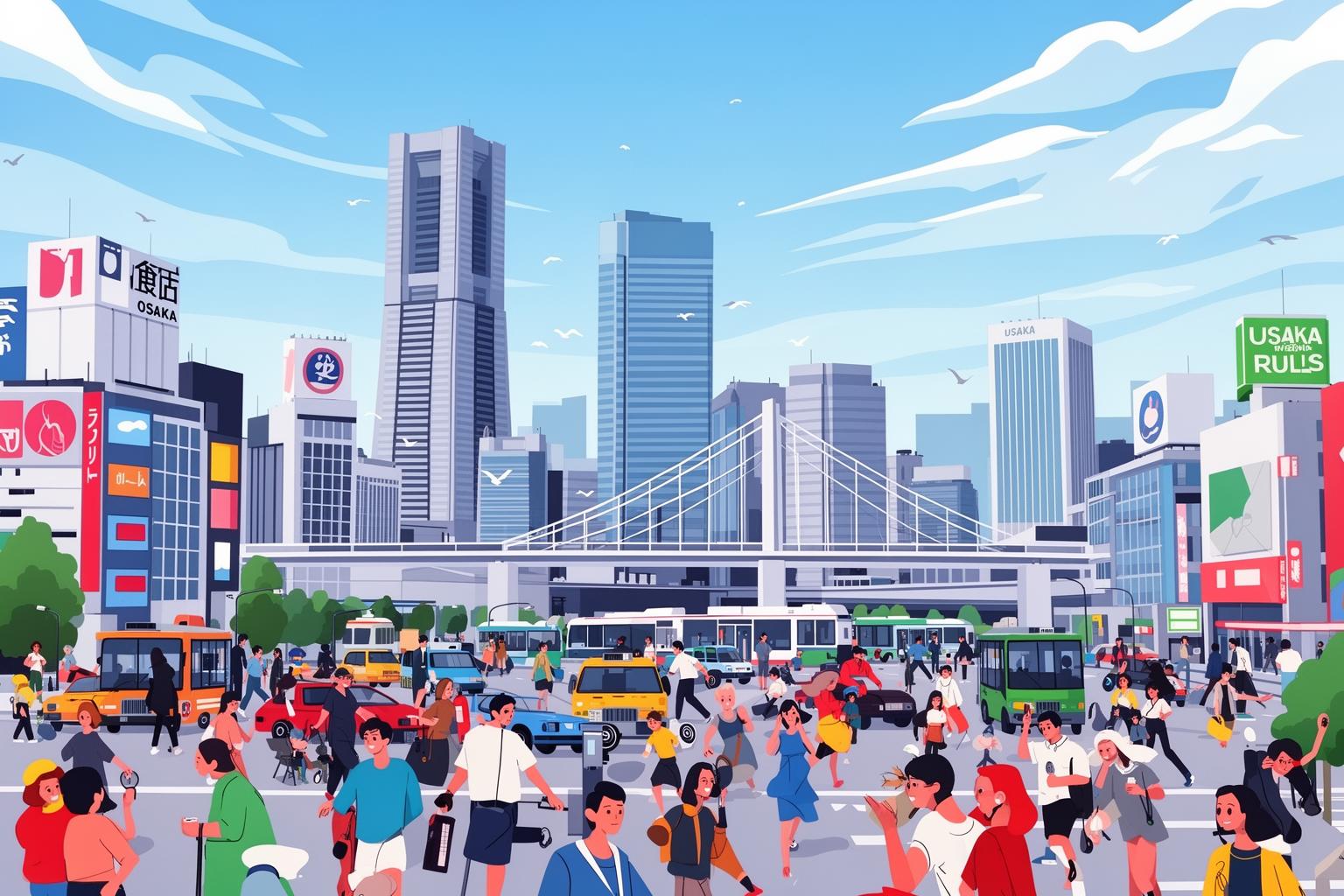
Stepping into a tachinomi feels like boarding a moving train. There’s a flow, an energy you need to match, or you’ll be left behind on the platform. This isn’t a place for hesitation. The social codes here are crafted for maximum efficiency and minimal friction—a beautiful, unchoreographed dance of urban life. Mastering these small rituals is your gateway to experiencing the authentic Osaka, the city that fuels the gleaming offices above.
The Art of Entry: Finding Your Spot
First rule: no waiting to be seated. There are no seats. You approach the entrance, which might just be a gap in a plastic curtain, and peer inside. You’re not seeking a host; you’re scanning the counter for an opening. You’re reading the human geography. Is there a space, maybe a foot and a half wide, where you can slip in without completely disturbing the people on either side? It’s a quick mental calculation. If it looks packed tight, you move on. No lingering, no awkward hovering. If you spot a narrow opening, you catch the eye of the master behind the counter, give a subtle nod, and gesture with a finger: “Hitori?” (一人? – “One person?”). They’ll either nod you in or offer a quick, apologetic wave-off. If you get the nod, you slide in. It’s a commitment. You exhale, claim your small space with your elbows, and you’re in. This initial move sets the tone: confident, aware, and respectful of the shared space. You’re not just a customer demanding service; you’re a participant joining a temporary community.
Ordering Protocol: Quick, Decisive, and Clear
Once inside, the clock is ticking. The staff moves constantly—a whirlwind of pouring, grilling, and shouting. They don’t have time for you to leisurely study the menu scribbled on the wall. The unspoken rule is that you know the basics. The universal opening line is “Toriaezu, Nama,” or simply “Nama!” (生! – “Draft beer!”). It’s the conversational handshake of the Japanese bar scene. It gives you a minute to settle in and decide on food. When you’re ready to order more, you don’t wave your hand frantically. You wait for a lull, a moment when the staff glances your way, and you make eye contact. State your order clearly and succinctly. “Doteyaki, hitotsu.” (どて焼き、一つ – “One beef sinew stew.”) “Kushikatsu, moriawase.” (串カツ、盛り合わせ – “Assorted skewers.”) The tempo is brisk. This speed isn’t rude; it’s the place’s rhythm. It ensures everyone gets served in a high-turnover environment, keeping energy high and prices low. It’s a system born of pure, unfiltered Osaka pragmatism.
Personal Space is a Luxury, Not a Right
In Tokyo, a crowded train is a silent exercise in avoiding all human contact. In an Osaka tachinomi, physical closeness is part of the experience. You will be bumped. Your elbow will brush against your neighbor’s. This isn’t an invasion of your personal bubble; it’s simply a consequence of the setting. The key is the micro-interaction that follows. A quick “Ah, suimasen” (あ、すいません – “Oh, excuse me”), a slight nod, and the moment passes. There’s an unspoken understanding that everyone shares this cramped space together. This physical proximity breaks down social barriers much faster than a formal setting ever could. It creates a fleeting camaraderie among strangers, a shared moment in the heart of the anonymous city. You’re all here for the same purpose: to shed the day’s burdens. The lack of personal space is a feature, not a flaw. It sparks interaction, generates warmth, and makes the bar feel alive.
The Cash-on-Delivery Code
Many tachinomi operate on a “cash-on-the-spot” system. When you arrive, you’ll often find a small tray, basket, or designated spot on the counter in front of you. This becomes your personal bank for the evening. You place a 1,000 yen or 5,000 yen bill there. When your drink or food arrives, the staff takes the exact amount from your money and leaves the change. No running a tab, no waiting for a bill at the end. This system is brilliantly efficient. It allows for a smooth exit. When you’re ready to leave, you just pick up your change and go. A simple “Gochisousama deshita” (ごちそうさまでした – “Thank you for the meal”) to the staff is all that’s needed. This pay-as-you-go method keeps the operation fluid. It’s a transactional system that feels transparent and honest, reflecting a core aspect of Osaka’s merchant culture: straightforward, quick, and no-nonsense business.
Beyond the Beer: Tachinomi as a Social Sphere
To dismiss these places as mere watering holes is to completely overlook their significance. A tachinomi serves as an essential piece of social infrastructure in a city built on relationships and commerce. It represents a liminal space, a ‘third place’ that is neither the formal hierarchy of the office nor the private refuge of home. It is within this neutral ground that a different kind of communication, a more genuine Osaka interaction, can thrive.
The Great Equalizer
Within the four walls of a tachinomi, corporate titles start to blur. The section chief, or kacho, might find themselves squeezed next to a new recruit, the shinjin. While formal respect remains, the strict barrier of workplace seniority becomes permeable. The shared experience of standing, eating, and drinking in a cramped, informal setting serves as a social leveler. Conversations shift from projects and deadlines to baseball, hometowns, or mutual gripes about the summer heat. It is in these moments that real team bonding takes place, far more effectively than in any organized corporate retreat. This is where the renowned Osaka openness shines. People are more willing to reveal a piece of their true selves, their ‘honne,’ because the environment is so unpretentious and free of ceremony.
Networking, Osaka-Style
Networking in Tokyo often feels like a formal ritual, a stylized exchange of business cards (meishi) accompanied by deep bows and polite follow-up emails. At an Osaka tachinomi, networking unfolds organically, almost by chance. It begins with a shared observation: “That oden looks good, where’s it from?” or “Tigers are playing well tonight, eh?” It’s about forging a small, temporary connection with the person next to you. Osakans, rooted in a merchant tradition, excel at building rapport. They recognize that business is grounded in human relationships, not merely transactions. A casual chat in a tachinomi may not result in a deal the next day, but it sows a seed of familiarity. It’s about sizing someone up and sensing their character in a relaxed atmosphere. You might discover more about a potential business partner over a plate of grilled squid in ten minutes here than in an hour-long boardroom meeting. It’s fluid, intuitive, and fundamentally centered on people.
A Sanctuary for the Solo Soul
Despite the crush of people and constant noise, the tachinomi is also a refuge for the solo drinker. In fact, it’s one of the most comfortable places to be alone in public. Because there are no tables, you don’t occupy space meant for a group. You are your own self-contained unit at the counter. You can gaze into your beer, scroll through your phone, or simply observe the bar’s lively theater unfolding around you without feeling self-conscious. The surrounding buzz provides a kind of social camouflage. You are alone, but not lonely. It’s a place to unwind at your own pace, to transition from the ‘work self’ to the ‘home self’ with a buffer of anonymity. For many office workers, this brief 30-minute stop is an essential mental punctuation at the end of a long day.
Umeda’s Tachinomi vs. The Rest of Japan
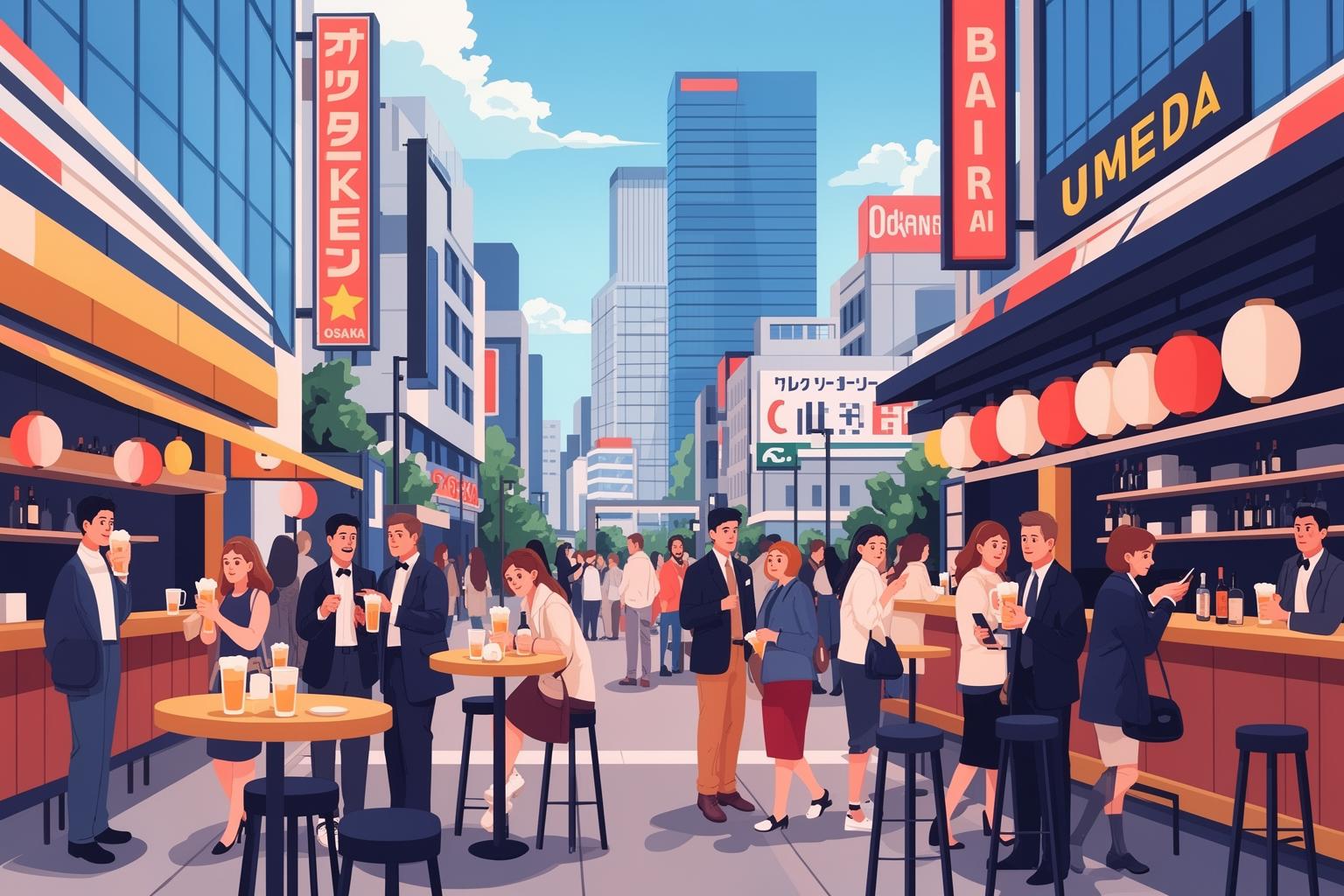
Not all standing bars are the same. The tachinomi of Umeda have a distinct character shaped by the district’s role as Osaka’s main business hub and transportation center. This context is what makes them stand apart from their counterparts in Tokyo or even other areas of Osaka like Namba or Tenma.
The Umeda Ecosystem: Sleek Exteriors, Rough Interiors
Umeda is a district of contrasts. You leave a station that resembles a futuristic spaceship and pass glossy department stores, only to descend a grimy staircase into a basement corridor that hasn’t changed since the 1970s. Here lies the densest cluster of tachinomi. The contrast is intentional. These bars offer a necessary escape from the polished, occasionally sterile corporate world above. They serve as refuges of analog charm in a digital age. The food is traditional, hearty, and affordable: doteyaki, karaage, sashimi. The drinks are simple: beer, highballs, sake. There’s no craft cocktail list or artisanal cheese platter. This is nourishment for the city’s workers—functional, dependable, and deeply satisfying. The rough interior is a mark of pride, a symbol of authenticity amid a world of curated perfection.
Tokyo’s Calculated Cool vs. Osaka’s Raw Energy
In popular tachinomi in trendy Tokyo neighborhoods like Ebisu or Nakameguro, you might experience a more stylized atmosphere. Interiors may be architect-designed, menus might emphasize natural wine or craft beer, and the crowd may be more conscious of appearances. It can feel like an act of casualness. In contrast, an Umeda tachinomi is all about function. Its aesthetic reflects accumulated history and practicality. The vibe is neither ‘cool’ nor ‘curated’; it is raw, lively, and unrefined. The volume is higher, laughter is fuller, and conversations are more straightforward. In Tokyo, you might talk about a new art exhibit. In Osaka, you’re more likely to debate the Hanshin Tigers baseball team with a stranger. It’s the difference between performative socializing and genuine social connection. One is about being seen; the other is about engaging.
What Foreigners Often Get Wrong
Navigating the tachinomi world can feel intimidating, and it’s easy to make incorrect assumptions based on experiences from other countries or different regions of Japan. Recognizing these common misconceptions is essential to fully appreciating the culture.
Misconception: “It’s just a cheap, fast bar.”
On the surface, yes, it’s affordable and quick. However, that’s a significant oversimplification. The tachinomi is a complex social environment governed by subtle, unspoken rules. It serves as a community center, a networking spot, a therapist’s office, and a canteen all at once. The low price and speed make it accessible, but it’s the culture that gives it depth. Viewing it as merely a place for inexpensive drinks overlooks the rich human drama unfolding at the counter every night. It’s the city’s living room, where the collective spirit of the working population is felt most strongly.
Misconception: “I’ll be bothering people if I try to talk to them.”
This fear stems from the stereotype of Japanese reserve. While it’s true that being loud or intrusive is unwelcome, striking up casual conversation is much easier here than in many other social settings in Japan, especially compared to Tokyo. The trick is to be attentive. If the person beside you is absorbed in their phone or focused on the TV, it’s best not to disturb them. But if they make eye contact or if you happen to order the same item, a simple remark can often start a conversation. Osakans are typically curious and happy to engage, especially with foreigners who show sincere interest in their culture. Sharing a laugh with a stranger at the counter is a quintessential Osaka experience. Don’t hesitate to test the waters with a friendly nod and smile.
Misconception: “I need to speak perfect Japanese.”
While fluency is helpful, it’s definitely not a requirement. In fact, stumbling through a few key phrases with enthusiasm often earns more goodwill than speaking perfectly. Both staff and patrons appreciate the effort. Equip yourself with essentials like: “Nama futatsu” (生二つ – “Two beers”), “Kore ikura desu ka?” (これいくらですか? – “How much is this?”), “Oishii!” (美味しい! – “Delicious!”), and the important closing phrases, “Okanjo onegaishimasu” (お勘定お願いします – “Check, please”) and “Gochisousama deshita!” These phrases are your entry ticket. Pair them with pointing, smiling, and a willingness to try new things, and you’ll not only get by but truly enjoy the experience. The tachinomi rewards effort and a cheerful attitude far more than perfect language skills.