You’re sitting in a sleek, glass-walled meeting room overlooking the urban sprawl of Umeda. The air is thick with the polite tension of a first-time business pitch. You’ve just laid out your proposal, a project you’ve poured weeks into. Across the table, the section chief from the Osaka-based company, a man with a warm smile and a sharp suit, leans back. He nods slowly, thoughtfully. Then he delivers the line: “Maemuki ni kentou sasete itadakimasu.” He says he will “positively consider it.” A wave of relief washes over you. Your Japanese colleague from the Tokyo office gives you a subtle, encouraging nod. It sounds like a win. You pack up your laptop, exchange crisp, new business cards, and leave feeling optimistic.
A week passes. Then two. Your follow-up emails receive polite but vague replies. The deal, you slowly realize, is dead on arrival. It never even had a pulse. What happened? You, my friend, just had your first crash course in the intricate dance of Honne and Tatemae, but with a unique Osaka spin. Honne is the raw truth, your actual feelings and intentions. Tatemae is the public facade, the socially acceptable mask you wear to maintain harmony. Every businessperson in Japan navigates this duality, but in Osaka, the rules of the game are different. It’s less about rigid, impenetrable politeness and more about a fluid, pragmatic negotiation. Here, the line between what is said and what is meant is a blurry, shifting frontier, a place where business gets done, relationships are forged, and fortunes are made. To survive and thrive here, you don’t just need to learn the language; you need to learn the rhythm, the unspoken cues, the subtle art of the deal that defines the very soul of this merchant city.
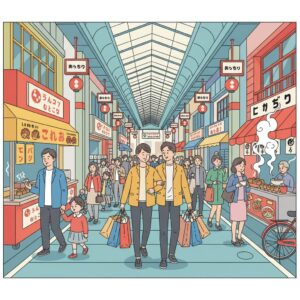
To truly understand this fluid, pragmatic negotiation style, one must experience the authentic social dynamics found in Osaka’s vibrant shotengai.
The Foundation: Why Osaka Plays the Game Differently
To grasp the local essence of Honne and Tatemae, one must look far back—not just a few years, but centuries. This mindset wasn’t born in the stoic, hierarchical courts of samurai lords; rather, it was shaped in the lively, chaotic, and relentlessly practical markets of a city built on trade. Osaka was, and in many ways remains, the tenka no daidokoro—the nation’s kitchen. It served as the central hub where rice, sake, and goods from across Japan were collected, priced, and distributed. This legacy forms the city’s DNA and influences everything about how business is conducted.
The Merchant’s DNA
Consider the differences in origin stories. Tokyo, once Edo, was the center of the Tokugawa shogunate—a city of warriors and bureaucrats. Society there was built on rigid hierarchies, unwavering loyalty, and the utmost importance of form and procedure. Saving face was not merely a social nicety; it was a matter of honor, sometimes even life or death. Thus, Tatemae in Tokyo developed as a protective barrier—a means to uphold this strict order, show deference, and maintain a respectful distance. The process, the proper way of doing things, often mattered as much as the outcome.
Osaka’s history, by contrast, is entirely different. It was a city of merchants, artisans, and financiers, where status was earned through business savvy rather than birthright. The aim wasn’t to preserve a feudal hierarchy but to make a profit, forge relationships that generated more business, and outwit competitors. In this environment, communication had to be efficient, even if indirect. The culture that emerged was grounded in pragmatism, rationality, and a keen understanding of the bottom line. The deal was king. A flawless process resulting in loss was worthless, while a somewhat messy, chaotic negotiation ending in a win-win outcome was a masterpiece.
This history isn’t mere trivia for the history books; it’s felt daily. It’s visible in the straightforwardness of shopkeepers in the shotengai, the endless discussions about value and price, and the willingness to bend rules to close a good deal. This is why Honne and Tatemae feel so different here—it’s a toolkit adapted for another purpose.
Tatemae as a Bargaining Chip, Not a Wall
In a Tokyo business meeting, Tatemae can seem like an impenetrable fortress. Polite phrases and non-committal replies create a smooth, frictionless surface that offers nothing to grasp. It’s a way of saying “no” without ever uttering the word, often aimed at ending the conversation gracefully. It’s a wall—carefully constructed and courteously maintained.
In Osaka, Tatemae seldom functions as a wall. It’s more akin to the opening move in a chess game. It’s a test, a way to gauge the situation and keep the dialogue going without revealing your full hand. The well-known phrase “kangaetokimasu” (“I’ll think about it”) perfectly illustrates this. Across much of Japan, this is a polite but firm “no.” Yet in Osaka, it’s ambiguous, carrying multiple possible meanings. It might be a “no,” but it could just as easily be an invitation: “Your offer isn’t quite right; convince me,” or “I like the idea, but the price is off. What else can you offer?”
An Osaka businessperson uses Tatemae not to shut down discussion, but to open an unofficial channel of negotiation. They create breathing room and offer you a chance to read the situation, adjust your approach, and try again. They anticipate that the initial answer is rarely final. The real conversation is about to start, and the Tatemae opener serves as the bell that marks the beginning of the round.
Reading the Air: Practical Cues to Osaka’s Honne
So, if polite phrases are merely the opening act, how do you reach the main event? How do you cut through the Tatemae veil and catch a glimpse of the genuine Honne? It’s a skill, and like any skill, it requires practice. You must learn to listen not only to the words spoken but also to the humor, the context, and the actions that follow. The clues are always there if you know where to look.
The Language of ‘Maybe’
Let’s break down some classic ambiguous phrases you’ll hear in meetings and explore how they resonate differently in Osaka. Mastering this is your first step toward fluency in the local business dialect.
“Maemuki ni kentou shimasu” (We will consider it positively.)
As in the opening story, this phrase is a classic for a reason. In Tokyo, it often signals the kiss of death. It’s a gentle way to say no, a formality used to close a proposal without causing offense. The “positively” part is pure Tatemae, intended to soften the rejection. In Osaka, although it can still mean no, you must pay close attention to what follows. Is the phrase accompanied by a question? For example: “Maemuki ni kentou shimasu. Tokoro de, nouki wa mou sukoshi hayaku dekinai desu ka?” (“We’ll consider it positively. By the way, is it possible to shorten the delivery time?”). That question—a small crack in the polite facade—is your opening. It’s Honne peeking through. They’re revealing the real sticking point. The “positive consideration” now depends on your ability to address this new issue. A genuine Osaka “no” typically comes with a tight-lipped smile and a quick change of topic to something neutral, like the weather or the Hanshin Tigers.
“Chotto muzukashii ka mo shiremasen” (It might be a little difficult.)
This phrase’s nuance is everything. The word chotto (a little) is key. In a more formal, risk-averse business culture like Tokyo’s, “a little difficult” is often a huge understatement, usually implying “it’s impossible and we’re not even going to try.” The conversation ends there. In Osaka, “a little difficult” can be a sincere statement of fact and, more importantly, an invitation to solve a problem. It means: “Here’s the obstacle. I’m telling you what it is. Now, what’s your solution?” An Osaka counterpart might say this and then lean in, awaiting your response. They’re testing your creativity and willingness to collaborate. They’re not saying no; they’re saying, “This part is hard. Help me make it easier.” Your job is to respond not with disappointment but with proposals. “I understand it’s difficult. What if we tried this approach instead? Or adjusted the timeline here?” This shows you’re a partner, not just a vendor.
“Saa… dou deshou ne” (Well… I wonder…)
This is a masterclass in ambiguity. It serves as a verbal pause, giving the speaker time to think. A non-Japanese listener might see this as weakness or indecision. That’s a mistake. In Osaka, it often signals that the logical part of the discussion is over and the negotiation of feelings and relationships is about to start. It prompts you to put more weight on your side of the scale. They’re not convinced by facts and figures alone. Now they want to be persuaded by you. This is your cue to emphasize benefits, discuss long-term partnership, or perhaps offer a small symbolic concession. Essentially, they’re saying, “I’m on the fence. Give me a reason to join you.”
Beyond the Meeting Room: The Power of the Nomikai
The most crucial business often happens far from the sterile conference room environment. It unfolds in the loud, smoky, lively chaos of an izakaya after work. The nomikai, or drinking party, is a vital institution across Japan, but in Osaka, it carries a distinct commercial edge.
In some corporate cultures, a nomikai can be a rigid formality, an extension of office hierarchy where you pour drinks for your boss and engage in carefully vetted, polite conversation. It focuses on team building and reinforcing established power structures.
In Osaka, the nomikai loosens the Tatemae masks through beer and sake, and the raw Honne finally emerges. It’s the second, more important phase of any serious negotiation. You might spend an hour in a formal meeting going nowhere, skirting topics with polite language. Then, you all move to a nearby pub, and within thirty minutes, the real conversation begins.
Picture this: Your pitch for a new software system receives polite nods and vague questions during the afternoon meeting. You’re unsure where you stand. At the nomikai that evening, after the first round of beers, the usually silent department head leans over and says, “Kimura-san, ano shisutemu, hontou no tokoro, ikura ni narun?” (“Kimura, that system… what’s the real price?”). He might then mention his boss’s strict budget constraints or that another department is competing for the same resources. This is pure gold. This is the Honne you’ve been waiting for. He’s not merely asking for a discount; he’s making you an ally. He’s revealing the internal political landscape you need to navigate. The formal Tatemae of the meeting room protected his position, but the informal Honne of the izakaya exists to actually get the deal done.
The Art of the Tsukkomi in Business
To truly understand Osaka, you have to appreciate its comedy. The city is the undisputed home of Manzai, a style of stand-up comedy typically performed by a duo: the boke (the silly, foolish one) and the tsukkomi (the sharp, straight man who corrects him). The tsukkomi’s role is to highlight the boke’s absurdities with a quick, witty retort, often punctuated by a light smack with a paper fan. This dynamic isn’t just for the stage; it’s a core part of Osaka communication and spills directly into business.
A well-timed, humorous tsukkomi can be a powerful way to express Honne without confrontation. It gently challenges something, saying “that’s a bit much” without causing anyone to lose face. It’s disarmingly direct.
For example, in a price negotiation, you present a figure that’s a bit high. Your Tokyo counterpart might respond with a polite, unreadable expression and later send a formal email saying your price was not competitive. There is no dialogue.
Your Osaka counterpart might lean back, laugh, and say, “Erai takai na! Sore, takara-kuji demo atatta hito you no nedan chau ka?” (“Wow, that’s expensive! Is that a price for someone who just won the lottery?”). This isn’t an insult. It’s a tsukkomi. It’s a clear signal—your Honne wrapped in humor. He’s telling you your price is outrageous, but with a smile. The joke breaks the tension and invites a playful reply. The correct response is not offense but laughing along and saying something self-deprecating like, “Well, we have to start somewhere!” followed by an immediate offer of a more reasonable price. By using humor, you skip several steps of polite, indirect negotiation and get straight to the heart of the matter. You demonstrate you can “read the air” and don’t take yourself too seriously—two highly valued traits in Osaka business.
The Foreigner’s Misstep: Common Traps and How to Avoid Them
For someone not raised in this culture, the Osaka approach to Honne and Tatemae can feel like navigating a minefield. The signals are subtle, the humor culturally specific, and the potential for misunderstanding considerable. Successfully navigating this landscape requires unlearning some of your own cultural conditioning and developing a heightened level of observational awareness.
Taking Tatemae at Face Value
Without a doubt, this is the biggest mistake foreigners make. Coming from a culture where words are expected to directly reflect intent, you might hear “We’ll consider it positively” and immediately revise your sales forecast. Or you might hear “That’s a very interesting idea” and assume they liked it. This mindset is a recipe for disaster.
The key to avoiding this pitfall is to stop focusing on the words alone and start looking for supporting evidence. Always watch for what comes next. Genuine interest is always backed by concrete follow-up steps. If someone is truly considering your proposal, they will request more information, arrange a follow-up meeting with their technical team, or provide a timeline for their decision. Actions speak the loudest Honne.
Conversely, if a positive-sounding Tatemae phrase is met with vague pleasantries, a quick topic shift, or a non-committal “We’ll be in touch,” treat it as a polite rejection. Don’t waste weeks sending hopeful follow-ups. Gracefully acknowledge the unspoken “no” and move forward. Learning to recognize the sound of a closing door—even when it’s whispered—is an essential survival skill.
Being Too Direct, Too Soon
After hearing that Osakans are more direct, you might be tempted to overcompensate. You may decide to skip pleasantries and get straight to your unvarnished Honne from the very first meeting. This is also a mistake. Osaka is more direct for Japan, but it is not a free-for-all of blunt, Western-style communication.
The dance of Honne and Tatemae, even at Osaka’s quicker pace, still requires a warm-up. You can’t get to Honne without first establishing trust and rapport. The opening moments of any interaction are critical. This is when Tatemae serves not as a shield but as a bridge. You engage in small talk, compliment their office, or ask about their weekend. You might discuss the latest Hanshin Tigers game or a newly opened local restaurant. This isn’t wasted time; it’s a crucial investment in the relationship.
You demonstrate that you see them as a person, not just a business transaction. This human connection is the lubricant that keeps Osaka business running smoothly. Once that bond is established, you can gradually become more direct. You earn the right to share your Honne by first showing respect for the cultural need for an initial layer of Tatemae. Rushing this process is considered rude and aggressive, and it will prevent you from moving beyond the polite facade.
Misinterpreting the ‘Value’ Conversation
In many Western cultures, discussing money early in a business relationship can feel crude or presumptive. The expectation is to build a case for value first and introduce the topic of price more gently later. In Osaka, however, this can come across as evasive. The idea of value is unmistakably and unapologetically linked to price.
The question “De, kore nanbo ni narun?” (“So, how much is this going to cost?”) can arise surprisingly early in a conversation. Don’t be caught off guard. It’s not an aggressive tactic; it’s a sign of genuine interest. For the pragmatic Osaka merchant, there’s no point in spending an hour discussing product features if the price is far beyond their budget. It’s inefficient. By asking about price upfront, they’re trying to set a realistic framework for the discussion.
Embrace this. Be ready to talk openly and honestly about price, discounts, and payment terms. This is a form of Honne that is both accepted and expected. Being evasive about pricing only breeds suspicion. Conversely, transparency about costs and a willingness to negotiate in good faith will earn respect. In Osaka, a good deal is one where both parties feel they’ve received good value—and that can’t happen without putting the numbers on the table.
What Daily Life Feels Like: Embracing the Osaka Flow
Once you begin to grasp this interplay, you realize it’s more than just a set of rules for business meetings—it’s the underlying operating system of the entire city. Living and working here means learning to navigate this system, embracing its nuances, and valuing the human-centered approach it embodies.
A Culture of ‘Case by Case’
One of the most striking contrasts you’ll notice compared to Tokyo is the system’s flexibility. Tokyo often operates by manuals and well-defined procedures. There is a “correct” way to do things, and deviation is discouraged, creating an environment that is highly efficient, predictable, and orderly.
In contrast, Osaka feels like a city governed by the principle of “keesu bai keesu” (case by case). Rules are frequently viewed as suggestions or starting points for negotiation. The unspoken understanding is that if a deal makes sense, the relationship is strong, and the outcome benefits everyone involved, a way will be found to make it happen, even if it means bending the official rules. This can be frustrating if you’re accustomed to a rigid system, but it can also be freeing. Solutions tend to be more creative and tailored to the situation. Your relationship with the person across the table matters more than what’s outlined on page 47 of the company handbook. This fosters a business atmosphere that feels more dynamic, somewhat chaotic, yet ultimately more adaptable and resilient.
The Human Touch is Non-Negotiable
It’s easy to interpret Honne and Tatemae as a cynical battle between being “real” and being “fake.” However, that’s a fundamentally flawed view, especially in Osaka. The entire ritual isn’t about deception but communication. The strategic use of Tatemae reflects social intelligence. It serves to protect relationships, avoid unnecessary conflicts, and create the space for genuine consensus-based agreements.
Your long-term success here depends less on the superiority of your product and more on your reputation as a person. Are you enjoyable to work with? Can you share a laugh and a drink? Do you grasp the give-and-take of a true partnership? Can you take friendly teasing without becoming defensive? These are the silent questions asked in every interaction. In Osaka, business is deeply personal. You’re not dealing with a corporation; you’re dealing with Tanaka-san, who works for that corporation. Forgetting this is the quickest way to fail.
From the Office to the Shotengai
The most wonderful aspect of learning the rhythm of Osaka business is realizing it’s the same rhythm that brings the entire city to life. The skills you develop in a Yodoyabashi boardroom are the very same you’ll use to befriend the owner of your local ramen shop or to successfully negotiate a discount on a bicycle in Nipponbashi Denden Town.
The line between the professional and personal is delightfully, refreshingly blurred. Business relationships often evolve into genuine friendships, and friendships can open doors to unexpected business opportunities. The elderly woman running the fruit stand in your local shotengai (shopping arcade) performs her own version of the Honne/Tatemae dance when she says a melon is “chotto dake ookii kedo, oishii de” (“It’s a little big, but it’s delicious”), subtly negotiating both price and value in a single sentence.
This captures the true essence of living in Osaka. You are not merely a cog in a machine; you are part of a vibrant, ongoing, city-wide conversation. Understanding Honne and Tatemae is your pass to that conversation. It’s the key that opens not only business deals but also a deeper, more authentic connection to the wonderfully complex, frustrating, and endlessly captivating spirit of this merchant city.