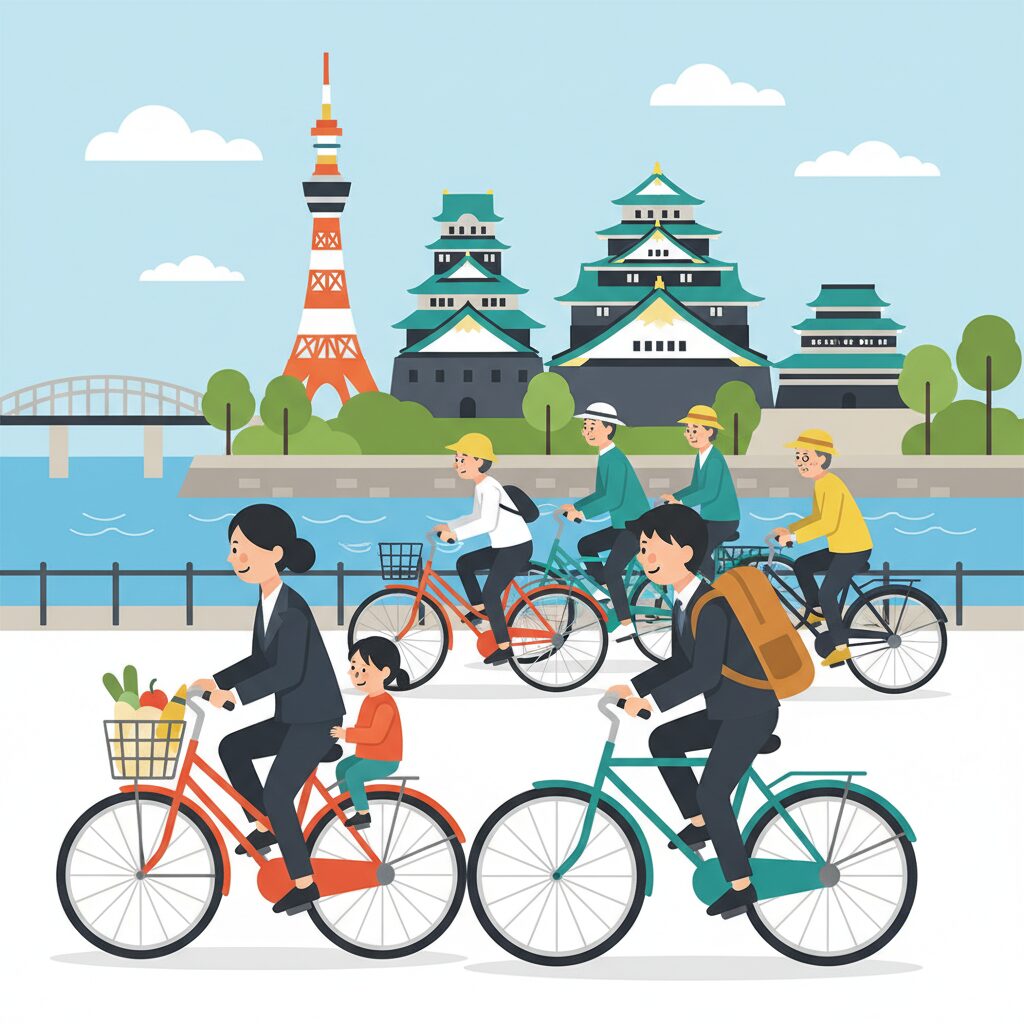
The first time it happens, you won’t be ready. You’ll be strolling down the Shinsaibashi shopping arcade, admiring the window displays, feeling the buzz of the crowd. Then, a whisper of displaced air, a flicker of movement in your periphery. A middle-aged woman on a bicycle, a fortress of a mamachari loaded with groceries and a sleepy toddler in the back, will materialize an inch from your elbow. She won’t slow down. She won’t swerve dramatically. She will simply glide through a space you didn’t know existed, her bell issuing a single, perfunctory chirin! that sounds less like a warning and more like a statement of fact: I am here. I am moving. Adjust. Before you can fully process it, she’s gone, swallowed by the river of people, leaving you with a gust of wind and a racing heart. Welcome to the ‘Osaka Dash.’ This isn’t just a commute; it’s a cultural phenomenon, a high-speed ballet of controlled chaos that defines the rhythm of the city. If you’ve spent any time in Tokyo, with its cyclists who often ride in neat lines and dutifully stop for red lights, Osaka’s approach feels like a different universe. It’s not about rebellion; it’s about a deeply ingrained philosophy of pragmatism, where the unwritten rules of the street are far more important than the ones in the traffic code. This is your guide to understanding and surviving the city’s relentless, two-wheeled river.
Beyond mastering the art of navigating Osaka’s fast-paced bicycle culture, visitors can enrich their experience by exploring a vegan food guide that showcases the city’s allergy-friendly culinary delights.
The Anatomy of the Osaka Dash
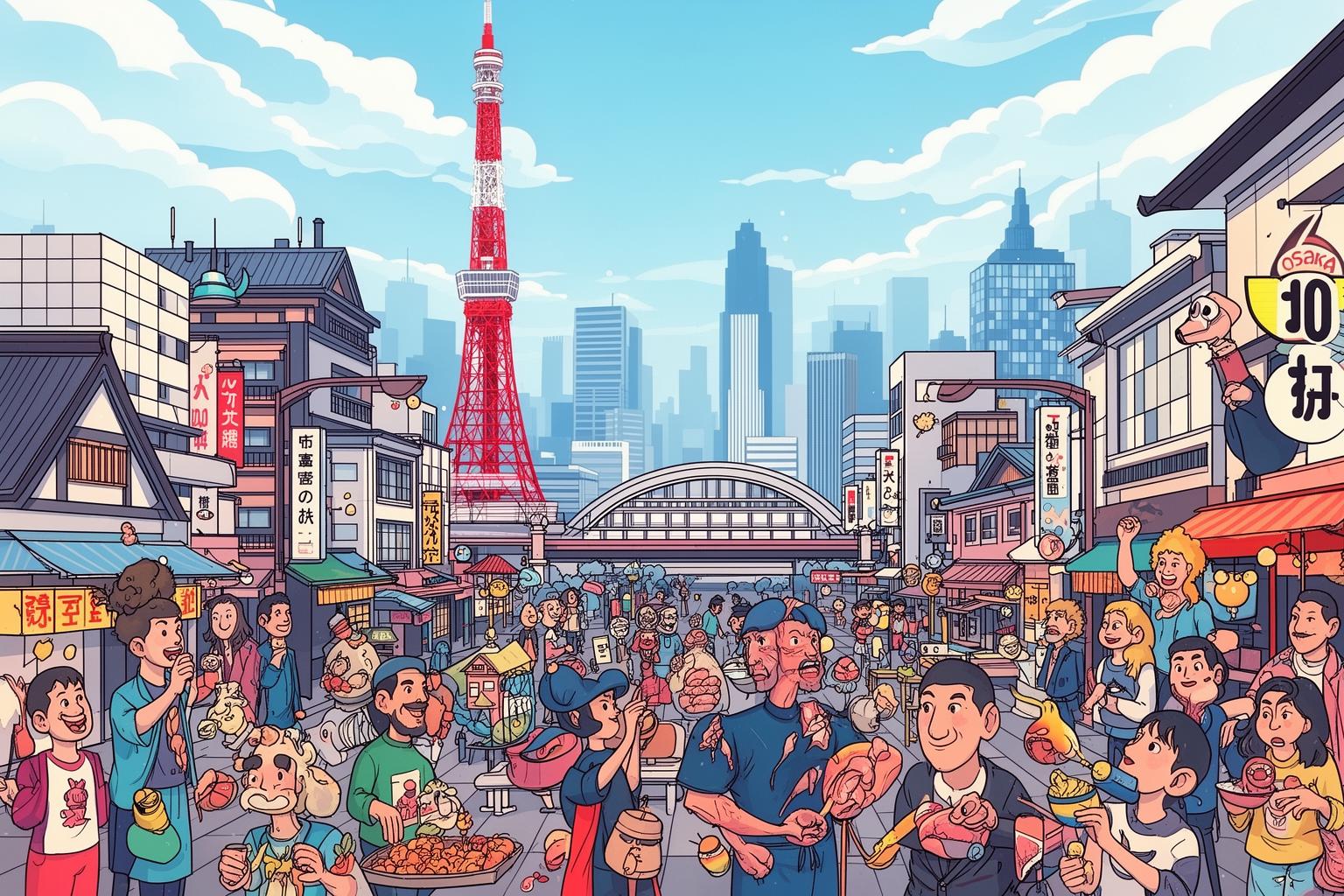
To the untrained eye, Osaka’s streets and sidewalks might seem like utter chaos. Cyclists move in all directions, appearing to disregard traffic signals, pedestrian priority, and even basic laws of physics. However, if you observe longer, you begin to recognize a pattern within the disorder. This isn’t a free-for-all; it’s a highly intricate, non-verbal negotiation happening at high speed. It’s a system founded on a mutual understanding of momentum, intent, and a collective agreement to make it all work.
It’s Not Chaos, It’s a System
The core principle of the Osaka Dash is radical efficiency. The objective is to travel from Point A to Point B with minimal deviation and zero wasted time. This mindset overrides nearly everything else. A red light isn’t an absolute stop; it’s a signal to evaluate cross-traffic. A crowded sidewalk isn’t a barrier; it’s an obstacle course. The entire city functions like fluid dynamics, where each cyclist acts as an individual particle within an ever-moving current. They weave and glide, constantly making micro-adjustments based on the movements around them. It’s a stunning, nerve-wracking dance of near misses. At its core, this unspoken agreement centers on mutual responsibility. Cyclists trust that pedestrians won’t make sudden, erratic moves, while pedestrians trust that cyclists can navigate tight gaps without collisions. This high-stakes pact is renewed thousands of times per minute on every major street, relying not on formal rules but on a shared, intuitive understanding at the street level.
The Unquestioned Queen of the Road: The Mamachari
At the heart of this system reigns the undisputed queen of Osaka’s streets: the mamachari, or “mom’s chariot.” These are far from lightweight racing bikes. They are sturdy workhorses designed purely for utility. A classic mamachari has a low, step-through frame, a wide, comfortable seat, a built-in kickstand, and most notably, vast cargo capacity. A deep basket rests at the front, while a strong rack, often fitted with a child seat, is at the back. These bikes serve as the urban equivalent of a family SUV. They ferry children to daycare, transport a week’s groceries from the market, and handle all kinds of weather. Riders of these machines are the true masters of the Osaka Dash. You’ll see mothers or fathers balancing toddlers, bags of daikon radishes, and designer handbags, all while holding an umbrella in one hand and steering with the other—never dropping below a steady pace. They are forces of nature, radiating a kind of gravitational pull. Pedestrians instinctively give way to them. Other cyclists steer clear. The mamachari rider is on a mission, and the whole city seems to understand it’s best to simply step aside. Their skill is born of necessity, and their confidence unwavering.
Reading the Unwritten Rules
To genuinely immerse yourself in Osaka life, you need to learn how to read the invisible code that governs its cyclists. This code combines physics, psychology, and local customs. It isn’t taught in any driving school; instead, it is absorbed through daily observation and participation. Forgetting the official rulebook is the first step. The real rules are far more flexible and far more crucial for your daily survival, whether you are on foot or riding a bike.
Sidewalks are Fair Game
In many parts of the world, and even in other Japanese cities, cycling on a crowded sidewalk is a major social faux pas, if not illegal. In Osaka, it is the default. While some designated bike lanes exist, they are few and far between. The true transportation arteries are the sidewalks, shared spaces where the delicate dance between pedestrians and cyclists unfolds. There is a clear, though unspoken, hierarchy. Pedestrians theoretically have the right of way, but bicycles carry momentum. This dynamic is fascinating. Cyclists are expected to perform the ‘Sidewalk Weave,’ a series of skillful maneuvers that slice through crowds without braking. Pedestrians, in turn, are expected to keep a predictable course and stay aware of their surroundings. You learn to listen for the faint hum of rubber on pavement approaching from behind. You learn not to stop abruptly to check your phone. The system functions only because both parties pay close attention. The moment a tourist freezes in a busy arcade to take a photo, the entire flow collapses into a chorus of ringing bells and quiet, exasperated sighs.
The Language of the Bell
In Osaka, the bicycle bell is not a friendly greeting. It is a sophisticated communication tool with its own grammar and syntax. A gentle, polite ting-a-ling from afar is seldom heard. Instead, the Osaka bell is used deliberately and precisely. A single, sharp chirin! behind you is a direct command meaning: “I am right behind you and have no intention of slowing down. Please acknowledge me by shifting a few inches to the left or right.” It is not a request but an instruction. A rapid, frantic series of chirin-chirin-chirin-chirin! is an emergency alert that means: “You have done something unpredictable and a collision is imminent. MOVE!” However, the most common form of communication is silence. The expert Osaka cyclist often uses no bell at all, operating on the assumption that you, the pedestrian, have the spatial awareness to sense their approach. The bell is reserved for clearing stubborn obstructions or correcting those not following the unwritten rules. It acts as punctuation in an otherwise entirely non-verbal conversation.
Intersections: A Game of Chicken
Watching Osaka cyclists approach a red light is a masterclass in risk assessment. A full stop is rare, made only when a wall of cross-traffic makes forward progress impossible. More commonly, they perform a ‘rolling stop,’ slowing just enough to scan for gaps among cars, pedestrians, and other bikes. If a safe opportunity arises, they take it—red light be damned. This behavior isn’t about breaking the law but stems from the sekkachi (impatient) spirit that defines Osaka’s character. Why wait for an arbitrary light to change when a perfectly safe gap exists now? It’s a constant, dynamic calculation. Cyclists judge the speed of oncoming vehicles, predict pedestrian movements, and monitor the intentions of riders beside them. It’s a high-stakes game of chicken played millions of times a day, and somehow, it almost always succeeds. This pragmatic approach to rules marks a key difference between Osaka and Tokyo. In Tokyo, rules are rules. In Osaka, they’re guidelines, with the real law being common sense and forward momentum.
The Osaka Mindset on Two Wheels

The Osaka Dash is more than just a mode of transportation; it perfectly captures the essence of the city’s character. It embodies a culture forged by centuries of commerce, where efficiency, straightforwardness, and a healthy distrust of rigid authority are ingrained in the local mindset. This is a city that prioritizes results over formal procedures.
Practicality Over Politeness
Osaka has long been a city of merchants. From the rice brokers of the Edo period to today’s small business owners, commerce drives the city’s rhythm. In business, time equals money, and wasting either is costly. This practical approach spills over onto the streets. A cyclist patiently waiting at an empty intersection is seen as wasting time. The focus is on practicality rather than politeness as defined by other cultures. The aggressive bell-ringing and close passing are not personal insults but the most efficient way to signal a need for space and keep moving. It’s a form of brutal honesty—no pretense. I need to get through, you’re in the way, so let’s resolve this quickly so we can both carry on. This can feel abrupt for newcomers, especially those from Tokyo, where preserving surface harmony (wa) is crucial. In Osaka, harmony is built on a shared understanding of one goal: getting things done.
The Illusion of Anarchy
A common misconception among foreigners is to view the Osaka Dash as pure, reckless chaos. It seems lawless because it operates under an unwritten code. The system functions not despite the lack of strict rule-following but because of heightened individual responsibility and awareness. Everyone in the flow—cyclists and pedestrians alike—is constantly watching, predicting, and responding. They read body language, anticipate movements, and trust others to do the same. The system only breaks down when someone behaves unpredictably. This is why tourists often cause (and suffer from) near-misses—they operate with a different set of expectations. They stop, turn, or move without checking, disrupting the delicate, fast-paced balance. To locals, this is far more dangerous than ten bikes running a red light together in a coordinated and predictable manner. Police seem to recognize this, generally turning a blind eye unless a cyclist is genuinely reckless. They understand that this organic, self-regulating system, despite its seeming madness, is what keeps the city moving.
Your Survival Guide to the Osaka Dash
Understanding the philosophy of the Osaka Dash is one thing; mastering it is another. Whether you choose to walk or ride, you must adapt your behavior to the local rhythm. Survival, and eventually comfort, comes from internalizing the unwritten rules and becoming a predictable part of the flow.
As a Pedestrian: Hone Your Sixth Sense
Your journey starts on foot. Before even considering riding a bike, you need to master the art of walking in Osaka. First, develop your situational awareness by using your ears as much as your eyes. Listen for the hum of tires, the click of gear shifts, and the dreaded chirin! Second, walk in a straight, predictable line—erratic movements disrupt the urban flow. If you need to stop, signal your intent or step aside to the edge of the sidewalk, out of the main current. Third, never assume you have the right of way, even at a crosswalk with a green light. Look both ways, then look again. Bicycles can come from any direction. Finally, give the mamachari plenty of space. They are the battleships of the sidewalk—less maneuverable and often carrying precious cargo. They have earned their space; respect it.
As a Cyclist: Adapt or Be Left Behind
If you choose to join the fray, confidence is essential. Hesitation is the most dangerous thing you can do when cycling in Osaka. When making a move—changing lanes, weaving through gaps, or rolling through intersections—commit fully. Timidity will confuse others and increase the risk of accidents. Become part of the assertive, non-verbal communication. Master the slow-speed wobble, crucial for navigating the tight confines of crowded shopping arcades. Understand the hierarchy: yield to cars and trams, but you hold more power than pedestrians. It’s your responsibility to navigate safely around them, but theirs not to obstruct you. Assume nothing: every car might turn without signaling, every pedestrian might step into your path, and every cyclist follows their own interpretation of traffic rules. Get a loud, quality bell and learn the local dialect. Don’t hesitate to use it to assert your presence. In Osaka, a quiet cyclist is an invisible cyclist—and an invisible cyclist is a vulnerable one.
Why the Osaka Dash Endures

The Osaka Dash is not just a temporary trend; it is a lasting feature of the city’s landscape, shaped by its distinctive geography and character. The city’s overwhelmingly flat terrain makes it a haven for cycling. As a dense, compact urban area, bicycles often prove faster and more convenient than cars or even the subway for short-to-medium-distance travel. Additionally, the city’s infrastructure has largely catered to cars and pedestrians, leaving cyclists to claim their space in the gaps—mainly on the sidewalks. This absence of formal cycling infrastructure has led to the emergence of the informal, intuitive system we see today.
In the end, the Osaka Dash persists because it perfectly mirrors Osaka itself. It’s a bit loud, slightly rough around the edges, and can seem daunting at first glance. It values practicality over aesthetics and doesn’t wait for approval. It captures the city’s energetic, pragmatic, and fiercely independent spirit. While Tokyo moves with polished, systematic grace, Osaka hustles, weaves, and dashes forward. The city’s rhythm is not in the quiet hum of a subway car but in the whirl of ten thousand bicycle wheels, each on its own urgent, efficient, and unapologetic journey. It is life at street level, raw and at full speed.