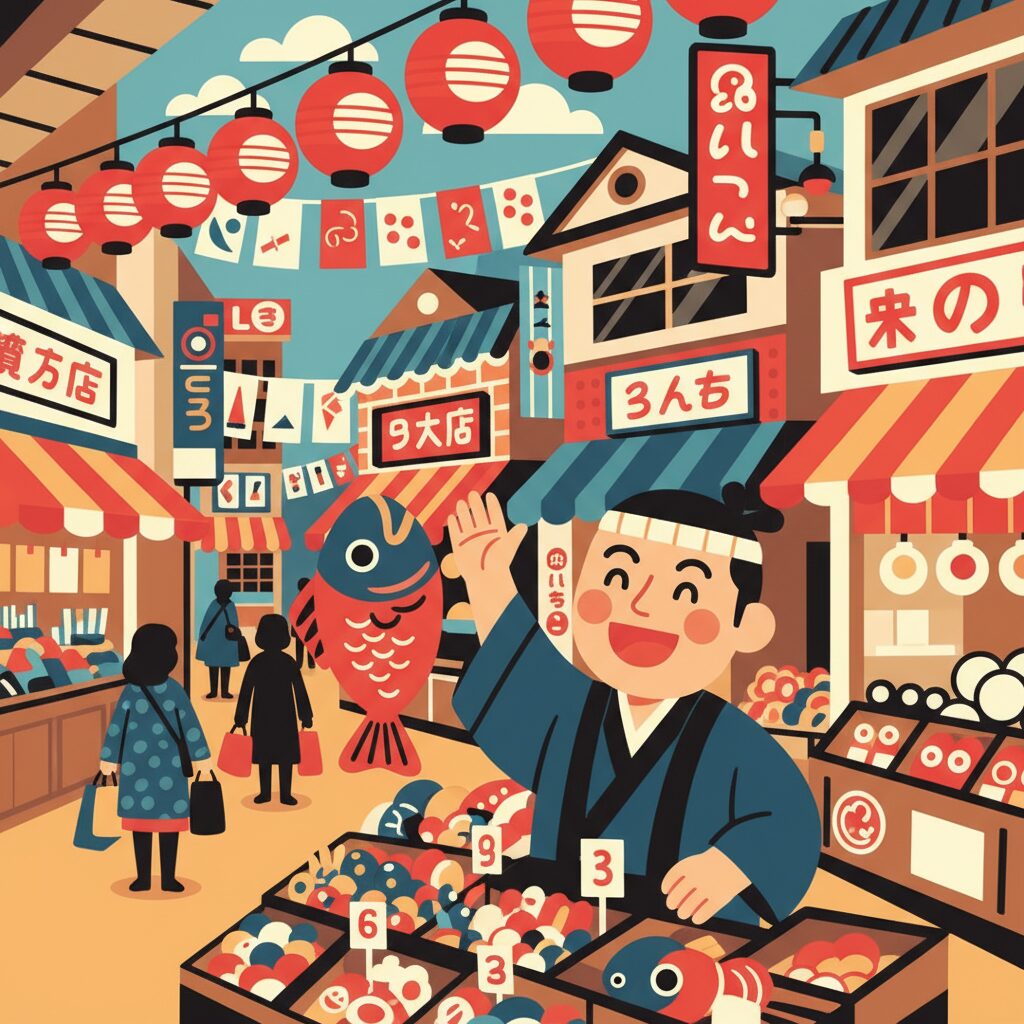
Walk out of a gleaming, silent supermarket in any modern city, and you’ll notice the quiet. The soft beep of a scanner, the gentle hum of refrigeration, the polite, almost whispered, “Thank you for your patronage.” You might have interacted with one person at the register, or maybe nobody at all, swiping your items over a self-checkout machine in a sterile dance of efficiency. It’s clean, it’s fast, and it’s profoundly anonymous. Now, forget all of that. I want you to step with me into a different world, a world that exists just a few blocks away from that quiet supermarket but feels like it’s on another planet entirely. I want you to step into an Osaka shotengai.
The air hits you first. It’s not one smell, but a dozen, all wrestling for your attention. There’s the sweet, smoky char of grilling eel from a tiny shop wedged between a pharmacy and a watchmaker. This gives way to the sharp, briny scent of the sea from a fishmonger’s stall, where glistening silver fish are laid out on beds of ice. A little further, the rich, savory perfume of simmering dashi broth and fried octopus from a takoyaki stand makes your mouth water. The sounds are just as dense. There’s the energetic, gravelly call of a vegetable seller announcing his daily specials—“Kyabetsu, hyaku-en ya de! Amain de!” (Cabbage, only 100 yen! It’s sweet!)—a rhythmic chant that forms the bassline of the arcade’s symphony. Layered on top is the clatter of a pachinko parlor, the squeak of bicycle brakes as someone weaves through the crowd, the laughter of old women gossiping on a bench, and the constant, cheerful greeting of “Maido!” (Thanks, as always!) echoing from every doorway. This isn’t just a place to buy things. It’s a living, breathing organism. It’s the true heart of neighborhood commerce and community in Osaka, and understanding it is the key to understanding the city itself.
For many foreigners, especially those coming from Tokyo’s polished and orderly environments, the shotengai can be a sensory overload, a chaotic jumble of sights and sounds that feels messy, even intimidating. It’s easy to see it as a relic, a charming but fading piece of Old Japan, destined to be replaced by the convenience of online shopping and mega-malls. But that’s a fundamental misunderstanding of what these covered arcades represent. They are not just collections of shops; they are the arteries of their neighborhoods, the stages upon which daily life unfolds, and the incubators of a unique commercial and social philosophy known as the akindo (merchant) spirit. This spirit, a blend of pragmatism, sharp business sense, and profound human warmth, is the invisible architecture that holds Osaka together. To live in Osaka is to orbit a shotengai, and to learn its rhythms is to learn the very pulse of the city.
Experience a different side of Osaka’s vibrant community by checking out a remote-work-friendly kissaten that perfectly complements the energetic pulse of the local shotengai.
The Concrete Canopy: A Neighborhood’s Artery
At its simplest, a shotengai is a street, often sheltered by a roof, lined with a dense array of small, independently owned shops. Yet this straightforward description doesn’t fully capture its essence. The roof is more than mere protection from Osaka’s intense summer sun and sudden rain showers; it serves as a psychological boundary. Step beneath the arcade’s canopy, and you enter a semi-public, semi-private space. It acts as the neighborhood’s shared living room, where the boundaries between commerce and community dissolve completely. The architecture itself tells a story. Weathered wooden storefronts from the Showa era stand proudly alongside shops boasting bright, modern aluminum facades. Faded hand-painted signs jostle for attention with blinking neon lights. The floor isn’t a pristine, polished surface but a patchwork of tiles and concrete, smoothed by decades of footsteps, bicycle tires, and shopping cart wheels.
This is a space designed for people, not cars. Life moves at a walking pace or the gentle rhythm of a mama-chari bicycle. The arcade creates a complete ecosystem for daily living. You can buy vegetables at one stall, purchase meat from a butcher who knows exactly how you like your pork sliced for shabu-shabu, and pick up fish from a man whose hands are permanently stained by his trade. Then, you can drop off your dry cleaning, collect a prescription at the pharmacy, buy a new pair of reading glasses, get a haircut, and enjoy a cheap, delicious lunch of udon noodles — all without ever leaving the comforting shelter of the arcade. These shops aren’t specialty boutiques catering to niche interests; they are the essential pillars of everyday life.
The sensory experience is everything. Close your eyes and listen. The dominant sound is human voices — not the hushed tones of a department store, but the full-throated, hearty sounds of people living their lives. Shopkeepers aren’t merely waiting for customers; they actively engage with the world, their voices a constant invitation to connect. A fruit seller might call out to a regular, “Oku-san, kyou no mikan, metcha umai de!” (Ma’am, the tangerines today are amazing!). You hear the rhythmic pon-pon-pon of a butcher tenderizing meat with a mallet, the sizzle and pop of fresh-fried prawns at a tempura shop, and the whirring of an old fan in a tea store. Each sound weaves into a rich tapestry of commerce and community.
And the smells tell the story of the day’s meals. In the morning, there’s the yeasty aroma of fresh bread from the local bakery and the savory scent of dashi being prepared for lunch. By midday, the air thickens with the smell of grilling fish and sizzling okonomiyaki batter. In the late afternoon, the sweet, comforting fragrance of mitarashi dango — skewered rice dumplings glazed with sweet soy sauce over hot coals — drifts through the air. This scent instantly transports any Osakan back to childhood, signaling the end of the school day with a comforting aroma. Unlike the filtered, sanitized air of a mall, the air in a shotengai is vibrant, heavy with the evidence of work, cooking, and life.
Decoding the Akindo DNA: The Soul of Osaka Commerce
To truly understand why the shotengai flourishes, you need to grasp the mindset of those who run it: the akindo, or merchants. The Osaka akindo is a cultural archetype, shaped in a city long recognized as Japan’s commercial heart. They are known for being pragmatic, fiercely independent, and guided by a unique philosophy that links business success with human connection. This philosophy rests on several core principles that are visible every day in the arcade.
More Than a Merchant, You’re a Neighbor
The key difference between a shotengai shopkeeper and a supermarket employee lies in the nature of their relationships. In the shotengai, connections aren’t transactional; they are personal and ongoing. The elderly woman running the tiny tobacco and candy shop has likely been there for fifty years. She watched you move into the neighborhood, saw your kids grow up, and asks why she hasn’t seen your husband lately. She is woven into the fabric of your life, and you into hers. This creates a strong bond of mutual loyalty.
This goes beyond simple friendliness. It reflects a deep understanding that good business is rooted in long-term trust and familiarity. The butcher doesn’t just sell meat; he remembers your son’s preference for pork cutlets prepared in a certain way. When you visit, he might say, “Kyou, ee tonkatsu you no buta-niku haitteru de,” (“Got some great pork in today for tonkatsu,”) because he’s not merely selling a product; he’s actively involved in your family’s meal plans. This type of personalized service can’t be replaced by any algorithm or loyalty card. It’s the ultimate customer relationship management, executed through genuine human attention rather than software.
‘Maido!’ and ‘Mokarimakka?’: The Rhythm of Conversation
The shotengai’s language is a dialect of its own, filled with expressions that reveal the akindo spirit. The most common greeting is “Maido!” or “Maido, ookini!” Literally, it means something like “each time” or “always,” but its real meaning is “Thank you for your continued patronage.” It’s a greeting that acknowledges a shared history and anticipates a future. It says, “I see you. You’re one of my regulars. Welcome back.” This instantly sets a warm, familiar tone, very different from the formal, stiff “Irasshaimase” (Welcome) you hear in Tokyo.
Even more iconic is the classic Osaka greeting, “Mokarimakka?” which literally means “Are you making money?” To outsiders, this might seem rude or intrusive regarding someone’s private finances. But in Osaka, it’s a standard, almost ritualistic greeting among merchants and even between merchants and customers. The usual reply is a wry, self-deprecating “Bochi bochi denna,” meaning “So-so, can’t complain.” The question isn’t serious; it’s a verbal handshake, a playful Osakan way of saying, “How’s business? How’s life? We’re all in this crazy game together, right?” It’s a gesture of camaraderie, a quick check-in that reinforces the sense of community and shared struggle. Business here is a conversation, not just a calculation.
The Gospel of ‘Omake’: A Little Something Extra
Nothing perhaps captures the akindo spirit better than the culture of omake. Omake refers to a small, free gift given by the seller to the buyer. It can be anything: the fruit seller tossing an extra orange into your bag, the butcher adding a few scraps of fat for cooking, the baker giving your child a small cookie, or the croquette shop owner throwing in an extra croquette when you buy ten. On the surface, it might seem like a simple marketing tactic, but it’s much more than that. Omake is the currency of goodwill. It’s a tangible expression of the relationship between buyer and seller. It’s the merchant’s way of saying, “I appreciate you,” without words. It transforms a simple economic transaction into a moment of human generosity and connection. This isn’t a calculated discount; it’s a spontaneous act of warmth. And it works remarkably well. That extra potato might be worth only 20 yen, but the feeling it creates—being seen and valued—is priceless. It’s what keeps people returning day after day, year after year, choosing to buy from “their” vegetable lady instead of a cheaper, more convenient supermarket.
A Tale of Two Cities: Why Tokyo Buys and Osaka Connects
The contrast between Osaka’s shotengai culture and Tokyo’s commercial environment is striking, highlighting the deep cultural divisions between Japan’s two major cities. While Tokyo emphasizes precision, formality, and aesthetic perfection, Osaka focuses on practicality, humor, and human connection. One feels like a carefully curated museum; the other resembles a loud, chaotic, and joyful family gathering.
The Transaction vs. The Interaction
In a typical Tokyo store, interactions are scripted and efficient. The clerk greets you formally, processes your payment with minimal fuss, bows, and politely thanks you. The aim is a smooth, error-free transaction. In an Osaka shotengai, the transaction often serves as the beginning of a genuine conversation. The shopkeeper is seen as a personality, not merely a functionary. They might offer unsolicited advice, crack jokes, comment on the weather, or ask about your day. The goal is not just to sell something but to engage with you on a personal level. This can be surprising for those accustomed to Tokyo’s reserve, as you might encounter direct questions that feel quite personal. However, this directness is not rudeness; it signifies that the merchant regards you as a fellow human being, not just a customer. By breaking down the formal barrier between buyer and clerk, they invite you into their world. The interaction itself becomes part of the experience you are receiving.
The Sound of Silence vs. The Roar of Life
Stroll through a Tokyo department store, and you’ll notice the carefully managed soundscape: soft ambient music, polite announcements, and the hushed murmurs of shoppers. It’s an environment created for calm, contemplative consumption. The Osaka shotengai offers the exact opposite. It’s a lively festival of sound. Merchants use their voices as instruments, creating a loud, competitive, yet ultimately harmonious symphony of commerce. They are unabashed about promoting their goods, with voices full of personality and passion. There’s a theatrical element to it all. The fishmonger might hold up a giant tuna collar and call out, “Saa, yasui de! Motte ike, dorobou!” (“Come on, it’s cheap! Take it, it’s a steal!”). This boisterous energy generates excitement and immediacy, turning shopping into an active, engaging event rather than a passive task. It reflects Osaka’s broader culture, which values direct expression, humor, and a fondness for spirited chaos over quiet restraint.
Navigating the Arcade: A Foreigner’s Field Guide
For a non-Japanese resident, the shotengai can appear to operate according to a set of unwritten rules. Cracking this code is key to fully enjoying the experience and transitioning from being an outsider to becoming an integral part of the neighborhood.
The Banter is a Welcome Mat, Not an Insult
The straightforward, often teasing communication style of Osaka merchants can easily be misunderstood. The woman at the vegetable stand might notice you picking up a tomato and joke, “Anata, ryouri heta sou ya noni, sonna ee tomato kau no?” (“You don’t seem like a very good cook, but you’re buying such a nice tomato?”). In many cultures, this might be taken as an insult. In Osaka, however, it’s an invitation. It’s a playful tease meant to see if you can take a joke and respond in kind. The right reaction is not to take offense, but to laugh and reply, “Kore de oishii mon tsukuru nen!” (“I’m going to make something delicious with this!”). This back-and-forth, a kind of verbal sparring known as tsukkomi and boke, is at the core of Osaka’s communication style. Participating shows you belong. They’re testing you, and if you pass, you’re accepted.
Haggling is a Dance, Not a Fight
Osaka’s reputation for shrewd merchants leads many foreigners to assume they should haggle over everything. This is a misconception. You don’t haggle over a 150-yen croquette or a bunch of spring onions. Haggling in the shotengai isn’t the aggressive price-cutting battle you might expect in a tourist market elsewhere. It’s a subtle dance reserved for particular situations—perhaps when purchasing a more costly item like an appliance from a family-run shop or buying in bulk. More importantly, the best “discounts” come not from demanding lower prices but from building a relationship. Become a regular customer. Chat with the owner. Show genuine appreciation for their products. After a few visits, prices may soften, or a generous omake might find its way into your bag. Loyalty is rewarded, not aggression.
It’s Not ‘Dirty,’ It’s Lived-In
Compared to a newly built shopping mall, a sixty-year-old shotengai may look a bit worn. The paint might be chipping, the signs rusty, and the floors far from spotless. It’s easy to mistake this for neglect or poor cleanliness. But this is a serious misunderstanding. The wear on a shotengai doesn’t signal decay; it testifies to its vibrancy. It’s the patina of a place deeply and continually used by its community. Every scuff on the floor, every faded banner, every hand-written sign tells a human story. It’s the difference between a brand-new, stiff pair of leather shoes and a pair worn for years, molded to your feet and carrying the memory of every journey. The shotengai is comfortable, authentic, and cherished. Its imperfections are proof of its purpose.
The Shotengai as a Social Safety Net

The true value of the shotengai goes well beyond commerce. In an era of growing social isolation, these arcades act as a vital, organic social safety net, especially for the community’s most vulnerable members: children and the elderly.
Eyes on the Street
Urban theorist Jane Jacobs emphasized the significance of “eyes on the street”—the concept that continuous, informal surveillance by residents and shopkeepers fosters a safe and lively neighborhood. The shotengai perfectly embodies this idea. Merchants are present all day, every day. They recognize the locals’ faces. They watch children walking to and from school. They notice if an elderly regular hasn’t visited to buy their daily newspaper and tofu. If a child scrapes a knee, someone from the pharmacy quickly offers a bandage. If an older person seems unwell, someone checks if they need assistance. This informal care network is more effective than any official security system. It creates a tangible sense of safety and belonging, reassuring people that they are not alone and that someone is always looking out for them.
The Rhythm of a Day
Life in a neighborhood centered around a shotengai follows a human-scale rhythm. The day starts with the clatter of metal shutters being raised and shopkeepers greeting each other as they prepare their displays. Late morning brings elderly residents, who shop leisurely, using the outing to socialize and stay active. The afternoon is filled with the cheerful chaos of children, newly freed from school, spending their pocket money on inexpensive snacks and sweets. Early evening sees a final wave of working parents picking up ingredients for dinner, the air carrying the promise of a home-cooked meal. This daily rhythm connects residents to one another and the natural cycles of the day, offering a structure and shared experience often missing in modern car-centric suburbs or anonymous high-rise living.
The Arcade at a Crossroads: Reinvention and Resilience
It would be misleading to depict the shotengai as a problem-free world. Many arcades are grappling with significant challenges. Japan’s aging population means numerous shopkeepers are retiring without successors to carry on their family businesses. The relentless competition from large supermarkets, convenience stores, and the vast reach of online retail is undeniable. In some less-populated areas, the unfortunate sight of shotengai with more closed shops than open ones is all too common.
However, to declare the shotengai dead would be to underestimate the resilience and practicality of the Osaka akindo spirit. This culture does not cling to the past out of mere nostalgia; it adapts to thrive. Throughout Osaka, quiet but powerful reinvention is underway. In some arcades, young entrepreneurs, attracted by low rent and an authentic atmosphere, are opening trendy coffee shops, craft beer bars, artisanal bakeries, and stylish vintage clothing stores alongside 80-year-old fishmongers and traditional pickle shops. This fusion creates a compelling blend of old and new—a multi-generational ecosystem where varied business models coexist.
Other shotengai are embracing specialization, becoming known for particular products, like the kitchenware of Sennichimae Doguyasuji or the retro video games of Den Den Town. They host community events, flea markets, and seasonal festivals to attract visitors and highlight the value of shared physical spaces. The shotengai mirrors Osaka itself: not always polished, occasionally loud and chaotic, but endlessly adaptable, deeply human, and with a heart that refuses to quit. Its future lies not in returning to a golden past but in a smart, pragmatic evolution. As long as the people of Osaka cherish a good laugh, personal connections, and the unexpected joy of a little something extra, the spirit of the arcade, in some form, will undoubtedly endure.