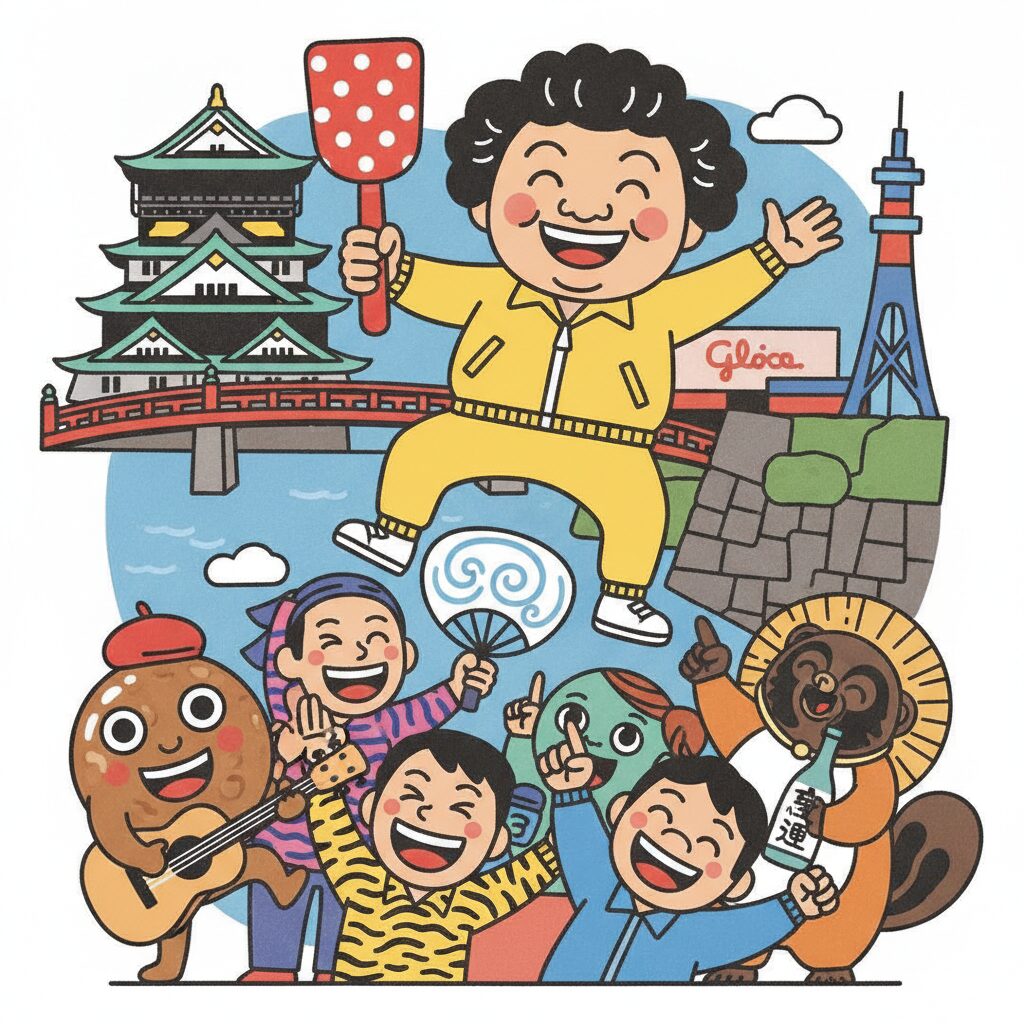
You’re standing in line at a takoyaki stand in Namba. The guy in front of you, a total stranger, turns around, points at your plain t-shirt and says, with a dead-serious face, “Wow, that’s the fanciest shirt I’ve ever seen. Is it your wedding day?” For a split second, you’re confused. Is he making fun of you? Is this some kind of passive-aggressive Osaka welcome? Then you see the twinkle in his eye, and the people around you are grinning, waiting for your response. Welcome to Osaka, where a normal Tuesday feels like an improv comedy show, and the punchline isn’t just a joke—it’s the whole point of the conversation.
If you’ve spent any time in Tokyo or other parts of Japan, you’ve likely mastered the art of polite distance, the subtle nod, the quiet reservation that keeps social gears running smoothly. You’ve learned to read the air, to blend in, to not cause a stir. Throw that playbook out the window. Here in Osaka, the social currency isn’t quiet harmony; it’s shared laughter. Humor is the city’s primary social lubricant, the tool used to break down walls, build instant rapport, and turn a transaction with a cashier into a memorable human connection. For outsiders, this can be baffling, even intimidating. But once you understand the rhythm, you realize it’s not aggression or sarcasm. It’s an invitation. It’s the city reaching out, asking you to play along. This isn’t about being a comedian; it’s about understanding that in Osaka, a good laugh is worth more than a thousand polite bows.
Embracing Osaka’s penchant for lively interaction, food enthusiasts can elevate their visit by indulging in an intimate kappo dining experience that captures the city’s playful culinary spirit.
The Unspoken Rule: Humor is Connection
In most places, you get to know someone first and then, maybe, share a joke. In Osaka, you share a joke to get to know someone. This reverses the usual order of social interaction. The unspoken rule here is that humor is the quickest way to connect. It acts as a shortcut through the layers of formality that often characterize Japanese relationships. A shared laugh signals, “We’re on the same wavelength. We can relax.” It’s an incredibly effective way to foster a sense of community, even with someone you’ll only encounter for thirty seconds while buying a can of coffee from a vending machine.
Consider it this way: in a Tokyo business setting, you might spend weeks exchanging polite emails, exchanging formal greetings, and carefully nurturing a relationship before any humor is introduced. In Osaka, a business partner might start a meeting by theatrically complaining about the terrible weather or making a self-deprecating joke about their awful tie. This isn’t unprofessionalism; it’s a deliberate tactic. It’s an attempt to form a human-to-human connection before getting into the cold, hard details of a business deal. They are testing the waters, seeking a partner who can handle both the pragmatism and playfulness the city is known for. Responding with stiff formality can suggest you’re not prepared for the Osaka style. A simple chuckle and a playful reply, on the other hand, can close a deal faster than any PowerPoint presentation.
This approach extends to every aspect of daily life. The woman at the bakery who says, “Buy this bread, it’s so good it’ll make you smarter!” isn’t just trying to sell you something. She’s aiming to brighten your day and build a friendly rapport so you’ll want to return. The elderly man on the train who notices you looking at your phone and jokes, “Don’t work too hard, you’ll break the internet!” isn’t being intrusive. He’s trying to share a brief moment of lightheartedness in an otherwise impersonal public space. Resisting or, worse, ignoring this is perceived as cold. It’s like refusing a handshake. Engaging, even with just a smile, completes the interaction and confirms the connection.
Decoding the ‘Boke’ and ‘Tsukkomi’ Dynamic
To truly grasp Osaka humor, you need to understand the basic grammar behind its comedy: the dynamic between the ‘boke’ and the ‘tsukkomi’. This isn’t just the stage routine of the manzai comedy duos you see on TV; it’s the core structure of everyday conversation. It’s a verbal dance, and everyone in Osaka knows how to perform it.
What is ‘Boke’? The Art of the Absurd
The ‘boke’ is the funny character—the fool—who says something silly, absurd, or a bit offbeat. It derives from the verb ‘bokeru’, which can mean to become senile or absent-minded. In conversation, it’s a deliberate act of playing dumb or making an exaggerated statement to set up the punchline. The crucial point is that the ‘boke’ expects a response. It’s like tossing out a verbal softball, fully anticipating someone will hit it.
You’ll encounter this everywhere. A friend might glance at the clear blue sky and, with a straight face, say, “Ah, looks like a typhoon’s coming.” That’s a ‘boke’. A coworker might see you struggling with a jar and say, “You need a license for those muscles.” That’s a ‘boke’. A shopkeeper might hold up a perfectly ordinary daikon radish and claim, “This one just arrived from Mars. Very rare.” That’s a ‘boke’. These statements are intentionally ridiculous, designed to be easily knocked down. It’s a low-risk, high-reward style of humor. The ‘boke’ takes a small chance by saying something foolish, creating an opportunity for someone else to shine by correcting them.
What is ‘Tsukkomi’? The Sharp Retort
The ‘tsukkomi’ is the straight man who delivers the punchline by pointing out the absurdity of the ‘boke’s’ remark. The word ‘tsukkomi’ means to thrust or poke in, and that’s exactly what it does—it punctures the ridiculousness of the ‘boke’s’ statement. The most famous ‘tsukkomi’ phrase is “Nande ya nen!” which roughly translates to “Why?!” or “What the heck are you talking about?!” But a ‘tsukkomi’ can be any kind of comeback, from a simple correction to a light smack on the arm.
Let’s revisit our examples.
- When your friend says, “Looks like a typhoon’s coming,” on a sunny day, the ‘tsukkomi’ is, “Nande ya nen! Look at the sky!”
- When your coworker says, “You need a license for those muscles,” the ‘tsukkomi’ is, “Be quiet and help me open this.”
- When the shopkeeper claims the radish is from Mars, the ‘tsukkomi’ is, “If it’s from Mars, it should be more expensive! Give me a discount!”
Importantly, the ‘tsukkomi’ isn’t mean-spirited. It’s not an attack. Instead, it’s a sign of affection and engagement. It shows you were listening closely enough to notice the absurdity. A good ‘tsukkomi’ completes the comedic exchange, creating a shared laugh and strengthening the bond between the two people. It says, “I get your humor. I’m on your wavelength.”
The Risk of Silence
So, what happens if you don’t respond? What if the Martian radish comment is met with a polite, puzzled smile and silence? To an Osakan, this is deeply unsatisfying. The verbal softball just dropped to the ground with a sad thud. The conversational dance stopped awkwardly. In many cultures, remaining silent might be considered polite if you don’t understand or want to engage. In Osaka, however, it can be seen as disinterest, aloofness, or even a lack of intelligence. You failed to “get it.” The silence isn’t peaceful; it’s an empty space where a connection should have formed. Failing to provide a ‘tsukkomi’ is like leaving someone hanging for a high-five. It’s simply… awkward. This is one of the biggest cultural misunderstandings for newcomers. Your effort to be polite by not challenging the absurd comment comes across as cold.
Humor in the Marketplace: The Language of Commerce
Nowhere is the spirit of Osaka humor more vividly alive than in its shotengai, the covered shopping arcades that serve as the lifeblood of local neighborhoods. These places aren’t sterile, quiet centers of commerce; rather, they are lively, bustling, and brimming with character. Here, banter is not a flaw but a feature, with humor intricately woven into the very act of buying and selling.
The Chatty Shopkeeper Trope is Real
The stereotype of the loud, witty, fast-talking Osaka shopkeeper exists for good reason: it’s true. A visit to buy vegetables at the Kuromon Market or any local shotengai rarely involves a silent transaction. The ‘obachan’ (auntie) selling pickled vegetables won’t just weigh your purchase and take your money. She’ll likely comment on your Japanese skills, ask where you’re from, and crack a joke about how her pickles will help you live to 150 years old.
A typical conversation might go like this: You: “I’ll have three of these eggplants, please.” Shopkeeper: “Three? Throwing a party? You’re too young to have so many friends!” (‘Boke’) You: “These are just for me! I’m a big eater.” (‘Tsukkomi’) Shopkeeper: “A big eater! Good, good! You need energy. Here, I’ll add a small one for free, for energy. Don’t tell my husband.”
This entire exchange is a performance. The joke about having too many friends, your playful comeback, her conspiratorial whisper—it’s all part of the experience. You leave with your vegetables and a smile. This interaction fosters a personal connection, transforming a simple purchase into a memorable moment. It’s why people stay loyal to local shops instead of giant, impersonal supermarkets. You’re not just a customer; you’re part of the audience, and sometimes a fellow actor on the stage.
“Mokkari makka?” – The Greeting That’s Not a Real Question
Spend enough time in Osaka’s business districts or shotengai, and you’ll inevitably hear the classic merchant greeting: “Mokkari makka?” Literally, it means “Are you making a profit?” or “Is business booming?” To outsiders, this might sound rude or intrusive—why would a stranger inquire about your finances? But this is not meant literally. It’s Osaka’s way of saying, “How’s it going?” or “What’s up?” A legacy from Osaka’s merchant past, it reflects how neighbors’ business fortunes were closely linked.
The typical response isn’t a detailed financial update, but “Bochi bochi denna,” roughly translating to “So-so” or “Can’t complain.” This ritualistic exchange perfectly captures Osaka’s spirit. It honors the city’s commercial heritage while turning a serious topic into a lighthearted, formulaic, and friendly greeting. It’s business, but played as a game—and another example of how Osakans use language to sustain a constant sense of warmth and camaraderie.
Tokyo Reserve vs. Osaka Banter: A Tale of Two Cities
The contrast between Osaka and Tokyo is striking, with humor at the core of this difference. It’s not that people in Tokyo lack a sense of humor—they certainly do. The distinction lies in how it is used. In Tokyo, humor tends to be reserved for private moments among close friends or trusted colleagues. In public, the prevailing attitude is one of polite, unobtrusive reserve. In Osaka, humor is a public resource, accessible to anyone at any time.
The Elevator Test
A simple elevator ride reveals everything you need to understand. In Tokyo, stepping into an elevator with strangers triggers an unspoken rule of silence. Everyone faces forward, avoids eye contact, and acts as if alone. The space is shared physically, but not socially. Speaking would be seen as an intrusion.
In Osaka, it’s a different story. When you step into a department store elevator in Umeda carrying a bag from a well-known cheesecake shop, it’s almost certain that someone—a middle-aged woman, a young student, or an elderly man—will glance at your bag and say something like, “Oh, you got the good stuff! I’m jealous!” or “Buying that for me? You’re too kind!” This isn’t an invasion of your privacy but an invitation. They’ve thrown you a conversational ball. You can smile and reply, “It’s a reward for a hard week,” leading to a pleasant, brief conversation. Tokyo’s elevator silence maintains order and respects personal space. Osaka’s elevator chatter builds a temporary, friendly community in the same space.
Reading the Air vs. Creating the Air
This difference arises from a fundamental concept in Japanese culture: ‘kuuki wo yomu,’ or “reading the air.” It means sensing the mood of a situation and acting to preserve group harmony. In Tokyo, this idea is paramount, with the aim of blending smoothly into the existing atmosphere without causing disturbance.
In Osaka, however, people often ‘create the air’ themselves. If a scene feels too stiff, too quiet, or too formal, an Osakan is likely to brighten it with warmth and humor. They might tell a joke, make a self-deprecating remark, or playfully tease someone to ease tension. They’re not disrupting harmony; they’re actively forming a different kind of harmony—one founded on shared laughter instead of shared silence. This can feel jarring to those used to Tokyo’s style, who may find it loud or intrusive. But for Osakans, a silent, tense room is much more uncomfortable than the risk of a joke falling flat.
Navigating Osaka Humor as a Foreigner
So, how do you, as a non-Japanese resident, fit into this world of endless banter? The good news is that the bar is incredibly low, and your status as a foreigner actually works to your advantage.
You Don’t Have to Be a Comedian
First and foremost, take it easy. Nobody expects you to be a manzai expert. The goal isn’t to be hilarious; it’s to be engaged. Osakans value effort. When a shopkeeper cracks a joke, you don’t need a witty retort that steals the show. A simple, sincere laugh and smile often make the perfect ‘tsukkomi’. It shows you got the joke, appreciated the effort, and are part of the moment. Overdoing it can feel forced. The aim is connection, not winning a comedy prize. Just being present and receptive covers most of the ground.
Your ‘Gaijin’ Status is a Superpower
Being clearly non-Japanese is like holding a “get out of jail free” card in social settings. Your mistakes aren’t just forgiven—they’re often seen as endearing. If you try a joke and it feels awkward, or if your ‘tsukkomi’ misses the mark, no one will harshly judge you. In fact, they’ll probably be thrilled you gave it a shot. Your effort to embrace the local culture on its terms earns you huge points. They know you’re learning and appreciate your attempt at joining in. This grants you the freedom to experiment and find your own conversational flow without the social pressure a native might feel. So lean into it. Give it a go. The worst outcome is a puzzled look, quickly replaced by a hearty laugh when they catch your intent.
A Starter Kit for ‘Tsukkomi’
While you don’t need to be an expert, having a few simple ‘tsukkomi’ phrases ready can make conversations much more enjoyable. Here are some basics to get you going:
- Nande ya nen! (なんでやねん!): The classic. Literally means “Why?!” but used like “No way!”, “What are you talking about?!”, or “You’ve got to be kidding me!” It’s a versatile response to any obvious ‘boke’. Use it with some energy.
- Honma ka? (ほんまか?): “Really?” or “Are you serious?” A softer ‘tsukkomi’, great for playful disbelief without the punch of “Nande ya nen!”
- Akan! (あかん!): “No good!” or “That’s not right!” Perfect for teasingly shutting down a ridiculous idea. If a friend suggests walking to Kyoto, just say “Akan!” with a laugh.
- Meccha omoiroyan! (めっちゃおもろいやん!): “That’s hilarious!” Sometimes the best ‘tsukkomi’ is just showing you enjoyed the joke. It lets people know you’re in on the fun.
Using even one of these phrases in the right moment will quickly endear you to locals. It demonstrates you’re not just observing Osaka life—you’re actively participating.
In the end, the nonstop jokes, teasing, and banter aren’t just noise. They’re the city’s unique soundtrack—a sound of people building connections, moment by moment, with everyone around them. It’s a culture that cherishes shared laughter over stiff politeness. For newcomers, the rhythm might be hard to catch at first. It can seem chaotic or even harsh. But once you stop just listening and start joining in, you’ll find the true heart of this city. A heart that beats with the joyful rhythm of a perfectly timed punchline. And you’re always welcome to be part of the act.