When you picture high-end dining in Japan, what comes to mind? For many, it’s an image of hushed tones, serene private rooms, and a kind of monastic reverence for the food. It’s an experience wrapped in layers of silent, beautiful formality, where the chef is a distant, almost mythical figure working unseen behind closed doors. This image, often shaped by portrayals of Tokyo’s most exclusive establishments or the solemnity of a Kyoto kaiseki meal, is certainly one facet of Japanese culinary art. But here in Osaka, we do things a little differently. Here, we have a tradition that takes that exquisite artistry and plants it right in front of you, stripping away the silence and replacing it with the sizzle of a grill, the sharp cadence of a perfectly wielded knife, and most importantly, the warmth of human conversation. This is the world of kappo, and it’s arguably the most honest, engaging, and quintessentially Osaka way to experience the pinnacle of Japanese cuisine.
Kappo (割烹) is a word that itself tells you everything you need to know. The characters mean “to cut” (割) and “to cook” (烹), typically with fire. It signifies a style of dining where the chef performs these fundamental acts of cooking directly in front of the diners, usually across a clean, smooth wooden counter. This isn’t just a seating arrangement; it’s a philosophy. It’s a declaration of transparency, a commitment to immediacy, and an invitation to a shared experience. While the rest of the world has caught on to the “chef’s table” or “open kitchen” concept, Osaka has been perfecting this intimate form of dining for generations. To sit at a kappo counter is to do more than just eat a meal; it’s to witness a performance, to engage in a dialogue, and to grasp a fundamental truth about the character of this city—a character that values substance over stuffiness, skill over secrecy, and a genuine connection over cold perfection. Forget what you think you know about fine dining. Let’s pull up a stool at the counter and see how Osaka serves luxury with a side of personality.
To further immerse yourself in Osaka’s vibrant food culture, consider checking out our standing bars etiquette guide, which offers an insightful look at the city’s lively social customs.
Beyond the Plate: The Counter as a Stage
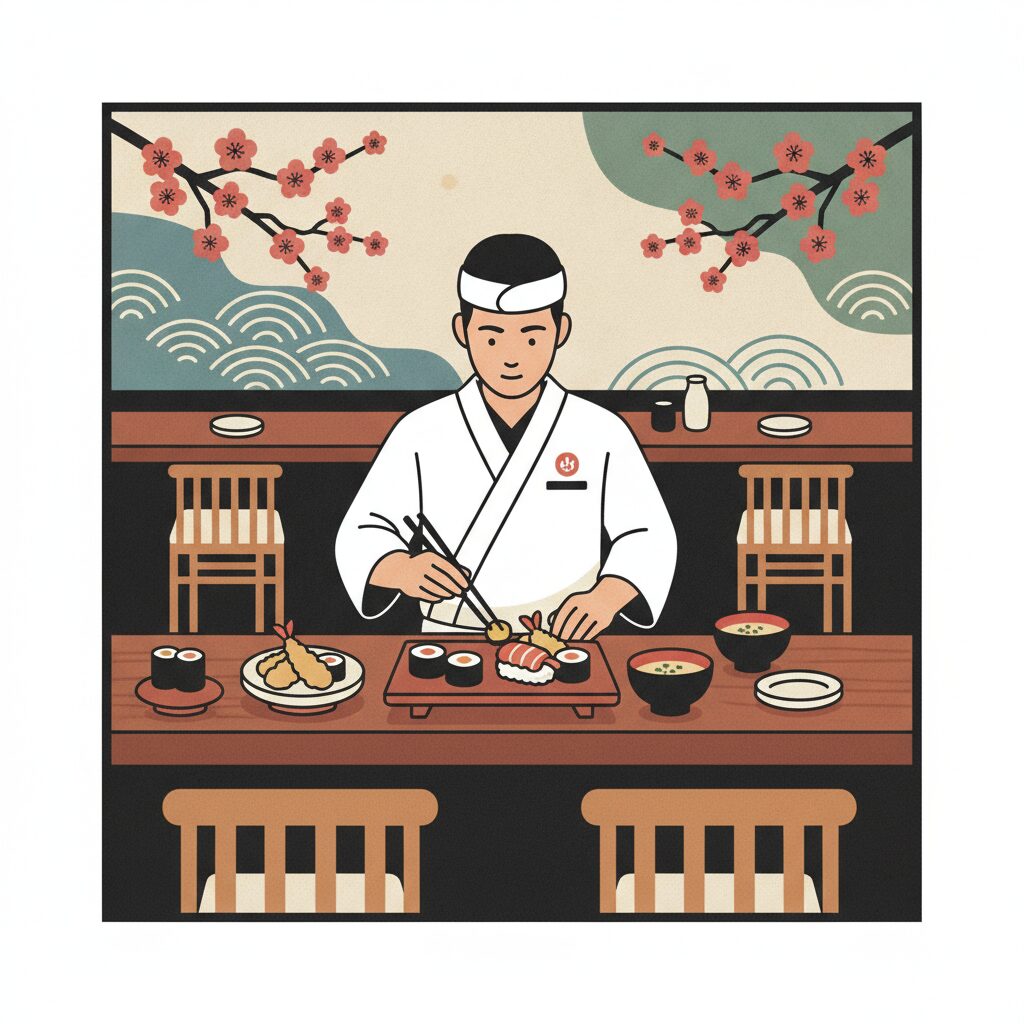
Step into a kappo restaurant in the lively entertainment districts of Kitashinchi or the more tranquil alleys of Shimanouchi, and the first thing that strikes you is the space. It’s small. Intimate. Often, the entire establishment consists of a single L-shaped counter seating around eight to twelve people. There are no vast dining rooms, no private booths. The focal point is clear and undeniable: the chef, or taisho. This is their stage, and you have a front-row seat. The polished wood counter serves as the proscenium arch, separating your world from theirs, yet also acting as the very bridge that connects you. Behind it, the taisho stands amid a meticulously arranged selection of tools and ingredients. Gleaming knives lie like surgical instruments. Earthenware pots simmer gently over carefully tended flames. A traditional charcoal grill, the shichirin, might glow softly in a corner, awaiting its turn. Everything is in its place, a testament to a lifetime of discipline and preparation.
This intentional arrangement contrasts sharply with the kitchen setup found elsewhere. In a typical restaurant, the kitchen is a hidden realm of controlled chaos, a backstage area meant to remain unseen. The magic occurs behind swinging doors, and the finished dish appears as if by magic. Osaka’s kappo tradition rejects this division. It insists that the process is as vital as the product. The value lies not only in the exquisite flavor of a perfectly grilled piece of nodoguro (blackthroat seaperch), but also in watching the chef’s focused expression as they salt it, in witnessing the precise moment it’s placed on the grill, and in hearing the delicate sizzle as the skin crisps. It’s a multisensory experience that builds anticipation and deepens appreciation for the craft. You see the effort, the skill, the intense concentration. This transparency reflects a core Osaka value. People here cherish honesty and directness. They want to witness the work. A slick presentation without visible substance is often met with suspicion. By revealing everything openly, the kappo chef makes a statement: “Here is my skill. Here are my ingredients. Nothing is concealed.” This creates a strong bond of trust between chef and diner, an unspoken pact of quality and respect.
The Art of Conversation: More Than Just ‘Irasshaimase’
If the counter represents the stage, then the conversation is the script—an improvised script performed every night. This is where the contrast with Tokyo’s high-end dining culture is most striking. While a top-tier sushi master in Ginza might share a few quiet words about the origin of a tuna piece, the experience often involves profound, almost reverential silence. The focus remains entirely on the food, inviting diners to worship at the altar of perfection. In Osaka, while the food is equally revered, that reverence is expressed through joyful engagement rather than silence. The taisho at a kappo restaurant is not merely a chef; they are a host, an educator, and a master conversationalist—the heart and soul of the evening. The silence is replaced by a comfortable, flowing dialogue that draws you into the experience from the moment you sit down. The greeting is warm and personal. They’ll inquire about your origin, your preferred drinks, and perhaps make a lighthearted remark about the weather or the day’s news. This is not mere small talk but a way for the chef to gauge your personality and begin tailoring the evening specifically for you. This embodies Osaka’s famous friendliness, but it is far from a simple cliché. It is an active, intelligent, and highly skilled form of hospitality.
As the meal advances, the conversation deepens and naturally revolves around the food. The chef presents each dish with more than just its name, sharing its story: “This bamboo shoot was harvested this morning from the Nose mountains. The recent rain made them particularly sweet.” Or, “We’re entering hamo (conger eel) season. Watch me perform the honegiri,” as they make dozens of exquisite, precise cuts into the eel’s flesh—a mesmerizing showcase of knife skills that makes the tiny bones edible. You are encouraged to ask questions: “What is this vegetable?” “Which sake pairs best with the sashimi?” The responses are never curt; they are generous, filled with pride and a genuine eagerness to share knowledge. This exchange transforms the meal from passive consumption into an active, educational, and deeply personal event. It dissolves the formal barrier between creator and consumer. In that moment, you are not simply a customer; you are a welcomed guest in their world, participating in the nightly ritual of their craft. This reflects a broader Osaka ethos that values human connection in commerce. A transaction should be more than just exchanging money for goods; it should be an exchange of energy, stories, and a shared moment between two people.
Reading the Room: The Unspoken Dance of Service
One of a kappo taisho’s most remarkable skills is their ability to read the room—or more precisely, to read each individual customer at the counter. Their social intelligence is as sharp as their knives. This is not a one-size-fits-all performance. The chef constantly and subtly observes, adjusting their approach accordingly. A young couple on a romantic date might be given more space and privacy, with the chef interjecting only at key moments to softly explain a dish. A group of business colleagues celebrating a deal might receive a more boisterous, performative style, with the chef cracking jokes and keeping energy lively. A solo diner who clearly appreciates food will be engaged in a detailed, technical conversation about aging methods and fermentation. This intuitive ability to gauge a customer’s mood and expectations is a hallmark of high-level service in Japan, but in Osaka, it feels less like formal training and more like genuine emotional intelligence. It is the art of omotenashi (Japanese hospitality) filtered through a pragmatic, people-centered Osaka perspective.
This adaptability arises from a culture less focused on rigidly following formal rules and more concerned with the ultimate goal: making the customer happy. Whereas in Tokyo the “correct” way of doing things can sometimes take precedence, in Osaka, the outcome is what matters most. The taisho wants you to leave not only satisfied with the food but uplifted by the entire experience. They want you to feel seen and understood. This is why foreigners who show genuine curiosity often encounter remarkable warmth and openness. The chef recognizes a kindred spirit, someone eager to connect, and will go to great lengths to meet them halfway. They might bring out a special bottle of sake or prepare a small off-menu dish just to gauge your reaction. This is the “why” behind the stereotype of the friendly Osakan. It is not superficial cheerfulness but a deep-seated desire to find common ground and build a real, albeit temporary, relationship across the counter. It’s a dance of social cues and shared moments, with the taisho always leading the steps with masterful grace.
“Omakase” with a Twist: A Dialogue, Not a Dictate
The most common way to dine at a kappo restaurant is omakase, which means “I’ll leave it up to you.” You entrust the entire meal to the chef’s discretion, allowing them to guide you through a sequence of seasonal dishes that highlight the best ingredients of the day. However, the concept of omakase can feel quite different in Osaka compared to other cities. In some settings, omakase can be a rather passive experience for the diner. The chef follows a set course, a perfectly orchestrated symphony of flavors, and the diner’s role is to receive it. It is a one-way transmission of the chef’s vision. In Osaka kappo, however, omakase often feels more like a collaborative process, a dialogue rather than a dictate. While the chef remains firmly in control, they continuously seek your feedback, both verbal and non-verbal.
They observe your expression as you take your first bite of a dish. Did your eyes brighten? They’ll notice. They might ask directly, “How is the salt level for you?” or “Do you enjoy shellfish?” Based on your reactions and preferences, they can subtly adjust the course of the meal. If you express a particular fondness for grilled dishes, they might replace a planned simmered item with something cooked over charcoal. If you seem hesitant about a certain ingredient, they may prepare it in a more approachable way. This interactive approach reflects the practical, customer-focused mindset of Osaka merchants. The goal isn’t to impose an abstract artistic vision on the diner; it is to provide maximum satisfaction. It is a flexible, adaptable form of luxury. This philosophy keeps the meal from feeling like an intimidating test of your culinary knowledge. You don’t have to pretend to enjoy everything. Your personal taste is a valid and important part of the experience. This makes the whole process more relaxing and enjoyable, especially for those unfamiliar with the subtleties of Japanese cuisine. You are not simply being served; you are being cooked for, personally. It’s a subtle yet profound difference that makes the meal feel like a bespoke creation, crafted just for you, in that moment.
The Ingredients Tell the Story
At the core of any great kappo meal is an unwavering commitment to seasonality and locality. The menu is a living document, changing not only every month but every day, dictated by what is best at the market that morning. The chef at the counter is the storyteller, and the ingredients are their main characters. They speak about the food with a strong sense of place and a deep, personal connection. They won’t just say “this is sea bream.” They’ll say, “This is tai from the Akashi Strait, caught this morning. The currents there are very strong, so the flesh is firm and has a wonderful sweetness.” They’ll present a plate of vibrant vegetables and explain that they are Naniwa-yasai, traditional heirloom varieties cultivated in the fertile plains surrounding Osaka for centuries. This narrative elevates the food beyond mere sustenance. Each dish becomes a lesson in local geography, a celebration of the region’s bounty, and a link in a chain of culinary history.
This pride in local products is a defining trait of Osaka. While Tokyo might be a global hub importing the finest ingredients from across the world and Japan, Osaka possesses a fierce, almost stubborn pride in what is grown and caught nearby. From the fish of the Seto Inland Sea to produce from the surrounding prefectures, there is a belief that the best things are often the closest things. The kappo chef is the ultimate advocate of this philosophy. They maintain personal relationships with the fishmongers, farmers, and foragers who supply them. They know the stories behind the food because they know the people who produce it. When they share this with you across the counter, they invite you into this local ecosystem of quality and trust. You begin to understand that the amazing flavor of a simple dish of steamed turnip comes not from some elaborate technique, but from the inherent quality of a perfectly grown vegetable, treated with respect. This anchors the luxury of the experience in something tangible and real. It is a sophistication born of simplicity and a deep understanding of one’s own environment—a very practical and powerful Osaka aesthetic.
Why Kappo is the Quintessential Osaka Luxury
Ultimately, the kappo counter experience transcends mere dining style. It serves as a perfect microcosm of Osaka itself, reflecting the city’s distinctive approach to life, business, and pleasure. Here, advanced skill (waza) meets warm human emotion (ninjo). It is a place where the pursuit of excellence is balanced by practical, down-to-earth sensibility. A kappo meal demonstrates that luxury need not be cold, distant, or intimidating; it can be warm, inviting, and intimately personal. It promotes the idea that the person preparing your food is not an anonymous worker but a craftsman and host worthy of recognition and engagement. This experience celebrates face-to-face interaction, honest exchange, and shared moments—values deeply embedded in everyday life throughout the city, from the vibrant stalls of the Kuromon Market to the small neighborhood tachinomi bars.
Living in Osaka, you come to realize that the city’s true pulse lies not in its grand landmarks but in these small, human-scale moments. Though the city may seem loud, chaotic, and a bit rough around the edges, beneath that exterior is a deep respect for genuine skill and heartfelt connection. The kappo restaurant is the finest expression of this spirit. You enter as a stranger and leave feeling like a regular. You come expecting to eat, but you depart having learned something, laughed, and connected. You have not merely consumed a meal; you have helped create a memory. For the people of Osaka, that is the ultimate luxury: an experience equally fulfilling to the soul and the palate, shared with good company, right across the counter.