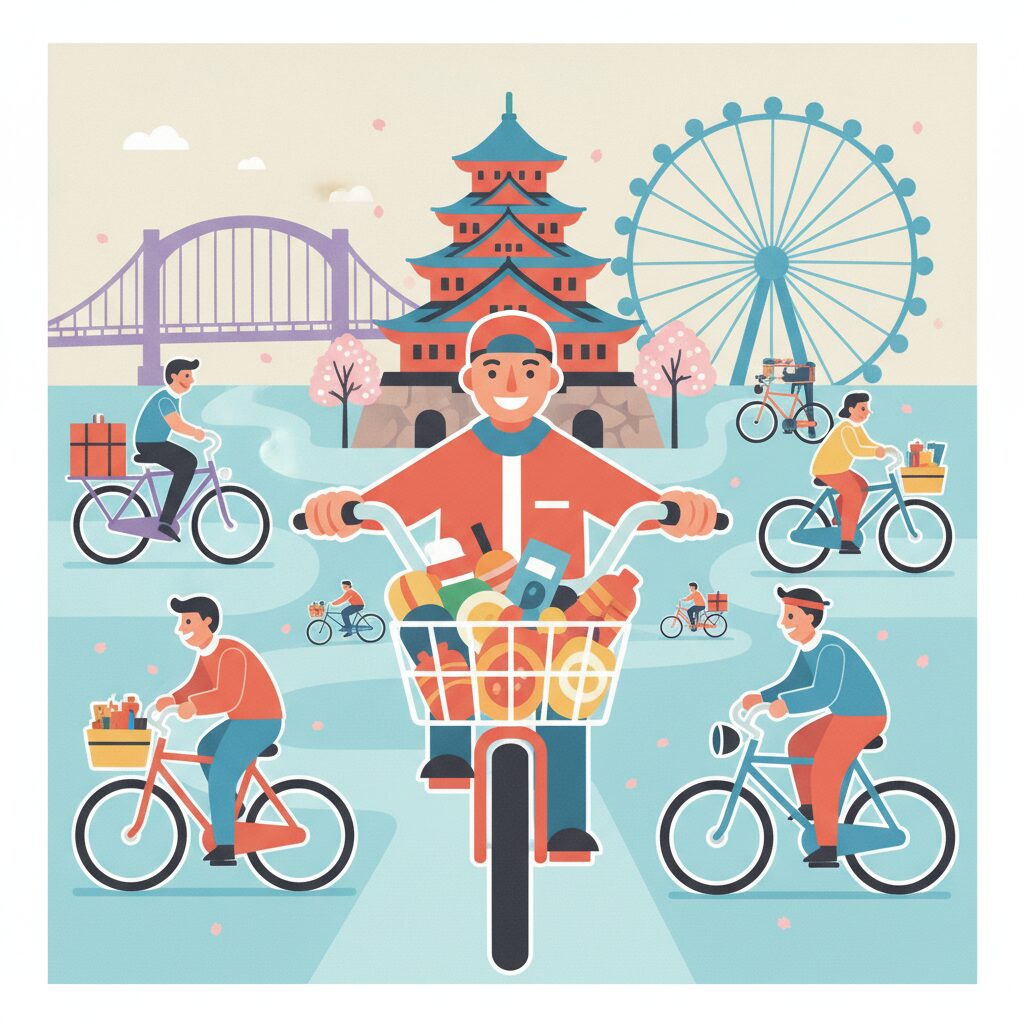
When you first arrive in Osaka, you feel the difference in the air. It’s not the humidity, though there’s plenty of that. It’s a certain kinetic energy, a street-level hum that’s less polished than Tokyo’s serene efficiency. And the source of that hum, the lifeblood flowing through the city’s arteries and capillaries, isn’t the sleek silver trains of the Midosuji Line. It’s the slow, steady, and utterly unstoppable tide of the mama-chari. The “mom’s chariot.” This humble, unpretentious bicycle is everywhere, a rolling testament to the city’s soul. You see them leaned against noodle shops, parked in herds outside supermarkets, and ridden with a kind of nonchalant mastery by everyone from sharp-suited office workers to grandmothers ferrying a mountain of cabbages in their front basket. At first glance, it looks like chaos. It looks a bit clunky, a bit dated. But to dismiss the mama-chari is to misunderstand Osaka entirely. This bicycle isn’t just a mode of transport; it’s a philosophy, a financial plan, and the ultimate life hack for anyone trying to navigate the glorious, practical reality of Japan’s second city. It’s the key that unlocks the map, revealing a city that operates on a human scale, governed by common sense and a healthy disregard for unnecessary formality.
Embracing the grassroots energy of Osaka’s streets might prompt you to examine a more structured urban transit experience through insights on Midosuji Line convenience.
The Unspoken Rules of the Sidewalk Ballet
Your first ride on a mama-chari in Osaka is a real baptism by fire. You quickly discover that the painted bicycle lanes are often mere suggestions, hopeful ideas from the city planning department. The real activity happens on the sidewalk. In Tokyo, cycling on a crowded pedestrian walkway would earn you a barrage of icy stares and tut-tutting, as if you’ve broken a deeply held unwritten rule. In Osaka, it’s simply the way people get from A to B. This doesn’t mean it’s a chaotic free-for-all. Rather, it’s a fluid, intuitive dance—a ballet governed by unspoken rules.
Pedestrians technically have the right of way, but it’s a soft right of way. They recognize bicycles as part of the ecosystem. As a rider, your role is to weave through the flow, not dominate it. You don’t barrel through crowds. You anticipate the movements of the elderly couple ahead and give a wide berth to the kids spilling out of a cram school. The primary means of communication is the bell. But an Osaka bell-ding isn’t a harsh car horn demanding you clear the way. It’s a gentle, almost apologetic chirin-chirin. It’s a verbal “excuse me,” a “sumimasen, just passing on your left.” It’s a sign of awareness, not aggression. This captures Osaka’s communication style perfectly: direct and straightforward, yet wrapped in a layer of casual politeness that assumes everyone is simply trying to carry on with their day. There’s a shared understanding that the goal is collective forward movement, not rigidly following rules that don’t fit the reality of narrow streets.
Foreigners often misunderstand this. They either ride with paralyzing caution, clinging to the road’s edge, or with oblivious aggression, treating the sidewalk like their personal freeway. The truth lies in between. You need to develop a sense for the rhythm, a sixth sense for the city’s flow. It’s about being assertive enough to claim your space but respectful enough to avoid causing meiwaku, or trouble, for others. Mastering this balance is your first true lesson in becoming an Osakan.
More Than a Bike: The Mama-chari as a Life-Support System
The design of the mama-chari exemplifies pragmatic engineering at its finest. It ignores aerodynamics, lightweight materials, and aesthetic appeal entirely. Every element is crafted for maximum functionality in the urban environment. The step-through frame lets you easily hop on and off, even while wearing a skirt or business clothes. The upright riding position offers excellent visibility over your surroundings. The chain guard keeps your pants free of grease. The built-in wheel lock is a stroke of genius—a simple lever that locks the rear wheel, perfect for quick stops at the convenience store without fumbling for a separate lock. The dynamo-powered headlight, which activates as you pedal, means you never need to worry about batteries. Yet the true core of the bike is its impressive cargo capacity.
The Grocery Hauler and Errand Runner
That deep, sturdy basket in front isn’t meant for a handbag. It’s designed to carry a ten-kilogram bag of rice, a six-pack of beer, a giant daikon radish, and three grocery bags from the local Tamade supermarket. It embodies the Osaka value often misunderstood by outsiders as kechi—stinginess—but better described as savvy thrift. Why pay 180 yen for a direct train ride to the main station market when you can cycle ten minutes to your neighborhood shotengai (shopping arcade) and bring back a week’s worth of food for free? The mama-chari turns the city into your personal pantry. You often see them so packed that you wonder how the rider can see over the load. The sturdy kickstand lets you load it fully without tipping—a small but vital detail. It’s the perfect tool for a locally focused lifestyle, encouraging visits to small mom-and-pop shops that give Osaka neighborhoods their distinct charm, as getting there is never a hassle.
The Family Minivan on Two Wheels
Around drop-off time at any kindergarten or elementary school, you’ll spot a gathering of mama-charis. These bikes are more than just transportation; they serve as the family station wagon. The rear rack almost always holds a strong child seat, complete with a headrest and safety harness. Sometimes, a smaller seat is mounted on the handlebars as well. It’s common to see a mother or father skillfully navigating this two-wheeled minivan, one child in front, another chatting in the back. During winter, kids are bundled into special leg-warming cocoons attached to the seats. This isn’t a lifestyle choice for social media—it’s the most brutally efficient way to manage family life in a dense, flat city. It’s cheaper than a car, more flexible than a bus, and faster than walking. It perfectly embodies the Osaka mindset of finding the most logical, cost-effective solution to daily challenges, without any concern for appearances.
The All-Weather Commuter
Rain doesn’t stop the mama-chari fleet; it adapts. Here you encounter one of Osaka’s most iconic and legally ambiguous practices: riding while holding an umbrella. It demands great balance and nerve and is technically prohibited. Yet, like many impractical rules in Osaka, it’s widely ignored. This practice inspired a clever invention: the Sasube. This clamp-like device attaches to your handlebars and holds your umbrella, creating a personal, mobile rain shelter. The Sasube is pure Osaka—an ingenious, cheeky workaround for a rule that interferes with everyday life. It says, “Yes, we know the rule, but this is just more practical, isn’t it?” This flexible approach to rules, based on common sense and convenience, is a defining feature that often distinguishes Osaka’s social atmosphere from the more formal, rule-bound culture of Tokyo.
The Economics of the Two-Wheeled Lifestyle
Living in Osaka can be much more affordable than living in Tokyo, with the mama-chari playing a major role in this. A brand-new, basic model can be purchased for under 20,000 yen. A second-hand bike, often obtained from large bicycle recycling centers, might cost only 7,000 or 8,000 yen. In comparison, a monthly commuter pass can easily range from 5,000 to 15,000 yen depending on your route. For the price of one or two months of train travel, you can fully own your mode of transportation. The only other mandatory expense is the one-time 600-yen bicycle registration (jitensha touroku), an essential step to prove ownership in case the bike is ever towed or stolen.
The city’s infrastructure, though not always perfect, is designed around this reality. Every train station is surrounded by large bicycle parking lots, or churinjo. Some are multi-story automated garages that seem straight out of a sci-fi movie, while others are sprawling, disorganized fields of metal. A day’s parking generally costs between 100 and 200 yen, a tiny fraction of what car parking would cost. This has created a unique hybrid commuting style in the region: cycle to your local station, park your bike, take the train to the city center, and then reverse the process going home. It offers the best of both worlds, providing door-to-door convenience at either end of the train ride. This dependence on bicycles as a “last mile” vehicle is far more ingrained in Osaka than in Tokyo, where life is more rigidly defined by the walking radius surrounding your designated station.
Where Tokyo Builds Up, Osaka Spreads Out (On Two Wheels)
The mama-chari fundamentally transforms how you perceive the city’s geography. Tokyo is a city defined by its stations. Your lifestyle, social connections, and shopping patterns are often shaped by the train line nearest to where you live. The city can seem like a collection of isolated islands connected only by a complicated subway map. Osaka, in contrast, is wonderfully and thankfully flat, making it a cyclist’s paradise. The mama-chari dissolves the divisions between train lines and turns the entire city into one seamless, continuous, and navigable space.
Starting from your apartment in, say, the Tennoji area, it’s a simple, flat ride to the nostalgic charm of Shinsekai. From there, you can cycle through the electronics hub of Den Den Town, cross over to the lively markets of Kuromon, and find yourself in the vibrant heart of Namba’s neon-lit district. Continuing north, you’ll pass the fashionable boutiques in Horie, the business district of Honmachi, and eventually arrive at the serene urban retreat near Utsubo Park. Such a smooth, cross-town journey would require numerous train transfers in Tokyo. In Osaka, it’s an enjoyable 30-minute bike ride. You begin to see the city not as separate destinations but as a rich mosaic of neighborhoods that flow into each other. You uncover hidden coffee shops, small parks, and charming local eateries tucked away in the spaces between stations—places most tourists and even many Tokyo locals never discover.
This shapes a different mental map. You navigate by landmarks—like that oddly-shaped building, the river, or the long shopping arcade—instead of station names. The city feels smaller, cozier, and much more approachable. The mama-chari offers the freedom to be spontaneous, to change your plans on a whim, to truly wander—and in doing so, to find the genuine heart of the city.
The Mindset of the Mama-chari Rider
Ultimately, riding a mama-chari means embracing an Osakan mindset. It’s a daily expression of the city’s core values—a continuous demonstration of your integration into the local culture.
Pragmatism Over Prestige
No one expects to win the Tour de France on a mama-chari. There are no flashy Lycra outfits, no clip-in shoes, no discussions about gear ratios. The bike might be a little rusty, the basket slightly bent, and the bell dulled. None of that matters. The only question is: does it work? Does it get you and your groceries home? This is the heart of Osaka’s pragmatism—a deep-rooted emphasis on function over form, substance over style. In a city renowned for its merchants, value is everything. Spending money on frivolous things isn’t common sense. A 200,000-yen carbon fiber road bike for supermarket trips is seen as absurd, a wasteful folly. A 10,000-yen steel-frame workhorse that endures for a decade is considered a smart investment. This sharply contrasts with the brand-consciousness found in some parts of Tokyo. In Osaka, the real flex isn’t what you own but how cleverly you live.
A Calculated Indifference to the Rules
Let’s be clear: Osakans are not criminals. Yet, there’s a healthy skepticism toward rules that seem inefficient or downright silly. The sidewalk riding, umbrella holding, and occasional “creative” parking—where a bike is propped against a guardrail for a short spell—all arise from an unspoken, shared understanding. The guiding question isn’t “What does the rulebook say?” but “Am I inconveniencing anyone?” If the answer is no, then it’s probably okay. This culture trusts individuals to apply common sense and situational awareness. It can be surprising for foreigners used to stricter social norms, but it’s a system based on mutual, if sometimes reluctant, tolerance. It reflects the spirit of a bustling port city where finishing the task matters more than perfect manners.
The Freedom of Low-Stakes Living
The mama-chari offers a liberating experience. It’s a tool, not a treasure. Its maintenance is minimal—maybe pumping tires and oiling the chain once a year. If it gets scratched, it barely registers. If it’s stolen (a common occurrence), it’s a nuisance, not a disaster. You sigh, file a police report, and find another cheap used bike. This approach encourages a resilient, unpretentious attitude toward possessions. It’s part of a larger Osaka philosophy: don’t sweat the small stuff. Things break, plans shift, rain falls unexpectedly. What matters is to have a practical, low-cost system to handle it all and keep moving forward. So if you really want to understand this city, set aside the tourist maps and train schedules for a day. Get a mama-chari. Feel the satisfying weight of its steel frame. Stuff the basket with something absurd. Join the slow, steady, rhythmic flow. You’re not just riding—you’re tapping into the very heartbeat of Osaka.