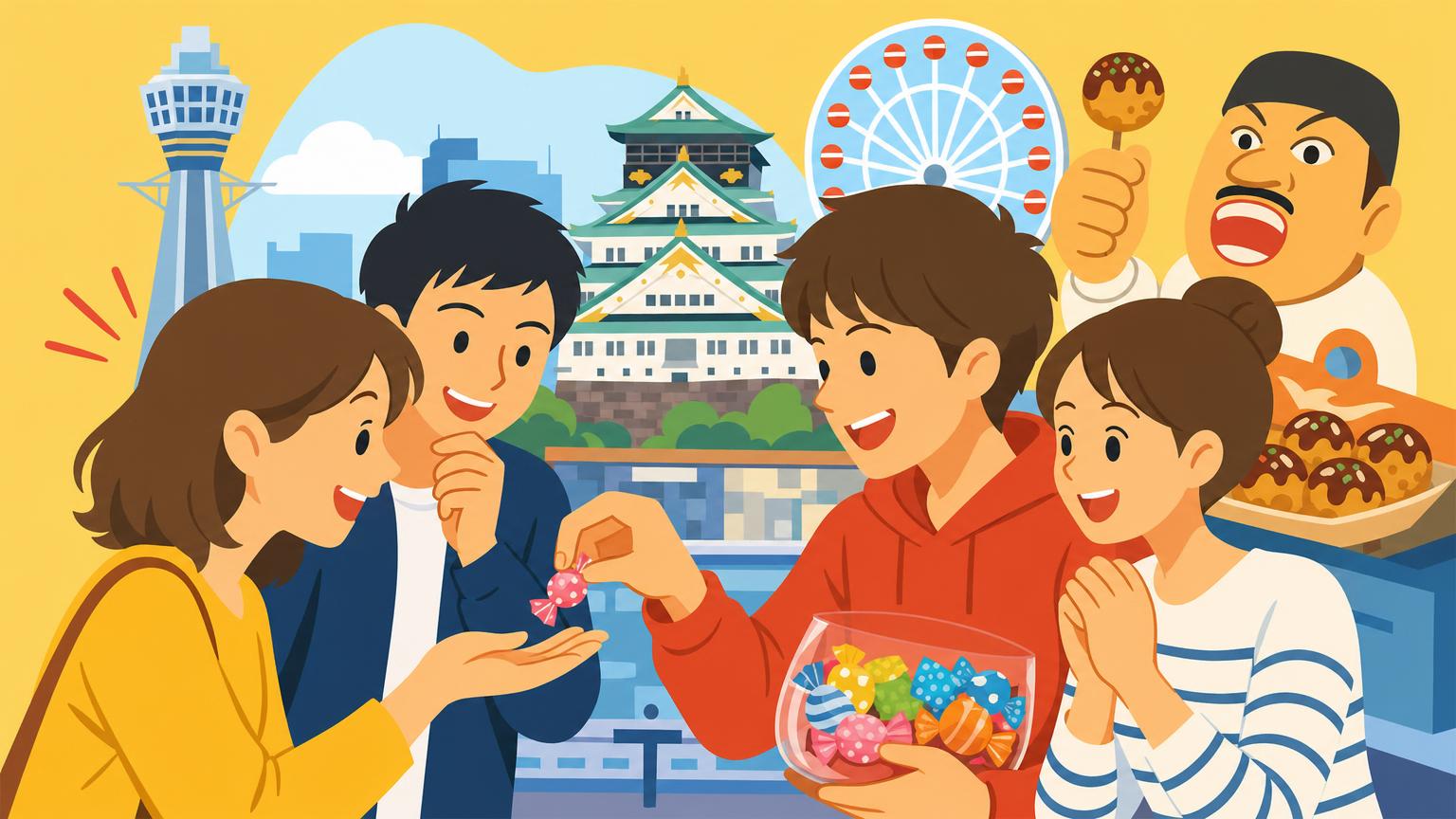
You are standing on a crowded train platform in Osaka when an older woman beside you suddenly opens her handbag.
She takes out a small wrapped candy and holds it toward you.
Maybe she has been watching you struggle with the ticket machine. Maybe you exchanged two sentences about the weather. Maybe nothing happened at all. She simply noticed that you look tired, hungry, nervous, or new to Japan.
She says, “Ame-chan.”
What should you do?
Should you accept it? Should you refuse? Is she flirting? Is it a test of your Japanese? Does accepting candy create an obligation to give something back?
For many foreigners living in Osaka, this small moment can feel strangely difficult. The candy is tiny, but the social meaning around it is not. In Osaka, giving and receiving candy can be a quiet way of managing distance between people. It can soften a first meeting, interrupt an awkward silence, or say, without saying directly, “You are all right. We are sharing this moment.”
The important point is that Ame-chan is not simply a local snack. It is part of a larger Osaka habit: making everyday contact feel less formal, less stiff, and slightly more human.
This does not mean every person in Osaka gives candy to strangers. It does not mean you should approach older women and ask for sweets. It does not mean Osaka people are automatically more generous than people in Tokyo, Kyoto, or elsewhere. The real difference is subtler. Osaka often allows more room for small, informal gestures between people who do not yet know each other well.
The map below is included only as a city-center reference. The subject of this article is not sightseeing. It is how people move through ordinary Osaka life, where a piece of candy can sometimes do the social work that a long conversation cannot.
Ame-chan Is a Social Gesture Before It Is a Sweet
Why a Piece of Candy Can Change the Atmosphere
In many Japanese situations, people begin with a certain degree of restraint. You do not immediately ask personal questions, casually touch someone you have just met, or normally interrupt a stranger’s quiet time on a train.
Osaka has these rules too. It is not a city without boundaries. However, conversations in Osaka often look for a small opening within those boundaries.
Ame-chan can provide that opening.
A person offering candy is usually not trying to establish a serious relationship. The gesture is much lighter than that. It may mean:
- “Take one. You look tired.”
- “The meeting is too formal, so let’s relax a little.”
- “We are sitting next to each other for a long time. Let’s acknowledge that.”
- “I have something in my bag, and sharing it feels natural.”
- “I want to talk to you, but I don’t know how to begin.”
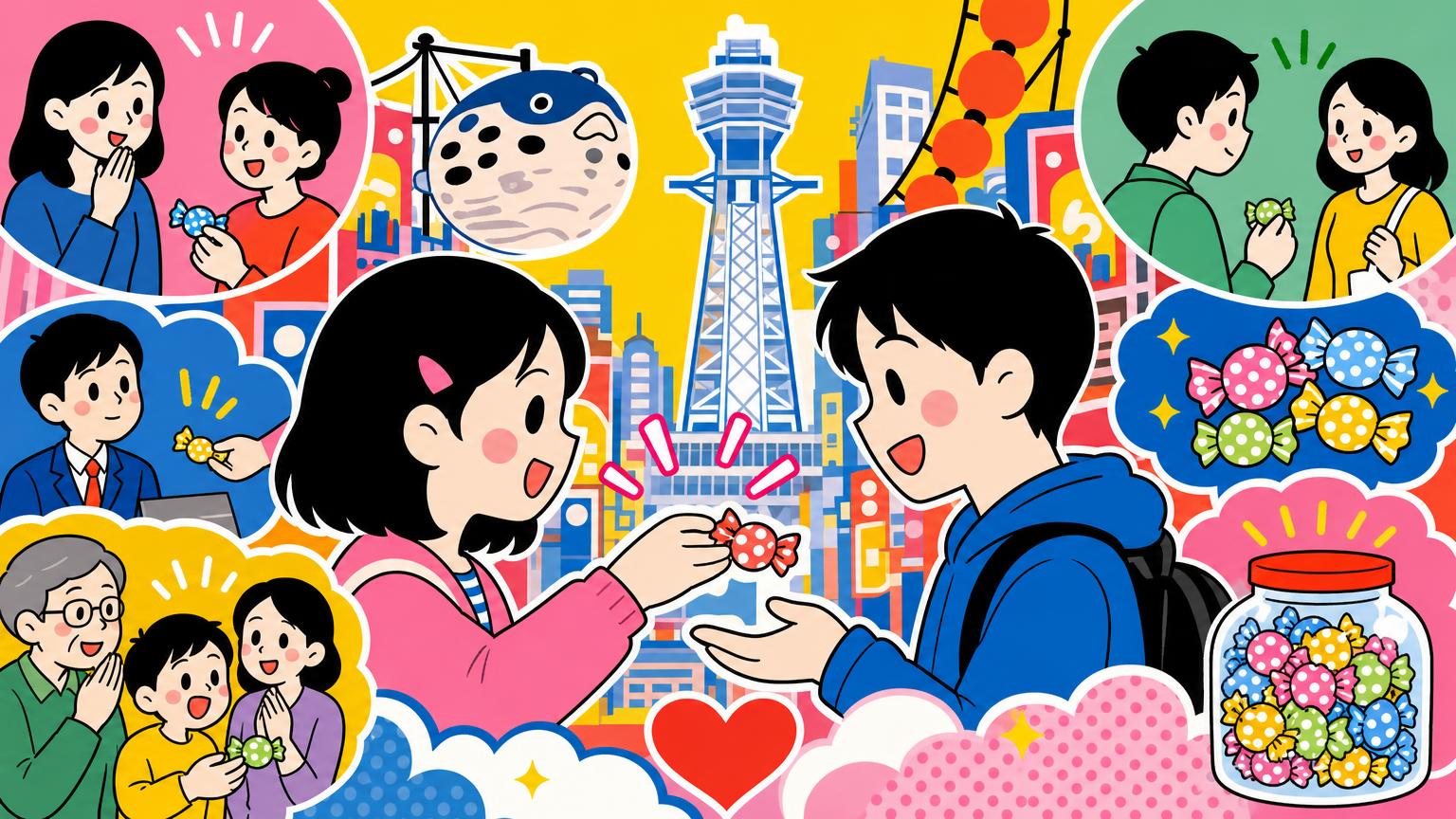
The candy creates a shared action. Both people look at the wrapper, both smile, and the receiver says thank you. The giver may make a joke about the flavor. A silent train ride becomes a brief human exchange.
This is why the gesture can feel more meaningful than the candy’s price suggests. A wrapped sweet worth only a few yen can reduce the social distance between two people.
For a foreign resident, the most useful way to understand Ame-chan is not as a special Osaka tradition to be performed on demand. Think of it instead as a small tool in the local communication kit. It is one of many ways people make an interaction warmer without making it feel heavy.
The Candy Is Often a Conversation Starter, Not a Gift
A formal gift usually carries stronger expectations. It may need to be wrapped properly. You may be expected to give something in return later. There may also be rules about when to open it and how to express your thanks.
Ame-chan is different.
It is usually more like sharing gum, offering a mint, or passing around snacks at work. The gift is intentionally small. That smallness matters because it keeps the moment easy. You do not need to show a large emotional response, give a speech, or offer an expensive return gift.
If someone gives you candy during a casual conversation, a smile and “Arigatou” are normally enough. If you want to sound more Kansai-like, “Ookini” is the local-flavored response. It means thank you, but carries a softer, more regional feeling than standard textbook Japanese.
You may also hear the giver say something like “Douzo,” “Tabete,” or “Ame-chan.” The tone is often more important than the exact words. A cheerful tone invites you to join the moment, while a quiet tone may simply mean the person is being considerate.
The safest response is to accept the gesture for what it is. It is a small kindness, so treat it warmly without turning it into a dramatic event.
The Osaka Obachan and the Art of Reducing Distance
The stereotype reflects a real social pattern
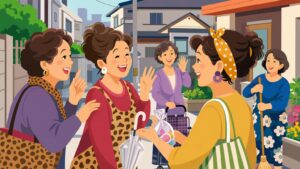
The image of the Osaka Obachan is familiar throughout Japan: a middle-aged or older woman with strong opinions, practical clothing, a loud laugh, quick timing, and a handbag that seems to contain every possible item, including candy.
This image is partly a joke, and it can also be unfair. Osaka women are not all loud, generous, or interested in talking to strangers. Many are private, busy, and tired. Like people everywhere, they have different personalities.
Still, the stereotype grew from something recognizable: in Osaka, older women are often given more freedom to speak directly and casually in public. An Osaka Obachan may comment on your umbrella, ask where you are from, tell you that your jacket is too thin, or hand you a piece of candy without treating the interaction as a formal social event.
The candy is useful because it suits this style of communication. It is direct, practical, and slightly funny. Instead of saying, “I would like to establish a friendly relationship with you,” the person simply says, “Ame-chan.”
The gesture can also protect the giver from embarrassment. If the receiver reacts awkwardly, the candy itself offers an excuse. It was only candy. Nothing serious happened. The conversation can continue or end without anyone losing face.
Osaka friendliness is often active rather than quiet
Foreigners sometimes describe Osaka as friendly and Tokyo as cold. That comparison is too simplistic to be useful.
Tokyo has plenty of kindness. It is often expressed through distance, efficiency, and thoughtful consideration. A Tokyo resident may avoid disturbing you, give you space, and solve your problem without making you feel watched. That can also be a form of respect.
Osaka kindness may be more visible. Someone may comment on your situation before you ask for help. Someone may joke with you while helping you. Someone may give you a piece of candy and then complain that you chose the wrong flavor.
The difference is not that one city has kind people while the other does not. The difference is how much informal contact people are willing to create in public.
In Osaka, a little teasing can help make an interaction more comfortable. The joke suggests, “We are not standing on opposite sides of a formal wall.” The same joke may feel rude if you are expecting a more restrained exchange.
This is where Ame-chan fits in. The candy is a low-risk form of involvement. It says, “I noticed you,” but usually not, “You now belong to me.”
Why foreigners may misread the gesture
Foreign residents may interpret the candy in several ways that do not match the giver’s intention.
You may think the person is being unusually personal. You may wonder whether you are expected to give money. You may assume that accepting it means you must immediately offer a gift in return. You may also worry that refusing it would be insulting.
Usually, none of these interpretations is necessary.
Ame-chan is often intentionally casual. The giver may offer the same candy to several people. It may come from a large bag purchased at a supermarket. It may be a familiar habit from childhood, work, family gatherings, or neighborhood conversations.
There can be exceptions. If the candy is expensive, beautifully wrapped, handed over in a formal setting, or connected to a business relationship, it may carry more significance. Context determines the weight of the gesture.
A useful rule is to observe what happens around you. If everyone receives one, it is communal. If the person gives you one while talking about a difficult day, it may be an act of comfort. If the person gives you one after you helped them, it may be a gesture of thanks. If the candy comes with a joke, the joke is probably part of the gift.
Why It Is Called Ame-chan
The suffix makes the word softer and more familiar
In standard Japanese, ame means candy. Ame-chan means candy with the affectionate or familiar suffix chan attached.
Chan is often associated with children, close friends, and cute names. However, Japanese suffixes do not correspond perfectly to English words. Ame-chan does not necessarily mean baby candy, childish candy, or candy belonging to someone named Ame.
The suffix makes the word feel warmer. It transforms an ordinary object into something familiar and approachable.
English speakers sometimes expect Japanese honorifics to function like fixed titles. In everyday Japanese, however, they are more flexible. The emotional nuance changes depending on the noun, speaker, relationship, age, and tone.
Ame-chan sounds small, friendly, and slightly playful. It is easier to say than “Would you like a piece of candy?” It also makes the candy feel like part of a shared local world rather than simply an object in a package.
The word reflects Osaka’s preference for emotional softening
Osaka speech often uses humor and an informal rhythm to make direct communication easier. This does not mean every sentence is a joke. Rather, practical speech may be expressed with a little extra warmth.
The phrase Ame-chan has that quality. A person can be direct without sounding harsh. The offer is clear, but the wording remains gentle.
You may notice similar emotional softening in the way people talk about food, shopping, children, pets, and household objects. Japanese speakers may use affectionate language for things that are not alive. In Osaka, this can combine with a lively conversational style, producing speech that feels especially animated to foreign residents.
Do not try to imitate this by adding chan to every noun. That may sound unnatural. Ame-chan is a set expression, so learn it as a cultural phrase rather than as a grammar rule.
Do not confuse familiarity with permission
A warm expression does not erase personal boundaries.
An Osaka person may use a friendly tone while still expecting you to behave appropriately. You should not touch someone else’s belongings without permission. You should not take food from a shared bag before it is offered. You should not assume that an older woman who gives you candy wants to have a long conversation.
The warmth is an invitation to relax, not an instruction to become intimate.
This distinction is important for foreigners because Osaka’s informal style can make the city feel more open than it really is. People may speak directly, but there are still strong expectations regarding manners, privacy, hygiene, and consideration for others.
The Unspoken Rules of Giving Ame-chan
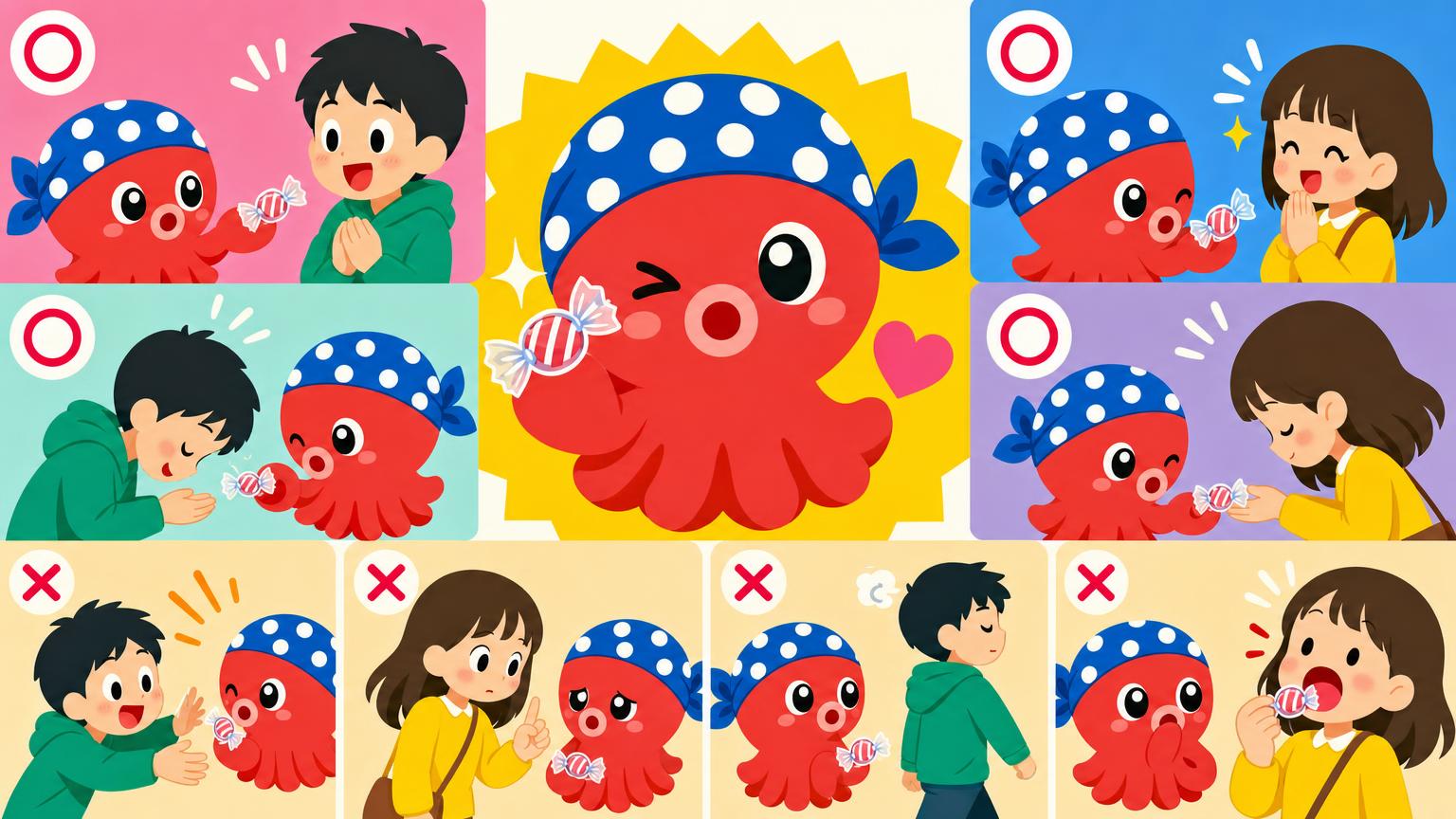
Offer without forcing
The most important rule is that an offer should remain just an offer.
A giver will usually hold out the candy and wait. They will not push it into your hand or become angry if you refuse. They may encourage you once, especially if they think you are being overly polite, but continued pressure is unusual in a healthy interaction.
If you are allergic, vegan, diabetic, avoiding sugar, or simply do not want food from a stranger, you can politely refuse. Say, “Sumimasen, taberarenai desu,” meaning that you cannot eat it, or simply smile and say, “Arigatou, daijoubu desu.”
In this context, the phrase daijoubu can mean no, thank you, but your body language should make that meaning clear. A small bow and a gentle hand gesture can help.
If you refuse, there is no need to give a long explanation unless you want to. Overexplaining can make the giver feel that the offer has become a problem. A short, clear answer is kinder.
Offer the whole piece, not a half-opened one
Candy is generally offered in its wrapper. This protects hygiene and keeps the gesture casual.
A wrapped piece is easy to accept and easy to decline. An unwrapped candy placed directly into someone’s hand can feel too intimate unless the people are already close.
At work, keep the candy in its individual wrapper when passing it around. Do not place loose sweets directly on a desk, where people may be unsure whether they are clean or available.
If you have opened a candy for yourself, it is usually better not to offer that same piece to someone else. The exception may be a close family or friend situation, but even then, follow the atmosphere of the group.
Do not give candy while someone is driving, cycling, or carrying heavy items
This may sound obvious, but foreigners often focus so much on the social meaning that they overlook the practical side.
Do not ask someone to unwrap candy while they are walking down crowded stairs. Do not offer a hard candy to someone who is speaking or exercising, or who is responsible for a child. Do not create a small safety problem in the name of being friendly.
Osaka people appreciate practical kindness. Often, the best gift is the one that does not create extra work for the receiver.
Consider the group
If you bring candy to a workplace, neighborhood meeting, language class, or shared apartment, think about how the group will receive it.
A common approach is to place individually wrapped candy in a shared space and say, “Douzo,” allowing people to choose. This gives everyone freedom. People with allergies or dietary restrictions can avoid it without having to refuse you in front of the group.
If you give one special candy to a single person in front of everyone else, the gesture may seem more personal. That is not necessarily wrong, but it does change the social meaning.
In a Japanese workplace, equal treatment can matter more than the price or quality of the item. A cheap candy available to everyone may feel more comfortable than an expensive present given only to a supervisor or one colleague.
Be careful with flavors that are funny to you
Osaka has a strong appetite for novelty, and local shops often sell candy with unusual names, food-inspired flavors, or humorous packaging. That does not mean everyone wants to be surprised with a strongly flavored sweet.
Before giving someone something with a powerful taste, describe it honestly. If it tastes like ginger, plum, coffee, mint, or a savory dish, say so. A joke is more enjoyable when the receiver has enough information to make a choice.
The Osaka style of humor often includes a little mischief, but that mischief should not take away the other person’s ability to say no.
The Unspoken Rules of Receiving Ame-chan
Accept with both hands in formal settings
In a casual situation, taking a piece of candy with one hand is usually fine. In a workplace, formal meeting, or interaction with an older person, using both hands can convey extra respect.
You do not need to make a theatrical bow. Accept the candy, make eye contact, and say thank you. If the giver is smiling and joking, you can relax your posture. If the setting is serious, keep your response simple.
Japanese manners often depend on adjustment. There is no single perfect gesture for every situation. Read the level of formality and match it.
Say thank you immediately
Do not put the candy directly into your pocket without acknowledging it. Even if you plan to eat it later, respond first.
“Arigatou” is safe and standard. “Ookini” is a natural Kansai-flavored alternative. You may also say “Ari ga tou gozaimasu” if the setting is more formal.
If you want to sound warm without being overly familiar, say “Ookini, itadakimasu,” meaning thank you, I will have it. Perfect pronunciation is not necessary. The effort is often appreciated, especially when your tone is sincere.
Do not eat it immediately unless the atmosphere suggests it
Sometimes the giver wants to see your reaction. In that case, opening the candy and trying it can be a pleasant response.
At other times, the candy is simply being passed around for later. If everyone else puts theirs in a bag or pocket, follow their example.
Opening food immediately can feel slightly awkward in a meeting or on a train, especially when the wrapper is noisy. Look around before you begin unwrapping it.
If you do try it and dislike the taste, you do not need to make a dramatic expression. Osaka humor may welcome a joke, but a harsh reaction could embarrass the giver. You can say, “Omoshiroi aji,” meaning interesting flavor, and leave it at that.
Do not assume you must return the candy immediately
A small piece of Ame-chan does not usually create a debt.
You do not need to frantically search your bag for a replacement. You do not need to buy an expensive snack. You do not need to say, “I owe you one,” unless you are joking with someone you know well.
If you want to return the kindness later, simply offer something when the timing feels natural. Bringing a small pack of sweets to the office, sharing snacks from your home country, or offering candy during another conversation is sufficient.
The exchange works best when it stays light. Immediate repayment can unintentionally make the moment feel like a business transaction.
Keep the wrapper until you find a bin
Osaka’s streets and stations can be surprisingly clean, even though public bins are not always easy to find. Do not hand the wrapper back to the giver unless they specifically ask you to. Keep it in your bag or pocket until you find a suitable bin.
This is a small action, but it shows that you understand the practical side of living in the city. Friendly conversation does not remove your responsibility for your own waste.
When You Should Refuse
Food allergies and dietary restrictions come first
You are always allowed to refuse any food offered to you.
This may feel difficult because Japanese social situations sometimes place value on accepting what is given. However, your health and personal boundaries matter more than avoiding a moment of awkwardness.
Use a brief explanation if helpful:
- “Gomen nasai, allergy ga arimasu.”
- “Sumimasen, taberarenai desu.”
- “Arigatou, daijoubu desu.”
You can also say “I have a food allergy” in English while making a clear gesture. Many people will understand from the context, even if they do not speak much English.
Do not eat an unknown candy simply to appear polite. Osaka people may value friendliness, but most reasonable people do not want you to risk your health for the sake of a social gesture.
Refuse if the situation feels unsafe
Ame-chan is usually harmless, but not everyone offering food has good intentions. If you are alone at night, the person is acting aggressively, or the offer is connected to pressure, money, or unwanted contact, you can decline and leave.
You do not owe anyone your trust just because they are holding candy.
This is especially important for women, younger residents, and anyone who may be vulnerable when communicating in a language they do not fully understand. Local friendliness should not be romanticized as automatic safety.
Refuse without apologizing excessively
Foreigners sometimes bow several times and apologize repeatedly when declining a small offer. This can make the moment feel more serious than it really is.
A calm smile, a hand gesture, and “Daijoubu desu, arigatou” are enough. If the person continues to insist, repeat yourself clearly. You do not need to negotiate.
The goal is not to reject the person, but simply to decline the food.
How Ame-chan Appears in Everyday Osaka Life
At work
In Osaka offices, candy may appear during long meetings, busy project periods, seasonal events, or casual conversations near the printer or coffee machine.
Someone may keep a jar of sweets on their desk, while a colleague may bring back candy from a family visit. A manager may offer everyone something during a difficult week. These actions can support workplace morale without requiring a formal announcement.
The social rule is to avoid making the candy more important than the relationship. Take one if you want one and thank the person. If you do not want it, decline quietly.
If you are new to a Japanese workplace, observing how colleagues handle shared snacks can teach you a lot. Do people take one immediately or wait? Do they choose carefully? Does the person offering it expect conversation? Is the snack placed in a common area or handed out individually?
These details reveal the workplace culture more accurately than any general rule about Japanese etiquette.
In neighborhood relationships
In apartment buildings and local communities, candy can be part of a larger pattern of low-level contact. You may receive a sweet from an older neighbor after helping carry something, during a local event, or while children are playing nearby.
This does not mean you must become socially active in every neighborhood activity. However, accepting small gestures of contact can help you become recognizable. In Osaka, being seen regularly can matter. A familiar face is easier to trust than an unknown person who appears only when there is a problem.
You do not need to speak perfect Japanese. Saying hello, thanking people, and remembering a few names can be more valuable than giving impressive gifts.
Ame-chan is part of this gradual process of becoming known.
In family and friendship groups
Among friends, candy can be used for teasing, comfort, or simply as a way to keep hands busy during conversation. Someone may give you a flavor they know you like, or insist that you try one they know you dislike. The meaning depends on the relationship.
With close friends, playful refusal is possible. With a stranger, it is better to be more careful. Osaka humor is easier to understand once trust has developed.
This is one reason foreigners sometimes feel that Osaka people are rude during their first few months in the city. A joke may arrive before you have enough context to recognize it as an attempt at closeness. Over time, you may realize that direct teasing was meant to reduce distance rather than create conflict.
Even then, you are allowed to say when something makes you uncomfortable. Good relationships do not require you to laugh at every joke.
Osaka Compared with Tokyo: What Actually Feels Different
The contrast concerns public interaction, not personality
The Osaka-versus-Tokyo question often comes up whenever foreigners discuss daily life in Japan. Which city is friendlier? Which is easier to live in? Which people are more open?
Ame-chan provides a useful way to avoid simplistic answers.
In Tokyo, a stranger may help you efficiently while maintaining a respectful distance. In Osaka, a stranger may help you while adding a comment, joke, complaint, or question. Both responses can be kind. The Osaka version simply makes the relationship more visible.
Tokyo often rewards smoothness, while Osaka often rewards responsiveness. In Tokyo, you may try not to impose. In Osaka, a small amount of involvement can be understood as a form of care.
Neither style is automatically better. The best choice depends on your personality.
If you prefer privacy and predictable boundaries, Tokyo may feel comfortable. If you enjoy spontaneous conversation and do not mind being noticed, Osaka may feel easier. If you are quiet but want to build connections, Osaka can still be welcoming, though you may need to respond actively when people open the door.
Osaka people may expect you to respond
This is one of the most important differences for foreigners living in Osaka.
Someone may make a joke and wait for your reaction. They may offer you candy and expect at least a smile. They may ask a question not because they need detailed information, but because they are creating a conversational rhythm.
A silent response can sometimes be interpreted as rejection, even when you are simply being cautious.
You do not need to become loud or performative. A brief answer, eye contact, and a small smile are enough to show that you are participating.
When someone gives you Ame-chan, your reaction becomes part of the exchange. The candy is not merely an object; it is a prompt.
Osaka is not a single social environment
The atmosphere varies by neighborhood, age, occupation, and situation.
Umeda’s business areas can feel fast-paced and impersonal during commuting hours. Tennoji can feel more mixed, with shoppers, commuters, families, students, and long-time residents moving through the same spaces. Nakazakicho has a different rhythm again, with small businesses and residential streets where repeated encounters are more noticeable. Shinsekai has its own blunt, theatrical energy, but that does not mean everyone there welcomes conversation.
Nishinari, Sakai, and suburban Osaka also have different histories and community patterns. The city is not one personality wearing a bright sign.
If you live in Osaka, avoid treating the most dramatic public behavior as the entirety of local culture. The ordinary city is quieter. Most people go to work, buy groceries, take trains, care for their families, and manage their private concerns. Ame-chan matters because it appears within these ordinary routines, not because everyone is constantly performing Osaka humor.
What Foreign Residents Often Get Wrong
Mistaking direct speech for anger
An Osaka person may speak directly because they want to resolve the issue quickly. Their voice may sound strong, especially if you are still learning Japanese. That does not necessarily mean they are angry.
Consider the entire interaction. Are they helping you? Are they smiling? Do they continue the conversation after making the comment? Do they offer a practical solution?
A direct complaint followed by assistance may be a form of involvement. A quiet, polite refusal may suggest more distance than a loud joke.
Mistaking jokes for universal permission
The opposite mistake is also common. Because Osaka has a reputation for humor, foreigners may assume that any joke is acceptable or that every stranger wants to engage in banter.
That is not true.
People can be funny while still being private. Someone may enjoy joking with friends but dislike being approached by strangers. An older woman may give candy to her neighbors but have no interest in speaking with a foreign resident on a crowded train.
Do not use the Osaka stereotype as a shortcut around consent or context.
Assuming every Ame-chan giver is an Osaka Obachan
Candy sharing is not limited to older women. Men, younger people, office workers, grandparents, shop staff, and family members may all share sweets.
The Osaka Obachan image is useful as a cultural symbol because it highlights directness, practicality, and public confidence. It is not a rule about who gives candy.
If you reduce the gesture to a funny old-woman habit, you miss its deeper meaning. Ame-chan is a way of expressing connection through something ordinary.
Believing that refusing food is always rude
Politeness does not require you to ignore allergies, health concerns, religious beliefs, personal choices, or discomfort.
A respectful refusal is part of normal adult communication. If the giver reacts badly to a clear and polite no, the problem is not your manners.
In everyday Osaka life, honesty is often more useful than excessive politeness. A direct explanation can be easier for everyone than accepting food you cannot eat and creating a larger problem later.
How to Use Ame-chan Naturally as a Foreign Resident
Keep a small supply if it suits your personality
You do not need to carry candy to be accepted in Osaka. However, keeping a few individually wrapped sweets in your bag can be useful.
You might offer one to a colleague after a long shift, share it with children only when a parent is present, or give one to a friend who has helped you. The gesture can also make a language exchange feel less awkward.
Choose ordinary, easy-to-understand candy. There is no need for expensive packaging. If the candy comes from your home country, explain what it is and mention any strong flavors.
The best offering is one that allows the other person to decline without embarrassment.
Use the moment to learn, not to perform
If someone gives you a local candy, ask what it is if you are curious. Ask whether people usually eat it at work or at home, and whether the flavor is popular with children or older people.
These questions can lead to a genuine conversation about life in Osaka. You may learn about school memories, neighborhood shops, family habits, or the person’s favorite convenience store.
The point is not to collect cultural trivia, but to understand how people connect memories to ordinary objects.
Keep your response simple
You do not need to give a speech about Osaka culture when someone offers you a sweet.
Say “Ookini.” Smile. Accept it if you want to. Put it away if you do not want to eat it right away. If the person jokes, respond with a small joke if you feel comfortable.
Social fluency develops through repetition. You learn the rhythm by participating in small moments, not by memorizing a perfect script.
A Practical Ame-chan Response Guide
If you want to accept
Say “Arigatou” or “Ookini,” and take the candy. If the person seems to expect you to try it, open it after assessing the situation. If you like it, say so. If you do not, say “Omoshiroi aji” or simply thank them again.
If you want to refuse
Smile and say, “Arigatou, daijoubu desu.” If necessary, add, “Allergy ga arimasu” or “Taberarenai desu.” Make your refusal clear, then change the subject or continue walking.
If you do not understand why it was offered
Accept or decline according to your comfort level. You can ask, “Kore wa nan desu ka?” meaning “What is this?” You can also ask, “Itsumo tabemasu ka?” meaning “Do you usually eat this?”
Curiosity is often a good bridge, but you are not required to eat something unfamiliar.
If the giver is joking
A small laugh is enough. You can say, “Hontou?” or “Omoshiroi desu ne.” If you understand the joke, respond naturally. If you do not, do not try too hard to pretend. A smile and a simple response are better than a forced performance.
If the situation feels uncomfortable
Say no, keep the candy if you have already accepted it, and leave. You do not need to explain your entire decision. Kindness is voluntary in both directions.
The Larger Lesson of Ame-chan
Ame-chan is easy to underestimate precisely because it is so ordinary. It is neither a festival nor a formal custom or dramatic symbol of Osaka. It is simply a piece of candy passed between people in everyday life.
That is exactly what makes it useful for understanding the city.
Osaka often communicates through small gestures that exist somewhere between formality and intimacy: a comment from a stranger, a joke while solving a problem, a complaint that ends with practical help, a snack pushed across a desk, or a candy offered on a train platform.
These gestures do not erase social boundaries. Instead, they make those boundaries more flexible.
For foreigners, the challenge is learning when to step closer and when to remain polite. The answer is not to imitate a stereotype of Osaka friendliness, but to pay attention to context, tone, timing, and the other person’s response.
When someone offers you Ame-chan, they are not asking you to prove that you understand Osaka. They are giving you an opportunity to respond to a small act of connection.
Accept it if you want to. Refuse it if you need to. Say “Ookini” when the moment calls for it. Keep the wrapper until you find a bin. Do not force the gesture, and do not overthink the debt.
In the end, the unspoken rule is simple: share a little warmth, leave the other person room to choose, and let the interaction remain lighter than the candy in your hand.