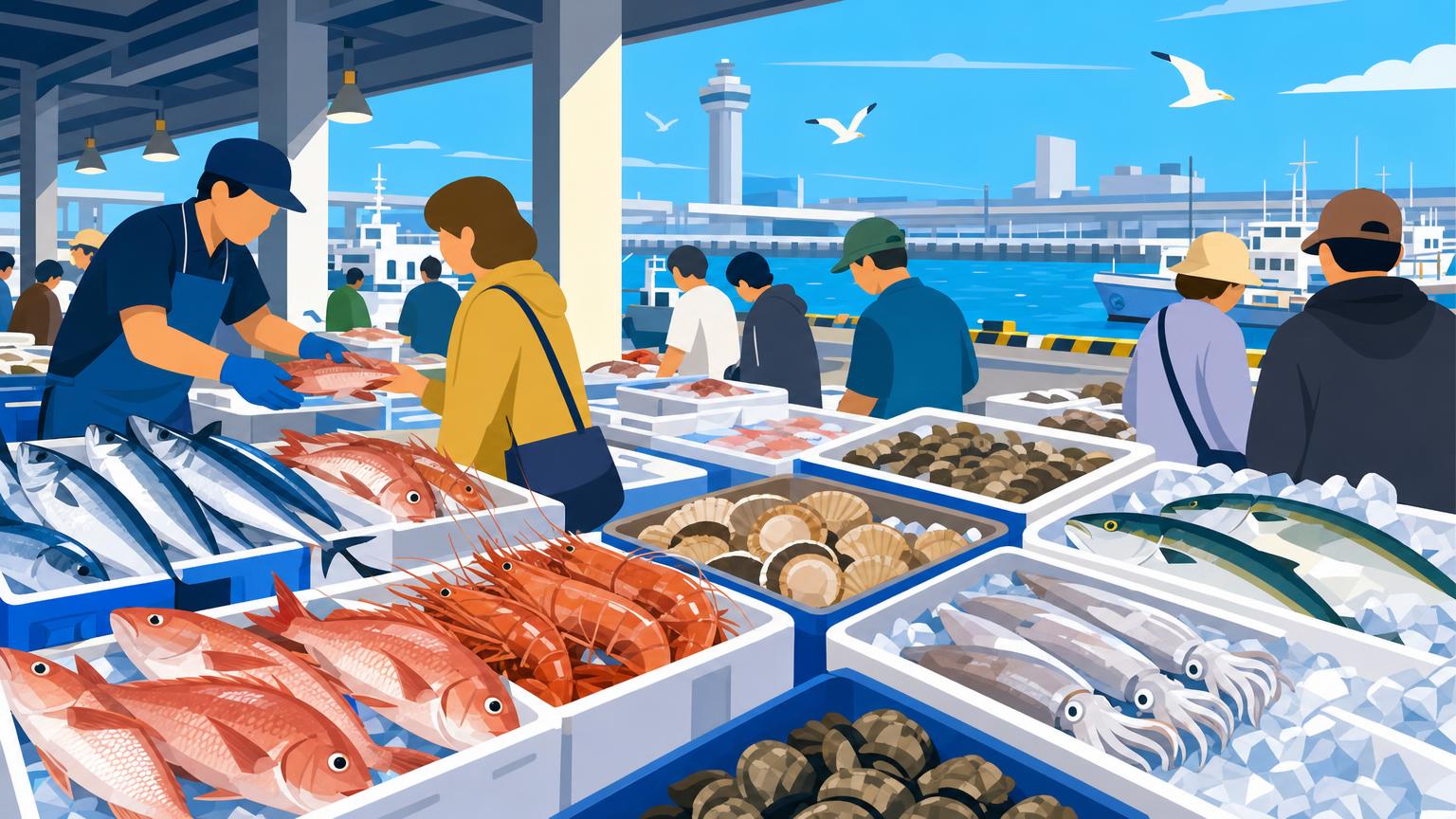
Is Osaka really a city that ends at Namba? Many foreign residents first live near Umeda, Tennoji, or the eastern suburbs, then slowly discover that the city’s everyday life stretches much farther south. Along the Osaka Bay coast, the rhythm changes. Trains become less crowded. Houses sit lower. Fishing boats, delivery vans, schoolchildren, elderly shoppers, and airport workers share the same streets. A Sunday morning at a local fish port can explain Osaka more clearly than a famous sightseeing district.
The important distinction is that there are two nearby seafood experiences that people often mix together. The Izumisano Fisheries Cooperative Aozora Market is a permanent local market beside Sano Fishing Port in Izumisano. It generally opens from 10:00 a.m. until around 5:00 p.m. and closes every Wednesday. Nearby Tajiri Fishing Port holds a genuine Sunday morning market from 7:00 a.m. until noon. The two ports are close enough to combine, but they do not operate in the same way.
For foreign locals, this is not mainly a day-trip checklist. It is a way to observe how South Osaka works: how people buy food, how they speak to shopkeepers, how they decide what is worth paying for, why a barbecue can be both casual and carefully organized, and why “friendly” is too simple a word for Osaka behavior. The coast shows a practical, talkative, slightly teasing side of the region. It also shows the limits of that friendliness. You are welcomed when you participate properly, not simply because you are a visitor.
Why South Osaka Feels Different from Central Osaka
Osaka Does Not Have One Single Urban Personality
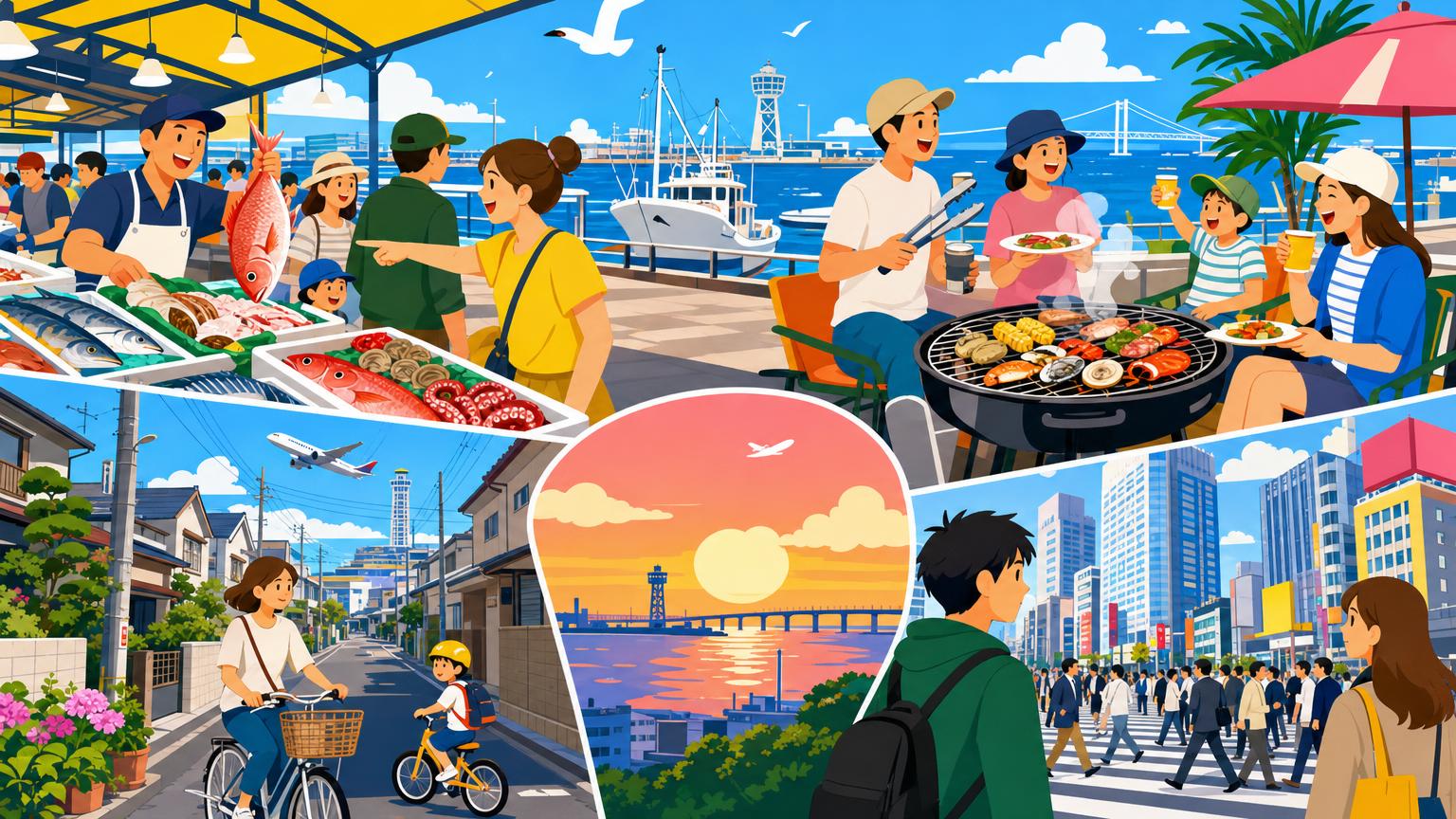
Foreign residents often get to know Osaka through its central neighborhoods. They hear jokes in Namba, shop around Shinsaibashi, eat in Tennoji, and compare the city with Tokyo. That experience is real, but it is incomplete. Osaka is not just a dense entertainment city. It is also a broad regional network of ordinary towns connected by private railway lines, industrial roads, fishing ports, shopping streets, farms, apartment blocks, and airport infrastructure.
Izumisano is part of that wider network. It is close to Kansai International Airport, but it does not feel like an airport district in the way many foreign residents might expect. There are hotels and transport links, but there are also fishing families, local businesses, compact neighborhoods, older shopping streets, and residents who shop for dinner rather than souvenirs.
This is one reason South Osaka can feel more direct than central Osaka. In a large city center, interactions with shop staff may be designed around speed and anonymity. At a port market, a seller may ask what you plan to cook, whether you have a kitchen, how many people you are feeding, or whether you know how to clean the fish. The conversation is not always polished. It can sound abrupt, but it can also be genuinely useful.
The Osaka and Tokyo Contrast Is Not Simply “Friendly Versus Unfriendly”
People often say that Osaka residents are friendlier than Tokyo residents. That comparison is too vague to be useful when you are living here. The difference is often about the acceptable distance between strangers.
In Tokyo, public behavior frequently protects personal space. Conversations with shop staff may remain formal and efficient. In Osaka, a seller may comment on your purchase, joke about your Japanese, or ask where you are from. A customer may answer loudly from several meters away. Someone may complain about the price and then buy the item anyway. The exchange can feel more personal, but it is not automatically intimate.
At a fish market, this distinction matters. A shopkeeper may not be trying to provide a perfect customer-service experience. They may be deciding whether you understand the product, whether you are serious about buying, or whether you need help. Their first words can sound like a challenge: “How will you cook that?” or “That is too much for one person.” In Osaka, this can be a form of practical care mixed with humor.
The right response is not to freeze because the Japanese is direct. Smile, ask a simple question, and show that you are listening. If you do not understand, say, “Sumimasen, mou ichido onegaishimasu,” and point to the item. If you cannot cook it, say so. Many sellers would rather help you choose something manageable than watch you buy an impressive fish that becomes a problem at home.
Understanding the Two Fish-Port Markets
Izumisano Aozora Market is a local food market connected to the port
The official name is the Izumisano Fisheries Cooperative Aozora Market, or Izumisano Gyokyo Aozora Market in Japanese. The market is located beside the fishing port at 2-5187-101 Shinmachi, Izumisano City. It developed from local fish sellers who offered seafood after auctions and now operates as a permanent market building with numerous seafood shops, restaurants, and other small businesses.
The name Aozora means “blue sky,” reflecting the market’s earlier open-air character. Today, you should not picture a completely informal row of temporary stalls. It is a working market building with separate vendors. Fish shops dominate, but you may also find vegetables, flowers, fried food, meat, kitchen tools, and restaurants. This mix is important because it shows that the market is not simply a seafood attraction. It is part of the local food economy.
A resident may visit to buy one fish for dinner, a bag of vegetables, prepared food for an elderly parent, or ingredients for a family barbecue. Someone else may be purchasing seafood for a celebration. A foreign resident who visits only to photograph the tanks may miss the main point: people come there to solve ordinary food-related needs.
Tajiri Sunday Morning Market is the early-morning counterpart
Tajiri Fishing Port is nearby, but it is located in Tajiri Town rather than Izumisano City. Its Sunday morning market operates every Sunday from 7:00 a.m. to noon, in front of the Tajiri Fisheries Cooperative office. Different vendors sell fresh fish, seafood, vegetables, daily goods, and prepared foods. Official town information warns that popular items may sell out because many local shoppers arrive early.
This market feels more like a weekly community event than a permanent shopping hall. Its early start shapes the social atmosphere. Families arrive before breakfast, older residents inspect seafood carefully, and vendors begin packing up before noon if they have sold much of their stock. Some stalls may close earlier than the official ending time.
For a foreign resident, Tajiri is useful because it demonstrates the importance of timing in Japanese daily life. The market does not remain open late for people who sleep in. The best items are available when the sellers are ready to offer them. The market’s schedule is part of the product itself.
Why the two markets are often confused
Both ports are located near Kansai International Airport. Both sell local seafood. Both are in South Osaka and can be reached via the Nankai railway network. Both also have a more local atmosphere than Kuromon Market. Online descriptions use broad terms such as “Izumisano fish market” or “Sunday fish market,” which can make the two locations seem interchangeable.
In practice, they are not interchangeable.
A simple way to remember the difference is:
- Tajiri is the early Sunday morning market, best visited between around 7:00 and 9:00 a.m.
- Aozora is the permanent Izumisano market, generally open from 10:00 a.m. to around 5:00 p.m., except on Wednesdays.
- Aozora’s seafood barbecue operates on weekends and public holidays, with its own reception procedures.
- Aozora’s auction takes place in the afternoon when fishing conditions and operations permit; you should not assume that it will occur every Sunday.
Check the official websites or social media updates before leaving home. Fishing conditions, weather, public holidays, and temporary closures can affect the experience. The official Aozora market page states that, on fishing days, the auction begins around 2:00 p.m., followed by the sale of auctioned fish in the shops. Other local information indicates that viewing the auction may require advance reservations and may be restricted by weather or operating conditions.
What a Sunday Morning Actually Feels Like
The market is not organized around your sightseeing schedule
A common misunderstanding among foreign residents is expecting a Japanese market to function like an attraction. You arrive when it is convenient, browse slowly, take photographs, eat something, and leave. At Tajiri, this approach can leave you out of step with the place.
By 7:00 a.m., the market is already operating. People know what they want. Sellers may be weighing fish, cutting portions, wrapping items, or answering questions from regular customers. The space may be wet, crowded, noisy, and uneven. It is not rude for a seller to focus on the customer in front of them rather than explain every product in English.
Watch first. Notice how people form loose lines. See where customers stand while fish are being wrapped. If several people are waiting, do not step directly into the most convenient spot. Ask, “Kore wa daijobu desu ka?” while pointing, or wait until the seller acknowledges you.
The social rule is simple: do not make the market reorganize itself around you.
Osaka conversation can sound more argumentative than it really is
At markets in South Osaka, a customer may say that a price is high. The seller may reply that the fish is excellent. The customer may laugh, complain again, and then buy it. To a foreign observer, this may look like a conflict. Often, it is simply a familiar bargaining performance without formal bargaining.
That does not mean every item is negotiable. Do not assume you can demand a discount. Instead, pay attention to the tone. A playful complaint can be part of the relationship between local buyers and sellers. A visitor who copies the words without understanding that relationship may sound aggressive.
A safer approach is to politely ask whether the price is fixed: “Kono nedan wa kimatteimasu ka?” If you buy several items, you can ask whether there is a set price, but do not treat the market like a stage for negotiation. Japanese yen, a clear request, and a quick decision are usually more valuable than a long discussion.
“Friendly” does not mean unlimited access
Foreign residents sometimes hear that Osaka people are open and then expect to join any conversation. At a market, people may speak to you warmly while still expecting you to respect working space, food hygiene, and local routines.
Do not touch seafood unless you are invited to do so. Do not open packaging to inspect an item. Do not block the front of a stall while deciding. Ask before taking a close-up photograph of a person, a stall, or an auction. If a vendor says no, accept it without making the situation emotional.
The market is friendly in a practical sense. Someone may show you how to carry a bag, tell you which fish is easier to cook, or point you toward a restaurant. That does not mean the entire market is available as a performance for outsiders.
How to Buy Seafood When You Live in Osaka
Start with the cooking problem, not the most impressive fish
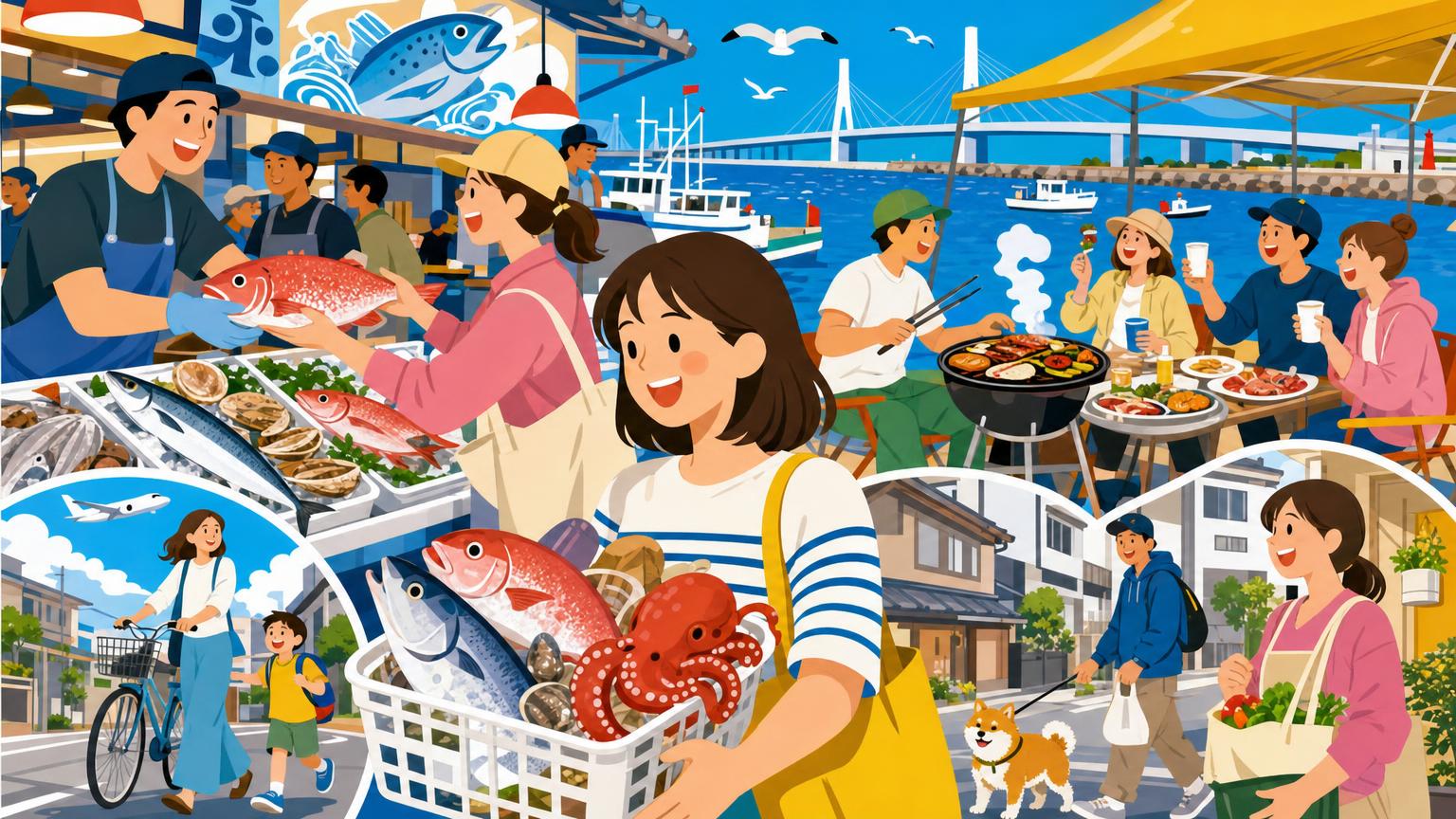
If you are new to Japanese seafood, the best question is not, “What is the freshest?” Nearly everything displayed for sale is meant to be fresh. A more useful question is, “What can I cook tonight?”
Tell the seller:
- how many people you are feeding
- whether you have access to a kitchen
- whether you want sashimi, grilling, frying, or soup
- whether you need the fish cleaned
- whether you are taking it home by train
Useful Japanese phrases include “sashimi you,” meaning for sashimi; “shioyaki you,” meaning for salt grilling; “uroko to watta nuki,” meaning remove the scales and internal organs; and “sanmai oroshi,” meaning fillet it into three pieces. Perfect pronunciation is not necessary. Pointing, gestures, and a translation app can help complete the conversation.
Be honest about your kitchen. A whole fish may seem economical, but it becomes less so if you do not have a knife, cutting board, or the confidence to prepare it. Prepared sashimi, grilled items, fried fish, sushi, or a cleaned fillet may be better suited to your lifestyle.
Carrying seafood home is part of the planning
Aozora and Tajiri are easy to visit by train, but seafood presents a practical problem. Ice melts, bags leak, and fish smells. A long trip back across Osaka may not be comfortable for you or your fellow passengers.
Bring a reusable insulated bag and, if possible, a small towel or plastic bag to protect your other belongings. Ask the vendor how the item should be stored. If you are buying a large quantity, taking a taxi or car may make more sense than carrying everything through Namba.
Some foreign residents assume that a market must accept international credit cards because it is near KIX. That assumption is unsafe. Tajiri’s official FAQ states that credit cards and electronic money are not accepted. Aozora’s payment methods may vary by shop, and local tourism information advises visitors to prepare Japanese cash. Carry cash in small denominations.
Sunday sushi is part of the local rhythm
The Aozora market’s official shop information notes that handmade sushi is sold every Sunday. Availability and selection may change, but Sunday is an especially useful day for residents who want to eat immediately rather than plan a full seafood purchase.
The food is best understood as a working market meal. You may see fatty tuna, sweet shrimp, shellfish, local fish, and seasonal items, but the exact selection depends on the landings and individual vendors. Do not expect every English menu term to correspond exactly to the fish in front of you. Ask what is popular that day and whether the item is raw, cooked, or ready to take home.
If you are pregnant, have allergies, or are unsure about raw seafood safety, ask clearly about the ingredients and preparation. A market’s freshness does not eliminate the need to make choices appropriate for your health.
Harbor Barbecue: How the Experience Works
The barbecue is more than simply an outdoor restaurant
The seafood barbecue facility beside Aozora Market is designed around a two-step process. First, you check in at the barbecue facility, purchase additional food from the market, and bring eligible items to the barbecue area. According to the official local tourism information, the facility operates on Saturdays, Sundays, and public holidays, while individuals and small groups generally do not need reservations. Groups of ten or more should contact the facility in advance.
The published information lists reception hours from 11:00 a.m. to 5:00 p.m., with entry reception closing at 3:30 p.m., although you should confirm current operating conditions before visiting. The barbecue fee includes charcoal, seasonings, tools, and a portion of meat. Additional seafood, such as scallops, oysters, shrimp, octopus, shellfish, and fish, can be purchased separately at the market. Prices and available ingredients vary by season.
The important social rule is to check the guidelines before bringing food into the seating area. The published facility information states that only food purchased at Aozora Market may be brought in, and drinks must be purchased at the venue. Outside drinks are not permitted. These rules are not a minor detail; they help the facility manage cleaning, sales, and food safety.
A good barbecue group works in stages
For foreign residents, the smoothest approach is to divide the tasks:
- One person checks in at the barbecue reception and asks about seating.
- One person walks through the market and compares the seafood.
- One person keeps track of cash, bags, and drinks.
- The group returns to the barbecue area before the food begins to melt or warm up.
Do not buy everything at once. First look over the seafood, then ask about serving sizes. A blue crab, several scallops, shrimp, oysters, and fish can quickly become too much food, especially when the barbecue also includes meat and rice.
At the grill, cook slowly. Shellfish can spit, whole fish need time, and octopus and squid change texture quickly. Do not place every item on the hottest part of the grill at once. Ask the staff if you are unsure. A brief question is better than wasting an expensive ingredient.
The smell is part of the experience: charcoal, sea air, soy-based seasoning, shellfish shells opening in the heat, and the sweet smoke of fat. The atmosphere is lively rather than elegant, so clothing that can handle smoke is a sensible choice.
Why barbecue reveals Osaka culture
A harbor barbecue reflects a particular Osaka balance between abundance and restraint. The atmosphere feels generous, but the food is not treated carelessly. People choose carefully, share dishes, compare prices, and comment on freshness. Someone may tease a friend for buying too much, while someone else may quietly give a child the best piece of grilled fish.
This is everyday Osaka hospitality: not necessarily soft or formal, but attentive to whether everyone is eating, whether the bill is reasonable, and whether the group is enjoying itself.
For foreign residents, the lesson is that participation matters more than performance. You do not need to speak fluent Japanese, but you do need to read the situation, follow the facility rules, and share the space without turning the meal into a private party that ignores everyone around you.
The Afternoon Fish Auction and the Meaning of Time
Why an afternoon auction is unusual
Many people picture fish auctions as dawn events. At Aozora, however, the auction associated with local fishing operations may begin around 2:00 p.m. on days when boats have gone out and conditions permit. Fish landed throughout the day may then be offered for sale at the market later in the afternoon.
This schedule reflects local fishing and distribution patterns rather than a tourist timetable. Boats depart early, return later, and the catch moves through the cooperative’s system. As a result, the market’s afternoon energy may differ from the Sunday morning rhythm at Tajiri.
Do not arrive assuming an auction is guaranteed. Weather, fishing activity, holidays, and reservations can all affect the schedule. Some official and tourism information indicates that viewing requires advance reservations, while other listings note that auctions may not be held on Sundays. Confirm directly if attending the auction is central to your plans.
How to behave if you attend
An auction is not a show where visitors can move freely. Remain in the designated viewing area, and keep your voice low enough for staff and buyers to work. Do not reach toward the seafood or enter the bidding space. Photography may be restricted. Follow all instructions, even if they are given only in Japanese.
Focus on observing the rhythm rather than trying to understand every word. Buyers quickly assess quality, size, condition, and price. The auction is a condensed expression of local knowledge, but it is also a workplace. Your role is to watch without interfering.
Getting There from Osaka
From Namba
The simplest rail route is usually via the Nankai network. Take a Nankai train toward Izumisano, Kansai-Airport, or Wakayama, depending on the service. Izumisano Station is the main station for Aozora Market. Nankai’s official station information places Aozora Market about twenty minutes on foot from Izumisano Station, while local tourism information estimates roughly fifteen to twenty minutes, depending on the route.
The walk is possible, but it is not always the best option for a group carrying seafood or traveling in hot weather. Taking a taxi from the station may be more practical. If you use one, show the Japanese name “泉佐野漁協青空市場” and the address if necessary.
For Tajiri Sunday Morning Market, continue farther south on the Nankai Main Line to Yoshiminosato Station. The market is approximately a ten-minute walk from the station, and its official Sunday hours are 7:00 a.m. to noon.
From Tennoji and eastern Osaka
From Tennoji, you may first need to transfer to Namba or another station with access to the Nankai network. Allow more time than a simple map estimate, since a Sunday morning train connection, the station walk, and the market’s opening time all matter.
If you live in northern Osaka, driving may be easier for a seafood-focused day because of parking and carrying capacity. However, driving changes the social experience. You will not have the same opportunity to watch residents move through the station area, and someone in your group must avoid drinking at the barbecue.
A car is useful for families and large purchases, but public transport is entirely practical for a small group making modest purchases.
From Kansai International Airport
Izumisano is close to Kansai International Airport, which makes it suitable as a South Osaka weekend outing or as a carefully planned first or final stop. However, the market is not located within the airport area. You still need to travel to Izumisano Station or arrange a taxi. Local information places Aozora Market about 1.2 kilometers from Izumisano Station, or roughly fifteen minutes on foot, while the Nankai station guide gives a walking estimate of around twenty minutes.
Do not attempt a market visit during a tight international connection. Train delays, taxi waiting times, luggage storage, market crowds, and the distance back to the airport can quickly eliminate your margin. This option is better suited to residents, airport-area hotel guests, or travelers with a genuinely generous schedule.
For everyday life in Osaka, the airport connection has another significance. KIX makes South Osaka international without making it uniformly cosmopolitan. A foreign resident can live near the airport and still experience neighborhoods where local conversation, shopping habits, and port work remain more important than tourism.
Planning a Resident-Friendly Weekend
A Slow Sunday Plan
A realistic Sunday schedule could start at Tajiri rather than Aozora. Arrive around 8:00 a.m., walk through the stalls, buy a small amount of seafood, and use the eat-in area if it is available. The official Tajiri FAQ notes that there is a free eating space, as well as cafés and sushi-related businesses.
After Tajiri, you can head toward Aozora Market for a later lunch, more shopping, or barbecue if the facility is operating. This is not a guaranteed single-ticket itinerary, so you will need to check opening days, transportation, and your appetite. The appeal lies in experiencing two different types of local markets on the same coast.
A more relaxed alternative is to visit only Aozora from late morning. Eat sushi or a seafood bowl, shop for dinner, and have barbecue if you have checked the rules and reception hours. This option is easier for residents with children, older relatives, or guests who do not enjoy very early mornings.
A Saturday Harbor Barbecue
Saturday may be better if your main purpose is the barbecue. You can arrive before lunch, check in, choose your seafood, and eat without trying to combine the trip with Tajiri’s early rush. The atmosphere is usually less pressured than a Sunday morning market visit, although weekends can still be busy.
If you live in Osaka, consider making the trip about food rather than trying to visit several destinations. Buy enough for one meal. Sit by the port. Talk with the people you came with. Notice how the weather changes the coast. South Osaka is not always dramatic, but that is the point. The experience closely reflects ordinary life.
What to Bring
Bring Japanese cash, a reusable insulated bag, a hand towel, wet tissues, and clothing that can handle smoke. Comfortable shoes are helpful because market floors and port-side paths may be wet or uneven. A portable translation app is useful, but avoid holding your phone over a vendor’s hands while they are working.
If you have dietary restrictions, learn the Japanese words before you go. “Niku nashi,” meaning no meat, is useful at a barbecue, but ask what the set includes. “Ebi dame,” meaning shrimp is not okay, may be too vague if you have a serious allergy. Explain clearly and confirm that the staff understands.
If you are bringing a dog or a baby, check the conditions in advance. Tajiri’s FAQ says pets are not formally prohibited but advises caution because food is being handled and other customers may be affected. It also notes that wheelchairs and strollers can be used, although some paths are uneven.
How Izumisano Compares with Kuromon Market and Kizu Market
Kuromon Market is easier for first-time visitors
Kuromon Market in central Osaka is convenient, highly visible, and used to welcoming visitors. You can find prepared food, snacks, seafood, and restaurants within a compact area. For someone new to Japan, that convenience is valuable.
However, Kuromon is not a perfect example of ordinary Osaka food shopping. Its business environment has been shaped by tourism, and visitors may feel that food is being presented for immediate consumption. Izumisano feels more closely connected to buying ingredients for home, even though restaurants and barbecue facilities are also available.
The difference is not that one market is authentic and the other is fake. That judgment is too simplistic. The difference lies in what each place asks you to do. Kuromon makes eating easy. Aozora asks you to choose, carry, cook, or understand where the food comes from.
Osaka Kizu Market serves a different purpose
Osaka Kizu Market is a wholesale-oriented market near the city center. Access, opening practices, and conditions for public purchasing can change, so foreign residents should not assume it functions like a casual retail market. If you are looking for a straightforward seafood outing, Aozora is easier to understand and better suited to a relaxed weekend meal.
Aozora’s value is not simply that it is less crowded. It offers a clearer connection between the port, cooperative, seller, kitchen, and table. You can see that food is not merely an Osaka attraction. It is part of how households organize their weekends and daily meals.
The local-versus-tourist distinction is not absolute
Local people also enjoy Kuromon, and tourists visit Aozora as well. A Japanese resident may come to Aozora specifically for a special meal, while a foreign resident may use Kuromon for practical shopping. Avoid turning the comparison into a moral ranking.
The more useful question is: what kind of interaction do you want? If you need simple prepared food, Kuromon may be easier. If you want to practice buying ingredients, asking questions, and experiencing a less tourist-centered environment, Aozora is the better choice.
What Foreign Residents Commonly Misunderstand
“The market is open, so everything will be available”
A market may be open even after the best seafood has sold. Tajiri operates only in the morning, and individual stalls may close early. The shops at Aozora carry different stock and may not all keep the same hours. Fishing conditions also influence what arrives.
This is normal, not poor service. A fish market is linked to boats, weather, landings, and local demand. If you are looking for a specific species, ask before making the trip.
“Fresh means expensive luxury seafood”
Freshness does not belong to a single price category. A local market may offer inexpensive fish, seasonal shellfish, prepared foods, and premium items alongside one another. The best purchase depends on what you plan to do with it.
Do not buy the most expensive seafood simply because you want to experience the market properly. Ask what local residents purchase for an everyday meal. You may learn more from a packet of fried fish or a simple grilled item than from a luxury platter.
“Osaka people will always explain everything cheerfully”
Some sellers enjoy talking with foreign customers, while others are busy. Some can communicate in English, but many cannot. A friendly city does not guarantee bilingual service.
Be patient. Use short phrases. Point to the item. Accept a brief answer. If you need detailed information about allergens, raw preparation, or cooking, visit at a quieter time and ask respectfully.
“A Sunday morning market is a tourist attraction”
The Tajiri market is also a weekly shopping destination. People may be there to buy fish for lunch, vegetables for the week, or household goods. Their weekend is not an educational program for visitors.
You may observe, but do not treat people as background scenery. Ask before photographing faces. Keep the walkways clear. If a child is choosing seafood with a parent, give them room.
The Deeper Osaka Lesson at the Water’s Edge
Osaka Is Practical Before It Is Polished
Central Osaka can be stylish, modern, and highly designed, but the region’s daily culture is often more practical than polished. People want to know whether something works, whether it is worth the price, whether it can be used, and whether everyone in the group is satisfied.
At the harbor, this attitude becomes clear. A seller does not need to describe a fish in fashionable terms; they need to explain how to cook it. A customer does not have to pretend that every price is affordable. They can ask questions, compare options, and decide.
This practical directness may feel less smooth than Tokyo-style service. It can also feel more human because the purpose of the exchange remains clear.
Osaka Relationships Are Built Through Repeated Small Contacts
You may not become friends with a market seller after a single visit. That is not the expectation. In local life, trust often develops through repetition: buying the same kind of fish, remembering a recommendation, returning with a question, and respecting the seller’s time.
The same pattern appears in neighborhood cafés, bicycle shops, clinics, school communities, and apartment buildings. Osaka’s openness often emerges after people see that you participate reliably. A foreign resident who says hello, pays attention, and keeps returning can gradually receive more advice and more relaxed conversation.
This differs from expecting instant inclusion. Being foreign may make you noticeable, but it does not automatically make you part of the community. Participation is what does that.
South Osaka Helps Correct the “Osaka Equals Comedy” Stereotype
Osaka is associated with humor because people may joke, tease, and speak vividly. But daily life is not a comedy stage. At the market, humor often helps people manage practical tensions involving price, freshness, queues, weather, and the difficulty of choosing.
A joke can soften a correction. A complaint can express familiarity. A loud exchange can still be cooperative. If you understand only the words, you may think people are arguing. If you observe what happens next, you may see that they continue shopping together.
The coast makes this especially clear because the setting is ordinary enough for behavior to matter more than performance.
A Practical Final Plan for Foreign Locals
If you want an early market experience, go to Tajiri on Sunday morning. Arrive before 9:00 a.m., bring cash, expect some stalls to sell out, and leave room in your bag for seafood. Eat something simple and observe how local customers move through the port.
If you prefer a later seafood day, choose Izumisano Aozora Market. Go after 10:00 a.m., remember that Wednesday is the regular closing day, and allow time to walk from Izumisano Station or take a taxi. Look around before buying, and ask how the item should be cooked. If you want barbecue, check the weekend facility schedule and reception rules before arriving.
If you want to understand Osaka people, do not judge the trip by how many dishes you ate or how many photographs you took. Pay attention to how customers speak with sellers. Notice how people complain without necessarily being angry. Observe how food choices are connected to households, budgets, weather, and time. Keep in mind that the most valuable interaction may be a brief explanation of how to cook a fish.
That is the part many visitors miss. South Osaka’s seaside markets are not simply hidden attractions near the airport. They are working places where Osaka’s character becomes practical: direct but not always harsh, generous but not careless, humorous but not constantly performing, and welcoming when you make the effort to fit into the rhythm of everyday life.