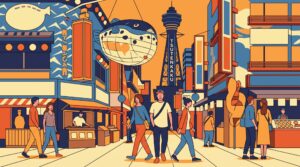
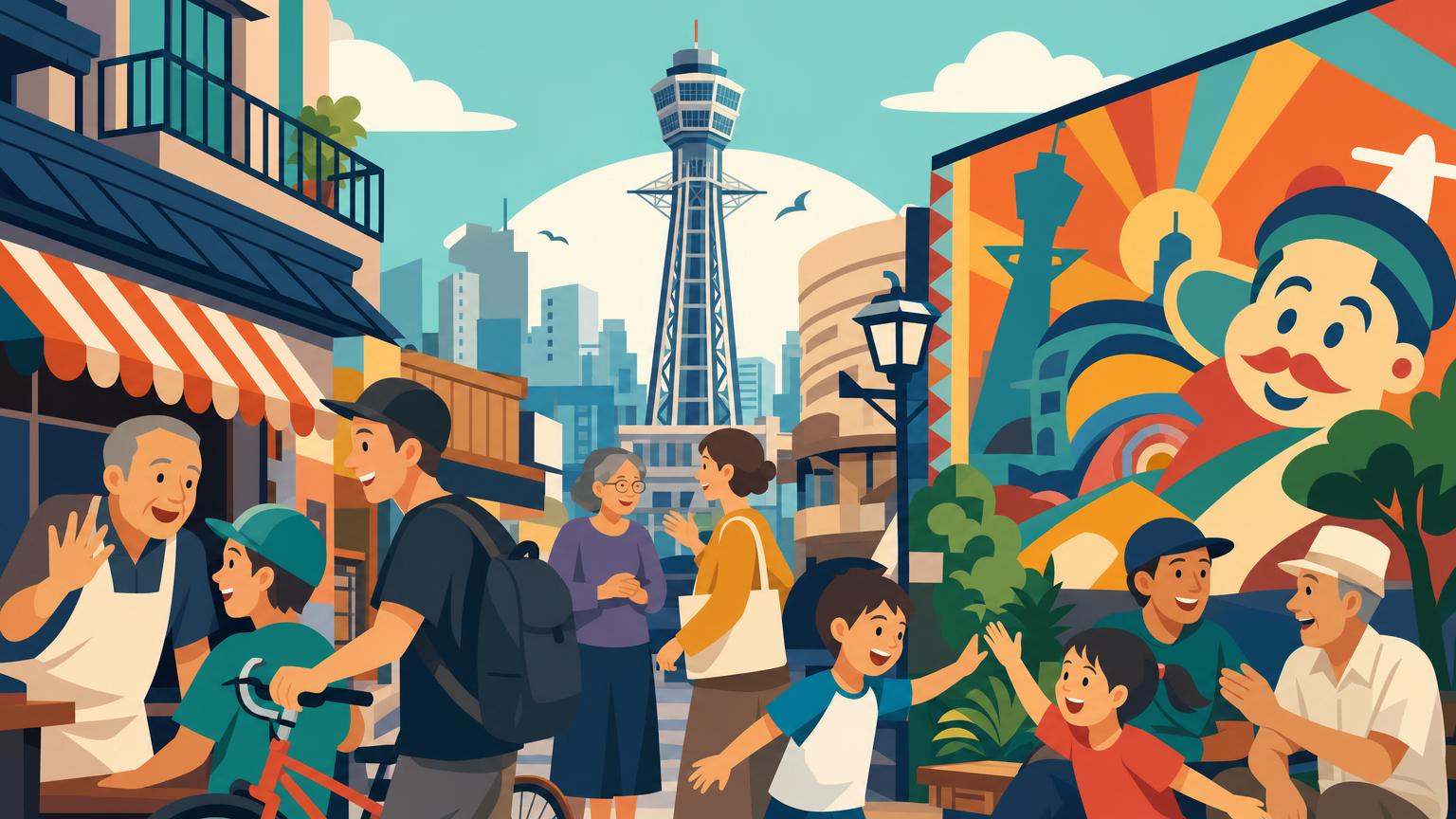
A foreign resident can walk through Shinsekai, look up at Tsutenkaku, eat kushikatsu, and still miss the most important part of the neighborhood.
The tower is easy to notice. The local rhythm is not.
Shinsekai is often introduced as a retro entertainment district, a “deep Osaka” stop, or a place to experience old-fashioned street food. Those descriptions are not completely wrong, but they turn a living neighborhood into a stage set. Behind the neon signs are people going to work, buying groceries, meeting friends, managing small shops, caring for family members, and negotiating the changes brought by tourism, new hotels, rising rents, and younger businesses.
That is why the real question is not simply whether Shinsekai is worth visiting. The more useful question is this: What kind of neighborhood is Shinsekai when you stop looking at it as a tourist attraction?
For people considering living in Osaka, Shinsekai offers a concentrated lesson in the city’s character. It shows Osaka’s practical humor, its comfort with mixed social backgrounds, its strong small-business culture, and its habit of accepting people without requiring them to look polished. It also shows the limits of romanticizing “local life.” Some streets feel warm and communal. Others can feel rough, tired, or socially complicated. The neighborhood is welcoming in one sense, but it is not designed to make every outsider feel instantly comfortable.
Shinsekai developed as part of Osaka’s southern downtown area and has long been connected with entertainment, low-cost lodging, food businesses, labor, and working-class life. Janjan Yokocho opened in 1921, when Shinsekai was already a major entertainment district in a rapidly growing Osaka. Today, the area combines old residents, long-running family businesses, day visitors, international tourists, workers, elderly people, and newer residents who are attracted by relatively accessible housing and central transport.
The map below shows the general Shinsekai area. It is useful for orientation, but it cannot show the social boundaries that residents feel: the difference between a busy food street and a quiet residential lane, between a place where strangers are expected and a place where they are not, or between daytime Shinsekai and late-night Shinsekai.
What Shinsekai Really Is: A Neighborhood, Not a Theme Park
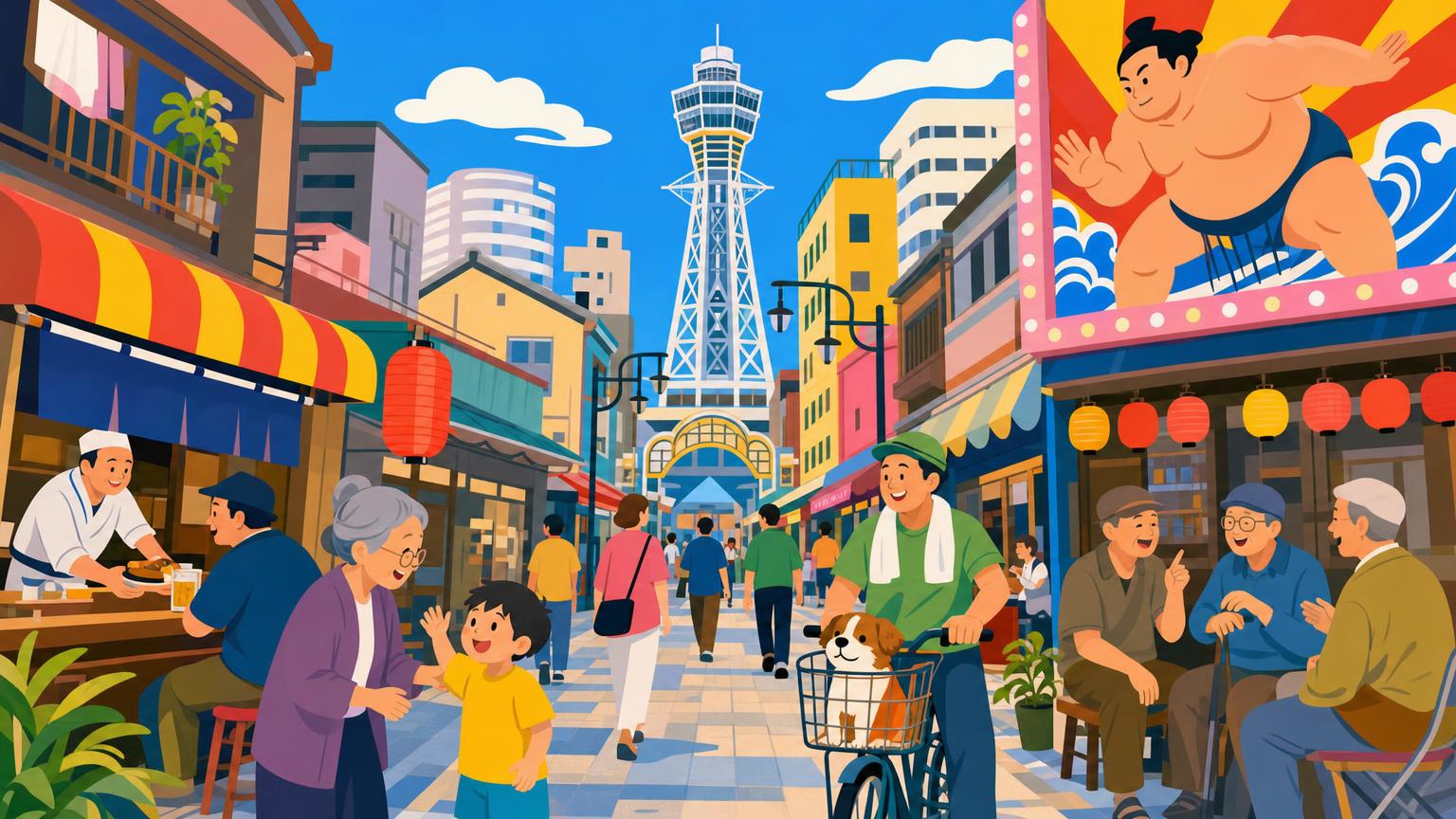
The name Shinsekai means “New World.” It sounds futuristic, but the neighborhood’s present-day image is closely associated with the past. That contrast explains much of both its appeal and its misunderstanding.
Shinsekai was planned during a period when Osaka was presenting itself as a modern industrial city. The area’s origins are connected to the 1903 Fifth National Industrial Exposition in Tennoji, after which entertainment facilities and urban development expanded around the southern side of the city. The original ambition was not to preserve old Osaka, but to create a new and exciting Osaka that could compete with major cities both at home and abroad.
Over time, the neighborhood’s energy changed. Its grand modern image became worn, some businesses closed, and the area became associated with inexpensive food, old entertainment, low-cost accommodation, laborers, older men gathering in public spaces, and social problems that more prosperous parts of Osaka preferred not to discuss.
That history is still visible, but it should not be regarded as the whole story.
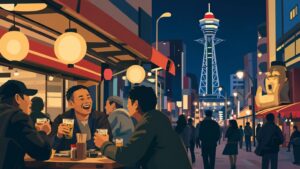
A first-time visitor may notice the large signs, narrow arcades, old restaurants, cigarette smoke, loud advertisements, and faded buildings. A resident may notice something else: who opens a shop before breakfast, which restaurant knows its regular customers by name, where people sit alone without being disturbed, and which side streets become quiet after the restaurants close.
The neighborhood’s identity is built less on architectural beauty than on repeated use. A small restaurant survives because regulars continue to return. A standing bar feels familiar because the same customers occupy the same few stools. A shopping street remains meaningful because people still shop there, not because it has been preserved for photographs.
This distinction matters when considering where to live in Osaka. In newer districts, community may be organized through apartment buildings, schools, gyms, parenting groups, or online networks. In Shinsekai, community can be more visible in commercial spaces. The local café, sento, barber, tobacco shop, diner, or small izakaya may serve as an informal social room.
That does not mean everyone knows everyone else. Osaka is still a large city. It means that everyday contact can occur through repeated, low-pressure encounters rather than formal introductions.
The Local Community Is Mixed, Uneven, and Changing
One of the biggest mistakes foreigners make is looking for a single “type” of Shinsekai resident.
There is no one local personality. Shinsekai is located near Dobutsuen-mae Station, Ebisucho Station, Shin-Imamiya Station, Tennoji, Nishinari, and Abeno. The surrounding area includes entertainment streets, apartment buildings, older homes, hotels, welfare facilities, shopping streets, religious institutions, offices, and major transportation routes. The experience can change from one block to the next.
Nishinari, which borders Shinsekai, has historically been known for inexpensive lodging and “doya” accommodation. The area is also associated with labor, welfare, and people living on the margins of conventional middle-class life. These facts are important, but they do not justify treating local people as scenery or categorizing them as a danger.
A neighborhood with many different social backgrounds can feel less controlled than an affluent residential district. You may see people sleeping outdoors, visibly intoxicated individuals, people speaking loudly to themselves, elderly men gathering in the street, and residents whose appearance does not fit the clean, quiet image often associated with Japan. You may also encounter remarkably observant shop owners, neighbors who look after one another, families who have lived there for generations, and workers simply trying to get through another day.
Foreign residents sometimes interpret visible differences as hostility. Sometimes, however, it is simply difference. A person staring may be curious, tired, drunk, or lost in thought. A blunt comment may be an attempt to start a conversation rather than an insult. A shop owner who quickly says “no” may be protecting the business from a difficult situation, not rejecting foreigners in general.
At the same time, cultural explanations should not become excuses for poor behavior. If someone is harassing you, following you, touching you, or pressuring you to spend money, leave. Osaka’s informal atmosphere does not mean you have to tolerate intimidation.
The honest picture is mixed: Shinsekai can be socially open, but it can also be socially rough. It can feel human and unfiltered, but not always comfortable. It can offer a strong neighborhood identity without providing the polished services that make life easier for newcomers.
Why Shinsekai Feels Different from Tokyo
The comparison between Osaka and Tokyo is often reduced to “Osaka people are friendlier.” That explanation is too vague to be especially useful.
The more practical difference is that Osaka often has a lower barrier to informal interaction. People may comment on the weather, ask where you are from, joke about your Japanese, or recommend a dish without first establishing formal social distance. In Tokyo, strangers can be equally kind, but public behavior often feels more compartmentalized. People tend to protect their personal space more carefully, particularly on trains, in offices, and in crowded commercial areas.
Shinsekai makes Osaka’s informal style especially visible because the neighborhood has many face-to-face businesses. Customers sit close together, and staff can see what people order. Regulars may speak to newcomers. A conversation might begin because someone notices that you are unsure how to order or because you react to a local joke.
This is not the same as deep friendship.
An Osaka shop owner may tease you today and forget your name tomorrow. A regular may offer you advice but never invite you into their private life. The interaction is genuine, but it may remain local and temporary. Foreigners sometimes mistake this quick warmth for a promise of long-term acceptance, only to feel disappointed when the relationship does not develop further.
The opposite misunderstanding can also occur. Some foreigners interpret teasing as aggression because they are accustomed to more careful language. In Osaka, humor can be used to reduce distance. A joke may communicate, “You are not being treated formally.” However, humor depends on context. A friendly laugh from one person does not make every joke acceptable.
Tokyo often rewards quiet efficiency, while Osaka often rewards conversational flexibility. In Tokyo, a person may avoid creating trouble by saying nothing. In Osaka, someone may try to handle the same situation by talking, joking, bargaining, or complaining openly.
Shinsekai is one of the places where this verbal style can be particularly clear. Customers may shape the mood of a restaurant through conversation. Staff may correct behavior directly, and regulars may tease each other loudly. Someone who grew up in a more restrained culture may think the room is angry when it is simply active.
Still, do not turn this into a rule that every Osaka resident wants conversation. Many residents simply want to eat quietly, commute, shop, and return home. The skill is not to “be sociable,” but to recognize whether the situation is open to interaction.
What Foreigners Often Misunderstand About Osaka Warmth
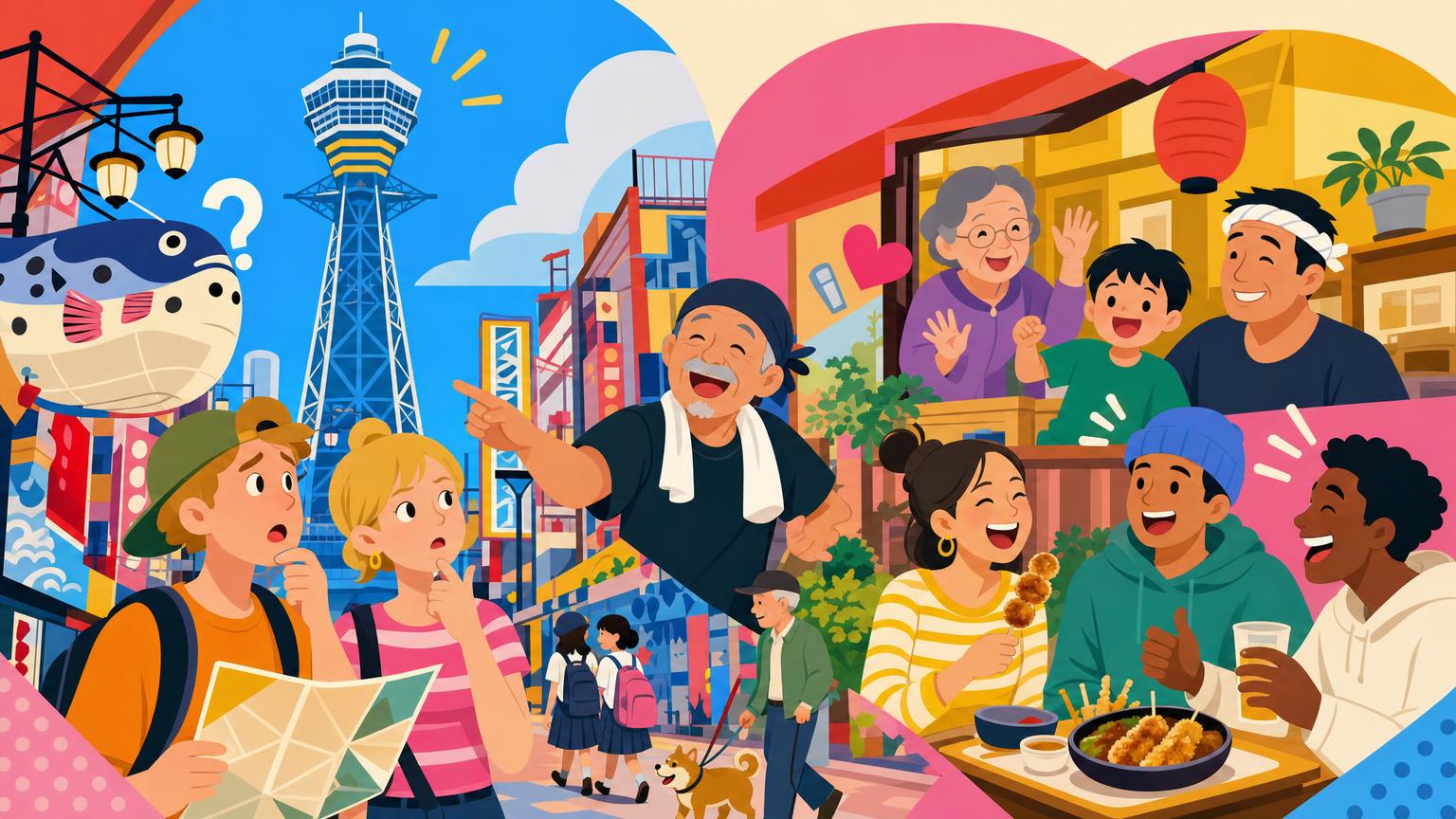
Osaka’s reputation for friendliness attracts people who are tired of anonymous city life, and some expect to find an immediate sense of community. That expectation can create problems.
The first misunderstanding is assuming that friendliness means informality has no rules. It does. You can speak casually only once the relationship allows it. You can joke only when the other person is participating. You can enter a small restaurant only if you understand its atmosphere. You can ask questions, but you should not treat local people as unpaid tour guides.
The second misunderstanding is assuming that a direct answer is rude. In Shinsekai, a shopkeeper may tell you that a table is reserved, that your order is too complicated, or that you should wait outside. The wording may be shorter than you expect. Usually, the practical meaning matters more than the emotional tone.
The third misunderstanding is assuming that old-fashioned means untouched by change. Shinsekai has been changing for years. Tourism has brought in new money and new businesses. Hotels and short-term accommodations have expanded throughout the southern Osaka area. New restaurants may use the visual language of the Showa period while being operated by younger owners or companies with modern business models.
The fourth misunderstanding is assuming that “authentic” means poor or uncomfortable. Many local businesses are inexpensive because of their format, customer base, or long-established operating style. That does not make the people who use them any less sophisticated. A customer eating at a standing bar may have a long career, a university degree, or decades of business experience. Social class is not always visible in the way a visitor expects.
The fifth misunderstanding is treating the neighborhood’s vulnerable residents as part of its atmosphere. They are not. A person sleeping outside, asking for help, or struggling with addiction is not a local attraction. Do not photograph people without their consent. Do not point, laugh, imitate, or bring friends to stare. This should be obvious, but tourist curiosity can become humiliating very quickly.
How Osaka Conversation Works in Everyday Life
If you live in Osaka, you may notice that communication often depends more on timing and tone than on perfect grammar.
A person might use a joke to soften criticism. A restaurant worker may exaggerate a complaint. A neighbor might complain about garbage sorting while also helping you understand the collection schedule. Someone may say “muri” — impossible — when they actually mean “that will be difficult, so please change your plan.”
The words may sound stronger than the intention.
This does not mean you should ignore people’s words. It means you should listen to the complete situation: their facial expression, volume, whether they continue helping you, whether others are laughing, and whether the conversation is public or private.
Osaka humor is often based on a small shift in expectations. One person says something obvious, another points out that it was obvious, and everyone shares the moment. The humor may be quick and unpolished. If you respond with a small laugh or a simple “sou desu ne,” you can often keep the exchange comfortable without understanding every reference.
Foreign residents sometimes worry that their Japanese is not good enough to participate in these interactions. In reality, perfect Japanese can make a conversation more formal than necessary. A few practical phrases, a willingness to listen, and the ability to laugh at your own mistakes are often more valuable than advanced vocabulary delivered tensely.
Useful habits include:
- Let the other person finish before responding, especially in a crowded shop.
- Use a polite greeting when entering a small business, even if regulars speak casually.
- Ask before taking photographs inside a restaurant or arcade.
- If someone jokes with you, respond lightly rather than trying to create a perfect comeback.
- If you do not understand, say so simply instead of pretending.
- When a conversation becomes uncomfortable, smile, thank the person, and leave.
The goal is not to imitate Osaka-style friendliness. It is to avoid treating every interaction as a transaction.
Small Businesses Explain the Neighborhood Better Than the Tower
Shinsekai is best understood through its small businesses.
A major attraction can draw people into the area, but small businesses explain why the neighborhood has its personality. They show what customers value, how much time people spend together, and what kinds of behavior are accepted.
In a chain restaurant, the customer experience is standardized. In a small Shinsekai shop, however, the experience may depend on the owner’s mood, the time of day, the regular customers, the size of the counter, and whether you understand the house rhythm. The menu may be simple, but the social rules can be complex.
A restaurant can be inexpensive and still require good manners. Do not block the entrance while making a decision. Do not remain in your seat after finishing if people are waiting. Do not demand lengthy explanations from busy staff. If the shop is clearly designed for quick meals, eat, pay, and make room for the next customer.
This is particularly important for foreign residents who want to become regulars. Becoming a regular is not achieved by spending a lot on one visit. It is achieved through consistency. Visit at reasonable times. Remember the basic rules. Say hello. Do not create extra work. Pay promptly. Be considerate of other customers.
The same principle applies to bars and cafés. A small business may welcome foreigners while still depending on a quiet balance. If you arrive with a large, noisy group, take photographs of everything, or stay for hours while ordering very little, you alter the environment for everyone else.
Osaka’s local culture is often described as relaxed, but that relaxation has a material foundation. Someone is cleaning the tables. Someone is paying the rent. Someone is managing stock, licenses, suppliers, and staff. The casual atmosphere works because people are handling practical responsibilities in the background.
That is a useful lesson for life in Osaka. Informality does not mean the city has no systems. It means those systems are often hidden within habits and relationships.
Janjan Yokocho and the Meaning of an Arcade Street
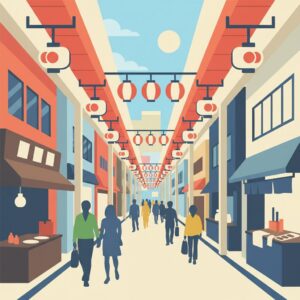
Janjan Yokocho, officially connected with the Nan’yo-dori Shotengai shopping arcade, is one of the clearest examples of how Shinsekai brings together history, food, entertainment, and everyday social life. Its commonly used name refers to the sound of shamisen music that once helped draw customers in. The arcade opened in 1921, when the surrounding district was a major entertainment area.
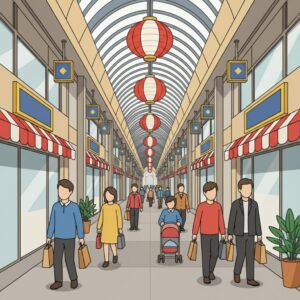
To visitors, Janjan Yokocho may appear to be a narrow, photogenic street lined with food shops and older businesses. For locals, however, an arcade can serve a more practical purpose. It provides shade and shelter in bad weather, offers a recognizable route between stations and neighborhoods, and creates a cluster of businesses where people know one another. It also gives small shops a shared identity without requiring them to become part of a large commercial complex.
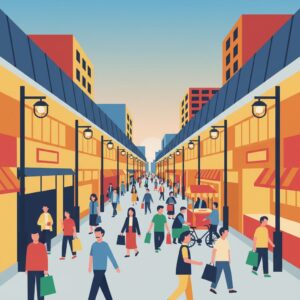
This is one reason covered shopping streets are important in Osaka. They are more than just collections of stores. They can function as public living rooms, particularly for older residents. Someone may have no reason to visit a large shopping mall, yet still walk through the arcade, stop for lunch, greet someone, and purchase a few everyday items.
The arcade also reflects the tension between local use and visitor attention. When tourists stop in the middle of the walkway, take extended photographs, or gather around a shop entrance, ordinary movement can become difficult. In a neighborhood with narrow streets, even small disruptions are felt immediately.
The best way to behave is simple: keep moving when the walkway is busy, stand to one side while checking your phone, ask before photographing people, and remember that the street is used by residents who are not participating in your travel experience.
Food Is Social Infrastructure in Shinsekai
Kushikatsu is more than just a famous Osaka food. In Shinsekai, it helps explain how the neighborhood functions.
Deep-fried skewers are easy to order, share, and enjoy as either a quick meal or a casual drink. The food encourages movement: order several pieces, eat, talk, decide what to try next, and leave room for another customer. It suits a district built around compact restaurants and strong repeat business.
The most important rule for first-time customers is the shared sauce rule. Traditionally, diners must not dip a partially eaten skewer back into the communal sauce container. This is known as “nidoduke kinshi,” or no double dipping. If you want more sauce after taking a bite, use the provided cabbage to scoop up sauce and place it on your food, or follow the restaurant’s current serving method. Many restaurants now provide individual containers or squeeze bottles, but you should still observe what the people around you are doing.
The rule is not a quaint performance for tourists. It is a practical hygiene measure in a shared dining environment. Following it shows that you understand the space is communal.
This is a small but useful example of Japanese social behavior. Rules are often communicated through objects, layout, and observation rather than lengthy verbal explanations. The sauce container, cabbage leaves, chopsticks, tray, and seating arrangement all show you how the restaurant works.
Foreign residents sometimes feel embarrassed about making a mistake. Most staff understand that newcomers may need guidance. Watch first, and ask politely if you are unsure. A simple “dou shimasu ka?” or “How should I do this?” is better than touching everything on the counter while guessing.
Doteyaki, a dish of beef sinew simmered in miso and other seasonings, is another food associated with Osaka’s casual drinking culture. Its appeal is not only its flavor. It is the kind of dish that makes sense in a neighborhood where food is designed to be comforting, affordable, and enjoyed alongside conversation.
Pay attention to what people order at different times. Lunch customers may be alone and focused. Afternoon regulars may use the shop as a social stop. Evening customers may drink and talk more loudly. The same restaurant can feel like three different places in a single day.
Is Shinsekai a Good Place to Live?
The answer depends on what you need from a neighborhood.
Shinsekai can be a practical base for people who value central access, affordable food, strong transport connections, and a lively street environment. Dobutsuen-mae Station connects to the Osaka Metro Midosuji and Sakaisuji lines. Ebisucho Station serves the Sakaisuji Line, while Shin-Imamiya Station is also within walking distance, depending on your exact location.
The area is close to Tennoji, Abeno, Namba, and other major parts of Osaka, making commuting and daily errands convenient. You can reach large supermarkets, hospitals, department stores, and shopping centers without crossing the entire city.
However, convenience is not the same as comfort.
Some residents enjoy living near busy food streets because there is always light, activity, and somewhere to eat. Others dislike the noise, cigarette smoke, drinking culture, tourist traffic, or visible social problems. A building that feels charming during an afternoon walk may seem different when delivery trucks arrive early, customers leave restaurants late, or groups gather outside at night.
Before renting, visit the exact street where the apartment is located at several different times:
- Early morning, when shops are opening and workers are moving through the area.
- Around lunchtime, when restaurants and arcades show their usual daily rhythm.
- In the evening, when drinking establishments become busier.
- On a weekend night, when visitor numbers and noise may increase.
- On a rainy day, when narrow covered streets feel different from sunny ones.
Do not judge a property solely by its distance from Tsutenkaku. A ten-minute walk can place you in a completely different atmosphere. Check the route to the station, the nearest supermarket, the condition of the building, the sound insulation, garbage rules, bicycle parking, and whether the area feels comfortable when you are alone.
Foreign residents should also consider how much social interaction they want. Shinsekai may offer more visible contact than a quiet apartment district, but that does not guarantee personal support. If you do not speak Japanese, daily tasks may still be challenging. Lease contracts, garbage collection, neighborhood notices, medical appointments, and communication with landlords require practical language skills or reliable assistance.
The neighborhood can be a good fit for someone who is observant, flexible, and comfortable with urban diversity. It may be a poor fit for someone who wants quiet streets, polished public spaces, predictable nightlife, or a community that clearly explains itself to newcomers.
Safety: Calm, Alert, and Honest
The question “Is Shinsekai dangerous?” usually reflects several different concerns.
People may be wondering whether they could be attacked or scammed, whether they will encounter poverty, whether the area is comfortable for women, whether it is safe to walk at night, or whether their image of old Shinsekai is outdated.
A useful answer is that Shinsekai is not a place that requires panic, but it is also not somewhere you should completely switch off your awareness. Its historical reputation comes from its association with working-class life, inexpensive lodging, entertainment, nightlife, and neighboring areas with visible social problems. Today, the main streets are busy with restaurants, visitors, workers, and residents, while the surrounding environment can vary considerably from one block to another and depending on the time of day.
Use ordinary urban precautions:
- Keep your phone and wallet secure on crowded streets.
- Avoid following strangers into bars or restaurants if you feel pressured.
- Be cautious with alcohol, especially when you are alone.
- Do not photograph people in vulnerable situations.
- Use well-lit routes late at night.
- If a street feels uncomfortable, take another route without making a scene.
- Save your accommodation address in Japanese for taxis or emergencies.
- Trust your instincts, but do not view every unfamiliar person as a threat.
Women and solo residents should check the route home, not just the route to the station. A main road may feel comfortable, while a quiet side street may feel isolated. Parents should remember that the neighborhood is an active downtown area, not a controlled family attraction. People with disabilities should check pavement conditions, station exits, and the accessibility of older buildings in advance.
The most important safety rule is social rather than physical: do not enter a situation simply because you feel obligated to be polite. If someone is persistent, step away. If a venue’s pricing is unclear, leave before ordering. If someone blocks your path, move toward a brighter public area or a staffed business.
At the same time, do not spread dramatic stories about Shinsekai based on a single uncomfortable encounter. Neighborhood reputations can persist long after conditions have changed. A careful description is more useful than either alarm or romantic nostalgia.
The Difference Between “Local” and “Authentic”
The word “authentic” is often used carelessly when discussing Shinsekai.
If authentic means “not designed solely for tourists,” some parts of the neighborhood qualify. Residents use the streets, and long-running businesses serve regular customers. The area also has a history that predates the arrival of international visitors who photograph it.
If authentic means “frozen in the past,” however, the word becomes misleading. Shinsekai has always changed. The original district was itself a modern development, and its entertainment culture shifted over time. Businesses opened and closed, while residents moved in and out. The current retro image is just one layer of a much longer urban history.
A foreigner may come looking for “real Osaka” and unconsciously expect local people to remain poor, old, informal, and visually nostalgic. That is not respect for local culture; it is a demand that the neighborhood perform a past version of itself.
Real local life includes renovations, convenience stores, smartphones, chain restaurants, delivery services, new apartment buildings, foreign residents, changing family structures, and people who are tired of being observed. It includes young workers who do not identify with Shinsekai’s old image, as well as shop owners who welcome visitors because tourism helps them continue operating. It also includes residents who would prefer fewer cameras and less noise.
Understanding Osaka means accepting that culture is not a museum object. It is shaped by ordinary choices, including choices that change the appearance of the neighborhood.
How to Build Trust If You Live Nearby
If you plan to live in Osaka and spend time around Shinsekai, trust is built through repetition and restraint.
Begin with the basic behaviors that make shared urban life easier. Sort your garbage properly. Keep your bicycle out of the way. Do not smoke in places where smoking is prohibited. Keep your voice down near homes late at night. Learn your building’s rules. Pay your bills on time. Greet people when the situation calls for it.
These actions may seem too ordinary to qualify as cultural understanding, but they matter more than dramatic attempts to imitate Osaka humor.
If you visit a local business regularly, remember small details. Use the same polite greeting. Thank staff when they help you. Do not demand special treatment simply because you are a foreign customer. If you cannot read the menu, ask for help without assuming that the staff must provide service in English.
When someone corrects you, separate the useful information from your emotional reaction. You may dislike the tone, but the advice may still be practical. If the correction is unfair or aggressive, you are allowed to leave. Living in Osaka does not mean accepting every form of local behavior as cultural wisdom.
Community participation also has its limits. You do not need to attend every neighborhood event or become close with every shop owner. Japanese cities include many people who live quietly without strong local involvement. Integration does not require you to perform gratitude or prove that you are more “Japanese” than other foreigners.
A sustainable relationship with the neighborhood is usually modest. Be recognizable, reliable, and considerate. That is enough to become less of a stranger.
What Shinsekai Teaches About Osaka
Shinsekai reveals a side of Osaka that is easy to overlook when the city is described only through food and humor.
It presents a city where social status can be less carefully concealed in public. It shows how small businesses create everyday connections. It demonstrates that blunt conversation can coexist with generosity. It also shows that people may be willing to joke with strangers while still protecting the boundaries of their private lives.
It also highlights Osaka’s unevenness. The city is not equally comfortable for everyone. Low prices can exist alongside low wages. Tourism can generate income while increasing pressure on residents. A neighborhood may be celebrated for its rough charm even as the people who live there struggle with aging buildings, poverty, addiction, or limited access to support.
For foreign residents, this is important. Osaka may feel more open than Tokyo, but openness is not the same as equality. A shopkeeper may welcome you without understanding your needs. A neighbor may be kind but have limited patience for repeated mistakes. A neighborhood may appear socially mixed while still containing invisible boundaries based on class, age, gender, nationality, and ability.
Understanding the city means observing how people move through those boundaries.
Who gets greeted? Who waits? Who speaks first? Who is allowed to be loud? Who is expected to apologize? Who can sit alone without being questioned? Who is treated as a customer, a neighbor, a nuisance, or a curiosity?
These questions reveal more about Osaka than any list of attractions.
A Practical Mindset for Foreign Residents
If you are considering living in Osaka, Shinsekai can help you determine what kind of urban life suits you.
Choose the area if you value:
- Convenient access to central Osaka.
- Affordable casual food and a wide range of small businesses.
- A neighborhood with a visible history and a strong street character.
- Informal conversation and a less polished urban atmosphere.
- Proximity to Tennoji, Namba, and transport links to southern Osaka.
- Learning through observation rather than through carefully designed visitor services.
Think carefully if you need:
- Very quiet evenings.
- A highly uniform residential environment.
- Extensive English-language support in everyday businesses.
- A neighborhood that feels comfortable without requiring adjustment.
- A strong sense of privacy in public spaces.
- A predictable atmosphere at all hours.
Neither list is a judgment; it is simply a question of fit.
Osaka is a good place to live for many foreigners because daily life can be practical, social, and relatively direct. However, the city does not present its culture as a finished package. You learn it through small negotiations: when to speak, when to wait, when to joke, when to apologize, when to leave, and when to return.
Shinsekai makes those negotiations visible.
Beyond the Tower
Tsutenkaku is the symbol people recognize, but it does not fully explain Shinsekai. The deeper story lies in the spaces around it: the restaurant where a regular is greeted before ordering, the arcade where an elderly resident walks beneath the same roof each morning, the worker eating quickly at a counter, the young tenant carrying groceries past old signs, and the shopkeeper deciding whether a curious visitor understands the difference between a photograph and an intrusion.
The local community is not one single warm atmosphere. It is a collection of habits, memories, businesses, vulnerabilities, jokes, boundaries, and repeated encounters.
That is why Shinsekai can feel both welcoming and uncomfortable in the same afternoon. It is not contradicting itself; it is showing you more than one Osaka at once.
For a foreign friend, I would explain it this way: come with curiosity, but not entitlement. Listen for the meaning behind direct words. Notice the people who are not performing for visitors. Treat small rules as signs of shared life, not as obstacles. Do not confuse poverty with authenticity or informality with permission. If you are considering living nearby, walk the streets at different times and ask yourself whether you can respect the neighborhood as it is, rather than only as you hope it will appear.
Beyond the tower, Shinsekai is not a preserved image of old Osaka. It is a working part of the city, changing in public and carrying its history without becoming trapped within it.
That may be the most Osaka lesson of all.