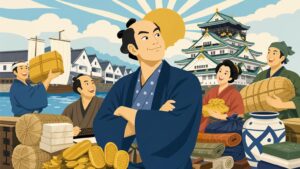
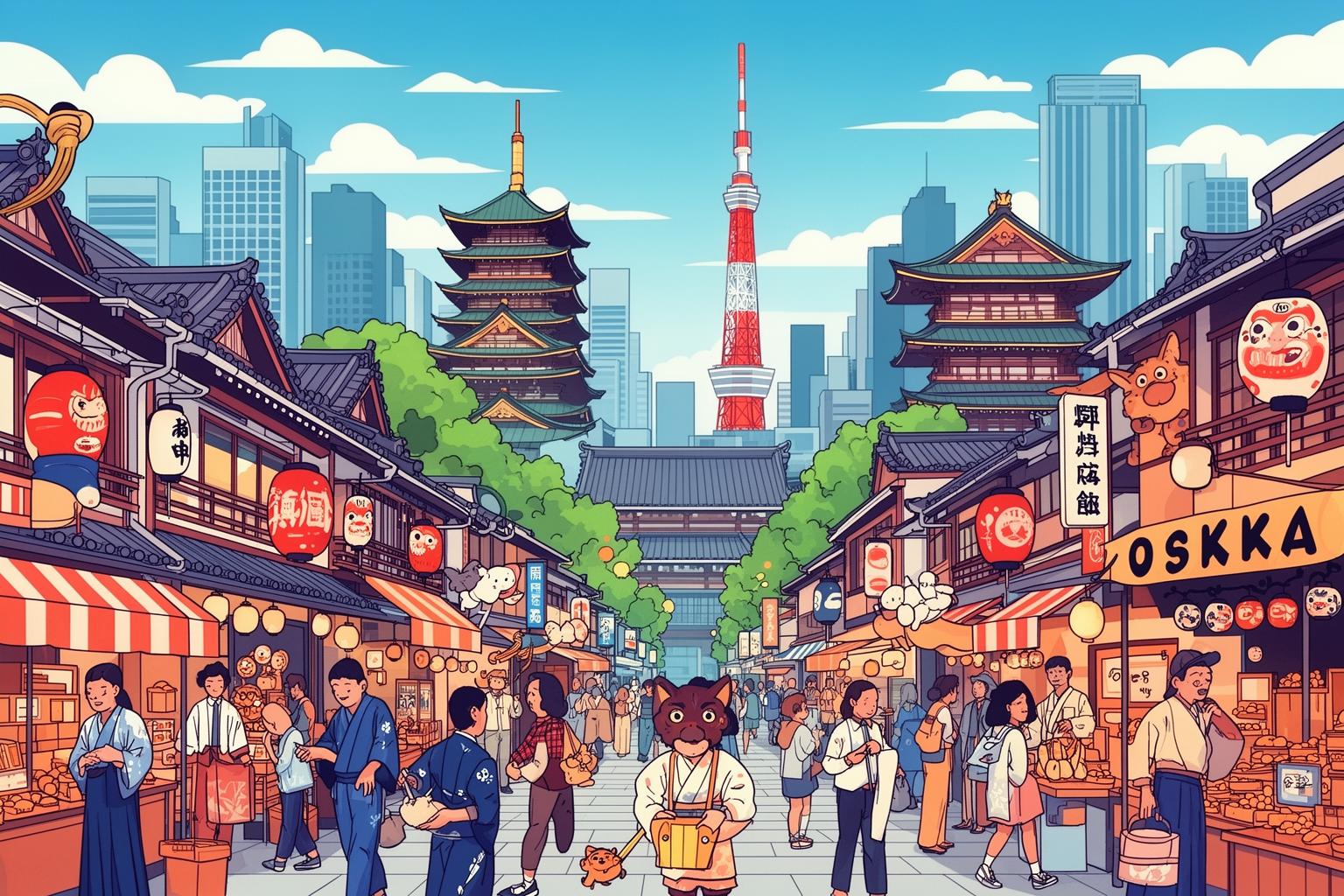
You’ve seen the pictures. The Glico Running Man, arms outstretched in perpetual victory over Dotonbori’s neon-soaked canal. You’ve heard the stereotypes. The loud, food-obsessed locals who treat every conversation like a stand-up comedy routine. Osaka, the city that works hard and plays harder, a vibrant, chaotic contrast to the serene elegance of Kyoto or the polished efficiency of Tokyo. But when the tourists go home and the last train rumbles out of Namba, a different city wakes up. This is the Osaka that shows up for work at 9 AM in the glass towers of Umeda and the bustling wholesale districts of Honmachi. And if you’re planning to live and work here, understanding this Osaka—the professional Osaka—is the key to everything. The city’s pulse isn’t just fueled by takoyaki and cheap beer; it’s driven by a powerful, centuries-old philosophy known as Akindo Damashii (商人魂), the Merchant’s Soul.
This isn’t just a quaint historical term. It’s a living, breathing ethos that shapes every negotiation, every meeting, and every business relationship. It’s the invisible software running on the city’s hardware. Foreigners often get it wrong, mistaking it for a simple, crude obsession with money. They hear the constant talk of profit and loss, the relentless bargaining, and see a culture that’s just, well, cheap. But that’s a surface-level reading, a misunderstanding that will leave you confused and frustrated in a business meeting. Akindo Damashii isn’t about hoarding yen. It’s a deeply pragmatic, human-centric approach to commerce that values mutual benefit, direct communication, and long-term trust over rigid formality and short-term gains. It’s the reason a handshake deal here can feel more binding than a 50-page contract in Tokyo. To survive, and to thrive, in the Osaka workplace, you have to look past the punchline and learn the intricate dance of the merchant’s soul.
To truly understand how this pragmatic, human-centric approach to commerce extends beyond the office and into the city’s social fabric, consider how the principles of trust and direct communication are practiced in places like Kyobashi’s vibrant tachinomi bars.
Deconstructing Akindo Damashii: More Than Just a Price Tag
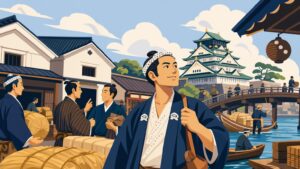
Before we can grasp how Akindo Damashii operates in a modern office, we need to rewind. We must return to a time when samurai were the ruling class, yet merchants held the true power. This spirit didn’t emerge in a boardroom; it was forged in the bustling markets and crowded docks of a city known as Tenka no Daidokoro—the Nation’s Kitchen.
The Historical Roots in Senba and the Merchant Class
During the Edo period, while Tokyo (then Edo) was the political center, Osaka stood as the undisputed commercial hub. Rice, sake, textiles—everything flowed through this city. The legendary Dojima Rice Exchange was the world’s first futures market, where contracts traded on the promise of a future harvest. In areas like Senba, textile merchants built dynasties spanning generations. Unlike the samurai class, whose status was based on birth and honor, an Osaka merchant’s value was measured by skill, reputation, and ability to generate value. They couldn’t rely on a sword or title; their only weapon was wit, and their only armor, credibility.
This created a fundamental divide in the Japanese psyche that remains palpable today. Samurai culture, which heavily shapes Tokyo’s business etiquette, emphasizes tatemae (建前)—the public façade, formal gestures, and preservation of harmony at all costs. It’s a world of implicit communication and strict hierarchy. In contrast, Osaka’s merchant culture is grounded in honne (本音)—true intentions and the real bottom line. For an akindo, concealing true intentions was bad for business, causing wasted time and misunderstandings. It was better to be direct, clear, and honest, even if it caused some friction. This history explains why a Tokyo meeting can feel like a carefully rehearsed play, while an Osaka meeting feels more like an improvisational workshop.
Shobai: The Art of the Deal as a Relationship
In Osaka, the word for business is shobai (商売). Though common across Japan, here it holds deeper significance. It’s not just about transactions; it’s the craft of commerce and the art of sustaining a flow of value between people. A true master of shobai isn’t someone who wins a single big deal, but someone who builds a network of partners and customers who return repeatedly, year after year. The goal isn’t to win the negotiation; it’s to nurture a relationship that endures well beyond the final payment.
This philosophy reveals a strong focus on the long game. An Osaka business owner might offer you a steep discount on your first order—not out of desperation, but as an investment. They are securing your future loyalty and demonstrating commitment to a partnership. They know that delivering quality at a fair price now means you’ll think of them first for the next ten orders. This stands in sharp contrast to a transactional mindset, where every deal is judged independently. Here, every deal is just one chapter in a much longer story.
Son-toku: The Calculation of Mutual Benefit, Not Selfish Gain
Perhaps the most misunderstood concept in Osaka’s business vocabulary is son-toku (損得), literally meaning loss and gain. To outsiders, constantly calculating son-toku might seem greedy or materialistic. But this is a crucial misinterpretation. Within Akindo Damashii, son-toku isn’t a selfish calculation; it’s a transparent way to assess mutual benefit.
When an Osaka businessperson evaluates a deal, they ask: “What is the son-toku for me?” followed immediately by “What is the son-toku for them?” A deal where one side gains everything while the other bears all loss is deemed a failure. It’s unsustainable, damaging both the relationship and reputation. A good deal—good shobai—allows both parties to clearly perceive the toku. It’s a win-win philosophy. This is why negotiations are frequent; it’s not about cutting the other person down, but collaboratively adjusting factors—price, volume, delivery, features—until the son-toku balances for everyone involved. It openly acknowledges that for business to succeed, all parties must feel they have received a fair deal.
The Osaka Negotiation: A Dance of Honne and Humanity
Nowhere is the spirit of the merchant more apparent than in negotiation. Across many regions of Japan, negotiation often unfolds as a subtle, almost invisible process of consensus-building behind the scenes. In Osaka, however, it takes center stage. It is a dynamic, verbal, and deeply human exchange that can seem abrupt to outsiders but follows its own distinct logic and rituals.
Mokkari-makka? and Bochi-bochi denna: The Greeting Ritual
Step into a meeting with a longtime client in Osaka, and the first question you’re likely to hear won’t be about the weather. Instead, it will be “Mokkari-makka?” (儲かってまっか?), a classic phrase in Osaka-ben meaning, “Are you making a profit?” In Tokyo, such a direct inquiry about profits would be considered highly impolite—akin to asking to see someone’s bank statement. Yet in Osaka, it serves as a common greeting, the business equivalent of “How are you?”
This phrase signals that both parties are ready to do business and that open discussion about value is encouraged. It immediately cuts through small talk. The usual reply is just as important: “Bochi-bochi denna” (ぼちぼちでんな), which roughly means “So-so” or “Getting by.” No one ever claims, “Business is booming!” even if it is—that would come across as arrogant. The bochi-bochi response expresses humility, keeps the conversation balanced, and invites cooperation. It conveys the message, “We’re both working hard to make a living, so let’s explore ways to support each other.” This two-step linguistic exchange sets the tone for open and honest negotiation.
The Art of the Nego: Why Everything is Open for Discussion
In Osaka, the first price offered is seldom the final price. It acts as the opening line of a conversation. This process, known as the nego (a Japanized shorthand for ‘negotiation’), is an expected part of doing business. A supplier might give you a project quote, and while in a more formal business culture you would simply accept or reject it, in Osaka, you are expected to engage with the offer.
This approach is not about disrespect; it’s about collaboratively discovering the true market value. The seller aims for the best price, and the buyer seeks the best deal. The nego is the process of finding a mutually satisfactory balance. For example, you might say, “This proposal looks good, but the budget is tight. Is there flexibility on the price?” Or more directly, “Chotto takai naa…” (“It’s a bit expensive, isn’t it…?”). This is not an insult but an invitation to problem-solve. The seller might respond by discussing volume discounts or suggesting adjustments in project scope to lower costs. The back-and-forth is central to the process. Accepting the first offer without question can sometimes appear odd, as if you are not concerned with securing good value.
Reading the Air vs. Speaking Clearly
Throughout much of Japan, kuuki wo yomu (空気を読む), meaning “reading the air,” is a vital social skill—interpreting the unspoken mood and expectations of a group. While this ability remains important in Osaka, it is balanced by a much stronger preference for clear, direct communication. People tend to say what they mean, especially in business contexts.
Consider a scenario in Tokyo where a manager presents an idea that a subordinate disagrees with. The subordinate might offer a vague response like, “That is an interesting perspective. Perhaps we should also consider potential challenges,” indirectly expressing disagreement. In an Osaka office, the same subordinate is more likely to say, “Buchō, sore wa chau to omoimasu.” (“Chief, I think that’s wrong.”). The word chau (違う), an Osaka-ben term meaning “different” or “wrong,” is used frequently. This directness is not viewed as confrontational or disrespectful but as efficient. Why waste time hinting at an issue when it can be pointed out and resolved immediately? This bluntness stems from the merchant’s emphasis on speed and accuracy—ambiguity costs money in the marketplace.
The Omake Culture in the Workplace
Omake (おまけ) refers to the little extra something a shopkeeper adds for free when you make a purchase—extra potatoes from the grocer or an additional piece of candy for a child. This spirit thrives in Osaka’s business world as well. It serves as an invisible currency of goodwill that smooths the gears of commerce.
In a professional setting, omake is not about free products but small value-added gestures: a design firm including an extra round of minor revisions at no additional charge, a supplier expediting a shipment to meet a tight deadline, or a business partner making a valuable introduction to a potential client. These acts are not contractual obligations but expressions of partnership, saying, “I value our relationship and am willing to go the extra mile.” When conducting business in Osaka, always consider how you can offer a bit of omake, and when you receive it, be sure to acknowledge it. This practice is essential to building the trust that underpins enduring shobai.
Pragmatism in Practice: Speed, Flexibility, and Getting Things Done
Akindo Damashii is not merely a philosophy for deal-making; it represents a holistic approach to work. The Osaka workplace is marked by a deeply ingrained pragmatism that values results over procedure, flexibility over formality, and speed over ceremony. For some, this can be a refreshing change, while for others, it may be a culture shock.
Chau chau! – The Directness of Osaka-ben in Meetings
We mentioned the word chau, but its significance cannot be overstated. It captures the Osaka mindset of rapid course correction. The well-known tongue-twister “Chau chau? Chau chau.” (“Is it a chow chow dog? No, it’s not.”) illustrates its frequent usage. In meetings, you’ll hear it often. “No, that’s not the correct data.” “That’s not what the client intended.” “That’s not the most efficient method.”
In Tokyo, such blunt negations might stall a meeting and cause loss of face. There, the emphasis is on building consensus gradually, making sure everyone agrees before moving forward. In Osaka, the priority is reaching the correct answer as swiftly as possible. A straightforward “chau” isn’t an attack; it’s a contribution. It means, “Let’s not waste time going down the wrong path.” This fosters a more dynamic, sometimes chaotic, meeting atmosphere where ideas are openly challenged, assumptions questioned directly, and directions can shift instantly. The aim is not to achieve perfect harmony but to leave with a clear, effective action plan.
The Hierarchy Question: Flatter Structures and Accessible Bosses
Traditional Japanese corporate culture is known for its strict hierarchy, where the gap between a new employee and a department head (buchō) can feel vast. Although hierarchy exists in Osaka companies too, daily interactions often seem much flatter and more casual. The akindo mindset appreciates input from everyone, regardless of rank, provided it benefits the bottom line.
An Osaka boss is often more of a player-coach than a distant commander. They are more likely to be found on the floor, chatting directly with staff, cracking jokes, and engaging in project details. It’s common to see a director and a junior employee passionately debating a marketing slogan’s merits. This accessibility stems from pragmatism. A good idea is a good idea, whether it comes from a seasoned veteran or a fresh graduate. The person nearest to the customer or problem usually has the best solution, and a savvy merchant boss wants to hear it. This creates a lively, less intimidating work environment where people feel empowered to speak up and contribute.
Decision-Making: The Ketto-shugi (Result-ism) Mindset
If Tokyo’s business culture is characterized by meticulous planning and consensus-building (nemawashi), Osaka’s culture is defined by ketto-shugi (結果主義)—a focus on results. The prevailing attitude is often, “Let’s just try it and see what happens.” There is a much higher tolerance for experimentation and a lower tolerance for paralysis by analysis. Osaka teams prefer launching a project at 80% completion and iterating based on real feedback rather than spending months in meetings perfecting a plan that may never materialize.
This results in a brisker workflow. Decisions are made swiftly. The person responsible for the outcome is empowered to make the call. This can feel liberating but also carries a high level of accountability. If you’re in charge of a project, you must deliver results. Excuses about the process or unforeseen events carry less weight here. The ultimate question is always: “Did it work? Did it create value?” This unwavering focus on results is the engine behind Osaka’s commercial vitality. It’s a culture that rewards action, adaptability, and, above all, tangible success.
Building Relationships, the Naniwa Way
Despite all the emphasis on numbers, profit, and results, the foundation of Osaka’s business world remains deeply and profoundly human. A deal is never merely a transaction; it is an agreement between people. The strength of that agreement hinges entirely on the strength of the relationship. Building that relationship—building trust—is a process that goes far beyond office walls, often unfolding over a shared meal or a round of drinks.
The Nomikai with a Purpose
The nomikai (飲み会), or company drinking party, is a cornerstone of Japanese corporate culture. However, the style of a nomikai in Osaka can differ markedly from one in Tokyo. A Tokyo nomikai tends to be more formal, emphasizing group harmony and hierarchical etiquette. You pour drinks for your boss, listen attentively, and avoid controversial subjects.
In contrast, an Osaka nomikai is frequently more lively and intentional. While it fosters team bonding, it also serves as a vital space for honne communication. This is where genuine conversations occur. Removed from office pressures, people speak more openly. It is here that you truly get to know your clients and colleagues as individuals. What are their passions? Their concerns? Can you trust their character? In Osaka, business partners want to see the authentic you—they want to know if you’re straightforward, have a sense of humor, and are someone they would be willing to work with for years to come. Although deals may not be finalized at the bar, the human connections formed there often lay the groundwork for those deals.
Loyalty is Earned, Not Assumed
In some corporate environments, loyalty is chiefly directed toward the company or group. In Osaka, loyalty is more personal and reciprocal. It is earned through consistent performance and mutual respect. While a contract is a necessary formality, the true bond lies in the relationship cultivated over time. If you prove to be a reliable partner—delivering quality on time, communicating honestly, and embracing the principle of mutual son-toku—you will earn fierce loyalty.
Your Osaka clients will remain loyal even when competitors offer slightly better prices. They will give you the benefit of the doubt if mistakes occur and recommend you within their network. However, this loyalty is not unconditional; it depends on the continual delivery of value. Should your work quality decline or if you begin taking the relationship for granted, that loyalty can quickly vanish. It is a pragmatic partnership: as long as you help them succeed, they will help you succeed. This simple, powerful code of conduct commands deep respect.
Humor as a Business Tool: The Serious Role of Owarai
It is no coincidence that Osaka is Japan’s undisputed comedy (owarai) capital. Comedy is deeply embedded in the city’s identity and plays a surprisingly important role in business. Humor acts as social lubricant—a way to break the ice, build rapport, and ease tension.
In a tense negotiation, a well-timed self-deprecating joke can instantly shift the mood, reminding everyone that they are simply people working together to find a solution. A manager who can make the team laugh is viewed as more human and approachable, encouraging open communication. Making fun of oneself is especially effective; it demonstrates humility and confidence and signals that, while you take the business seriously, you don’t take yourself too seriously. Learning to appreciate—and occasionally employ—a bit of Osaka-style humor can be one of the most effective ways to connect with colleagues and clients. It shows you understand the local culture on a deeper level—you truly get the joke, in more ways than one.
Navigating the Culture: Advice for the Foreign Professional
Understanding Akindo Damashii is one thing; successfully functioning within it is another. For a foreign professional, the Osaka workplace can feel like a whirlwind of mixed signals. The informality might be mistaken for a lack of seriousness, and the directness can come across as abrasive. Here are some practical tips for navigating this distinctive environment.
Misunderstanding the Kechi Stereotype
The most common and damaging stereotype about people from Osaka is that they are kechi (ケチ), or stingy. You’ll often hear endless jokes about Osakans splitting bills down to the last yen or arguing for hours over a small discount. But to dismiss this behavior as mere stinginess misses the real point. It’s not about being cheap; it’s about being intensely value-conscious.
The spirit of the merchant abhors waste. Every yen must serve a purpose. Therefore, an Osaka businessperson will rigorously examine expenses and insist on the best possible deal, seeing it as their responsibility to ensure money is spent effectively. They are obsessed with cost-performance. They’ll haggle over a 1,000 yen difference on office supplies, but they’ll willingly pay more for equipment or services that offer clear, long-term value. Don’t be offended when your price is questioned. Instead, be prepared to justify it. Show them the ROI. Clearly explain the value proposition. Frame it not as a cost, but as an investment. If you can prove the toku, they will be ready to pay.
Embrace Direct Communication, But with a Smile
Given the preference for honne, you should be more direct than you might be in other parts of Japan. It’s acceptable to state your opinion clearly, ask straightforward questions, and express disagreement. However, it’s vital to deliver this directness with the right tone. Osaka bluntness is almost always softened by a layer of warmth—a smile, a joke, or a friendly demeanor.
A cold, robotic statement of fact will not be well received. But a direct point expressed warmly and cooperatively will be respected. For example, instead of saying, “Your deadline is impossible,” try, “This is a very tight schedule! We’ll need to work closely together to make this happen. What’s the most critical part we should focus on first?” You’re addressing the challenge plainly but framing it as a joint effort. This blend of directness and warmth is the heart of Osaka communication.
Show Your Work and Your Value
In Osaka, your title, your company’s brand, and your fancy suit carry less weight than your proven ability. The merchant spirit is a meritocracy. People are judged by their skills and the results they deliver. Don’t rely on credentials to gain respect. You must prove your worth tangibly.
Come to meetings prepared with data. Present concrete examples of past successes. When proposing something, be ready to explain every detail and its value. Be transparent about your process. The more you demystify your work and show a clear link between your efforts and positive outcomes for your client, the more trust you’ll build. Here, talk is cheap. Results are everything.
Don’t Mistake Informality for Lack of Professionalism
Finally, understand that casual banter, jokes, use of first names, and direct questioning do not mean a lack of professionalism. Expectations for quality, punctuality, and reliability are as high, if not higher, than anywhere else in Japan. The work ethic is intense. The process might appear louder, messier, and more chaotic—but the commitment to excellent work is unwavering.
Informality is simply a different method to achieve professionalism. It’s a cultural tool to build trust, speed communication, and foster collaboration. So, laugh at the jokes, engage in friendly debates, and don’t hesitate to show some of your personality. But never miss a deadline. At the end of the day, an akindo always keeps their word. That final unbreakable rule is the essence of the merchant’s soul.