Step off the train at Umeda, Osaka’s gleaming northern hub, and you’re greeted by a world of polished chrome, towering glass, and department stores that feel like secular cathedrals. It’s modern Japan, curated and refined, a city putting its best face forward. But then, you hop on a rattling brown Hankyu train, the city’s workhorse, and ride just one stop. Three minutes, that’s all it takes. The doors slide open, and you step out into Juso. The air changes. The gloss is gone, replaced by something rougher, more chaotic, and infinitely more honest. Juso isn’t putting on a show for anyone. It’s a place that lives and breathes the core paradox of Osaka: a city that is simultaneously a massive, functional metropolis and a collection of stubbornly local, unpretentious villages. To an outsider, especially one coming from the manicured urban landscapes of Tokyo, Juso can be a shock. It’s a major transportation nexus, a critical artery pumping people to Kyoto and Kobe, yet it’s also home to one of Kansai’s most infamous and sprawling red-light districts. These two identities aren’t separated by miles of concrete; they are literally across the street from each other. Families with strollers navigate the same station platforms as late-night revelers heading into the neon glow. This jarring proximity isn’t a flaw in urban planning; it’s a feature. It is a powerful, living exhibition of the Osaka mindset, a philosophy of raw pragmatism, compartmentalization, and a complete lack of concern for appearances. Understanding Juso isn’t just about learning a neighborhood’s layout; it’s about decoding the very soul of Osaka, a city that thrives in the spaces between polish and grit, between the sacred and the profane, between the day and the night.
Juso’s raw authenticity mirrors the city’s wider passion for culinary indulgence, as reflected in the Osaka food lifestyle that drives both daily routines and social connections.
The Commuter’s Crossroads: Juso by Day
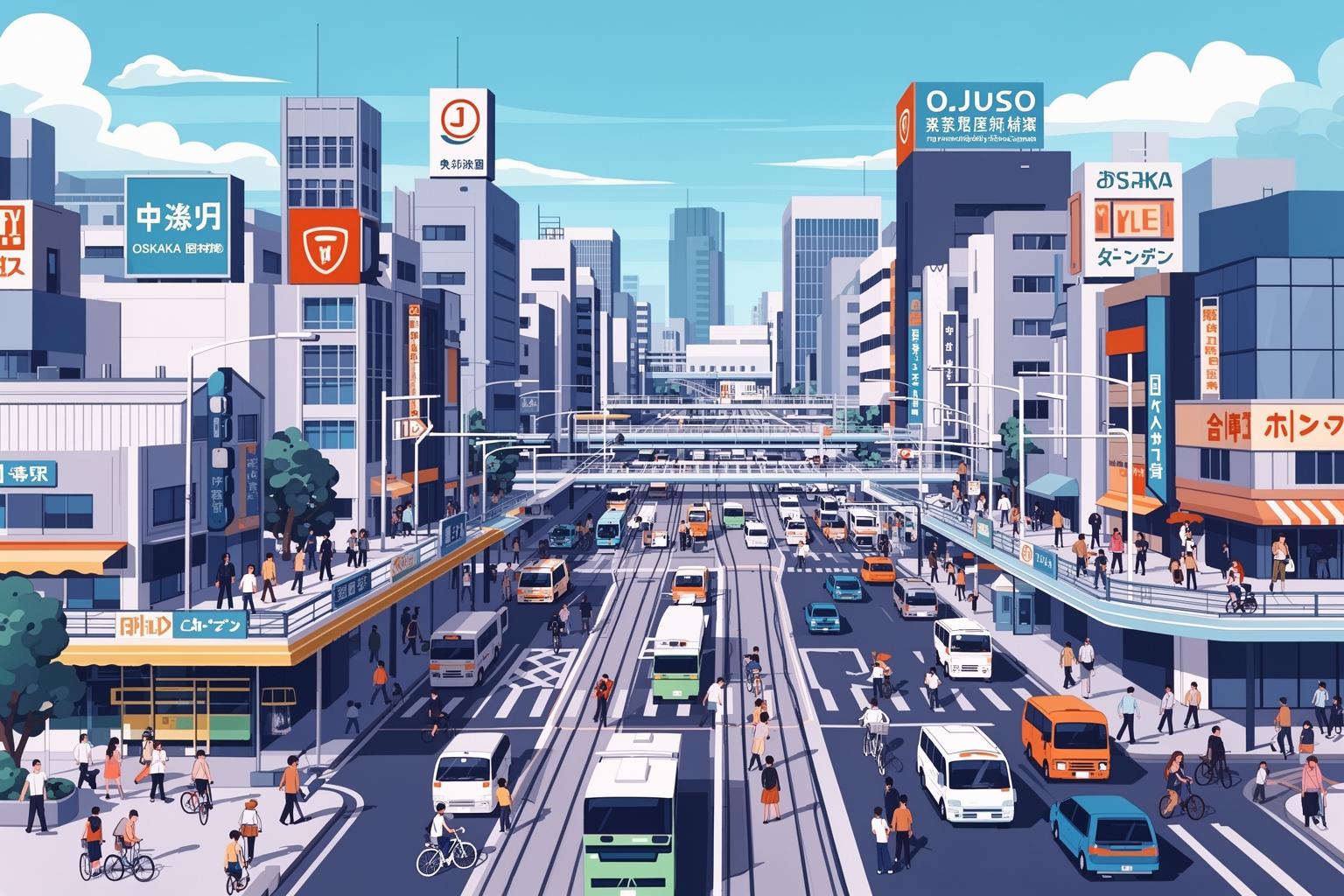
Long before the first neon sign flickers to life, Juso is already buzzing with activity. Its primary role, the one that defines it for hundreds of thousands of Kansai residents, is as a machine for moving people. As the sun rises, the station transforms into a vortex, pulling in and expelling a relentless flow of humanity. This is Juso at its most functional, reduced to pure, unadulterated logistics. The station itself is a masterpiece of utilitarian design, where three major Hankyu lines—the Kobe, Kyoto, and Takarazuka lines—merge in a complex, multi-level choreography. It is not a destination station like Umeda or Namba, filled with attractions and shiny boutiques; rather, it is a place of transit, a crossroads where lives briefly intersect before heading towards offices, schools, and homes scattered throughout the region. The daytime rhythm of Juso is the rhythm of the daily grind, a metronome set by train schedules and the urgent chime of closing doors.
A Nexus of Hankyu Lines
To appreciate Juso’s significance, one must understand its geography. It sits on the north side of the Yodo River, serving as the first major junction after the Hankyu railway’s terminus in Umeda. If Umeda is the heart, Juso is the aorta, the point from which the main arteries branch out to nourish the entire northern Kansai plain. This strategic location makes it an unavoidable passage for a vast number of commuters. Residents from the serene suburbs of Takarazuka, the ancient capital of Kyoto, and the cosmopolitan port city of Kobe all find their paths converging here. The platforms are a constant ballet of transferring passengers, a hurried walk from one track to another, eyes fixed on the departure boards. The trains themselves are a distinct Osaka institution. The iconic maroon Hankyu carriages, with polished wood interiors and olive-green velvet seats, evoke a more elegant era of rail travel, contrasting with the gritty functionality of the station they serve. This daily surge of people supports the first layer of Juso’s economy, built on speed and convenience: stand-up noodle shops serving quick bowls of udon, kiosks selling newspapers and morning coffee, and bakeries offering grab-and-go pastries for perpetually late salarymen.
The Salaryman’s Rush
The morning and evening rush hours in Juso are a spectacle of organized chaos. It’s a crush of bodies, yet governed by an unspoken set of rules. There is efficiency in the movement, a collective understanding of how to navigate narrow platforms and staircases without causing complete gridlock. Classic archetypes of Japanese work life appear: crisp-suited salarymen with briefcases, high school students in neat uniforms, office ladies in sensible heels. Their faces wear masks of morning fatigue or end-of-day exhaustion. They are not here to experience Juso; they are here to pass through it. For them, the neighborhood’s notorious nightlife is just background noise, a collection of shuttered storefronts and darkened signs barely noticed on their way to Platform 3. This daytime Juso embodies the Japanese ability to compartmentalize life. The station and its immediate surroundings form a neutral zone, a purely functional space that belongs to everyone and no one simultaneously.
The Shotengai’s Humble Charm
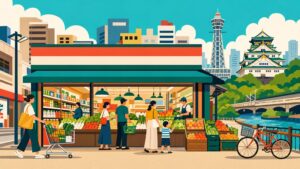
Step away from the station’s immediate surroundings, and you encounter the second pillar of Juso’s daytime identity: the shotengai, or covered shopping arcades. Several arcades branch out from the station, worlds apart from the glamorous, tourist-filled arcades of Shinsaibashi. These are working-class commercial streets, built for the people who live here. The ground is worn concrete, the ceilings a patchwork of corrugated plastic, and the air thick with the smells of daily life: the sweet aroma of grilled unagi, the savory scent of croquettes frying in a butcher shop window, and the slightly musty smell of old bookstores. These shops are not trendy or chic; they are practical. You’ll find greengrocers with dirt-cheap vegetables stacked high in styrofoam boxes, tiny stalls selling homemade tofu and pickles, and discount clothing stores with racks of sensible sweaters and comfortable pants. It’s a place where the fabric of an older Japan remains visible, a community built on small, family-run businesses.
A Taste of Everyday Osaka
Walking through the Juso shotengai during the day is a sensory immersion. You hear the cheerful, rhythmic calls of shopkeepers advertising their daily specials, a classic feature of Osaka commercial culture. You see elderly residents heading to the local clinic, young mothers comparing prices on daikon radishes, and local workers grabbing cheap, filling lunches at tiny curry counters. Pachinko parlors, their doors wide open, spill a cacophony of electronic noise and flashing lights into the street, a perfectly acceptable form of daytime entertainment. Old-school kissaten, with their vinyl booths and siphon coffee makers, offer a quiet refuge for locals to read the newspaper and smoke. This is the unvarnished reality of life in a neighborhood that values substance over style. There is no pretense here. Juso’s daytime persona is built on providing life’s necessities at a fair price, a core tenet of the pragmatic Osaka spirit. It is a community that serves its residents, not visitors, and it makes no apologies for its lack of glamour.
The Switch Flips: Juso After Dark
As daylight fades, Juso undergoes a profound transformation. It isn’t a slow change; it’s as if a massive switch flips. The river of commuters dwindles to a trickle before reversing direction, while a new wave of people starts to arrive. The modest, utilitarian neighborhood of the day retreats into the shadows, and a different Juso awakens, glowing under the lurid light of a thousand neon signs. The air, once filled with the scents of cooking and commerce, now carries the aroma of cheap perfume, grilled meat from numerous izakayas, and a faint trace of stale beer. The soundscape shifts from the rumble of trains to a mix of karaoke seeping from upstairs windows, the insistent chatter of touts, and the laughter of groups heading out for the night. This is the Juso of reputation, the one spoken of in whispers, standing in sharp contrast to its daytime self. It’s a district devoted to release, shedding the constraints of the working day in a blaze of light, sound, and indulgence.
The “Other” Side of the Tracks
Juso’s nightlife geography is famously—and somewhat crudely—divided by the train tracks. On one side lies a more “mainstream” collection of restaurants and bars; on the other, you enter the core of the fuzoku, or adult entertainment, district. The change is immediate and unmistakable. The signs grow more garish, the alleys narrower and darker, and the businesses more explicit. This area is a maze of hostess clubs, “snack” bars where female bartenders provide conversation for a fee, and the notorious “soaplands,” a uniquely Japanese type of brothel. Muryo annaijo, or “free information offices,” plaster their windows with photos of available hostesses, their bright lights drawing in potential customers. Men in sharp suits stand outside establishments, bowing and beckoning passersby with practiced ease. This district operates with surprising openness, a stark departure from the often hidden or discreet nature of similar areas in other countries. It’s simply there—a fact of life in the neighborhood, as undeniable as the train station itself.
A Legacy of Fuzoku
Juso’s reputation as a red-light district is not a recent phenomenon. It has deep historical roots, evolving over decades as one of Osaka’s primary centers for after-dark entertainment. This long history has embedded it into the city’s consciousness. It isn’t viewed as an urban blight to be eliminated but rather as a contained and, in some ways, necessary part of the city’s ecosystem. It provides an outlet, a service, and employment, all largely confined within its geographical boundaries. Those who work in and frequent these establishments are part of the neighborhood’s complex fabric. For most Osaka residents, the district’s existence elicits little more than a shrug. It’s just Juso being Juso. This acceptance of the city’s grittier side marks the local culture, contrasting sharply with the more image-conscious approach often seen in Tokyo, where such districts are typically pushed to the periphery or subjected to periodic “clean-up” campaigns.
Not Just Sleaze: The Izakaya and Food Culture
However, it would be a mistake to paint Juso’s nightlife with a single, sordid brush. The very streets and alleys that host the adult entertainment industry are also home to one of Osaka’s liveliest and most affordable food and drink scenes. The district is renowned among locals for its dense concentration of tachinomi (standing bars) and classic izakayas. These spots aren’t fancy; they are often cramped, smoke-filled, and noisy, with menus handwritten on yellowing paper taped to the walls. But the food is exceptional, and the prices remarkably low. Here lies the true heart of Osaka’s culinary identity: delicious, unpretentious fare for the working person. Salarymen, ties loosened and jackets draped over chairs, gather to unwind over plates of yakitori, takoyaki, and doteyaki (beef sinew stewed in miso). The bars serve as social equalizers; construction workers drink beside office managers, united by a cold beer and a good meal after a long day. Juso also hosts the original branch of Negiyaki Yamamoto, a legendary restaurant famed for perfecting the negiyaki, a savory pancake similar to okonomiyaki but loaded with green onions. Its lasting popularity is proof that Juso’s culinary reputation is as strong as its more infamous one.
An Unspoken Agreement
The most intriguing aspect of Juso after dark is the unspoken agreement of coexistence. The different worlds of the night function in parallel, rarely overlapping. Salarymen heading to their favorite izakayas pass by the soaplands without a second glance. Patrons of the adult entertainment venues stick to their zones. There’s an invisible social contract at work, a form of urban compartmentalization allowing these disparate activities to occur within feet of each other without conflict. This is Osaka’s pragmatism at its purest. The system works because everyone implicitly understands their role and space. The district is a complex machine with many moving parts, and as long as each remains in its lane, the machine runs smoothly. There’s no moral judgment—just practical acceptance of urban life’s multifaceted nature. This capacity to tolerate and even embrace contradiction is what makes Juso, and Osaka by extension, so compellingly authentic.
The Osaka Mindset on Display
Juso is more than just a location; it serves as a living textbook of the Osaka mindset. The neighborhood’s striking duality, its acceptance of the gritty and practical, and its complete lack of pretense provide a clear glimpse into the city’s soul. To grasp why Juso exists as it does is to understand the core values that set Osaka apart from Tokyo and other major Japanese cities. This philosophy is grounded in pragmatism, a distrust of superficiality, and a kind of blunt honesty that can be both refreshing and disarming. Juso wasn’t crafted by a committee to project a polished image; it evolved naturally to meet the needs of its people, imperfections and all. And in Osaka, that’s what counts most.
Pragmatism Over Polish
Imagine a district with Juso’s transportation significance in Tokyo. The very idea borders on the absurd. It would have been redeveloped long ago. The old shotengai would have been replaced by a gleaming shopping mall, the narrow, winding streets straightened into broad boulevards, and the entire area rebranded under a sleek, marketable name. Think of Shinagawa, Osaki, or any other major transport hubs that have been sanitized and commercialized into uniform, corporate centers. That is the Tokyo approach: identify a valuable asset, polish it to perfection, and maximize its commercial potential in a way that supports a clean, modern, and international image. Osaka, as embodied by Juso, follows a completely different logic. The guiding question is simple: “Does it work?” The station efficiently moves hundreds of thousands of people. The shotengai offers affordable goods to the local community. The entertainment district generates income and serves its clientele. Since all functions are fulfilled, why spend a fortune to change it? This “if it ain’t broke, don’t fix it” mindset is deeply rooted in Osaka’s culture. There is a strong reluctance to spend money solely for appearances. Functionality, efficiency, and value are the true virtues here. The outcome is a city that feels older, more worn-in, and far richer in texture than its eastern counterpart.
“Honesty” in Urban Planning
There is a peculiar honesty to Juso’s layout. The city does not hide its less pleasant aspects or pretend they don’t exist. The red-light district isn’t tucked away in some forgotten corner; it sits right next to one of the busiest train stations in the area. This is no accident; it reflects a worldview that embraces life’s complexities. Tokyo carefully curates its public image, presenting a version of itself that is clean, safe, and orderly. It is a city deeply conscious of how it is perceived externally. Osaka, by contrast, appears largely unconcerned with such matters. It presents itself as it is: a bustling, messy, and sometimes contradictory commercial city. This openness about its rough edges can be mistaken for a lack of civic pride, but for many Osakans, it signals the opposite. It is a mark of confidence, conveying that the city’s true value lies in its economic vitality and the well-being of its residents, not in a meticulously groomed public persona. Juso epitomizes this attitude: a neighborhood unapologetically itself, secure in its chaotic, layered identity.
What Foreigners Misunderstand
The most frequent question from foreigners considering living near Juso concerns safety. With the neon signs and touts, it’s easy to assume the entire area is dangerous or unpleasant. This is a major misconception. The “danger” is highly concentrated and contained. The residential areas, often just a two-minute walk from the station, are remarkably quiet and normal. Japan’s overall public safety is so high that even in a district known for adult entertainment, random street crime is exceedingly rare. The nightlife district is a business, plain and simple. It operates under its own internal rules, which do not include disturbing local residents. Patrons are there for a specific purpose, and workers are focused on their tasks. There is no spillover of chaos into the surrounding community. You won’t encounter trouble wandering from the entertainment zone into the supermarket. Invisible boundaries are respected. Understanding this compartmentalization is crucial to comprehending life in many parts of Osaka. The city is a mosaic of distinct areas, and peace is maintained because everyone respects the divisions.
Living on the Edge of the Neon
Despite all the talk about its dual identity, Juso is fundamentally a residential neighborhood. Thousands of people live there, balancing the contrast between its lively energy and quiet domestic life every day. Choosing to live in Juso is a classic Osaka compromise, favoring exceptional convenience and affordability over pristine surroundings. This choice exemplifies a practical approach to urban living, where the advantages of being at the heart of the Kansai transportation network outweigh the downsides of residing next to a bustling entertainment district. In reality, daily life here is far more ordinary and comfortable than its reputation might imply.
The Residential Reality
Just a few hundred meters from the station in any direction, the neighborhood’s character changes significantly. The noise from the station and the neon lights fade away, replaced by the calm hum of a typical Japanese residential area. Streets narrow and are lined with a mix of older two-story wooden houses, small apartment buildings from the 1970s and 80s, and occasional new, slim “pencil” buildings. The housing stock tends to be older and therefore much more affordable than what you’d find in trendier districts like Umeda or Nishi-ku. For young professionals, students, or families on a budget, this is an irresistible attraction. The ability to reach Umeda in three minutes, Kobe in twenty-five, and Kyoto in forty—all without changing trains—is an invaluable convenience. This unmatched access is what residents are effectively paying for, or rather saving on, by accepting the neighborhood’s less polished image.
Who Lives Here?
Juso’s residents are a diverse group. Elderly people who have lived in the same homes for decades provide a sense of history and stability. Students attending nearby universities are drawn by the low rents and easy city access. Young single professionals and service workers appreciate the convenience for their daily commutes. Families also benefit from the affordability, allowing them to secure more space than elsewhere. For these residents, the neighborhood isn’t defined by nightlife but by the local park, public library, quality supermarkets, and simple commute. They experience a different Juso, one that exists alongside but separate from the after-dark scene. Their children attend local schools, they participate in community events, and they lead perfectly ordinary lives, buffered from the district’s more infamous elements by invisible but strong boundaries.
A Tale of Two Shotengai
The subtle reality of life in Juso is reflected in the contrasting atmospheres of its shopping arcades. The main arcade, Juso Fureai Dori, which stretches west from the station, is a lively mix of businesses serving both commuters and nightlife visitors. Here, inexpensive izakayas, pachinko parlors, and takoyaki vendors abound. It’s noisy, busy, and transient. However, just a little farther along is the Juso Motomachi Shopping Street, where the vibe changes dramatically. This arcade is quieter, more relaxed, and clearly caters to local residents. Shops focus on everyday needs: a family-run fishmonger, a traditional sweets store present for generations, a small hardware shop, and a community board advertising neighborhood events. This is where residents do their regular shopping, stop to chat with neighbors, and feel the true heartbeat of the community. The existence of these two distinct commercial centers, so close yet serving very different purposes, perfectly illustrates how Juso simultaneously serves both passersby and those who call it home.
Juso is Osaka in a Nutshell
Ultimately, Juso is not an anomaly. It represents the most powerful, concentrated expression of Osaka‘s essential character. This neighborhood resists simplification, embodying the city’s core principles of pragmatism, functionality, and a complete disregard for superficial appearances. The seamless coexistence of a vital transportation hub for families and professionals alongside a sprawling, neon-lit district of vice is not a contradiction to be solved; it is the very essence of the city’s spirit. It’s messy, loud, occasionally grimy, but relentlessly and unapologetically alive and functional. Juso doesn’t waste energy on pretense. It doesn’t put on a show for tourists or try to conform to any preconceived idea of what a Japanese city should be. It simply exists. It works, provides, and serves the diverse and often conflicting needs of a vast, dynamic population. The ability to stand on a corner and see a grandmother buying fish for dinner, a group of students laughing on their way to the train, a salaryman heading into a standing bar for a quick drink, and the glowing sign of a hostess club all within the same view is not a sign of urban decay. It is the mark of a city being honest with itself. To truly understand Juso—to embrace its layers, its grit, and its incredible efficiency—is to understand why Osaka will never be Tokyo. And for the millions who call this vibrant, chaotic city home, that is exactly the point.