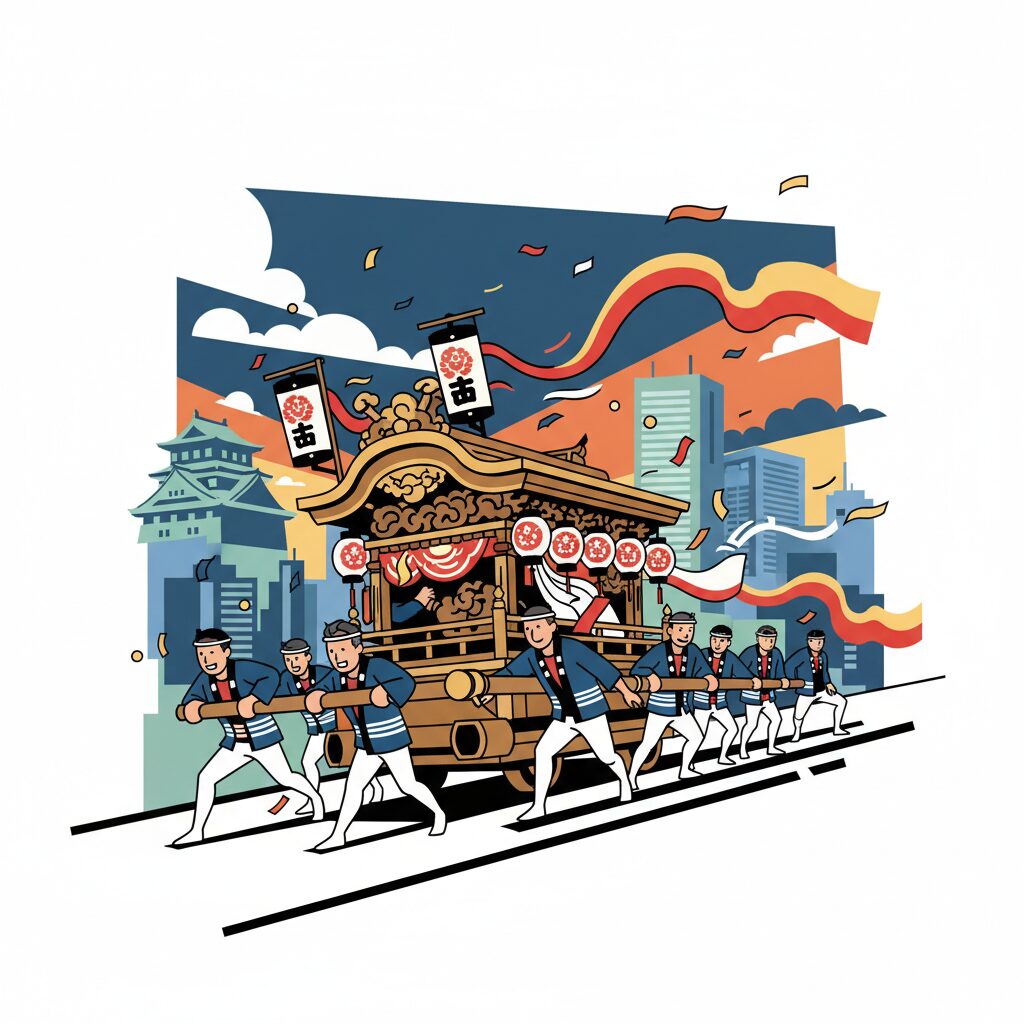
The first time I heard it, I thought a construction site had gone rogue. A deep, rhythmic pounding, a percussive beat that vibrated through the thin walls of my apartment in a quiet corner of Osaka. It was followed by chanting, a chorus of male voices shouting in unison, not with anger, but with a kind of focused, guttural energy. I looked out my window and saw it: a massive, ornate wooden cart, a danjiri, being pulled by dozens of men in matching happi coats, their faces glistening with sweat under the relentless summer sun. My first thought, as a foreigner still calibrating my understanding of Japan, was a simple one: What is the point of all this noise and effort?
For many non-Japanese, our exposure to Japanese festivals comes from glossy travel brochures or dramatic YouTube videos. We see the massive, city-stopping parades like Kyoto’s Gion Matsuri or Osaka’s own Tenjin Matsuri. We see the almost mythically famous Kishiwada Danjiri Matsuri, with its daredevil rooftop riders and high-speed cornering. These are spectacles, designed for an audience. But what I was witnessing, and what you will inevitably encounter if you live here, was something different. This was smaller, more intimate, and infinitely more important to the people involved. This was the neighborhood festival, the beating heart of local Osaka life. These events are not tourist attractions; they are the social operating system of the city, the invisible framework that holds communities together. They explain more about the Osaka mindset—its pragmatism, its fierce local pride, and its unwritten social rules—than any guidebook ever could. Forget the big-name events for a moment. To understand Osaka, you need to understand why a group of accountants, shopkeepers, and factory workers would spend their weekend hauling a two-ton wooden float down a tiny side street.
To truly appreciate how these festivals shape the social fabric, it’s essential to understand the distinct character of each Osaka neighborhood.
The Neighborhood as the Stage: Why Local Matters More
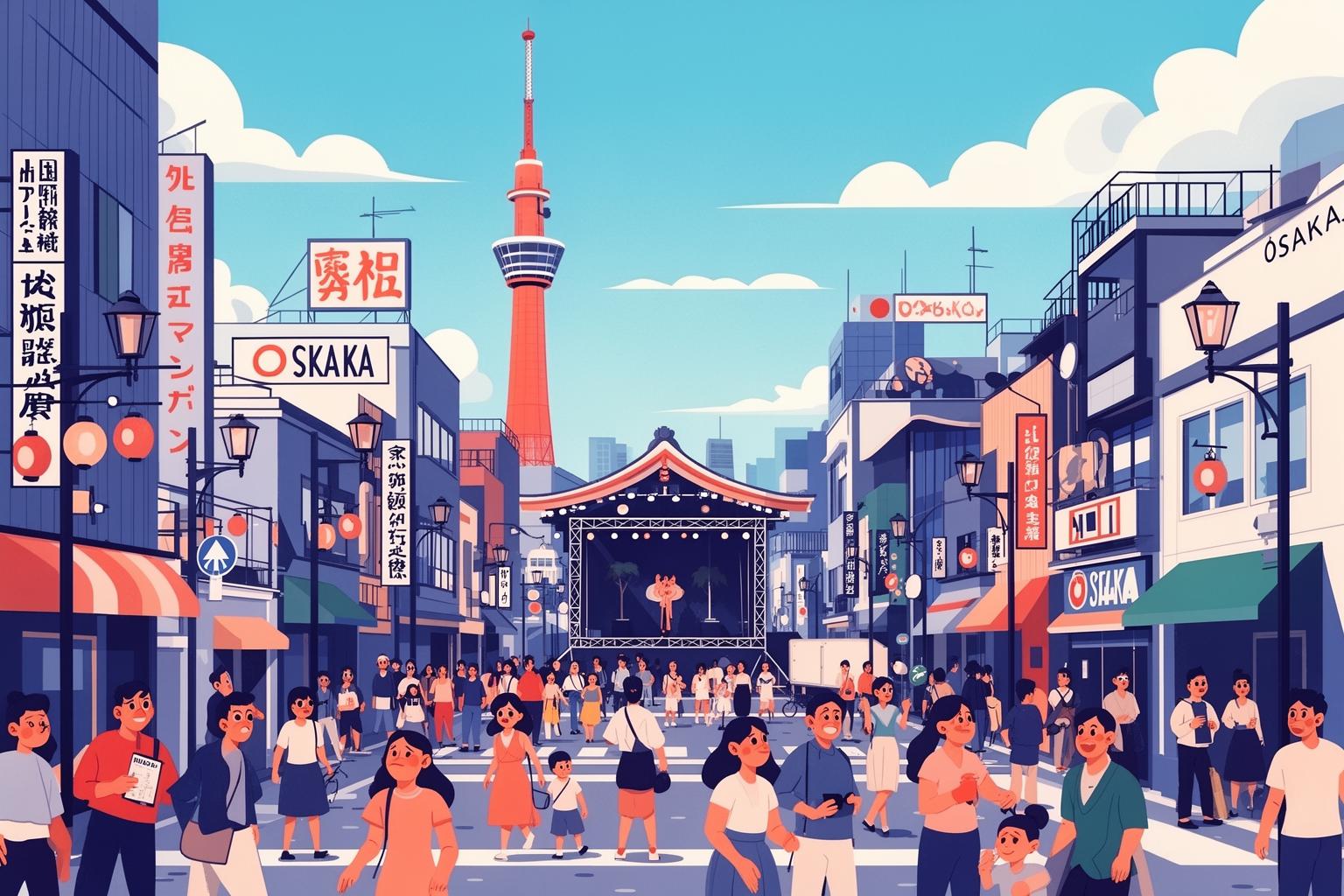
In Tokyo, neighborhoods often feel like mere clusters of postcodes, transient spaces where people sleep before commuting daily to the city’s vast commercial centers. In Osaka, however, the neighborhood, or jimoto, forms the core of a person’s identity. The local festival serves as the fullest public expression of this identity. This is not simply about enjoyment; it is a deeply serious event, woven into the community’s obligations and pride. The neighborhood itself becomes both the cast of performers and the primary audience.
A System of Obligation and Pride
Weeks before the first drum sounds, the festival’s presence is already felt. White paper lanterns, bearing the names of local businesses and families, line the shopping arcades, or shotengai. This offers the first indication of the festival’s true purpose. These are not mere decorations; they are public declarations of support. Each lantern represents a contribution, a gofushin, to the local neighborhood association, the chōnaikai, that organizes the event. The size and prominence of your lantern—or how many lanterns display your company’s name—directly signal your commitment to the community. It acts as a form of social currency. A generous donation is more than charity; it is an investment in one’s local reputation. In a city shaped by merchants, reputation is paramount. This system ensures everyone—from the elderly couple running the corner tobacco shop to the president of a local manufacturing firm—has a stake in the festival’s success. It sharply contrasts with the anonymous corporate sponsorships common at major events. This is personal. Your neighbors see your name, know you contributed, and remember. Not contributing is a subtle social misstep, signaling that you are not a team player in a city that values collective effort above all else.
Generations on a Rope: The Unspoken Hierarchy
Watch the group carrying the mikoshi (portable shrine) or the danjiri, and you’ll witness Osaka’s social structure in action. Though it appears like a chaotic throng, it operates as a finely tuned machine governed by a strict, unwritten hierarchy. The most important roles are not filled by the strongest or youngest, but by the elders, the oyaji-tachi—men in their fifties, sixties, and even seventies. They don’t do the heavy pulling; instead, they walk alongside, wielding fans and authoritative commands, directing the flow, anticipating turns, and ensuring safety. Their authority is absolute, earned through decades of experience. The middle-aged men, those in their forties, serve as the engine. They form the core muscle, bearing the heaviest load, their bodies conditioned by years of participation. The younger men, in their twenties and thirties, occupy the outer edges of the ropes, learning the rhythms, taking orders, and proving their value. Even children play a part. It’s common to see smaller, child-sized danjiri pulled by local kids, guided by teenagers. This is not just a charming scene; it is an apprenticeship. From a young age, they learn their place within the structure, how to respect their elders, work as a team, and embrace ownership of the shared tradition. This is how social rules—respect for the senpai-kohai (senior-junior) dynamic, the importance of endurance, and the sense of shared responsibility—are passed down. It is a practical education in being part of an Osaka community, taught not in a classroom but through sweat and calloused hands.
More Than Just a Party: The Real Work Behind the Scenes
One common misconception is to see these festivals as spontaneous bursts of cultural expression—a weekend of celebration that appears and vanishes like magic. In reality, the festival represents the climax of a year-long cycle of preparation, negotiation, and diligent effort. The relationships formed during these behind-the-scenes moments often prove to be stronger and more meaningful than the public festivities themselves. The festival is just the surface; the true community-building occurs in the months leading up to it.
The Year-Round Commitment
Long before the aroma of takoyaki fills the streets, meetings take place in chilly community halls. Routes are debated, permits obtained from the local police, and roles assigned. The danjiri or mikoshi—often centuries-old, priceless neighborhood heirlooms—must be carefully maintained. This involves detailed carpentry, rope-making, and polishing, typically carried out by volunteers with specialized, inherited skills. The musical accompaniment, known as narimono, demands constant practice. For weeks on end, evenings echo with the sounds of drums and flutes from a local shrine or garage, as men and boys rehearse complex rhythms until they become second nature. This collective effort acts as a powerful social glue. It brings together people from diverse backgrounds—the salaryman, ramen chef, electrician—to collaborate on a complex, high-stakes project. They argue about logistics, share cigarettes during breaks, complain about the heat, and through this, build a deep, functional camaraderie that goes beyond their everyday lives. This forms the foundation of the neighborhood network. After spending a dozen Saturday afternoons re-roping a danjiri alongside someone, the connection forged is far stronger than mere neighborly acquaintance.
The Language of the Festival: Osaka-ben in Action
If you want to truly hear Osaka speak, attend a local festival. It is here that the region’s dialect, Osaka-ben, is displayed in its rawest and most authentic form. The polite, indirect expressions typical of standard Japanese are cast aside, replaced by a vocabulary of efficiency, immediacy, and raw emotion. The chants themselves are the most obvious example: the iconic “Sorya! Sorya!” of the danjiri pullers or the powerful “Wasshoi! Wasshoi!” of the mikoshi carriers. But listen closely to the interactions among the participants. Their speech is full of rough commands, sharp jokes, and blunt remarks. A senior member might shout an order—”Motto hiitare!” (Pull harder!)—completely lacking the polite softening customary in a Tokyo office. Mistakes are met not with gentle correction but with firm words like “Akan ya nai ka!” (That’s no good!). To outsiders, especially those used to the formal politeness of Japanese customer service, this can sound harsh or rude. However, this is a fundamental misunderstanding of Osaka communication. In the high-pressure, physically demanding context of a festival, there is no room for ambiguity. Clarity and directness are crucial for safety and success. This pragmatic, results-focused language is not offensive; it is a sign of trust and closeness. It is the language of a working city, and the festival serves as its most vibrant classroom.
The Unwritten Rules for Outsiders and Neighbors
For a foreigner living in the neighborhood, the festival can be both captivating and overwhelming. The energy is contagious, yet the social customs remain unclear. How does one become part of it? The answer highlights a fundamental aspect of Osaka society: a clear divide between insiders and outsiders, but with a defined and valued role for everyone. Navigating this means understanding that participation doesn’t always involve active involvement; sometimes, it’s about respectful observation.
To Participate or to Watch?
Many eager foreigners naturally want to ask, “Can I join in?” In nearly all cases, the response is a polite but firm no. This is not exclusion but a reflection of practicality and deep responsibility. These neighborhood groups are often tightly knit, with membership sometimes tracing back through generations of the same family. They rely on a high level of trust and non-verbal communication developed over many years. An inexperienced person, unaware of subtle cues and physical demands, is a risk. A danjiri can weigh over three tons; a misstep during a turn can cause serious injury or damage the sacred float, bringing great shame to the neighborhood. So, what role do you play? That of an enthusiastic and supportive spectator. Your presence is essential. The festival is a performance for the community. By lining the streets, cheering on the participants, and showing appreciation for their effort, you serve a vital purpose. You validate their hard work. Buy a beer and some karaage from the local stalls, clap when they manage a difficult maneuver, and offer a respectful nod to the participants. This is your way of taking part, and it is genuinely welcomed and appreciated. You help create the festive spirit that makes all their effort worthwhile.
The Hidden Economy and Social Network
Look beyond the parade itself, and you’ll notice the festival’s important economic and social roles. The food stalls, or yatai, are frequently run not by itinerant professionals but by local businesses. The okonomiyaki stand might be operated by the family that owns the neighborhood hardware store; the shaved ice stall by the local barbershop. It’s an opportunity for them to connect with the community on a different level and earn some extra income. More importantly, the festival is a major networking occasion. After a long, hot day pulling the danjiri, participants gather at local izakayas or makeshift beer gardens. Over shared drinks, exhausted yet exhilarated, the real social bonds are formed. The local plumber and the printing press owner, having sweated together for hours, build a bond of mutual respect. This is where favors are exchanged, business advice shared, and community matters informally addressed. In Tokyo, networking might involve a formal business card exchange at a high-rise bar; in Osaka, it’s sharing a beer on a plastic crate with someone whose back you have been watching all day. This is how the city operates—through personal relationships forged in shared effort and celebration.
What the Danjiri Teaches You About the Osaka Mindset
Ultimately, these neighborhood festivals serve as a living metaphor for the city itself. They are not polished or pristine events; rather, they are loud, sweaty, somewhat chaotic, and fueled by a fierce, hyper-local pride. By observing them, you don’t just witness a tradition—you receive an immersive lesson in the core values and character of Osaka. It’s an insight into what the people here cherish and how they perceive themselves and their place in the world.
Pride in Place, Not Polish
Tokyo’s identity is often tied to the nation as a whole—it is the center of government, finance, and modern culture. In contrast, Osaka’s identity is deeply decentralized. People take pride not only in being from Osaka but specifically from a particular ward, station, or neighborhood. The local festival is the most potent expression of this detailed identity. Two neighborhoods just a few blocks apart may engage in a friendly yet intense rivalry, each claiming their danjiri is older, their drummers more skilled, and their participants tougher. This pride isn’t about sophistication or elegance; it’s about history, endurance, and authenticity. The worn, darkened wood of a centuries-old mikoshi embodies immense pride, honoring the generations who have carried it. This reveals much about Osaka’s character—a city that values what is genuine and lasting over what is new and shiny. The emphasis is on substance and history, not superficial appearance. Osakans are deeply rooted in their small corner of the world, and the festival is their annual proclamation of its significance.
Function Over Form: The Logic of Controlled Chaos
To a first-time observer, a danjiri performing a yarimawashi—a full-speed, ninety-degree turn—appears as terrifying chaos. Men sprint, wooden wheels screech, and the massive float seems on the verge of toppling. It seems reckless and uncontrolled. But it is anything but. It is a display of tremendous skill, timing, and coordination, with dozens of people executing their specific roles in perfect harmony. This is an ideal metaphor for Osaka itself. The city can feel loud, messy, and disordered compared to Tokyo’s calm and orderly atmosphere. People jaywalk, speak loudly on trains, and the architecture is a chaotic blend of different eras and styles. An outsider might mistake this for a lack of discipline, but that misses the point. Beneath the chaotic surface lies a powerful, pragmatic logic. Like the yarimawashi, it is a system focused on results rather than appearance. Osakans concentrate on the goal—closing the deal, reaching their destination, maneuvering the danjiri around the corner. The process may not be pretty, but it is ruthlessly effective. The festival teaches you to recognize the underlying order within apparent chaos and to understand that in Osaka, function always, without fail, triumphs over form.