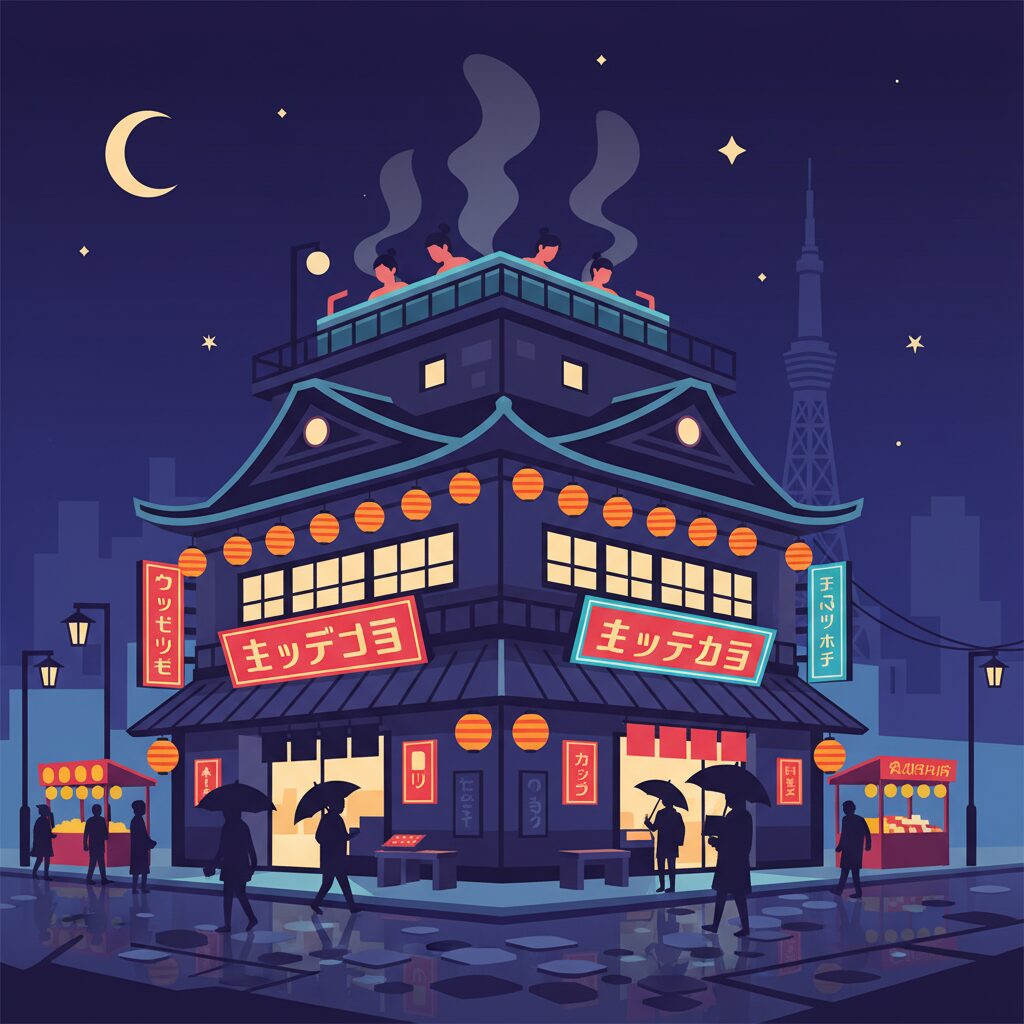
The first time I saw it, I was genuinely confused. It was nine o’clock on a Tuesday night, deep in a residential maze of a neighborhood somewhere in Higashinari Ward. A man in his seventies, a young couple, and a mother herding two small children all walked down the narrow street, each carrying a small plastic basket holding soap, shampoo, and a neatly folded towel. They weren’t heading to a gym. They were heading to the local bathhouse, the sentō. My Western brain immediately jumped to conclusions. Do they not have showers at home? Is this a special occasion? The truth, I soon learned, was far more interesting and revealed something fundamental about the social DNA of Osaka. In a world of increasing privacy and digital isolation, the sentō isn’t just a place to get clean. It’s the neighborhood’s living room, a nightly ritual that reinforces community bonds in a way that a polite nod over the garden fence never could. While sentō are dwindling across Japan, in the hardworking, unpretentious backstreets of Osaka, they remain stubbornly, vibrantly alive, serving a purpose that goes far beyond simple hygiene.
Osaka’s rich culture also shines through in modern conveniences such as the innovative depachika dining experience, where residents find solutions for specialized diets that further illustrate the city’s vibrant community life.
More Than Just a Tub: The Sentō’s Unspoken Role
To grasp the concept of the sentō in Osaka, you need to rewind time a little. It’s tempting to look at a modern Japanese apartment, equipped with high-tech washlets and automated bath-filling systems, and wonder why anyone would choose to leave. However, for generations—especially in the crowded wooden houses and post-war apartment blocks that characterized much of Osaka—a private bathroom was a luxury. Often, all there was was a small, cold water tap and a basic toilet. The sentō wasn’t a matter of preference; it was a nightly necessity. This shared experience of necessity wove the public bath into the very fabric of daily life. It became the place you went after a long day at the factory or shop, not only to wash away grime but to unwind with people who understood your life because they lived it too.
The Communal Habit That Endured
Today, most homes have showers. Yet the sentō persists. The habit, it turns out, outlasted the need. It evolved from a utilitarian function into a social institution. Entering a neighborhood sentō is like stepping into a time capsule. You’ll find elderly men and women who have frequented the same spot for over sixty years. You’ll see young fathers carefully washing their toddlers, teaching the unspoken rules of the bath. University students and single office workers seek a soak in tubs much larger than their apartment bathrooms. This is a complete cross-section of the neighborhood—a demographic mix you wouldn’t come across in a trendy café or a sterile co-working space. This is where the community genuinely gathers, on equal footing, stripped of the uniforms and titles of the day.
Where “Naked Communion” Gets Real
There’s a Japanese concept called hadaka no tsukiai, which roughly means “naked communion” or “naked friendship.” The idea is that by removing your clothes, you also remove social status, wealth, and pretense. In this shared vulnerability, communication becomes more honest. While this concept is known throughout Japan, Osaka’s version feels distinctly less philosophical and much more practical. It’s less about deep spiritual connection and more about the straightforward, grounded business of being neighbors. The CEO and the construction worker are simply two guys soaking in hot water, grumbling about the Hanshin Tigers’ latest loss. The lawyer and the shopkeeper are just two women comparing notes on where to buy the best daikon radishes. The conversations are everyday, direct, and completely genuine. It’s the ultimate social equalizer, and in a city that prides itself on its down-to-earth nature, the sentō is its natural home.
The Osaka Sentō vs. The Tokyo Experience
If your only experience with Japanese bathing involves a serene, minimalist onsen in Hakone or a sleek, modern “super sentō” in Tokyo, the traditional neighborhood bathhouse in Osaka will come as a real shock to the system. This contrast underscores a fundamental difference between the two cities: Osaka’s emphasis on practicality and community rather than aesthetics and formality. It’s neither better nor worse, just a distinctly different way of approaching shared spaces.
Function Over Formality
Many sentō in Osaka are quite old. The tilework might feature a stunning, though slightly cracked, mural of Mount Fuji dating back to the Showa era. Lockers might be wooden and secured with vintage key bands worn on the wrist. The weigh-in scales often seem like museum pieces. There’s a charming, well-used quality to these places. They’re not designed with Instagram in mind but for daily, heavy use. The goal isn’t to create a tranquil, spa-like retreat but to offer a hot bath and a communal space for people to connect. In Tokyo, there’s often a sense of quiet reverence and individual reflection. In Osaka, the mood resembles that of a public park—a setting for active, vocal community life. A stranger is more likely to ask where you’re from before you’ve even dipped a toe in the water, not out of nosiness, but from genuine, straightforward curiosity.
The Soundtrack of the Neighborhood
Forget the soft trickle of a bamboo fountain. The soundscape of an Osaka sentō is a lively symphony of human activity. It’s the loud, echoing clatter of plastic washing stools on tiled floors. It’s the booming voice of an elderly man sharing a story with a friend across the room. It’s the splash and laughter of children being a bit too rowdy and the gentle admonishment of an unrelated “aunty” who has taken on the role of guardian of order. In the changing room, a television is almost always on, blaring a variety show or, more often, a baseball game, while patrons offer their unsolicited commentary. This celebration of spirited, human noise is quintessentially Osaka. The city thrives on energy, chatter, and the sense that something is happening. A quiet, contemplative bath is fine, but it’s in the noisy, communal one that you truly feel the city’s heartbeat.
Decoding the Nightly Ritual: A Practical Guide
For a newcomer, entering this world can feel overwhelming. The rules are unspoken, the interactions swift, and you’re essentially exposed. However, understanding the flow of the evening ritual can turn it from an intimidating ordeal into a deeply fulfilling experience. The process unfolds in three acts: the reception, the bath, and the all-important aftermath.
Act One: The Gatekeeper’s Desk
The ritual begins at the bandai, the tall reception desk where you pay your fee (a municipally regulated price, usually just a few hundred yen). The person behind this counter, often the elderly owner, serves as the neighborhood’s unofficial information hub. They greet regulars by name, inquire about their children, and hold your locker key. They know everything about everyone. Listening to the rapid-fire Kansai-ben chatter is an education in itself. This isn’t just a transactional front desk; it’s the sentō’s central nervous system. Don’t be surprised if they strike up a conversation, asking simple questions about your day. A smile and a brief greeting go a long way here.
Act Two: Etiquette, Osaka-Style
The basic rules of the sentō are universal across Japan: you must wash your body thoroughly before entering the communal tubs. You bring a small towel for washing, but it should never enter the bath water itself (most people place it on their head or set it beside the tub). In Osaka, however, the enforcement of these rules is distinctive. In a more reserved city, a mistake might earn you a sharp, silent glare. In an Osaka sentō, an oba-chan (a woman of aunty-age or older) is more likely to march right over, correct you directly, and then launch into a long story about her nephew. The intention isn’t to embarrass you; it’s to teach. It’s a form of tough, practical love. They aren’t just sharing a bath; they are actively welcoming you into their community. The key is not to take offense but to appreciate their directness. They see you not as a tourist to be ignored, but as a temporary neighbor to be properly instructed.
Act Three: The Post-Bath Social
This is perhaps the most vital part of the experience, and one that many foreigners overlook. The ritual doesn’t end upon exiting the water. The changing room, the datsuijo, serves as a second living room. People don’t rush to leave. They dry off leisurely, sit on the worn wooden benches, and linger. They rehydrate with classic post-bath drinks from the vending machine—ice-cold coffee milk in a glass bottle being the quintessential choice. They watch the conclusion of the baseball game on the TV. They strike up conversations with those nearby, continuing chats that began in the bath. This is where genuine bonding occurs, in the relaxed, steam-warmed afterglow. Spending even ten minutes here, observing or engaging in light conversation, reveals the sentō’s true role as a social hub.
Why the Sentō Explains the Osaka Mindset
At its core, the sentō perfectly encapsulates the spirit of Osaka. It’s a place that prioritizes practicality over polish, community over privacy, and straightforward communication over subtle formality. This helps explain why people often describe Osaka as “friendly” or “warm.” It’s not merely a vague, cheerful attitude but a deeply rooted cultural habit of breaking down barriers and sharing space in a genuine, tangible way. The sentō serves as the training ground for this mindset.
A Community Woven with Water and Steam
In an era where neighborly interaction is often limited to a quick “hello” in passing, the sentō offers a dependable, consistent, and low-pressure setting for community life. You see familiar faces every evening. You watch children grow up. You notice when an elderly regular hasn’t appeared for a few days and check in on them. It functions as a powerful, informal social safety net. This is the fabric of a true neighborhood, woven not just from physical closeness but from shared experiences. It’s an intimacy that’s rare in the more anonymous urban environments of other major cities, and it directly stems from institutions like the sentō that encourage casual, unguarded interactions.
Resisting the Tide of Modernity
Make no mistake—sentō are closing down. The economics are challenging, owners are growing older, and modern convenience is a strong temptation. Yet the ones that survive in Osaka endure because they are more than mere businesses. They are treasured community assets. The regulars who come night after night are making a deliberate choice. They opt for the echoey, lively, shared space over the silence of their private bathroom. They choose the slightly-too-hot jacuzzi and the company of neighbors over solitude. It is a quiet, daily affirmation of community over isolation, a small act of resistance against the fragmentation of modern life. It stands as a testament to an Osaka that cherishes human connection, in all its loud, steamy, and imperfect glory.