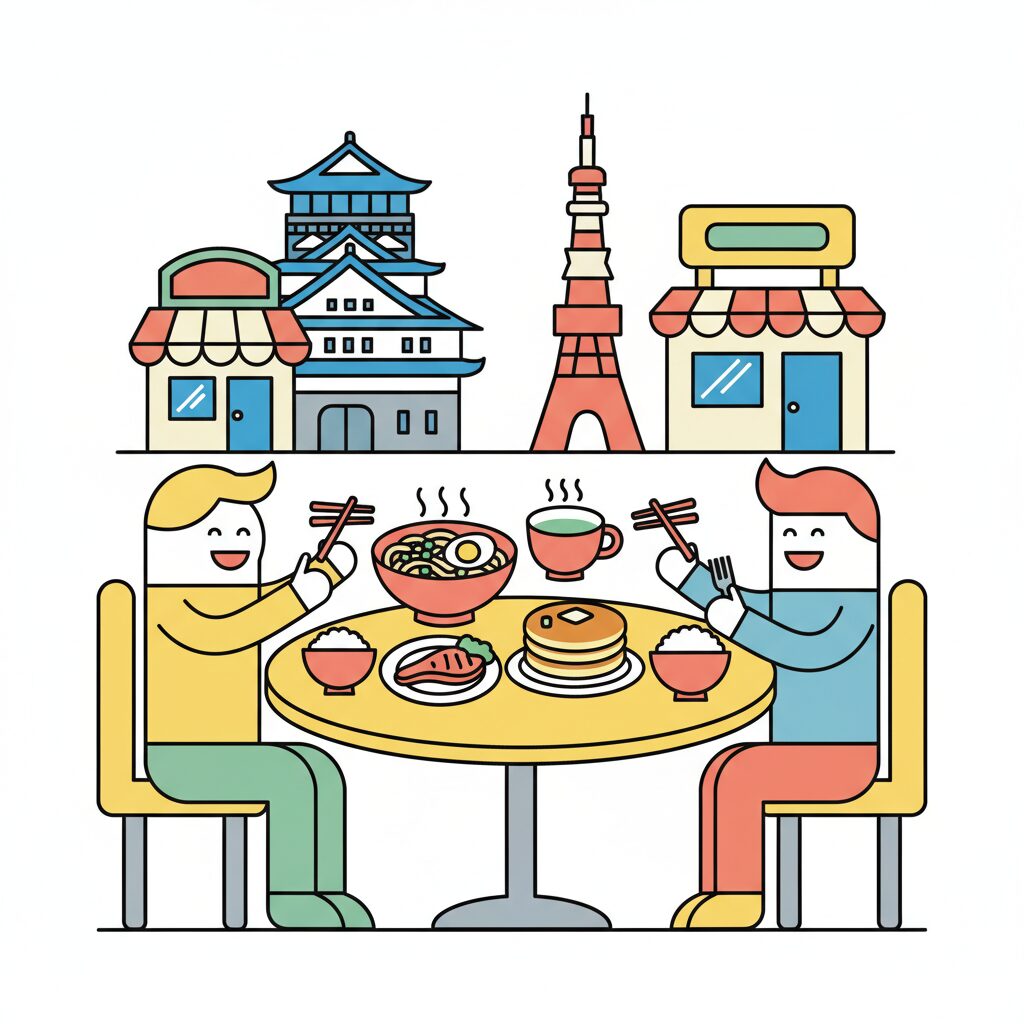
Step into a coffee shop in Osaka between the hours of eight and eleven in the morning. Order a single cup of coffee, a simple transaction you’ve performed a thousand times elsewhere. You expect a porcelain cup filled with dark, steaming liquid. What you get, however, is an entire ecosystem on a tray. Alongside your coffee arrives a slice of impossibly thick toast, golden-brown and glistening with melted butter. Next to it sits a perfectly boiled egg, a small dish of crisp salad drizzled with dressing, and perhaps even a tiny yogurt. You check the bill, expecting a mistake. There isn’t one. All of this—the toast, the egg, the salad—is included in the price of your 450-yen coffee. This isn’t a special promotion or a first-time customer bonus. This is ‘Morning Service,’ or mōningu sābisu, a daily ritual that serves as one of the most potent and revealing windows into the soul of Osaka. In Tokyo, coffee is a transaction, a caffeine delivery system designed for speed and efficiency. In Osaka, it’s the opening bid in a negotiation of value, community, and unwritten social rules. It’s a cultural institution disguised as a breakfast special, and understanding its nuances is key to understanding the city itself. Forget the tourist guides; the real story of Osaka is written on the placemats of its ten-table coffee shops, whispered over the rustle of morning newspapers and the clink of sugar cubes against ceramic. This is where the city’s heart beats loudest.
As you savor the layered experiences of Osaka’s morning service, exploring the city’s vibrant cycling culture offers yet another dynamic perspective on its ever-evolving character.
It’s Not About the Free Toast; It’s About the Deal
A common misconception held by foreigners—and even many Tokyo residents—is to view the Morning Service simply as an act of generosity. They see it as a charming, hospitable gesture. However, interpreting it this way misses the point entirely. The free toast is not mainly an expression of kindness; it is a demonstration of a brilliant, deeply rooted economic philosophy. This is the city of merchants, Japan’s historical commercial center, where the culture is driven by an unyielding pursuit of value. The Morning Service is the contemporary embodiment of this tradition.
The Psychology of ‘Mōkarimakka?’
In Osaka, the traditional greeting isn’t about the weather; it’s Mōkarimakka? roughly meaning, “Are you making a profit?” The common response is Bochi bochi denna, or “So-so.” This exchange is more than a quirky local custom; it’s a verbal handshake acknowledging a shared worldview where business, value, and everyday life are inseparable. The Morning Service represents this philosophy on a plate. The shop owner isn’t simply handing out food—they’re making a strategic decision: by offering an unbeatable deal, they win your loyalty. They fill their seats during the morning rush, creating a lively environment that draws in more customers. They cultivate repeat clientele who come back for lunch, an afternoon coffee, or a slice of cake. The free toast is an investment, a down payment on future business. For the customer, engaging in this exchange feels like a small triumph. You haven’t just bought breakfast; you’ve secured an excellent bargain. You’ve been smart. This satisfaction resonates deeply with the Osakan psyche, known for being shrewd, practical, and averse to being overcharged. In Tokyo, you might pay 800 yen for a specialty coffee in a minimalist setting because you’re paying for the brand, the design, and the curated experience. In Osaka, that reasoning seems frivolous. The question always is: what am I actually getting for my money? The Morning Service is the victorious answer.
The Anatomy of a Classic Osaka Morning Set
Though the concept is widespread across the city, the execution becomes a competitive arena. The basic offering is the “A Set”: a cup of coffee or tea, a thick slice of toast, and a boiled egg. The toast is crucial. It’s not thin, supermarket-sliced bread. It’s atsugiri toast—a slice so thick it’s almost like a bread steak, sourced from a local bakery and perfectly toasted. But that’s just the baseline. The shop next door might offer the “B Set,” which includes a small salad. Another nearby place might add a sausage. Some ambitious cafes might serve a small bowl of udon, fried chicken pieces, or even a mini gratin. This isn’t about culinary creativity; it’s about signaling value. Each extra item silently announces to the neighborhood: “My Morning Service is a better deal than theirs.” The owners are engaged in a constant, friendly battle, giving up margins to earn customer loyalty and local pride. For residents, this results in an exciting variety of breakfast choices that feel like daily wins. It’s a system where consumers reap the benefits of the fierce, merchant-class competition that shapes the city.
The Kissaten as a Neighborhood Living Room
To truly understand the Morning Service, you must first grasp its natural setting: the kissaten. This is not the sleek, modern café typical of global city centers. A genuine Osaka kissaten is something entirely different. It’s like a time capsule, often featuring dark wood paneling, worn velvet chairs, soft jazz or classical music playing from old speakers, and the subtle, sweet aroma of coffee mixed with the scent of old newspapers lingering in the air. These spaces aren’t made for transient laptop users. They are designed for community. They serve as the unofficial living rooms of their neighborhoods, and the Morning Service acts as the daily house meeting.
Where Your Name is the Only Reservation You Need
At the center of the kissaten is the “Master,” the owner-operator who serves as part barista, part therapist, and part community organizer. The Master knows every regular by name, anticipates their usual order without asking, and understands the complex web of neighborhood relationships. When you enter, the greeting isn’t a scripted “Welcome!” but a personal recognition. They’ll remember that you were searching for a new apartment or that you were venting about your favorite baseball team, the Hanshin Tigers, losing a game. This fosters a strong sense of belonging that contrasts sharply with the impersonal efficiency of a Tokyo Starbucks. In Tokyo, service is marked by seamless, invisible perfection. Staff are trained to be polite, professional, and maintain a respectful distance. In an Osaka kissaten, the service is visible, audible, and deeply personal. The relationship with the Master is as integral to the experience as the coffee itself. Newcomers may initially find this familiarity intrusive, but it forms the foundation of the kissaten experience. You aren’t just a customer number; you are Suzuki-san or Tanaka-san, a recognized figure in this small world.
The Sound of a Real Osaka Morning
Silence is scarce in an Osaka kissaten. The atmosphere is filled with the hum of conversation, carried out in the city’s distinctive, melodic dialect, Osaka-ben. Elderly patrons discuss politics while flipping through the sports sections of actual, printed newspapers. Local business owners hold informal meetings over toast and coffee, their voices rising and falling with the rhythm of negotiation. A lone salaryman might be reading a manga, but he is the exception, not the norm. This is a place of active, not passive, engagement. A foreigner attempting to settle in with a laptop and noise-canceling headphones for hours would be committing a serious, unspoken social faux pas. The kissaten is not a co-working space. Its value lies in community. The low price of the Morning Service depends on a steady stream of customers. The expectation is that you will engage in the life of the room, even if only as an observer, and then move on to make room for the next person. The ambient noise is not a distraction; it is the essence of the place. It is the sound of a community checking in with itself before the day truly begins.
Decoding the Unspoken Social Contract
Like many facets of life in Japan, the Morning Service follows a set of unwritten rules. These guidelines aren’t displayed anywhere but are well understood by regulars and crucial for any non-Japanese resident to comprehend. Navigating this social contract properly distinguishes between being a welcomed part of the morning ritual and feeling like an awkward outsider. These rules are subtle, shaped by a distinct Osakan blend of pragmatism and social expectation.
Don’t Linger, But Don’t Rush
The most important rule concerns pacing. The great value of the Morning Service is not a license to occupy a table all morning. The business depends on turnover. The owner offers you a generous deal with the expectation that you’ll consume your order within a reasonable period—about thirty to forty-five minutes—and then leave gracefully. This doesn’t mean you should feel hurried. Eating quickly and leaving right away would also seem odd. The expectation is that you’ll enjoy your coffee, read the paper, exchange a few words with the Master or other patrons, and then recognize when it’s time to go. This is a delicate balance. In Tokyo, you often pay a premium just to have a seat. The high price of coffee in a Ginza café implicitly includes a “seat fee.” In Osaka, the reverse is true. The price is affordable because the seat isn’t yours to claim for long. You’re part of a steady flow, a morning tide of residents coming and going. Understanding this rhythm and your role within it shows respect for both the establishment and fellow customers.
Conversation is Part of the Service
In many parts of the world, especially Tokyo, good service is typically unobtrusive. Staff aim to be efficient and invisible. At an Osaka kissaten, this can be quite different. The Master or staff may start a conversation, asking where you’re from, what you do, or your thoughts on the weather. For those accustomed to polite anonymity, this might feel intrusive or overly familiar. However, it is almost always an expression of inclusion. It’s an invitation to move beyond being a passive customer and become a temporary member of the community. Responding with a simple one-word answer followed by silence can be taken as coldness or disinterest. Engaging in return, even with limited Japanese, is the expected response. This exchange is considered part of the service you’re receiving. It’s the human element that justifies this place over a soulless chain café. By showing an openness to connect, you honor your part of the social agreement. The Morning Service is a meal, yes, but it is also an interaction, and your participation is expected.
More Than a Morning Ritual: A Reflection of Osaka’s Soul
At its core, the Morning Service is much more than just an affordable breakfast. It serves as a daily referendum on the fundamental values of Osaka. It encapsulates the city’s entire economic and social philosophy, where pragmatism and human connection coexist as two sides of the same coin. This offering, available every day for the cost of a cup of coffee, stands as one of the most genuine reflections of the city’s character.
Pragmatism Wrapped in Hospitality
Osaka’s culture is often described in broad, simple terms like “friendly” or “outgoing,” but the Morning Service reveals a deeper complexity. The hospitality shown is not purely altruistic; rather, it represents a form of strategic, mutualistic pragmatism. The owner offers exceptional value to cultivate a loyal clientele, while customers provide steady business in return for a good deal and a social gathering place. This creates an elegantly efficient, self-sustaining system based on a shared understanding of “good business.” It embodies Osaka’s merchant spirit at its purest: crafting situations where everyone feels they come out ahead. This win-win dynamic is something Osakans excel at creating, making the city feel distinctly different from Tokyo, where interactions tend to be more formal and transactional. In Osaka, every exchange has the potential to build a relationship, with each relationship rooted in a clear-eyed calculation of mutual benefit.
Why Tokyo Doesn’t Get It (And Why That’s Okay)
Newcomers from Tokyo are often puzzled by the Morning Service, questioning its financial sense or viewing it as an outdated custom. This confusion arises from a fundamental difference in urban mindset. Tokyo culture often prizes specialization, polish, and a strict separation of roles—visiting a café for coffee, a bakery for bread, and a restaurant for meals, each delivering a refined focus. Osaka’s kissaten culture rejects this approach. Instead, it embraces hybrid spaces that function as part restaurant, part office, part community center, and part living room. The Morning Service is the adhesive that binds these roles together. It is not merely a loss leader but the very heart of the business. For anyone seeking to truly grasp what life in Osaka feels like—beyond the dazzling lights of Dotonbori and the imposing walls of Osaka Castle—the answer lies in these modest neighborhood coffee shops. Take a seat in a plush velvet chair, order your coffee, and observe the city’s unwritten rules unfold before you. This is more than breakfast; it is a lesson in how to live in Osaka.