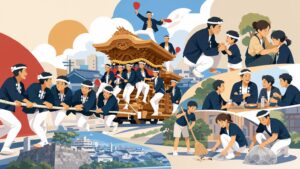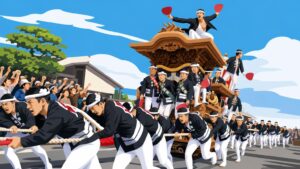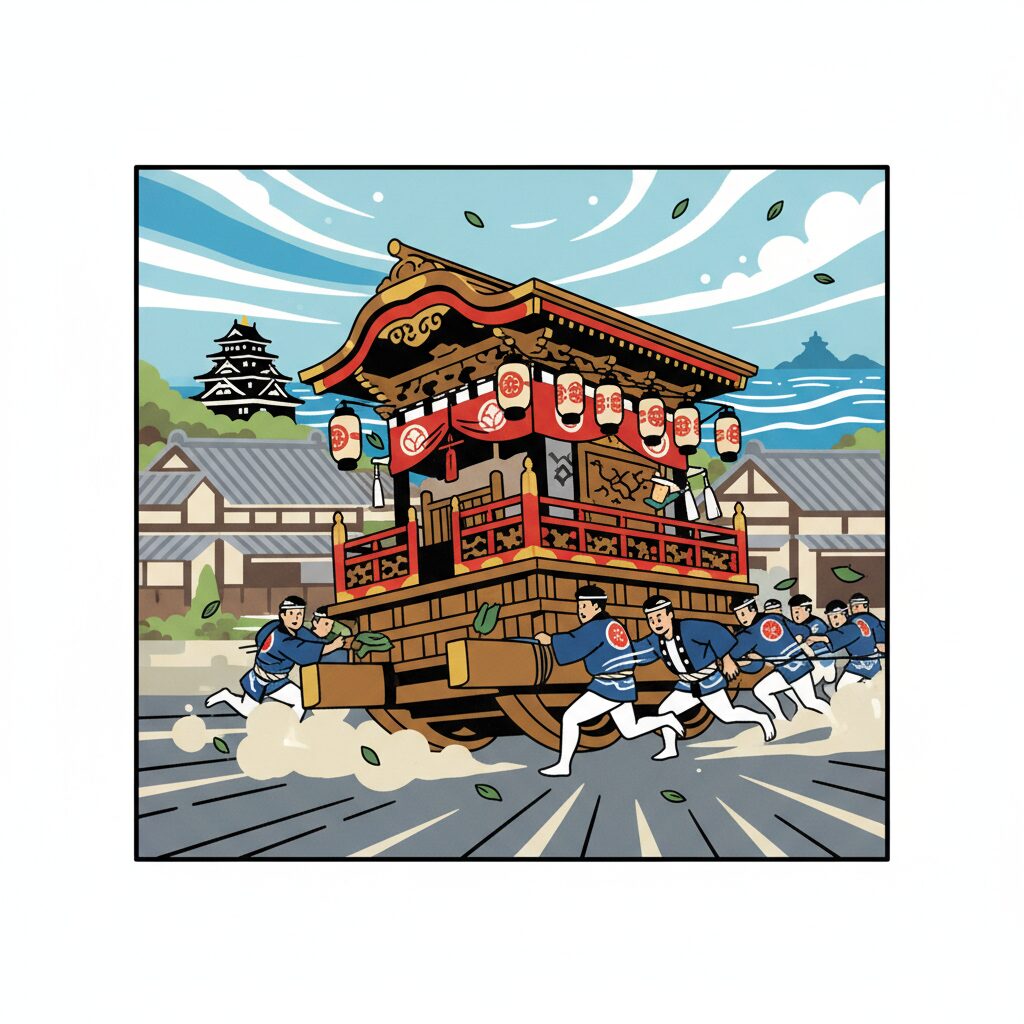
Walk through the streets of Kishiwada on a humid August evening, long after the tourists have gone home. You’ll hear it. A distant, thunderous rhythm. It’s the sound of wood on wood, the rumbling of giant wheels on asphalt, the coordinated shouts of a hundred men. This isn’t a performance. It’s practice. It’s the pulse of a city that doesn’t just host a festival, but is consumed by it. Outsiders see the Kishiwada Danjiri Matsuri as two chaotic days in September, a thrilling, dangerous spectacle of massive wooden floats, or danjiri, careening around tight corners at full speed. They see the sweat, the adrenaline, the risk. What they don’t see is the other 363 days of the year. They don’t see how this festival is the city’s operating system, its social blueprint, and the source of an identity so powerful it borders on a religion. What if a festival wasn’t just something you attended, but something you were born into? A system that dictates your friendships, your finances, your social standing, and even your sense of self-worth from cradle to grave? This isn’t a guide to watching the Danjiri. This is a look under the hood at the lives powered by its relentless engine, a peek into a corner of Osaka that operates on a completely different frequency from the neon buzz of Namba or the polished commerce of Umeda. This is the reality of life inside the Danjiri machine.
Amid Kishiwada’s relentless festive fervor, a brief escape to explore fresh fish and local angling culture in Misaki offers a serene counterpoint to the city’s perpetual rhythm.
More Than a Festival: The Danjiri Calendar is the Real Calendar
For most people in Japan, the year is defined by cherry blossoms, summer holidays, and New Year’s celebrations. But in Kishiwada, the calendar centers around one true focal point: Danjiri. Everything revolves around the second weekend of September. Life is measured not in months, but by festival milestones. The year doesn’t start on January 1st, but on the Monday following the festival’s conclusion, during the cleanup and the shared quiet sigh. That brief moment of calm is the only off-season you get.
A Year Marked by Festival Milestones
By winter, the machine revs back to life. The seinen-dan, the young men’s association forming the core of the pulling teams, holds its first meetings. They’re not discussing the weather; they’re analyzing last year’s performance. Every turn, slip, and moment of triumph or defeat is scrutinized with the focus of a professional sports team reviewing game footage. Budgets are planned, leadership roles assigned, and the slow buildup begins. Spring brings the season of kifu, or donations. This isn’t a casual fundraiser but a deeply ingrained social obligation. Local businesses, families, and former residents are all expected to contribute. The amounts are significant, and donors’ names are often publicly displayed—a subtle record of community dedication. It’s a financial tax paid for the privilege of belonging. As summer heat descends on Osaka, the pace intensifies. Young men start conditioning, jogging through the city streets in the evenings, often wearing shirts emblazoned with their neighborhood team’s crest. Then comes the sound: the resonant beat of taiko drums and the sharp clang of bells echoing from community halls and garages where late-night practice sessions take place. Finally, in late August and early September, the shiken-biki—the official test runs—begin. The multi-ton danjiri are pulled from storage, and for the first time, full teams practice on the actual festival course. These aren’t casual rehearsals but full-dress, full-speed runs that draw large crowds of locals. The pressure is palpable. The real event is just weeks away, and the neighborhood’s honor is at stake.
The Financial and Time Demands of Tradition
This year-long cycle requires more than passion; it demands sacrifice. The financial burden is considerable yet rarely spoken of. Beyond the expected donations, participants must buy their own gear: the distinctive happi coat, the form-fitting patchi pants, jika-tabi footwear, and the essential hachimaki headband. For those in leadership positions, costs rise further, covering everything from team dinners to ceremonial expenses. It’s a steady drain on household budgets, an accepted expense of life in Kishiwada. But the toll on time is even greater. From spring through autumn, evenings and weekends vanish, consumed by meetings, practice sessions, maintenance of the danjiri, and ongoing strategic discussions. This isn’t a hobby; it’s a second, unpaid, highly demanding job. Newcomers to Osaka are often surprised by this level of dedication. In Tokyo, or even central Osaka, you might join clubs or volunteer groups of your choosing, setting your own involvement level. In Kishiwada, however, if you are born into the culture, the involvement is imposed on you. Excuses aren’t easily accepted. Your job, personal life, and family time—all must yield to the Danjiri calendar. This is the first major misunderstanding for outsiders: this isn’t a choice, it’s an obligation. It’s the price of membership in the community.
Born Into It: The Unbreakable Social Structure
This system endures not simply because of a shared interest, but because it rests on a foundation much deeper—rooted in geography, blood ties, and a rigid social hierarchy reinforced through generations. You don’t just sign up to pull a danjiri; your place in this world is assigned the day you are born.
Your Neighborhood is Your Team, Your Team is Your Family
Kishiwada is divided into dozens of neighborhoods, known as chō. Each chō has its own danjiri, colors, history, and intense rivalries. Being born in Kishiwada means your address automatically places you on a team. This isn’t like choosing a favorite baseball team—this is your identity. The kids you play with in the local park are the same ones you will one day pull the ropes alongside. The elderly man running the corner store is a respected elder within your local Danjiri association. This creates a hyper-local, multi-generational bond nearly impossible to find in modern urban Japan. In Tokyo, you might not know the name of your next-door neighbor. In Kishiwada, neighbors recount your grandfather’s Danjiri stories. This system fosters a profound sense of belonging and community, where people look out for each other because their fates and reputations are intertwined. However, it also forms an insular, nearly tribal environment. Your world is your chō. Friendships, business ties, and even marriages often develop within these boundaries. To an outsider, it can feel impenetrable. You may live in Kishiwada for years, but if you weren’t born into a chō, you will always remain on the outskirts, observing from the sidewalk.
The Pyramid of Power: Age, Gender, and the Danjiri Hierarchy
Each chō has a strict, unspoken pyramid of power—a meritocracy based on age, experience, and dedication. At the bottom are the children, who pull a smaller decorative version of the danjiri. As they become teenagers, they advance to pulling the main ropes at the back. The prime roles—steering the danjiri from the front, acting as brakes, and, most heroically, the daikugata who dances on the roof—are reserved for men in their physical prime, members of the seinen-dan. Above them are the elders, former participants who now serve as advisors, strategists, and disciplinarians, whose word is law. This hierarchy extends beyond the festival: respect to a Danjiri superior is shown all year round, regardless of your rank outside the festival. He might be your subordinate at work Monday through Friday, but at a Danjiri meeting on Saturday, he becomes your senior, and you listen. Gender roles are deeply traditional and clearly defined. Pulling and riding the danjiri is exclusively a male domain. Women, however, are the essential, powerful backbone of the entire operation. They act as logisticians, fundraisers, organizers, and the emotional core. During the festival, they prepare vast amounts of food, tend to injuries, and care for the children. Their work is relentless, less visible, but absolutely vital. Within this culture, their role is not seen as exclusion but as a different, equally important contribution. The pride women take in supporting their husbands, sons, and brothers is immense—they are the silent partners whose efforts make the entire spectacle possible.
The Pride and the Crushing Pressure
Bearing the weight of your neighborhood’s history on your shoulders is a source of immense pride. It creates a direct link to your ancestors and your community. Yet, that same weight can become a crushing burden, fostering a high-pressure environment where conformity is expected and individuality is often suppressed.
The Weight of the Hachimaki Headband
When a man ties the hachimaki headband around his forehead, he stops being just an individual. He transforms into a representative of his chō. His behavior reflects on everyone. The ultimate objective is the yarimawashi, the breathtakingly perilous maneuver where the danjiri pivots 90 degrees at full speed around a corner. A flawlessly executed yarimawashi is a moment of pure collective ecstasy. The roar of the crowd, the pride of the team—it’s an adrenaline surge that participants pursue all year long. It bestows honor and bragging rights on the entire neighborhood for the following 365 days. Conversely, a failed turn brings shame. A danjiri crashing into a building is more than property damage; it is a public humiliation, a loss of face for the whole community. This intense dynamic of honor and shame fuels the entire culture. It’s why they practice tirelessly and sacrifice so much. It’s not merely about enjoyment; it’s about preserving the reputation of your family and your home.
“Are You Pulling?” – The Question That Defines You
For a young man growing up in Kishiwada, one question will define his early adulthood: “Are you pulling this year?” It is asked by relatives, neighbors, and old friends, and there is only one acceptable answer. Saying no is not simply a personal choice; it is perceived as rejecting your roots, your duty, and your community. The social pressure is overwhelming. Young men have been known to quit jobs with rigid hours that conflict with Danjiri practice. They feel pressured to decline promotions that would require relocating away from Kishiwada. Opting out can result in quiet ostracism, being labeled selfish or lazy. It is a heavy expectation for a young person with different dreams or ambitions. The Danjiri stands as the ultimate expression of manhood and local loyalty, and choosing another path is often seen as a personal failure.
The Other Side of the Coin: Those Who Leave
Naturally, not everyone stays. Some leave, seeking a life free from suffocating expectations and the relentless festival schedule. They move to Osaka City, to Tokyo, to build a life on their own terms. Yet, for many, a part of them remains tied to their chō. They may return to watch the festival from the sidelines or send donations from afar. For those who stay in Kishiwada but opt out of participation, life can be complicated. They exist in a strange limbo—physically present but socially excluded. They become spectators in their own hometown, a constant reminder of the binary choice that defines life here: you are either all in, or you are not in at all.
How Danjiri Shapes the Kishiwada Mindset
The cumulative impact of this year-long cycle of training, sacrifice, and high-pressure performance fundamentally shapes the character of the people. The so-called kishiwada-damashii, or Kishiwada spirit, is more than just a stereotype; it is a mentality forged in the intense environment of the festival.
A Different Kind of “Osaka Spirit”
Osakans are often described as loud, direct, and friendly. The Kishiwada spirit amplifies that directness to the extreme, adding grit, intensity, and fierce local pride. The communication style is blunt and hierarchical, emerging from a context where clear, immediate commands are essential to avoid disaster. There is little room for suggestions or polite ambiguity when maneuvering a four-ton float. To outsiders, this may seem rough or even aggressive, but within the community, it is recognized as efficient and honest. This mindset prizes physical toughness, unwavering loyalty to the group, and profound respect for tradition and seniority. It reflects a conservative, collectivist culture that sharply contrasts with the individualism of a metropolis like Tokyo. In Kishiwada, the group—the chō—always takes precedence over the individual.
The Misunderstanding of “Danger”
Foreign onlookers, and even many Japanese, often focus on the danger of the Danjiri Matsuri. They notice the speed, the near-misses, the occasional crashes, and dismiss it as reckless or crazy. This fundamentally misinterprets what is occurring. The danger is very real, but it is not glorified. What is celebrated is the remarkable skill, discipline, and teamwork required to manage that danger. The daikugata dancing on the roof is no daredevil; he is an elite athlete with an extraordinary sense of balance, whose movements communicate instructions to the team below. The men at the front are not merely running; they are masters of leverage and momentum. The hundreds pulling the ropes act as a single, synchronized organism, responding instantly to commands. The yarimawashi is not chaos; it is a fierce, beautiful problem of physics and human coordination. To view it as merely dangerous misses the entire point. It is a profound display of trust—trust in leaders, in the person beside you, and in years of training that prepare you for that heart-stopping moment.
Living in Osaka means understanding that the city is not a single entity. It is a mosaic of fiercely independent neighborhoods and towns, each with its own culture. Kishiwada is perhaps the most extreme example. The Danjiri is not just an event; it is the lifeblood of the city. It drives the economy, maps the social landscape, marks the calendar, and embodies what it means to be from this place. For residents, the rumble of the danjiri wheels on the pavement is more than a festival sound. It is the sound of home. It is the rhythm that shapes their entire life—one of pride, pressure, and an unbreakable, all-consuming sense of belonging.