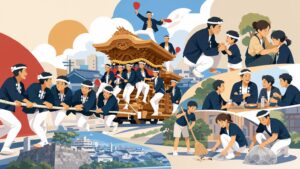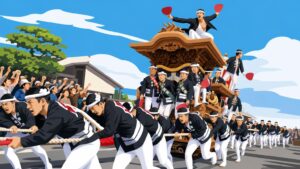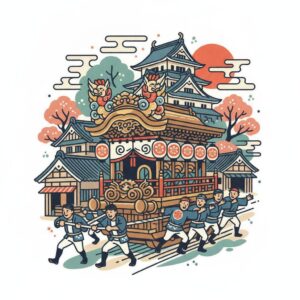
Talk to anyone in Osaka about Kishiwada, and one word immediately explodes into the conversation: Danjiri. It’s a vision of chaos and courage, of massive wooden floats tearing through narrow streets at impossible speeds, men leaping and dancing on their roofs. For two days in September, this city in southern Osaka, part of the region known as Senshu, becomes the epicenter of what is arguably Japan’s most thrilling and dangerous festival. It’s an image that defines Kishiwada for the outside world, a spectacular burst of raw energy that seems to confirm every stereotype about Osakans being loud, passionate, and a little bit crazy. But here’s the thing that living in Osaka teaches you: the festival isn’t the story. It’s just the final, explosive chapter. The real story of Kishiwada, the narrative that reveals a deeper truth about the Osaka mindset, is written in the 363 days between the festivals. It’s found in the quiet pride of its castle town streets, the salty air of its coastline, and the unyielding rhythm of a community bound by a shared identity that runs deeper than any skyscraper in Umeda. To understand this place is to understand that in Osaka, your neighborhood isn’t just where you live. It’s who you are. And in Kishiwada, that identity is everything. It’s a contrast that tells you more about this region than any travel guide ever could. It’s the difference between the fleeting thrill of a spectacle and the enduring strength of a culture built from the ground up, block by block, generation by generation.
For travelers eager to uncover the rich historical tapestry of southern Osaka beyond the festival fervor, a visit to Tondabayashi’s traditional merchant district offers a captivating glimpse into the region’s Edo-period heritage.
The Echo of the Danjiri: A Year-Round Pulse
What many foreigners—and even Japanese from other areas—misunderstand about the Danjiri festival is that they regard it simply as an event. They view the two days of intense excitement as a release, a wild celebration before returning to normal life. This is a basic misinterpretation of the local culture. In Kishiwada, the Danjiri is not just an event; it is a way of life. The festival serves as the tangible expression of a social structure and collective identity that shapes daily life throughout the year. The true significance doesn’t lie in the streets in September; it’s found in the quiet, steady, and demanding work that takes place behind the scenes. Each neighborhood, or chou, possesses its own Danjiri float—a massive masterpiece of carved wood and intricate craftsmanship that can cost hundreds of millions of yen. These are not simply museum artifacts but living symbols, the pride of the community, with their upkeep considered a sacred responsibility. From a young age, children are included; they don’t just observe but take part. Toddlers learn the rhythmic chants, teenagers practice pulling the enormous ropes, and young men aim for the most challenging and honored role: the daikugata, the carpenter who performs on the float’s roof. This is far more than a pastime; it is an apprenticeship in community life. Neighborhood associations, the seinen-dan (youth groups), and elder councils are the real centers of power and social interaction here. A person’s standing in the community is deeply connected to their involvement with the Danjiri, influencing social networks, business ties, and even family relations. This fosters a strong, almost tribal sense of belonging. When someone from Kishiwada is asked where they’re from, they don’t simply say “Kishiwada.” Instead, they identify their specific neighborhood—Kaminomachi, Numa-cho, Miyayamoto-cho—because that is their primary identity. This intense local pride is characteristic of the Senshu region, sharply contrasting with the more anonymous and transient lifestyle typical of central Osaka or Tokyo. In Tokyo, people might define themselves by their company or alma mater; in Kishiwada, identity is rooted in one’s street, float, and dedication to the group. This ongoing commitment is what explains the intense emotion visible during the festival. It’s more than adrenaline; it’s the product of a year-long shared effort, financial sacrifice, and promises passed down through generations. It is the pride of a community laying bare its very soul.
Castle Town Bones, Port City Heart
Walking through Kishiwada feels like reading a history book crafted through its architecture and atmosphere. The city’s layout reveals the coexistence of two distinct identities, blending to shape the local character. At its heart stands Kishiwada Castle, a beautifully reconstructed fortress that proudly symbolizes the city’s samurai heritage. The area surrounding the castle, with its stone walls, moats, and meticulously designed streets, still radiates a sense of order and hierarchy. This reflects the legacy of the feudal lord, embodying structure, discipline, and a profound respect for tradition. For residents, the castle is more than a tourist attraction; it forms a constant backdrop and a tangible reminder of the city’s historical importance, anchoring local pride in a visible landmark. Yet, just a short stroll from the castle’s stately presence, the city’s character shifts. The streets narrow, buildings become more utilitarian, and the air carries the subtle, unmistakable scent of salt and sea. This is the other Kishiwada—the port town. For centuries, Kishiwada has been a hub for fishing and maritime trade, fostering a mindset quite unlike the rigid samurai ethos. Life by the coast is pragmatic, resilient, and fiercely independent. Fishermen and merchants depend on their wit, hard work, and the unpredictable rhythms of the ocean. This has shaped a culture that is straightforward, unpretentious, and deeply connected to the practicalities of daily living. This duality is palpable in the city’s social fabric. There is a deep respect for tradition and the intricate social codes of the Danjiri community, echoing the old castle town’s structure. Yet alongside it exists a rugged, direct, no-nonsense attitude born from the port. People here care less about appearances than those in the more polished neighborhoods of central Osaka. They prioritize substance over style, action over words. This fusion of proud traditionalism and working-class pragmatism is quintessentially Senshu. The city honors its samurai heritage while embracing the rugged hands of its fishermen. This balance prevents pride from tipping into arrogance and pragmatism from hardening into cynicism. It forms a grounded identity, built on the foundation of the castle and seasoned by the sea’s salt.
The Feel of the Old Town: More Than Just Buildings
To truly understand this dual identity, one must wander through the Kishiwada Shotengai, the covered shopping street near the station. Unlike the sleek, modern shopping centers in Namba or Umeda, this place resembles a living museum of mid-century Showa-era Japan. The shops are mostly small, family-run businesses that have stood for generations: a tailor specializing in Danjiri festival attire, a shop selling the specific tabi socks worn by festival pullers, a local bakery with recipes unchanged for fifty years. Here, interactions are different. In central Osaka, shopping is often a swift, anonymous exchange; here, it’s a conversation. Shopkeepers know their customers by name, inquire about their families, and discuss preparations for the neighborhood festival. The shotengai is not merely a commercial space; it acts as a community hub, an extension of the neighborhood’s living room. The pace is slower, more human. It’s where the castle town’s reverence for lineage and the port city’s emphasis on close-knit community ties converge. Elderly residents chat on benches, children run errands for their parents, and store owners exchange gossip. It’s a network of relationships woven over decades, fostering a sense of security and belonging that is increasingly rare in Japan’s larger cities. While Tokyo races toward the future, and even central Osaka continually reinvents itself, places like Kishiwada hold on to a tangible connection to their past. For a foreigner, this can feel both insular and wonderfully welcoming. You are clearly an outsider, yet the genuine curiosity and straightforwardness of the locals can be disarming. They take pride in their town and way of life, gladly sharing it—as long as you show sincere respect for the traditions they cherish.
Senshu-ben: The Sound of Southern Osaka
One of the first things you’ll notice in Kishiwada is that the language sounds different. Even if your Japanese is fluent, you might struggle to follow conversations. This is Senshu-ben, the dialect of Osaka’s southern region. To someone from Tokyo, all Osaka-ben might sound rough, but within Osaka, Senshu-ben is known for being especially coarse, fast-paced, and direct. Words are clipped, sentences have a distinct, almost confrontational intonation, and local slang is common. For outsiders, it can be intimidating, sounding aggressive as if a quarrel is always imminent. However, this is a misunderstanding. The directness of Senshu-ben is not a sign of anger; it reflects the local character. It’s a dialect that removes the polite, indirect layers typical of standard Japanese. There’s little room for ambiguity or delicate phrasing. It’s a language shaped by the docks and markets, where clear, efficient communication is crucial. It’s honest and unfiltered—what you hear is what you get. The dialect also acts as a strong social marker. Using Senshu-ben declares identity. It says, “I am from here. I belong to this place.” It instantly distinguishes insiders from outsiders. When you hear a group of local men discussing Danjiri plans in pure, unfiltered Senshu-ben, you witness a form of cultural bonding. The language itself reinforces their shared history and values. This linguistic pride is a key reason why southern Osaka feels so different from the city center. While the language in Umeda is becoming more homogenized due to business and media influence, Senshu-ben remains defiantly local. It’s a form of resistance against the cultural pull of the metropolis, a way of preserving a unique identity. For a foreigner living here, making an effort to understand, if not speak, a few phrases of Senshu-ben can be a powerful gesture. It shows a level of respect beyond simply learning standard Japanese. It acknowledges that you see them not just as “Osakans,” but as people from Kishiwada, from Senshu, with their own culture and voice.
Life by the Water: A Different Rhythm
The presence of the sea does more than simply flavor the air; it sets the pace of life. A weekend trip to Kishiwada should include an early morning visit to the coast, to spots like the Kishiwada Gankou Asaichi (Harbor Morning Market). This is where the pulse of the city’s port town beats strongest. Long before the shops downtown open, this place hums with activity. Fishermen, their faces weathered by sun and salt, unload their catches. Local restaurateurs and sharp-eyed grandmothers haggle for the freshest fish, their voices blending with the calls of seagulls. The market is a feast for the senses. The scent of fresh saltwater, the sight of gleaming silver fish on ice, the rough, noisy banter of the vendors—it’s worlds apart from the sterile, plastic-wrapped efficiency of a city supermarket. This is where the true character of Kishiwada shines through. The people here are hardy, practical, and possess a deep, instinctive connection to their environment. Their livelihoods depend on it. This bond with the sea infuses the local cuisine. While central Osaka is known for takoyaki and okonomiyaki, the coastal Senshu towns take pride in their seafood. You’ll find small, humble restaurants serving incredibly fresh sashimi, grilled fish, and local specialties like anago (conger eel) and watarigani (gazami crab). Food here isn’t about trends or Instagram-ready presentations; it’s about freshness and tradition. It’s about eating what the sea offers, prepared in ways passed down through generations. This coastal rhythm also brings a different type of leisure. On a sunny afternoon, you won’t see people flocking to trendy cafes. Instead, they’ll be at Rinku Town or Marble Beach, just a short drive along the coast, enjoying the expansive sky and sea breeze. Families fish off the piers, couples watch the sunset, and friends gather for barbecues. It’s a simpler, more natural lifestyle that values space and nature over consumerism. This is a vital piece of the puzzle to understanding Osaka. The prefecture isn’t just a dense urban landscape. The Senshu coastline offers an escape, a “backyard” that shapes the region’s identity as much as the neon lights of Dotonbori do. It nurtures a different outlook, one that’s a bit slower, more grounded, and always facing the sea.
Beyond the Stereotype: Finding Your Place in Senshu
Spending time in Kishiwada provides a meaningful insight for any foreigner seeking to understand Osaka. It compels you to move beyond the familiar clichés. Is Osaka friendly? Yes, but in Kishiwada, that friendliness stems from a close-knit community where everyone is aware of each other’s affairs. It’s not the impersonal, fleeting friendliness of a large city; it’s the demanding, supportive, and sometimes overwhelming embrace of a small town. Is Osaka loud and lively? Definitely, but the noise of the Danjiri festival isn’t mere random celebration; it’s the sound of a community expressing its identity with full passion. The greatest error is to generalize all of Osaka with one perspective. The hyper-commercial energy of Kita and the rebellious youth culture of Minami represent just two aspects of a multifaceted city. Kishiwada and the broader Senshu area embody something entirely different: a deep, unwavering dedication to local identity, tradition, and community. This part of Osaka feels older, more rooted, and less concerned with external opinions from the rest of Japan. For some, this strong localism may seem impenetrable. Social circles are close-knit, the dialect thick, and traditions demanding. Yet, for those who take the time to look beyond the dazzling spectacle of the festival, Kishiwada offers a window into the heart of Osaka. It unveils a culture where pride is not about individual success but about collective effort, where identity is shaped not in office towers but on the streets of one’s neighborhood. It serves as a reminder that beneath the modern facade of Japan’s second city lies a mosaic of deep loyalties and fierce passions, as profound and powerful as the ocean tides washing its southern shores.