
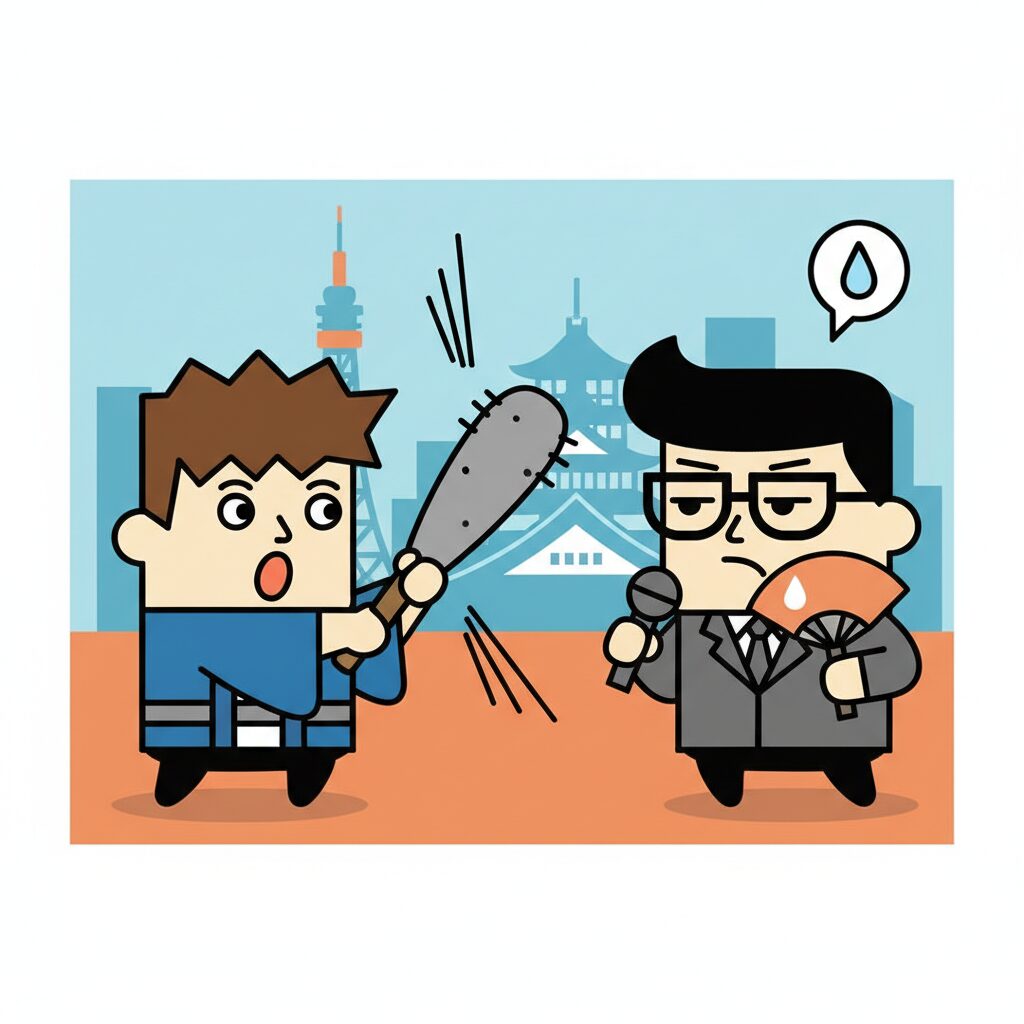
I remember my first week in Osaka like it was yesterday. Standing in the aisle of a local Tamade supermarket, a brightly lit palace of chaotic bargains, I was staring blankly at a wall of soy sauces. A little old lady, probably in her late seventies with a perm of impressive structural integrity, shuffled up beside me. She grabbed a bottle, looked at my confused face, then looked at the bottle in her hand and proclaimed in a booming voice to no one in particular, “Well, this one says it will make me a world-class chef. I suppose my husband will finally be happy!” She then winked at me and shuffled off, cackling softly. I just stood there, bewildered. Was she talking to me? Was she serious? In Tokyo, such an encounter would be unthinkable. Here, it was just a Tuesday. It took me months to realize that I hadn’t just witnessed a moment of senile eccentricity. I had been given a front-row seat to the fundamental rhythm of Osaka life: the comedy. This city’s soul isn’t just in its takoyaki or its towering castle; it’s in the constant, rolling banter of its people. It’s a culture of humor, or owarai, so deeply ingrained that it dictates the flow of conversation from the boardroom to the butcher shop. And at the heart of this comedic pulse is a concept known as boke and tsukkomi. Understanding this dynamic duo is the single most important key to unlocking the delightful, baffling, and utterly human experience of living in Osaka. The epicenter of this culture, its spiritual home, can be found in Namba, where comedy is not just an art form, but a way of life.
The city’s wit is complemented by a unique merchant mentality that shapes daily spending and saving habits in unexpected ways.
What in the World is ‘Boke and Tsukkomi’?
Before you can navigate a conversation in Osaka, you first need to understand the two basic roles. These roles form the foundational DNA of Japanese stand-up comedy, known as manzai, but their principles have permeated mainstream culture so much that they have become the default style of casual interaction. Think of it as a conversational dance, with everyone in Osaka knowing the steps from birth. It’s a call-and-response pattern that keeps dialogue lively, engaging, and, most importantly, enjoyable. It turns mundane exchanges into small performances, transforming the entire city into a stage where everyone is implicitly invited to join in.
The Dynamic Duo of Japanese Comedy
The two roles are simple in concept but nuanced in execution. First, there’s the boke (ボケ). The term comes from bokeru, meaning to be senile or air-headed. The boke is the fool, the funny character, the one who says or does something absurd, illogical, or simply silly. They play the setup. They intentionally miss the point, make ridiculous remarks, or humorously misunderstand a situation. The supermarket lady claiming her soy sauce held the secret to culinary greatness? A classic boke move. She was purposely creating a small, absurd moment for a shared laugh.
Then there’s the tsukkomi (ツッコミ). This word comes from tsukkomu, meaning to thrust or poke into. The tsukkomi is the straight man, the responder. Their role is to highlight the absurdity of the boke‘s comment with a quick, witty retort. They deliver the punchline. The tsukkomi corrects the boke, steering the conversation back to reality, often with a mock sense of frustration. Had I been a seasoned Osaka resident, I might have responded to the supermarket lady with, “Careful, or he’ll expect a fancy meal every night!” This acknowledges her joke, validates it, and completes the comedic exchange. The tsukkomi‘s reaction is what makes the boke‘s remark funny. Without the tsukkomi, the boke is just an odd person talking to themselves. Together, they create a perfect, self-contained cycle of humor.
More Than Just Jokes: It’s a Conversational Structure
This isn’t about memorizing jokes or delivering perfectly timed punchlines. It’s an improvisational tool for social bonding. The boke creates an opening, a small rip in the fabric of normal, polite conversation. The tsukkomi then stitches it up with a laugh. This ongoing back-and-forth serves an important social purpose. It’s a way of saying, “I see you, I hear you, and I’m on the same wavelength.” It’s a shared secret handshake affirming connection. When someone offers you a boke, they are effectively tossing you a conversational ball. The expectation is that you’ll return it with a tsukkomi. Dropping the ball—by taking the boke literally, ignoring it, or reacting with confusion—can be more socially awkward than the original absurd statement. The aim isn’t just to be funny; it’s to be actively engaged. It’s a collaborative effort to make the shared experience of everyday life a bit less dull and a bit more fun. This philosophy lies at the heart of what makes social interactions in Osaka feel so distinct, so much richer and more unpredictable than anywhere else in Japan.
Spotting Comedy in the Wild: Boke and Tsukkomi on the Streets of Osaka
Once you recognize what you’re looking for, you start noticing it everywhere. It appears in the way the baker sells you bread, the way friends greet each other at the station, and even in how colleagues navigate their workday. It’s the city’s unofficial language, a subtle layer of performance art superimposed on the canvas of daily routine. These aren’t grand gestures; they’re tiny, fleeting moments of improvised comedy that sprinkle the day and make life here feel incredibly vibrant.
The Supermarket Shuffle
Let’s return to the supermarket, a prime setting for observing this phenomenon. The other day, I was at the checkout, and the young man ahead of me was buying a single, sad-looking cabbage. The cashier, a middle-aged woman with a twinkle in her eye, scanned it and said with a perfectly straight face, “Wow, big party tonight, huh?” That was the boke. The young man, without missing a beat, sighed dramatically and replied, “Yeah, it’s gonna be wild. Me and the cabbage. We’re watching a movie.” That was his tsukkomi to her boke, but also a self-deprecating boke of his own. The cashier then completed the circle with her own tsukkomi, tapping the counter and saying, “Well, don’t have too much fun, you two!” Everyone in line, including me, smiled a little. The exchange lasted maybe ten seconds, but it momentarily lifted the mood of everyone within earshot. It was completely pointless, yet utterly essential. It didn’t make the transaction faster or more efficient, but it made it more human.
The Train Station Tango
Train stations provide another perfect stage. The relentless punctuality of Japanese trains creates a natural tension, which becomes fertile ground for humor. You’ll often see a pair of friends running for a train. One makes it on, the other is left standing on the platform as the doors close. The friend on the train might dramatically press their face to the glass, mouthing “Don’t forget me!” The friend on the platform might respond by bowing deeply, as if to a departing emperor. It’s a small play performed for an audience of two. Or consider the frequent announcements about delayed trains. In Tokyo, these are met with silent, patient frustration. In Osaka, they’re seen as an opportunity. I once overheard a man say to his companion after a delay was announced, “Great! Now we have time to start that business we were talking about.” His friend replied, “With our luck, the train will arrive just as we become millionaires.” They turned a moment of shared annoyance into a private joke, defusing tension for themselves and those around them.
Office Banter and the Corporate Comedian
Perhaps most surprising to foreigners is how this comedic rhythm permeates the Japanese workplace, a setting often linked with strict hierarchy and formality. While professionalism remains crucial, the boke and tsukkomi dynamic acts as an important social lubricant, especially in Osaka-based companies. It helps to level hierarchies and build rapport in ways that formal team-building exercises never could. Imagine a meeting where a junior employee presents a slide with a typo. In a tense office, this might be a moment of embarrassment. In an Osaka office, the boss might lean back and say, “I didn’t know we were launching a new product called ‘Projcet.’ Is it innovative?” That’s the boke, coming from a position of authority. The junior employee can respond with a tsukkomi: “Yes, it’s so secret that even I don’t know what it is yet!” Everyone laughs, the tension breaks, the mistake is noted, and the team moves on. The teasing signals a healthy, trusting relationship. It says, “We’re comfortable enough with each other to be playful.”
The Osaka Mindset vs. The Tokyo Standard
To truly understand the essence of Osaka, you need to grasp how this comedic foundation shapes a mindset vastly different from that of Tokyo. If Tokyo is like a carefully crafted novel of social etiquette, Osaka resembles a loud, chaotic, and hilarious improv show. The two cities function on fundamentally distinct social “software,” and much of the famous rivalry arises from these differing approaches to communication and public life. Foreigners often fall into the binary of “Tokyo is polite, Osaka is rude,” but the reality is far more nuanced.
Communication as Entertainment
In Tokyo, communication tends to be transactional, aiming for clarity, efficiency, and the maintenance of harmony (wa). Politeness is key, with conversations often layered with indirectness to avoid offending or imposing. You say what is necessary, do so with utmost respect, and then move on. In contrast, Osaka embraces communication as a form of mutual entertainment. The goal extends beyond merely conveying information to creating a shared enjoyable experience. The exchange itself is the focus. An Osakan might take extra time telling a story, incorporating dramatic pauses, humorous asides, and self-deprecating jokes, because the telling is a performance. They aren’t just sharing information; they’re offering you a good time. This can be mistaken for being loud or inefficient, but it stems from a deep generosity of spirit. Sharing laughter is a valuable currency in Osaka.
The Fear of Being Boring
The cultural pressure in Tokyo centers on not causing trouble for others (meiwaku o kakenai). In Osaka, a strong undercurrent is the fear of being omonnai—boring or unfunny. Being labeled omonnai is considered a much greater social offense than being somewhat loud or overly familiar. This creates a social obligation to be engaging. People feel compelled to add something to the conversation, whether it’s a funny story, a clever remark, or a well-timed tsukkomi. This is a major reason why Osakans are stereotyped as friendly and outgoing. Their chattiness isn’t random; it’s a cultivated skill. They’re always looking for chances to spark playful back-and-forths, to find a partner for a brief comedic duet. For outsiders, this might feel intense, but it’s also an open invitation. The entry barrier to conversation is very low, as long as you’re willing to join the game.
‘Nande ya nen!’: The Ultimate Expression of Tsukkomi
You can’t talk about Osaka without mentioning its trademark phrase: Nande ya nen! (なんでやねん!). Literally, it means “Why?!” or “What the heck?!”, but carries a much richer connotation. It’s the quintessential tsukkomi line, akin to a playful slap on the head. It’s used to call out a boke with affectionate disbelief. If a friend tells you they plan to run a marathon tomorrow after eating nothing but ramen for a week, the only fitting response is a hearty Nande ya nen! It’s not a question seeking an answer, but a punctuation that says, “That’s the most ridiculous thing I’ve ever heard, and I love you for it.” Hearing this phrase resonate through the streets and shotengai shopping arcades is to hear the very heartbeat of the city. Learning to use it, or even just recognizing the moments that call for it, marks a significant step toward thinking like a local.
A Foreigner’s Guide to Playing Along
So, you grasp the theory and notice it happening around you. What’s next? Joining in this conversational rhythm can be intimidating. What if your joke falls flat? What if you misread the tone? Fortunately, Osakans are typically forgiving, especially toward foreigners who clearly make an effort. Often, the attempt is valued more than flawless delivery. Still, there are some strategies to help you ease into the flow.
To Boke or to Tsukkomi? That’s the Question.
For beginners, the safest and simplest role to take is the tsukkomi. Your task is just to react. You don’t need to come up with the absurdity; you simply acknowledge it. You don’t even need advanced Japanese. When the butcher says, “This chicken is so fresh it might fly away,” you don’t need a witty reply. A straightforward “Seriously?!” (Maji de?!) or “No way!” (Uso!) said with a laugh works perfectly as tsukkomi. It shows you get the joke and are joining in. Attempting to be the boke requires more skill. It demands a solid understanding of language and cultural context to create humor that’s absurd in a funny way, not just incorrect. When a foreigner tries a boke and slips up, it might just sound like a language error, and listeners may gently correct you rather than respond with a tsukkomi, killing the comedic flow.
The Art of the Self-Deprecating Boke
One type of boke that’s relatively safe for foreigners is self-deprecation. Poking fun at your own challenges with Japanese life is a great way to invite a warm, friendly tsukkomi. It’s relatable and shows you don’t take yourself too seriously—a quality highly valued in Osaka. For instance, if you struggle with chopsticks and accidentally launch a piece of sushi across the table, you might say, “My chopsticks think they’re a rocket.” This is classic boke. It takes an awkward moment and turns it into humor. Your Japanese friends will likely respond with a tsukkomi like, “Careful, you’ll hit someone in America!” or “You need a license for those things!” By starting the joke yourself, you steer the conversation and encourage others to laugh with you, not at you.
What NOT to Do: Misreading the Teasing
This is arguably the most important tip for any foreigner trying to fit into Osaka life. The tsukkomi often comes as teasing, sharp remarks, or blunt comments that might come across as rude or harsh in other cultures. If an Osakan coworker looks at your bright, flashy shirt and says, “Wow, my eyes! Are you a traffic light?” they’re not criticizing your fashion. They’re giving you a prime chance for a tsukkomi. They’re treating you like one of their own. The worst response is to get defensive or stay silent. That kills the moment and creates awkwardness. The right approach is to fire back. “Yeah, and watch out—or I’ll turn red!” This is the game. The teasing signals affection and closeness. It means they’re comfortable enough to drop formal politeness. Silence is polite with strangers; banter is for friends.
Daily Life Immersed in Humor
When this comedic rhythm becomes the default mode for your interactions, it fundamentally transforms the texture of your daily life. It infuses everything with a sense of playfulness and resilience. Problems seem smaller, and connections with others feel more genuine. It’s a culture that deliberately nurtures joy in the small, ordinary moments of existence.
Raising Kids in a City of Comedians
As a parent, it’s fascinating to see children absorb this culture almost by osmosis. They naturally become skilled at boke and tsukkomi. My son once came home from the park with a large scratch on his knee. Before I could begin the usual worried-parent routine, his friend, who was with him, pointed at the scratch and said with utmost seriousness, “A monster bit him.” My son, holding back tears, looked at his friend and shouted, “It was a slide, you dummy!” They both burst out laughing. At that moment, the pain was forgotten. The situation was reframed from a minor tragedy into a humorous story. This environment teaches kids to find humor in mishaps and not take every setback too seriously. It’s a form of emotional resilience imparted not through lectures but through a lifelong practice of playful banter. They learn to be the hero of their own funny story, not the victim of a sad one.
Why Your Local Shopkeeper Knows Your Life Story
The cliché that “Osaka people are friendly” is true, but often misunderstood. It’s not the passive, reserved friendliness you might find elsewhere. It’s an active, engaged, and often boisterous friendliness founded on this ongoing comedic exchange. When you buy your vegetables, the shop owner might comment on how tired you look (boke). You might reply that you were up all night studying how to be a good comedian (tsukkomi). They laugh and throw in an extra onion. This happens every day. Over weeks and months, these small interactions build a genuine relationship. They learn your name, ask about your kids, and notice when you get a haircut. This isn’t just good customer service; it’s a community being crafted, one punchline at a time. This is why living in Osaka can feel less anonymous than in other major cities. You are not just a consumer; you are a potential comedy partner, a member of the ensemble.
The Punchline: Embracing the Rhythm
Living in Osaka is like learning a new language, but the vocabulary goes beyond words; it includes timing, tone, and a willingness to be a bit playful. The boke and tsukkomi dynamic forms the core grammar of this city’s social life. It fuels the warmth and lively energy Osaka is known for. At first, it can seem confusing or even harsh if you’re not familiar with it, and it might feel like everyone’s teasing you and nothing is ever taken seriously.
However, once you understand the code, you realize the opposite is true. This culture of humor is deeply valued. It’s a conscious choice to prioritize laughter, to build bonds through shared amusement, and to confront life’s absurdities with a joke rather than a complaint. It represents an optimistic and resilient way of navigating the world. It explains why a trip to the supermarket can feel like a performance, or why a delayed train becomes an opportunity for humor.
So if you find yourself living here, don’t just watch from the sidelines. Step into the spotlight. When someone says something completely ridiculous to you, try not to be confused. See it for what it is: an invitation. A friendly gesture asking you to join in the dance. Take a breath, smile, and deliver your best tsukkomi. Even if it’s awkward or just a simple “No way!”, the laughter you receive will feel like you’ve finally found a home.








