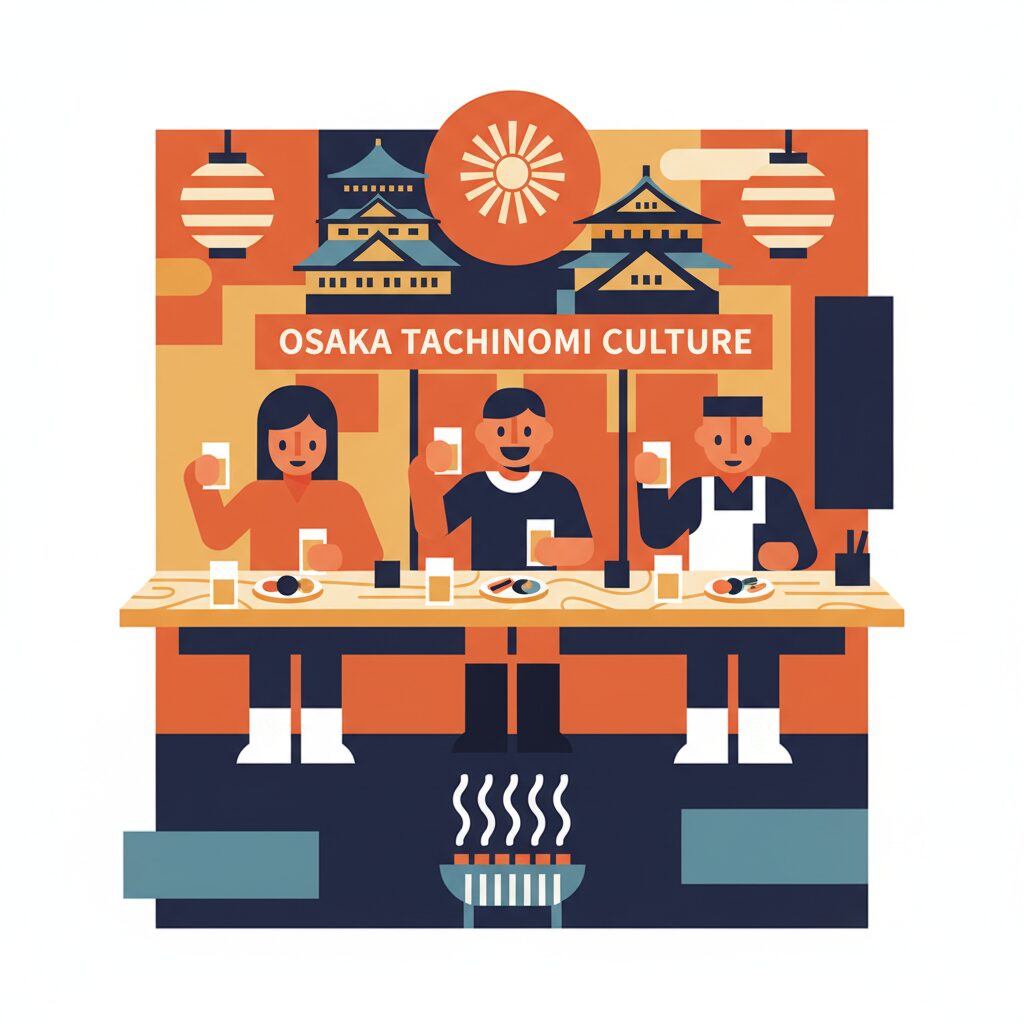
When I first moved to Osaka from Spain, I thought I understood bar culture. In Barcelona, a bar is a second living room. It’s a place of long conversations, leisurely tapas, and evenings that melt into nights. You find a seat, you settle in, you own that small piece of real estate for hours. Then I encountered my first true Osaka tachinomi. I was wandering through the labyrinthine arcades of Tenma, a neighborhood that hums with the energy of a thousand tiny kitchens, and saw it: a sliver of a room, packed shoulder-to-shoulder with people, all standing. There were no chairs, no tables to hide behind, just a long counter, a haze of grill smoke, and a symphony of clinking glasses and booming laughter. My first thought was, ‘Is there a private party? Is it full?’ But nobody was waiting for a table. The standing wasn’t a temporary inconvenience; it was the entire point. It looked chaotic, transient, and frankly, a little intimidating. This wasn’t a living room; it was a human loading dock for beer and bites. Why would anyone choose this? This question became my entry point into understanding the soul of Osaka, a city that lives, works, and drinks on its feet. The tachinomi, I soon learned, is far more than a bar. It’s a social barometer, an economic philosophy, and a cultural stage all packed into a few square meters. It’s where you find the city’s unvarnished truth, one quick drink at a time.
This stand-up drinking scene offers a glimpse into a city where fast social interactions mirror an equally dynamic professional realm, as highlighted in face-to-face business culture insights.
The Economic Engine: Why Standing Makes Sense in a Merchant City

To understand the tachinomi, you need to grasp Osaka‘s DNA as a merchant city. For centuries, it was Tenka no Daidokoro—the Nation’s Kitchen. It was a hub of commerce, rice brokers, and people whose lives revolved around shoubai, or business. This history ingrained a pragmatic, no-nonsense philosophy into the local character. Time is money, space is money, and value is everything. The tachinomi perfectly embodies this mindset. It’s a business model pared down to its profitable essence. Consider this: no chairs allow for more patrons in a smaller space. More patrons mean quicker turnover. Faster turnover results in more sales per hour. The low overhead—less furniture, smaller rent, minimal staff—directly translates to lower prices for customers. It’s a win-win built on sheer efficiency.
This is where Osaka’s famous concept of kosupa (cost performance) comes into play. In Tokyo, you might pay for ambiance, interior design, or exclusivity. In Osaka, you pay for the product. The pride lies in enjoying a delicious plate of doteyaki (beef sinew stewed in miso) and a large beer for just a handful of coins. This focus on value gives rise to the culture of senbero, a lively blend of sen-en (1,000 yen) and berobero (drunk). The ability to get pleasantly buzzed for about ten dollars is a source of local pride. It’s not about being cheap; it’s about being savvy. It’s the thrill of outsmarting the system, scoring a fantastic deal. A salaryman in a crisp suit will proudly recount the 300-yen highball he had at a grimy little spot under the train tracks—not celebrating the low price but his own cleverness.
This stands in sharp contrast to Tokyo’s bar scene. While Tokyo does have standing bars, they often feel more curated, a stylistic choice rather than a core principle. They may be trendy offshoots of major corporations or sleek, minimalist counters in upscale neighborhoods. In Osaka, the tachinomi feels elemental. It grows naturally from the city’s concrete, often tucked into shotengai shopping arcades, squeezed next to a train station, or wedged between office buildings. It’s not an aesthetic; it’s infrastructure—an essential part of the city’s social machinery. Its purpose is clear: to provide a fast, affordable, and communal space for the practical city’s working people. It’s less about being seen and more about just being—for a little while, before catching your train home.
The Social Glue: Breaking Down Barriers, One Glass at a Time
If the economics of the tachinomi explain why it exists, the social dynamics reveal its essence. Removing the chairs works a kind of magic: it eliminates social barriers. In a typical seated bar, tables create invisible partitions. You remain on your island, and they stay on theirs. Talking to strangers is an exception, an awkward break of etiquette. In a tachinomi, you have no choice but to share the same counter, the same space, the same air. You are literally shoulder-to-shoulder with the city. This enforced closeness is the key ingredient. It fosters a temporary, fluid community where interaction isn’t just possible but practically expected.
This setting serves as an equalizer. The strict hierarchies that often characterize Japanese society seem to vanish at the entrance of a tachinomi. A construction worker covered in dust might be sharing an ashtray with a bank manager. A young university student could be receiving restaurant advice from a grandmother who has been a regular for forty years. Your title, your company, your status—all become secondary to your immediate role as a fellow patron. Everyone stands on equal footing, standing at the same counter and paying the same low prices. This creates a rare atmosphere of casual intimacy not often found elsewhere in Japan.
This explains why the stereotype that “Osaka people are friendly” is both accurate and misleading. It’s not an innate trait but a learned behavior, cultivated in places like these. Osaka culture values directness and delights in human connection. Small talk isn’t a chore; it’s a pastime. I recall one of my first solo visits to a tachinomi in Kyobashi. I ordered a beer, feeling painfully self-conscious. The old man next to me, noticing my hesitation, grunted, pointed at my empty plate, and shouted to the owner, “Get her the potato salad! It’s the best!” Before long, we were discussing my home country, he was sharing stories about his grandchildren, and the man on my other side joined in to debate the best team in the Central League (it’s always the Hanshin Tigers, by the way). This would be almost unthinkable in a quiet, formal Tokyo bar. In Osaka, it was just a typical Tuesday night. The fleeting nature of the tachinomi makes these interactions low-risk. You’re only there for twenty minutes. If the conversation fades, it doesn’t matter—you’ll be gone soon, and so will they. This temporary, low-commitment social contract encourages people to open up in ways they normally wouldn’t.
The Unspoken Rules: A Foreigner’s Guide to Fitting In
Despite its apparent chaos, the tachinomi operates according to a set of deeply ingrained, unspoken rules. Navigating this etiquette is essential to transitioning from a bewildered outsider to a comfortable regular. This isn’t a place for hesitation. The pace is swift, driven by the same merchant efficiency. Mastering the flow is part of the experience.
First and foremost: know your opening move. The classic starter is “Toriaezu, biru“—“Beer for now.” It serves as a conversational placeholder, a social lubricant that gives you time to study the handwritten menu on the wall and decide your next order. Fumbling with your choice or taking too long disrupts the rhythm of the bar. Have a plan, even if it’s a simple one.
Second, be a master of personal space—or rather, the lack of it. You must make yourself small. Keep your bag on the floor or on a small hook if one is provided, never on the counter. Keep your elbows close. When moving, do so deliberately, excusing yourself with a quiet “sumimasen.” The space is communal, and the cardinal sin is to act as if you own more than the sliver your body occupies. It’s a delicate dance of shared spatial awareness.
Third, understand the money system. Many traditional tachinomi operate on a cash-on-delivery basis known as kyasshu on. You place a 1,000-yen bill or some coins in a small tray on the counter before you. With each order, the staff takes the exact amount from your tray. This is efficiency at its finest. No waiting for a bill, no complex calculations. When your money runs out, you either add more or you’re done. It keeps transactions fast and transparent. Always have cash, preferably in small denominations, ready to go.
Fourth, read the room’s energy. Each tachinomi has its own unique vibe. Some are quiet, contemplative spots where regulars nurse their drinks in silence after a long day. Others are raucous and loud, fueled by lively banter. The key is to match the prevailing mood. If people are chatting, feel free to join or listen. If it’s a quiet spot, don’t be the one trying to start a party. The ability to gauge the social temperature is crucial.
Finally, and perhaps most importantly, don’t get too comfortable. A tachinomi is a pit stop, not a final destination. It’s a place for a quick ippai—one drink, and maybe a small snack. The goal is to get in, enjoy the moment, and get out. Lingering for hours is a rookie mistake. It blocks a valuable spot at the counter and goes against the very spirit of the place. The beauty of the tachinomi is its transient nature. Embrace it. Have your drink, savor a brief connection with a stranger, and then move on to the next part of your evening.
The Other Side of the Counter: The Downsides and Nuances
Though I’ve grown fond of the tachinomi scene, it’s important to present a truthful, unromanticized view. It isn’t a universally welcoming utopia, and there are clear drawbacks, especially for foreigners and women. The elements that make these places unique—the speed, the intimacy, the unfiltered local vibe—can also be quite intimidating. Stepping into a tiny, packed space where you’re the only non-Japanese person and the menu consists of calligraphic scrolls on the wall takes a certain bravery. The rapid-fire Osaka dialect can be impenetrable, and the fast-paced ordering system can leave you feeling overwhelmed and self-conscious.
Additionally, the traditional tachinomi often remains a male-dominated environment. It’s the domain of the oyaji (middle-aged men), a stronghold of post-work male camaraderie. While outright violence or harassment is very rare in Japan, solo women can feel uncomfortably conspicuous. They might encounter curious looks or well-meaning but sometimes awkward attempts at conversation. Usually harmless and rooted more in novelty than ill intent, it can still be exhausting to feel constantly scrutinized. For many women—both Japanese and foreign—a visit to a classic tachinomi is an experience they prefer to share with a friend rather than face alone.
Then there are issues of comfort and hygiene to consider. To be frank: these are not temples of fine dining. They are practical, often grimy, and designed for speed rather than comfort. The floor may be slippery with spilled beer, the air heavy with cigarette smoke (though this is changing due to new regulations), and the restroom facilities… basic, to say the least. You stand on your feet, often after a long day of work or walking. It’s not a relaxing experience in the usual sense. Instead, it’s vibrant, stimulating, and often loud. If you’re seeking a calm, comfortable place to unwind, a tachinomi probably isn’t it.
Lastly, there’s a subtle yet important public health consideration. The accessibility and affordability of tachinomi normalize daily drinking. The culture of stopping for a quick beer and a snack on the way home from work—day after day—is deeply embedded. While it serves as a crucial social outlet for many, it can also blur the boundary between a healthy social habit and habitual dependence. The very ease of it—so cheap, so fast, so readily available—can cut both ways.
The Modern Evolution: From Grimy Corners to Gourmet Standing
The story of tachinomi in Osaka is far from static. While the traditional, smoke-filled spots beneath the train tracks remain cherished institutions, the city is experiencing an intriguing transformation of the concept. The fundamental idea—standing, socializing, quick turnover—has proven to be remarkably adaptable. A new generation of modern tachinomi is redefining what a standing bar can be, making the culture approachable for a broader and younger audience.
This new wave often emphasizes a specialty. Rather than just cheap beer and sake, you’ll find standing wine bars offering carefully curated selections from around the world, paired with artisanal cheese and charcuterie. Craft beer tachinomi showcase rotating menus of IPAs and stouts from Japanese microbreweries. High-end sake bars let you sample premium junmai daiginjo by the glass, guided by knowledgeable owners. There are even standing sushi bars and Italian bar in piedi serving gourmet small plates. These venues maintain the efficiency and social fluidity of the classic style while elevating the quality of their offerings.
Neighborhoods like Fukushima, Tenma, and the alleys of Ura Namba have become hotspots for this revival. Here, you can hop between a dozen distinct standing bar concepts in a single evening. These places draw a younger, more diverse crowd. It’s common to see groups of women enjoying wine, young couples on dates, and food enthusiasts eager to sample the latest creations from up-and-coming chefs. The atmosphere is more stylish, the design more deliberate, and menus are often bilingual. They have successfully captured the energetic, communal spirit of tachinomi while leaving behind some of the rougher, more intimidating traits.
This evolution is brilliant because it keeps the culture vibrant and relevant. It demonstrates that the principles of tachinomi are not merely relics of post-war Japan but a flexible and enduring social model. For foreigners living in Osaka, these modern standing bars offer an excellent entry point. They provide a gentler introduction to the culture, allowing newcomers to get comfortable with the standing format in a more familiar, less daunting environment before venturing into a classic oyaji haunt. It’s a sign of a healthy, living culture—one that honors its origins while boldly exploring new directions.
What Tachinomi Tells You About Osaka
After years of observing from the other side of the counter, I’ve come to see that the tachinomi perfectly encapsulates Osaka itself. It’s more than just a place to grab a drink; it serves as a living classroom for grasping the city’s distinctive character. If you want to understand what drives Osaka, you don’t need to visit a museum—you need to visit a standing bar.
First, it exposes the city’s deep-rooted Pragmatism. Every aspect of the tachinomi is designed for value and efficiency, from the absence of chairs to the cash-on-delivery system. It mirrors a culture that abhors waste—whether of time, space, or money. It represents the merchant’s philosophy applied to leisure.
Second, it displays Osaka’s natural Sociability. The layout is intentionally crafted to break down social barriers and foster interaction. It operates on the belief that a brief conversation with a stranger benefits the soul. It embodies a transient, low-stakes community that is both reassuring and distinctly urban. It stands in opposition to the anonymity that often characterizes big city life.
Finally, it emphasizes the city’s Egalitarian Streak. The tachinomi is one of the rare places where social hierarchies truly dissolve. Everyone stands at the same level, pays the same price, and follows the same rules. It’s a space that prioritizes straightforward, unpretentious, human-to-human connection over formal titles and social status. This sharply contrasts with the more structured and formal social settings found elsewhere in Japan.
When people ask me about the difference between Osaka and Tokyo, I often think about their bars. In Tokyo, you usually go to a bar with your tribe, your established group of friends or colleagues, and stick within that circle. In Osaka, you can walk into a tachinomi alone and, for a brief time, become part of a new tribe. You might never see those people again, but for the twenty minutes you share at that counter, you’re connected. You don’t just go to a tachinomi for a drink—you go to feel the city’s heartbeat. It’s where you learn that in Osaka, you’re never truly drinking alone, even when you arrive by yourself.