Step out of any subway station in central Osaka, and you’re hit with a unique urban current. It’s a city of grids, a metropolis carved by train lines and underground tunnels that efficiently shuttle millions from point A to point B. But between those points, life spills out. Look closer, past the high-rises and the glowing signs. You’ll see them everywhere: a river of bicycles. They’re parked in dense, metallic forests outside stations, they glide silently down narrow shotengai arcades, and they’re ridden by everyone from grandmothers with baskets full of groceries to office workers in crisp suits. In Tokyo, the train is absolute king. Life is dictated by the chime of the station melody and the precision of the timetable. But Osaka, while just as dense and fast-paced, operates on a slightly different frequency. It’s a city built on a human scale, a place that prizes clever shortcuts and practical solutions. And the ultimate tool for navigating this mindset isn’t a metro pass—it’s a simple bicycle. For those of us living here, particularly non-Japanese residents trying to sync up with the local pulse, understanding the role of the shared cycle, especially the ubiquitous red HUBchari bikes, is like learning a secret dialect. It’s the key to transforming the city from a series of destinations into a single, connected, and deeply personal landscape. It’s about more than just getting around; it’s about embracing the pragmatic, efficient, and surprisingly intimate spirit of Osaka itself.
Embracing the city’s vibrant rhythm isn’t limited to zipping through its streets on a red HUBchari bike—locals also enjoy unwinding at welcoming kissa-ten meeting spots that serve as genuine community hubs.
The Gospel of the Flat Earth: Why Bikes Just Make Sense Here
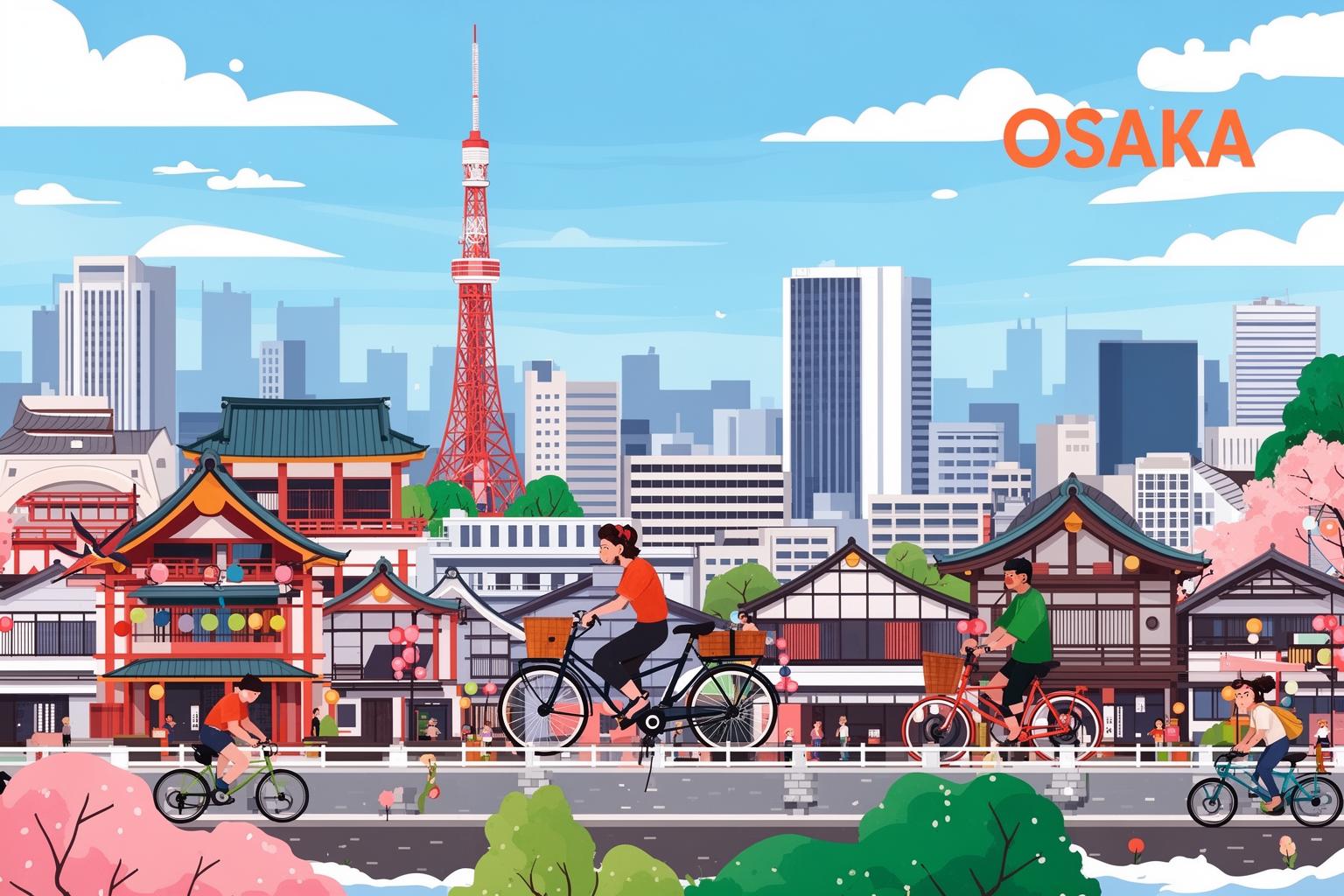
To grasp Osaka’s affection for bicycles, you first need to examine a topographical map. It’s flat—astonishingly and wonderfully so. Most of the city, from the lively business hubs of Umeda and Namba to the residential areas between, lies on the Yodo River delta. There are no grueling hills to tackle, no exhausting gear changes that leave you gasping and sweaty. This geographical blessing transforms cycling from a sport into a straightforward, accessible extension of walking. This sharply contrasts with areas of Tokyo, where neighborhoods like Roppongi or Shibuya are set on quite varied terrain, turning a casual ride into a real workout. In Osaka, the easiest route is almost always a straight, level path, making cycling the most practical option for trips under a few kilometers.
This physical simplicity directly supports a fundamental aspect of the Osaka mindset: pragmatism, often affectionately captured by the Kansai term ‘kechi’. Outsiders may mistakenly view ‘kechi’ as cheapness or stinginess, but that is a serious misinterpretation. It’s about being economically sensible—seeking maximum value with minimal waste. Why pay 180 yen for a one-stop subway trip when you can take a HUBchari for a fraction of the price, get some light exercise, and enjoy the fresh air? An Osakan will consider the time, cost, and convenience, and the bicycle consistently wins out. This mindset values function over appearance. You’ll see a high-powered executive in a tailored suit unlock a shared bike without hesitation, knowing it’s the smartest way to reach their next meeting across Nakanoshima island. In Tokyo, there’s often more emphasis on image and formality; taking a taxi might be preferred. In Osaka, however, the default is whatever works best. The shared bike perfectly embodies this ‘kechi’ brilliance—a low-cost, highly efficient answer to urban mobility.
Cracking the Code: How HUBchari Fills the Gaps
Osaka’s public transport is world-class, but like any system, it has its quirks. The Midosuji line serves as the city’s main artery, a strong north-south connection, yet traveling east to west can sometimes feel counterintuitive, often requiring transfers or lengthy walks. Many destinations lie in the unclear spaces between major stations. Your favorite ramen shop, that trendy vintage store, or a client’s office—they’re often about a 12-minute walk from the nearest subway exit. In a city where efficiency is prized, that’s a significant amount of time. This is where community cycle sharing, and HUBchari specifically, becomes a vital part of daily life. It’s the perfect ‘last-mile’ solution.
Operated by Docomo Bike Share, HUBchari is the leading provider, with its fleet of bright red, electric-assist bikes a familiar sight from Tennoji to Shin-Osaka. The system’s genius lies not only in the bikes themselves but in the density of its network. The app displays a network of stations, or ‘cycle ports’, hidden in parking lots, outside convenience stores, and near office buildings. This widespread presence offers freedom. You can ride from your apartment near Fukushima to dinner in Shinsaibashi, park the bike, and then take the subway home later. You’re no longer tied to a round trip.
The electric assist is the key feature that makes the system so appealing. It’s not a scooter; you still need to pedal. But with every push, a small motor activates, easing the effort of starting from a stop and making gentle hills effortless. This means you can ride across town to a meeting and arrive looking polished and composed, not disheveled and sweaty. It makes cycling accessible to everyone, regardless of fitness level. This little boost transforms the experience from a task into a joy, making it a practical, even preferred, alternative to a crowded train on a humid summer day.
Navigating the Urban Jungle: The Unspoken Rules of the Road
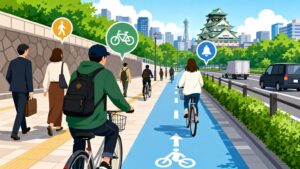
Using a HUBchari involves more than just downloading an app and scanning a QR code. It’s about adapting to the city’s distinctive, and sometimes chaotic, rhythm. For newcomers, especially those from countries with strict cycling infrastructure, Osaka’s streets can be confusing. The biggest challenge is the sidewalk. Technically, bicycles are vehicles and should be ridden on the road. In practice, nearly everyone rides on the sidewalk, especially on main roads where cars travel at high speeds. This is the first unspoken rule: when riding on the sidewalk, you are a guest in the pedestrian’s realm. This means moving slowly, giving plenty of space to people, and using your bell sparingly. An aggressive ding-ding-ding is considered rude; a single, polite ‘ring’ is a gentle way to announce your presence.
Parking presents the next challenge. Unlike some dockless systems where bikes can be left anywhere, HUBchari requires you to return the bike to an official port. This is where the app becomes essential. The biggest mistake any HUBchari user can make is reaching their destination only to find the local port completely full. You might spend anxious minutes riding around, trying to find a nearby station with an open slot, turning a simple trip into a stressful experience. The smart move is to check the port’s capacity on the app before starting your ride. This small habit saves a lot of frustration and perfectly illustrates the foresight and planning that supports the seemingly spontaneous Osaka lifestyle.
Lastly, there’s the flow of traffic itself. Osakans, whether walking, cycling, or driving, move with a confident purpose. They excel at calculating trajectories and weaving through gaps. This isn’t aggression; it’s a shared awareness of urban momentum. As a cyclist, you need to stay highly alert. Be predictable in your actions, but ready for the unexpected. Anticipate pedestrians stepping out, watch for delivery scooters darting down side streets, and realize that traffic signals are often treated as friendly suggestions. It’s not dangerous if you stay vigilant. It’s simply the city’s high-speed dance, and on a bike, you’re right at the heart of it.
The City Unlocked: From Daily Commute to Neighborhood Explorer
Once you become familiar with the system and its unwritten rules, HUBchari changes how you experience Osaka. It condenses the city, transforming it from an expansive metropolis into a network of connected villages. Your daily commute is no longer a subterranean journey spent staring at your phone. Instead, it becomes a sensory adventure. You’ll cycle through the peaceful, green space of Utsubo Park on your way to an office in Hommachi, breathing in the scent of roses in spring. You’ll stumble upon a small, family-run kissaten hidden in a backstreet of Kitahama that serves the ideal morning coffee, a spot you wouldn’t have discovered otherwise. You’re no longer just a passenger; you become an observer and a participant in the city’s morning ritual.
This new mobility reshapes your weekends. Areas like Tenma, with its maze of alleys filled with standing bars and izakayas, can feel intimidating to explore on foot. By bike, it turns into a playground. You can easily hop from a craft beer bar to a renowned sushi spot in minutes. The ride itself—winding through red lanterns and the lively sounds of the after-work crowd—is part of the experience. You can grab a bike in Namba and cruise down to the trendier, quieter streets of Minami-Horie, browsing its independent boutiques and furniture shops without worrying about parking or crowded trains.
This freedom fosters spontaneity, a trait that is distinctly Osaka. You might be on your way to the supermarket but decide on a whim to cycle over to Nakanoshima Park, picking up a bento along the way to enjoy by the river. You see a line forming outside a takoyaki stand and can easily pull over to check it out. The bike removes the hassle of travel, encouraging curiosity. It lets you say ‘yes’ to the small, unplanned moments that truly characterize life in a new city. It’s how you find ‘your’ bakery, ‘your’ park bench, ‘your’ shortcut. It’s how a place gradually, but surely, begins to feel like home.
Embracing the Practical Heart of Osaka
Ultimately, incorporating shared cycles into your daily routine is about more than just convenience. It’s about embracing the local philosophy. It’s about realizing that in Osaka, status often takes a backseat to substance. The shining subway and the polished taxi have their roles, but the modest bicycle holds a unique, esteemed position because it is, quite simply, the smartest tool for the job. It offers a direct, unmediated connection to the city. When you’re on a bike, you sense the subtle shifts in the pavement, hear the clatter of a nearby factory, and smell the dashi broth simmering in a local udon shop. You’re not viewing the city through a window; you’re moving through its very lifeblood.
Foreigners often arrive in Japan impressed by its impeccable order and strict rule-following. Osaka shares this, but it also carries a strong undercurrent of practical improvisation. People always find the cleverest way, the quickest route, the best deal. The shared bike is a modern expression of this age-old spirit. It’s a hack, a life pro-tip for urban living embraced by the whole community. Riding a HUBchari means joining this collective wisdom. It’s a silent gesture of understanding to the salaryman next to you at the traffic light, to the student speeding past, to the shopkeeper sweeping their storefront. It’s a declaration that you, too, get it. You know the best way to experience Osaka is not from above or below, but right at street level, moving at your own pace, powered by your own energy, and guided by the city’s pragmatic, vibrant, and ever-pulsing heart.