
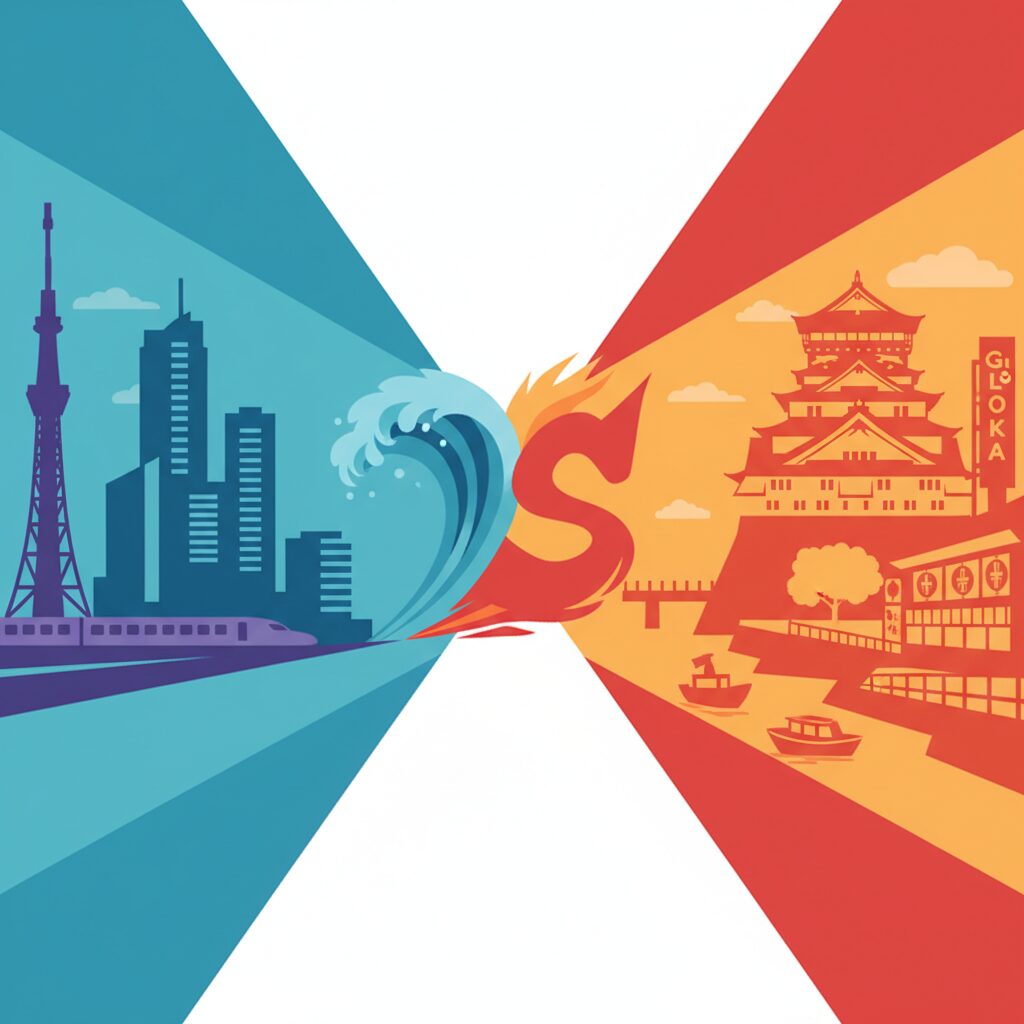
Hey everyone, Sofia here! When you first land in Japan, you hear the whispers almost immediately. The grand, epic rivalry. Kanto vs. Kansai. Tokyo vs. Osaka. It’s framed like a legendary battle: the polished, sophisticated capital versus the loud, merchant-hearted second city. On TV, it’s a comedy skit staple—the fast-talking Osakan outwitting the reserved Tokyoite. But when you move here, when you unpack your bags and start trying to figure out which train line goes where and why the escalators have switched sides, you have to ask the real question: Is this rivalry just for show, or is it something you actually feel in your day-to-day life? The answer, I’ve discovered, is a resounding yes, but not in the way you might think. It’s not about open hostility. It’s about two cities running on completely different operating systems. Tokyo is a meticulously coded app, running with flawless, silent precision. Osaka is a piece of powerful, unpredictable, and brilliantly chaotic hardware. It’s in the way people talk to you at the checkout counter, the way a business meeting unfolds, and the way the entire city breathes. This isn’t a tourist guide to the differences; this is a deep dive into the cultural currents that define daily life, work, and everything in between in the vibrant heart of Kansai.
For those curious about how Osaka’s flair for quick-witted banter reflects its everyday culture, exploring the nuances of tsukkomi humor can offer a fascinating extension of this vibrant rivalry.
The Sound of the Cities: Language as a Barometer
The most immediate and striking difference isn’t just in what people say, but how and why they say it. The language itself is the first sign you’ve entered a different world. In Tokyo, Japanese is often used as a means to create harmony and maintain respectful distance. It’s precise, layered, and beautifully indirect. You learn to “read the air,” grasping the meaning behind polite expressions. In Osaka, the dialect, Osaka-ben, serves as a tool for connection and efficiency. It’s direct, expressive, and unapologetically straightforward.
More Than an Accent, It’s a Mindset
Tokyo’s standard Japanese, or hyojungo, feels like a carefully composed piece of music where every note is perfectly placed. When you ask for help, you receive an answer that is impeccably polite, grammatically flawless, and sometimes so formal that it creates a subtle, invisible barrier. The aim is smoothness. In Osaka, the aim is clarity. The language flows faster, more melodically, with rising and falling intonations that instantly convey emotion. An Osakan will not only give you directions but also ask where you’re from, comment on your shoes, and mention that the place you’re headed to has a better, cheaper competitor just two blocks away. The barrier isn’t just lowered—it’s bulldozed in favor of genuine interaction. The classic phrase “Nande ya nen!” (roughly “Why the heck?!” or “You’ve got to be kidding me!”) isn’t merely a punchline; it’s a social tool. It cuts through formality, calls out nonsense, and says, “Let’s be real with each other for a moment.” It’s a means of closing distance, not creating it.
The Volume of Daily Life
This difference is most evident on public transportation. A Tokyo train during rush hour is a temple of silence. Everyone keeps to themselves, eyes glued to their phones. Speaking above a whisper feels like a social offense. An Osaka train on the JR Loop Line, however, is quite different. You’ll hear friends laughing, coworkers analyzing a meeting, and an obachan (middle-aged or older woman) chatting openly with a complete stranger. This isn’t considered rude; it’s just life unfolding in public. This isn’t because Osakans lack manners—it’s because the social contract differs. The unspoken rule in Tokyo is to minimize your presence in shared spaces. In Osaka, the unspoken rule is that shared spaces are meant for living, and living can sometimes be a bit noisy. It’s a fundamental philosophical divide you feel deep in your bones every single day.
Currency of Connection: Money, Value, and “Mokkari makka?”
Osaka was founded by merchants, and that heritage runs deep. The city’s relationship with money is distinctly different from Tokyo’s, influencing everything from shopping habits to social greetings. In Tokyo, price often reflects status, quality, and the level of refined service, or omotenashi. You pay extra for the brand, the elegant presentation, and the calm, polished experience. In Osaka, money is viewed as a practical tool, with the primary focus on value. The key question is always, “Is it worth it?”
The Art of the Bargain: A Social Ritual
This focus on value gives rise to Osaka’s well-known bargaining culture. A foreigner might misinterpret this as stinginess, but that misses the point entirely. Requesting a discount—”Chotto makete?” (“Can you give me a little break?”)—in a market or small shop isn’t just about saving a few yen. It’s a form of communication, a playful exchange, a sign of engagement with the seller and their product. It’s a way of saying, “I like this, you seem trustworthy, let’s make a deal.” In many Tokyo shops, attempting to bargain would be met with confused silence or even offense. The price is fixed; it’s a set point in a highly structured system. In Osaka, the price is the beginning of a conversation. Securing a good deal is a victory not only for your wallet but also for your social skills. It means you’ve made a connection.
The Merchant’s Greeting
The phrase that perfectly captures this mindset is the classic Osaka greeting: “Mokkari makka?” which literally translates to, “Are you making a profit?” It’s commonly followed by the reply, “Bochi bochi denna” (“So-so, bit by bit”). In Tokyo, asking someone about their financial situation so directly would be a serious breach of etiquette—akin to inquiring about their weight or age. But in Osaka, it’s the equivalent of asking, “How’s it going?” It’s a remnant of the merchant heritage, a practical and straightforward way of checking in on someone’s well-being. It acknowledges the reality that for most people, business and life are closely intertwined. It’s honest, direct, and quintessentially Osaka.
The Professional Divide: Work Culture Clash
For anyone aiming to work in Japan, grasping the Tokyo-Osaka divide is essential. The two cities have distinctly different business philosophies, and what is deemed professional in one may be viewed as inefficient or even rude in the other. It’s a classic contrast between process and results.
Meetings: A Performance vs. a Debate
A typical business meeting at a Tokyo company is a carefully staged performance. There’s a strict agenda. The preliminary work of building consensus, known as nemawashi, has already been completed behind the scenes. The meeting itself is often used to formally approve decisions that have already been made. Direct confrontation is avoided at all costs. The aim is to maintain group harmony, and the process holds as much importance as the outcome. In contrast, an Osaka business meeting can feel like a lively family argument. Ideas are presented, directly challenged, and debated passionately. People may talk over one another. While it can seem chaotic to outsiders, there is an underlying pragmatism. The objective is to reach the best idea and clearest decision as quickly as possible. Ego is secondary to the result. They might argue fiercely in the meeting room and then all go out for drinks afterward, the debate completely forgotten. In Tokyo, you demonstrate your value through meticulous preparation and strict adherence to protocol. In Osaka, you prove your worth by having a good idea and the courage to defend it.
Speed and Flexibility
This results-focused mindset makes the pace of business in Osaka feel much faster. Decisions can be made swiftly, without prolonged rounds of approvals. There’s a readiness to take risks when the potential reward is high. This is the merchant spirit: spot an opportunity, assess it quickly, and act. The Tokyo approach is more risk-averse. Every detail is examined, every stakeholder consulted. It’s a system designed to ensure stable, predictable outcomes, but it can also be slow and inflexible. For a foreigner, navigating these differences can be challenging. The Tokyo style requires patience and a keen awareness of subtle social cues. The Osaka style calls for a thick skin and the confidence to express your opinions directly. Neither approach is inherently superior, but each demands a completely different skill set to thrive.
Navigating the Social Maze: Friendships, Food, and First Impressions
How you make friends, how you eat, and how you present yourself to the world—the rivalry manifests in these aspects as well. It’s a story of tall, well-defined walls versus lower, more chaotic fences.
The Architecture of Friendship
In Tokyo, social circles often feel exclusive and hard to break into. Friendships are usually formed in structured settings like school or work and take time to grow. People tend to keep their private lives separate, making an invitation into someone’s home a rare and meaningful occasion. The social walls are high, but once welcomed inside, you’re met with tremendous warmth and loyalty. In Osaka, the initial barriers are much lower. Strangers strike up conversations at a ramen counter. The person next to you at a standing bar will ask about your life story. It’s far more spontaneous. Yet, moving from casual acquaintance to true friend requires demonstrating your authenticity. Osakans value humor, honesty, and a lack of pretense. They have a keen sense for detecting insincerity. You don’t win them over with polite deference; you win them over by being your genuine, flawed, and hopefully amusing self.
Eating: Refined Art vs. Communal Joy
The food scene perfectly reflects this social dynamic. Tokyo reigns supreme in high-end, Michelin-starred cuisine. Dining there is often a quiet, reverent experience centered on the chef’s craftsmanship and impeccable ingredients. It is food elevated to high art. Osaka, famously known as Japan’s kitchen (tenka no daidokoro), prioritizes food as a source of communal pleasure and unbeatable flavor. The city’s soul food is konamon—flour-based dishes like takoyaki (octopus balls) and okonomiyaki (savory pancakes). These are not delicate dishes to be eaten in silence. They’re hot, messy, and made for sharing with friends, gathered around a griddle, shouting over the sizzle. In Osaka, taste and value surpass elegant presentation every time. The question is not “Is it beautiful?” but “Is it delicious and priced right?”
The Sacred Rivalry: Hanshin Tigers vs. Yomiuri Giants
If you want a perfect, explosive metaphor for the entire rivalry, look no further than baseball. The Yomiuri Giants are Tokyo’s team. They are Japan’s New York Yankees: corporate, wealthy, and always expected to win. They embody the polished, dominant establishment. The Hanshin Tigers are Osaka’s team. Their fans are legendary for their passionate, sometimes rowdy, and forever hopeful devotion. To love the Tigers is to embrace the underdog role, celebrating raw emotion over corporate polish. A game at Koshien Stadium is a spectacle of collective catharsis—roaring, singing, balloon-releasing—a festival of Osakan identity. The rivalry on the field is a proxy war for the cultural clash off it: the slick, powerful capital versus the passionate, scrappy heart of Kansai. Loving the Tigers is a mark of cultural allegiance.
The “Ame-chan” Culture
Finally, there’s a small, charming custom that captures Osaka’s soul better than any grand theory. It’s the culture of “ame-chan,” or little candies. Throughout Osaka, especially among the obachan, it’s common to carry a stash of hard candies in their purses. They hand them out to everyone: a crying child, a supermarket cashier, or a foreigner who looks a bit lost. It’s a tiny, unsolicited act of kindness. It acts as a social lubricant, a way of saying, “Hello, I see you, we’re in this together.” This spontaneous, personal gesture of connection is something rarely found in the more reserved social atmosphere of Tokyo. It’s not grand or formal. It’s small, sweet, and deeply human—just like Osaka itself.
So, Who “Wins”? Reframing the Question
After living here, I’ve come to see that the whole notion of a rivalry, of one city being “better” than the other, is the wrong perspective. It’s not a competition. Rather, it highlights Japan’s remarkable cultural diversity. Tokyo and Osaka offer two distinct answers to the question of how to create a world-class city. Tokyo’s approach is order, harmony, and precision. It’s a city that operates with astonishing efficiency, where every detail is thoughtfully managed, resulting in a seamless, polished professionalism. It prioritizes the smooth operation of the system, and it is magnificent in its own way. Osaka’s approach centers on humanity, pragmatism, and energy. It’s a city that values personal connection, honest exchanges, and shared laughter. It thrives on a form of organized chaos, where the interaction among people produces a warmth and vibrancy that is utterly captivating. Choosing between them isn’t about picking a winner; it’s about deciding which system best aligns with your own nature. Do you flourish in a world of elegant scripts and flawless execution, or do you feel more at home in a brilliant, unscripted improv? Answering this question is key to understanding not only the rivalry but also which of these two extraordinary cities you can genuinely call home.








