
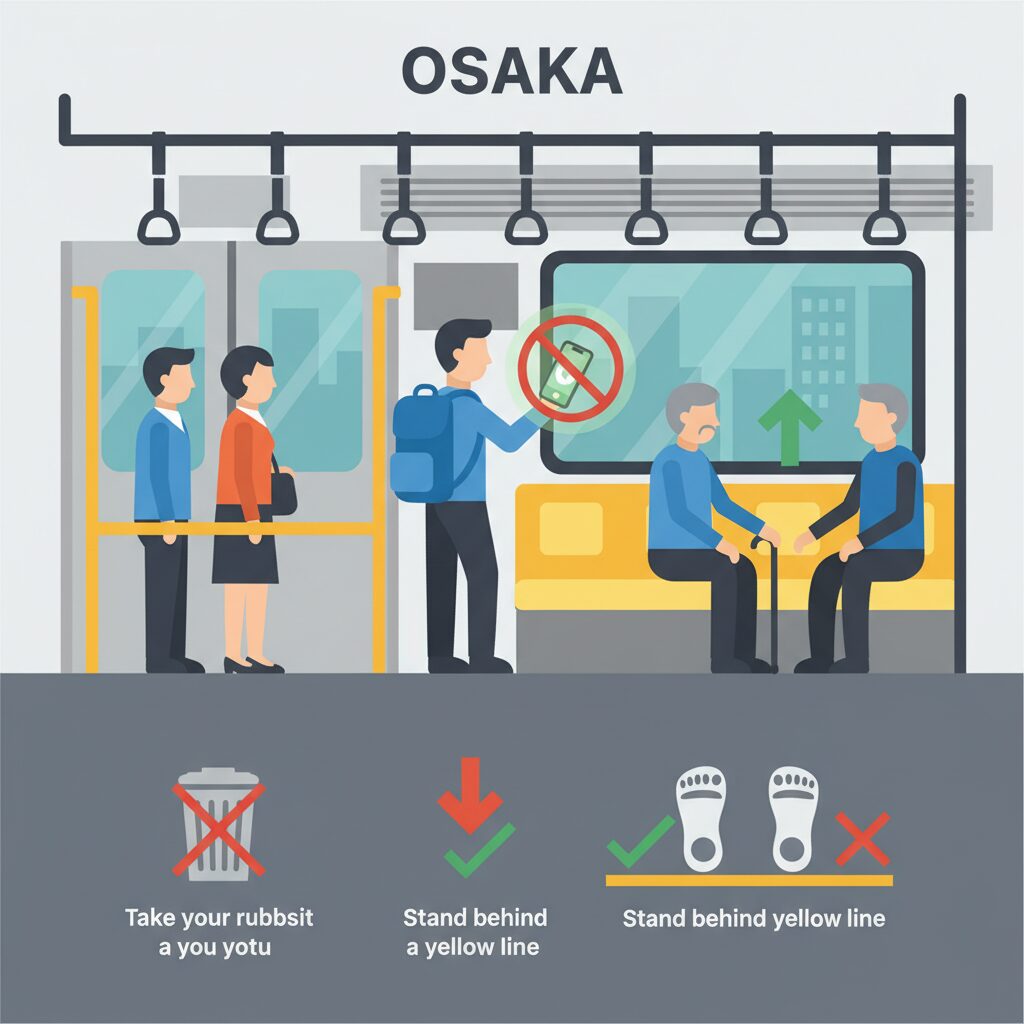
The first time you ride the Midosuji Line during the morning rush, you don’t just see Osaka, you feel it. It’s a full-body experience, a wave of humanity that washes over you with the force of a Dotombori canal current. My first few weeks here, fresh from the UK and armed with a guidebook understanding of Japanese etiquette, were a series of minor shocks. I had been pre-programmed for the serene, almost monastic silence of Tokyo’s train cars, a world where the loudest sound is the rustle of a newspaper or the gentle digital chime announcing the next station. I was ready for a world of perfect queues, of unspoken agreements to minimize one’s presence, to fold into the collective and disappear. That is not what I found. Instead, I found a city in motion, a place where the daily commute is less a silent meditation and more a boisterous, unscripted play. It’s a space where the air hums not just with the rattle of the train, but with the low murmur of conversation, the occasional, unapologetic ring of a phone, and the throaty laughter of students recounting last night’s adventures. This daily journey through the city’s veins is the single best lesson in understanding what makes Osaka tick. It’s where you see the city’s soul laid bare, a beautiful, chaotic, and profoundly human spectacle that stands in stark contrast to the polished reserve of Tokyo and the elegant decorum of Kyoto. To understand life here, you have to understand the journey.
The lively rhythm of Osaka not only finds expression in its bustling commutes but also in the practical nuances of everyday living, evidenced by how koshinryo renewal fees subtly influence the local rental market.
The Sonic Landscape: A Symphony of Controlled Chaos
Your ears are the first to detect the difference. The soundscape of a public space reveals everything you need to know about the local culture’s unspoken rules of interaction, and on Osaka’s public transit, the volume is simply cranked up a few degrees compared to its more reserved neighbors.
The Tokyo Silence vs. The Osaka Hum
In Tokyo, riding the train is an exercise in collective self-discipline. The famed Yamanote Line, even when packed to capacity, can feel like a library on wheels. Conversations are rare, and when they do happen, they are spoken in hushed, almost conspiratorial whispers. Making or receiving a phone call is a cardinal sin, an act so disruptive it draws silent, laser-sharp glares from fellow passengers. The shared goal is to preserve communal peace, the wa (和), by erasing your personal sonic footprint. It’s a social contract everyone agrees to the moment they tap their transit card.
Step onto a train at Umeda Station in Osaka, and that contract feels like it has been casually rewritten. The silence is replaced by a low, steady hum of human activity. Friends chat about their day, their voices at a normal conversational level. A grandmother might be cooing at a baby across the aisle. You’ll hear the unmistakable tinny sound of a video game being played, though usually with the volume kept reasonably low. The most striking difference for newcomers is the attitude toward phone calls. While long, loud conversations are still frowned upon, a quick, necessary call is often tolerated. You’ll see people cup a hand over their mouth, turn toward the corner of the train car, and speak in rapid, low-volume Kansai-ben: “Moshi moshi, ima densha non nen, ato de kakeru wa!” (“Hello, I’m on the train now, I’ll call you later!”).
This isn’t due to a lack of consideration. It’s a different interpretation of what counts as a public nuisance, or meiwaku (迷惑). In Tokyo, the mere possibility of disturbance justifies absolute silence. In Osaka, the philosophy is more practical. Are you actively and significantly bothering the people immediately around you? No? Then you’re probably fine. It’s a shift from prioritizing collective, preemptive harmony to a more results-oriented, individual-focused pragmatism.
Station Announcements and the Rhythm of the Rails
The auditory differences extend beyond the passengers. The automated announcements in Tokyo are sharp, formal, and unfailingly polite, delivered in a standardized, almost robotic rhythm. The human conductors mirror this formality, their voices steady and professional.
In Osaka, there’s a bit more personality. While the automated announcements are standard, conductors on lines like the Hankyu or Hanshin railways often let their character show through. Their announcements can feel more like a friendly guide than an impersonal voice. You’ll notice a slight musicality in their intonation, a cadence that reflects the local dialect. They might add a bit of extra flair, a friendly reminder to watch your step or a slightly more emphatic warning that the doors are closing. It feels less corporate, more human. It’s a small detail, but it adds to the overall sense that you’re in a city that values direct, personal communication over rigid, impersonal formality. The train isn’t just a machine; it’s a service run by real people, and you can hear it in their voices.
The Battle for Personal Space: Navigating the Platforms and Carriages
If the sound of the commute represents Osaka’s voice, then the way people move through its physical spaces is its body language. And like its voice, these movements are more direct, assertive, and follow a logic that can seem baffling to those used to the customs of Tokyo or Kyoto.
Escalator Etiquette: The Great Divide
This is probably the most well-known and visible sign that you’ve left Tokyo behind. Across much of Japan, including the capital, the golden rule is clear: stand on the left, walk on the right. It’s an automatic behavior ingrained in daily life. Fail to follow it, and you’ll cause a bottleneck and earn a few disapproving glances. In Osaka, this rule is completely reversed: stand on the right, walk on the left. This isn’t just a local quirk; it symbolizes Osaka’s unique regional identity and its historical rivalry with Tokyo. Newcomers and tourists frequently get it wrong, causing a brief moment of confusion as a rush of busy office workers weave around them.
Though the exact historical roots are debated—ranging from Osaka adopting London’s system to the influence of samurai culture standing right during the Edo period—its modern meaning is clear. Following the “stand on the right” rule is a daily affirmation of Osakan identity. It quietly declares, “we do things our way here.” For locals, adapting to this switch becomes second nature, an essential form of code-switching when moving between Kansai and Kanto.
Queuing Culture: Organized Lines vs. The Fluid Scrum
Queueing for trains in Tokyo is almost an art. Platforms have painted lines showing exactly where car doors will open, and commuters form two perfectly straight, parallel lines. People observe this order flawlessly, with no jockeying for position.
In Osaka, however, lines feel more like a suggestion. While platform markings exist and people generally gather in the right spots, the neat queues often break down into a more fluid, V-shaped cluster—a kind of polite scrum. It’s not cutting, but a subtle, strategic shuffle for prime positioning. Commuters angle their bodies and shift their weight thoughtfully, anticipating the exact door spot that will offer the quickest access to a seat. It’s a contest of inches and intuition.
Here, you might witness the legendary skills of the Osaka obachan (middle-aged women). With seemingly effortless ease, she navigates the crowd, spotting openings and sliding through to snag a seat before younger, less experienced riders even realize the doors have opened. This isn’t impoliteness; it’s expertise. It embodies a pragmatic mindset that prizes efficiency and results. Why stand rigidly in line when a more flexible formation gets everyone on the train just as effectively while rewarding the savvy? To outsiders, it may seem chaotic, but it follows its own internal logic.
The Art of the “Squeeze”: Getting On and Off
Rush hour is intense in any major city, but the way the crowd is managed differs. Tokyo is famous for its oshiya, white-gloved station attendants who physically push passengers into packed train cars to ensure doors can close. It’s a formal, organized response to an extreme challenge. The squeeze is intense but orderly and impersonal.
Osaka’s squeeze is much more organic and self-regulated. There are no official pushers. Instead, passengers collectively adjust—shuffling and turning to create space that seems nonexistent. It’s a communal effort often accompanied by grunts, sighs, and occasional murmurs of “chotto gomen ya de” (“excuse me a bit”).
Exiting a crowded train is the true test. In Tokyo, a passenger wanting to get off might quietly say “sumimasen” (“excuse me”), and a path will silently open. In Osaka, the approach is more forthright. You’re more likely to hear a loud “Orimasu!” (“Getting off!”) or “Sumasen, orimasu!” called out to the whole carriage. This isn’t a polite request; it’s a clear announcement of intent. If the verbal cue isn’t enough, it might be followed by a gentle-but-firm nudge from a shoulder or bag, signaling, “I am coming through.” Visitors often mistake this for aggression, but it’s not. It’s simply the most efficient way to communicate a need in a crowded, noisy space. It’s practical, direct, and effective.
Social Interactions: The Unwritten Codes of Conduct
The most significant differences lie in how people choose to interact—or not interact—with one another. The train car functions as a public-private space, with each city having its own set of behavioral norms.
Talking to Strangers: A Possibility in Osaka
In Tokyo, initiating conversation with a stranger on the train is a major social faux pas. It disrupts the personal bubble of privacy that everyone strives to maintain. People go to great lengths to avoid eye contact, focusing on their phones, books, or gazing into the distance. Speaking to someone without a clear reason invites suspicion and discomfort.
In Osaka, while it’s not a daily occurrence, the barrier between strangers is noticeably more porous. People are more inclined to make eye contact and share a smile. An elderly woman might comment on the book you’re reading or offer you a piece of candy. I once encountered a man who, noticing my puzzled look as I studied the route map, launched into a detailed, ten-minute explanation of the best transfer point, complete with hand-drawn diagrams on his newspaper. This spontaneous, unsolicited helpfulness is a hallmark of the Osakan spirit, rooted in a culture that is famously more outgoing, curious, and less bound by strict social formalities. The prevailing attitude seems to be, “We’re all in this together, so why not strike up a conversation?”
The Kyoto Contrast: Public Face vs. Private Thoughts
A short train ride away, Kyoto presents yet another unique commuting culture. The etiquette on a Kyoto city bus or the Karasuma subway line differs from both Tokyo and Osaka. It is a display of public grace. Passengers remain quiet, but it’s not the tense, impersonal silence found in Tokyo. Instead, it’s a calm, composed quietness. People are impeccably dressed and maintain perfect posture. The experience feels less like a commute and more like a procession.
The distinction lies in the tatemae (public face). In Kyoto, a city steeped in centuries of refined aesthetics and intricate social codes, preserving a polished and elegant public persona is essential. A Kyotoite would likely never engage a stranger in a loud conversation but would also avoid using a firm shoulder to exit a train. They might silently judge the size of your backpack or your choice of footwear, but their expression will show nothing beyond polite indifference. An Osakan, by contrast, might exclaim, “Wow, that’s a huge bag! Where are you traveling from?” The Osakan approach values honest, direct expression (honne) over a carefully maintained public image (tatemae), a trait that can feel either refreshing or unsettling depending on what you’re accustomed to.
Priority Seating: A Universal Rule with Local Flavor
Throughout Japan, yielding priority seats to those in need is a sacred custom. However, the manner of carrying this out varies. In Tokyo, it’s often done with quiet, nearly invisible subtlety. Someone will notice a person in need, stand without making eye contact, and move to another part of the train, leaving the seat free for them. It’s a responsibility fulfilled with minimal interaction.
In Osaka, however, this kindness is often expressed with flair. An older man might spot a pregnant woman and loudly declare, “Anata, koko suwari!” (“You, sit here!”). It’s not a suggestion, but a friendly command. The exchange is direct and personal. The recipient is expected to respond with a heartfelt and often equally loud, “Okini!” or “Sumimasen, arigatou gozaimasu!” The interaction forms a complete social transaction—kindness expressed not as a silent, anonymous duty but as an open, human-to-human connection.
Putting It All Together: The Commuter’s Mindset
These seemingly minor behaviors—how you stand, how you speak, how you queue—reflect a deeper cultural mindset. The daily commute is more than just a series of motions; it’s a performance of identity.
Pragmatism Over Polish
The essential difference can be summarized like this: Tokyo’s commute emphasizes polished, seamless, collective harmony, while Osaka’s commute focuses on pragmatic, direct, human efficiency. In Tokyo, the system is crafted to operate smoothly by having individuals minimize their presence and impact. It’s elegant, impressive, and distinctly impersonal. In Osaka, the system thrives on the assertive, interactive energy of its people. The objective is to get from A to B effectively, and if that involves some noise, shuffling, and direct conversation, it’s all part of the process. This reflects the legacy of a merchant city, where time is money, clarity trumps ambiguity, and getting things done outweighs keeping perfect form.
What Foreigners Misunderstand
The most common mistake newcomers make is interpreting Osaka’s directness as rudeness. The person talking on the phone isn’t being disrespectful; they’re being efficient. The scramble at the train door isn’t chaos; it’s a self-organizing system based on assertive positioning. The loud “Orimasu!” isn’t an aggressive yell; it’s the clearest way to communicate a vital need. Tokyo’s social rules rely on non-interference and reading the air (kuuki wo yomu), whereas Osaka’s rules rest on direct engagement and clear communication. Trying to apply Tokyo’s silent, subtle norms here will only cause confusion and leave you stranded on the platform.
How to Commute Like an Osakan
To survive and thrive in the Osaka commute, you need a mental shift. First, remember the golden rule: stand on the right. Stay aware of your surroundings and be ready to move with intention. Don’t hesitate when trying to exit a crowded train; a clear voice and confident posture are your best tools. Accept that your personal space will be smaller and more frequently invaded than you might expect. Most importantly, don’t shy away from the human aspect. If someone speaks to you, smile and engage. If you see someone in need, offer help directly. Embrace the controlled chaos. Learn to read the strategic positioning on the platform. View it not as a task, but as a daily puzzle, a game to be mastered.
Riding the rails in Osaka offers a crash course in the city’s character. It’s loud, somewhat messy, incredibly efficient, and filled with raw, unfiltered humanity. It lacks Tokyo’s polish and Kyoto’s serene composure but replaces them with a boisterous charm and a pragmatic spirit all its own. You don’t need a tour guide to grasp this city—just buy a ticket, stand on the right side of the escalator, and prepare for the ride. Here, the journey itself is the destination.








