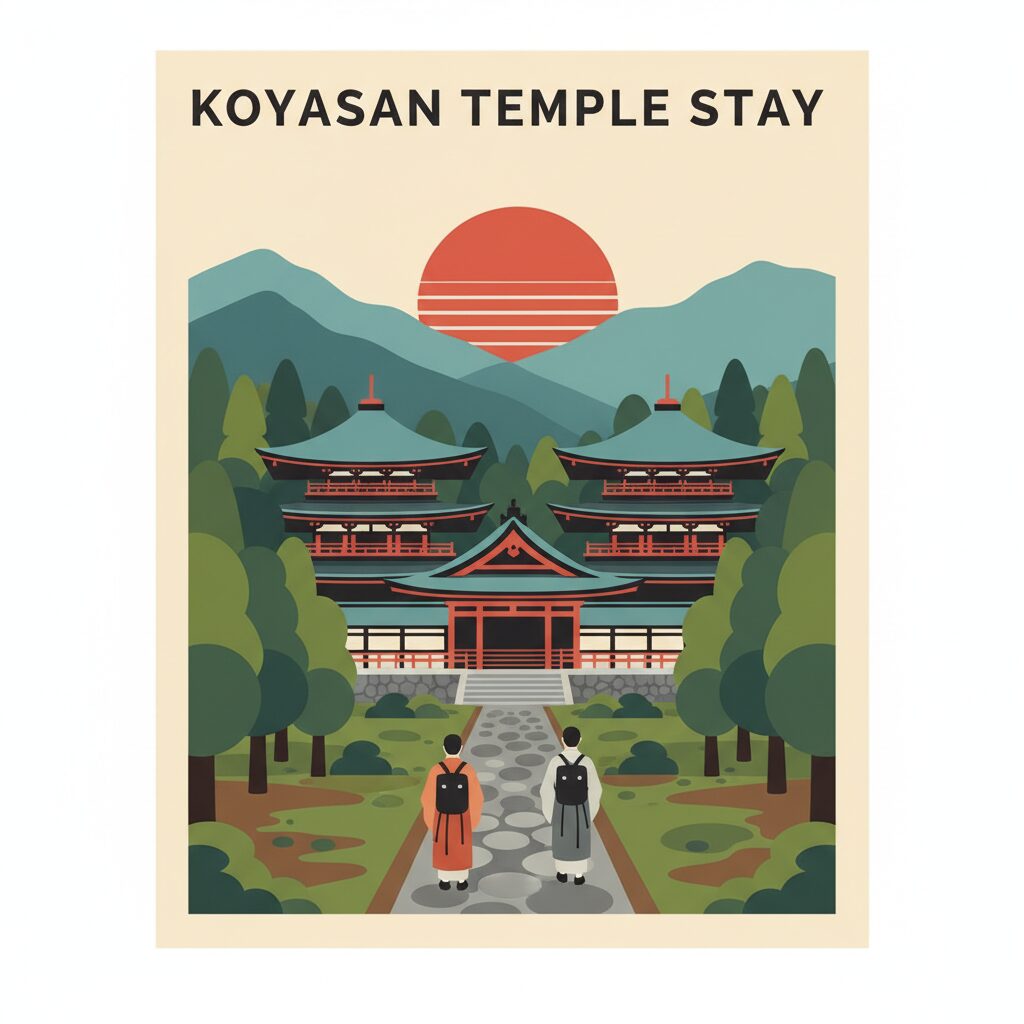
Osaka hums with a relentless, beautiful energy. It’s in the clatter of bicycles on the Shotengai pavement, the sizzle of takoyaki grills in Namba, the roar of the Hanshin Tigers crowd at Koshien. It’s a city that runs on a full-throttle mix of hard work, loud laughter, and exceptional food. But even the most resilient Osakan battery needs a recharge. When the summer humidity feels like a wet blanket and the Midosuji line at rush hour starts to feel less like a commute and more like a contact sport, you’ll hear a collective sigh ripple through the city. It’s the sound of people realizing they need a break. Not a vacation, not a trip, but an escape. And for many of us living in the Kansai basin, that escape has a name: Koyasan.
Mount Koya isn’t just a UNESCO World Heritage site floating in the misty mountains of Wakayama. For people in Osaka, it’s our spiritual back porch. It’s the quiet room in our sprawling, noisy home. A trip there is a rite of passage for anyone living here long enough to feel the city’s rhythm in their bones. But here’s the thing foreigners often misunderstand: we don’t go to Koyasan seeking enlightenment in the way a tourist brochure might suggest. The Osakan approach to a temple stay, or shukubo, is far more grounded, practical, and, frankly, focused on tangible comforts. It’s not about finding your inner Zen; it’s about finding a moment to breathe, to eat incredible food you didn’t have to cook, and to sleep without the sound of sirens. It’s a reset, done the Osaka way. This is how you plan not just a trip, but a genuine power-down that will make you appreciate the glorious chaos of Osaka even more when you return.
Embracing a break in Koyasan offers a refreshing pause from the city’s pace, just as negotiating rent in Osaka can be a savvy step towards balancing your urban lifestyle.
The Osaka Mindset: It’s Not a Pilgrimage, It’s a Power-Down
To grasp how Osaka views Koyasan, you first need to recognize the fundamental difference in mindset between Kansai and Kanto, between Osaka and Tokyo. This distinction is subtle yet profound, shaping everything from how people order coffee to how they seek spiritual refuge. A trip to Koyasan serves as a perfect example.
The Tokyo Approach vs. The Osaka Reality
If you asked a friend from Tokyo about planning a temple stay, the discussion would likely focus on aesthetics, reverence, and the carefully curated experience. They might mention finding a temple with the most historically significant screen paintings or one renowned for its particularly austere and challenging meditation sessions. The aim is often self-improvement through disciplined quietude. The trip becomes a performance of cultural appreciation, a pursuit of the perfect, Instagrammable moment of serenity. It’s all about doing it right.
The Osaka approach, in contrast, is simply different. It’s less about performing spirituality and more about addressing a problem. The problem? Urban burnout. The solution? A quiet room, a comfortable futon, a breathtaking natural setting, and a series of delicious, complex meals that require no shopping, cooking, or cleanup. An Osakan doesn’t go to Koyasan to impress anyone, least of all themselves—they go because they’re exhausted. It’s a pragmatic retreat, not a pilgrimage. Conversations tend to focus less on the temple’s historical significance and more on the quality of the goma-dofu (sesame tofu) and whether the bath was spacious enough.
“Chotto Karada Yasumetai nen”: The Real Motivation
There’s a phrase often heard in Osaka dialect: 「ちょっと体休めたいねん」 (Chotto karada yasumetai nen). It roughly means, “I just really want to rest my body.” It’s not a complaint but a straightforward acknowledgment of the human need to pause. This phrase serves as the unofficial motto for an Osakan trip to Koyasan. It reflects a deep desire to escape the physical and mental burdens of city life—the endless standing on crowded trains, the sensory overload of navigating Umeda Station, the constant pressure to be alert, ready with a quick retort or clever joke. Osaka is vibrant because its people are always switched on, but that switch needs an off position. Koyasan is that off position. It’s where you go to let your shoulders drop from around your ears and remember what silence sounds like. The spiritual benefits are a welcome bonus—a side effect of the core mission: simply, and profoundly, to rest.
Planning Your Stay: The Unspoken Rules of Osaka Practicality
Once the decision to reset is made, the Osakan planning process comes into play. It’s a showcase of pragmatism, guided by a concept at the heart of Osaka’s commerce and culture: kosupa.
Choosing Your Temple: It’s All About the Kosupa
Kosupa is a blend of “cost performance.” Outsiders often confuse it with cheapness, but this reflects a basic misunderstanding of the Osaka mindset. Kosupa isn’t about spending the least amount possible; it’s about achieving the best value for the money spent. An Osakan will willingly pay more if they believe the quality, experience, and satisfaction outweigh the cost. A temple stay is evaluated by this same strict, yet fair, standard.
So, what defines good kosupa for a Koyasan shukubo?
- Excellent Shojin Ryori: This is the top priority. Shojin ryori, the traditional vegetarian Buddhist cuisine, is not merely a meal; it’s the main attraction. A quality temple offers a multi-course dinner and breakfast that are artful, intricate, and deeply satisfying. An Osakan will carefully examine reviews for comments on the food. Was it innovative? Was it filling? Was the goma-dofu creamy and rich? A temple might have the most stunning garden in Japan, but if the food is mediocre, it’s poor kosupa. End of story.
- Comfortable and Clean Facilities: Practicality rules. Rooms should be clean, futons thick and comfortable, and shared bathrooms well-kept. While no one expects luxury, a baseline of comfort is essential. A private toilet is a significant bonus. A warm ofuro (communal bath) to relax in after a day of walking is crucial. These aren’t indulgences; they are vital for resting the body.
- Good Location and Atmosphere: Ideally, the temple is within walking distance of key spots like Okunoin cemetery and the Garan temple complex. Though Koyasan is quiet compared to Osaka, some temples are notably more peaceful. The aim is to reduce logistical hassle after arrival.
The Booking Process: No Fuss, Just Facts
There’s an official Koyasan Shukubo Temple Lodging Association website, where most Osakans begin and end their search. It’s efficient and provides all necessary details. They’ll filter by price, browse photos, and then closely read reviews through a specific filter.
What to Look for in Reviews
An Osakan scanning reviews will mentally discard the fluff. Elaborate descriptions of spiritual experiences are ignored. They seek practical, actionable facts.
- Good keywords: “delicious,” “filling,” “variety,” “beautiful presentation” (about food). “Clean,” “warm futon,” “great bath,” “quiet.” “Friendly monks,” “helpful staff.”
- Bad keywords: “small portions,” “basic meal.” “Thin futons,” “cold room.” “A bit noisy,” “far from the bus stop.”
They weigh these tangible points, compare two or three promising options, and then book one. The choice is made not with the heart, but with the mind. It’s a rational decision for an emotional and physical need.
Getting There: The Nankai Koya Line as an Urban Escape Pod
The journey to Koyasan is just as much a part of the experience as the stay itself. For Osakans, it begins at the chaotic, sprawling Nankai Namba Station, a place that stands in stark contrast to the mountain’s tranquility. Yet, this is where the process of unwinding begins.
A Commute to Another Reality
The Nankai Koya Line train starts off as a typical commuter train. It rattles through the dense urban expanse of south Osaka, passing low-slung houses and small factories. Passengers board and exit, heading to work, school, or errands. But as the train continues southward, the scenery gradually shifts. Buildings give way to fields, fields to hills, and hills to mountains. Train cars empty, leaving only those traveling to the final destination. You can feel the city’s hold loosening with each kilometer. The rhythmic clatter of wheels on the track becomes a calming mantra. It’s a familiar, accessible trip — it doesn’t feel like a grand adventure; it feels like you’re simply riding to the quietest, greenest suburb of Osaka.
The Cable Car: No Need for Awkward Silence
The final climb up the mountain is via a steep, almost vertical cable car. This is where you might expect a respectful hush to fall over the passengers. And sometimes it does. But if you’re sharing the car with a group of Osakan friends or a family, you’re more likely to hear exclamations, laughter, and chatter. “Whoa, look how steep that is!” “Can you see our house from here? No, of course not, you idiot!” “I can’t wait for dinner.” This isn’t disrespect; it’s a form of shared delight. The experience isn’t an internal, solitary one. It’s meant to be shared and discussed. Silence can wait. For now, the journey itself offers communal enjoyment. There’s no expectation to adopt a certain contemplative mood. You’re simply people on a very steep tram, and it’s pretty cool.
The Temple Stay Itself: What to Actually Expect, Osakan Style
Arriving at your chosen temple, checking in, and being escorted to your simple tatami room marks the true beginning of unwinding. You exchange the city’s noise for the aroma of aged wood and incense. Yet, even within the temple’s confines, the Osaka mindset influences the experience.
The Morning Ceremony: Participation Over Piety
Most temple stays offer the chance to attend the monks’ morning prayers, usually held early, around 6:00 AM. For many, this is the spiritual core of the visit. An Osakan attending the ceremony does so with genuine respect and curiosity. They sit properly, listen to the chanting, and follow the incense offering rituals. However, it’s key to grasp the internal perspective. They are not necessarily praying for personal salvation or seeking a profound mystical moment. Instead, they view it as an interesting, beautiful, and unique part of the experience they’ve paid for. It’s an event. Interwoven with their appreciation of the rhythmic chanting and flickering candlelight is the quiet, pleasant anticipation of the delicious vegetarian breakfast they know will come right after. The ceremony is beautiful, yes—but it also signals the upcoming fantastic meal. Both are equally valid and important elements of the experience.
Mastering Shojin Ryori: A Culinary Conversation
When meals are served, whether in your room or a communal dining hall, the true Osakan appreciation comes alive. Shojin ryori is a refined art, a subtle harmony of flavors and textures crafted solely from vegetables, tofu, and grains. The response isn’t quiet, passive eating. It’s active, engaged, and often conversational.
You’ll hear murmured exchanges between couples and friends: “This sesame tofu is something else—so creamy.” “What do you think this is? Konyaku? The texture is incredible.” “I wonder how they achieve such a rich broth without fish.” It’s just like discussing a new ramen spot or a perfectly grilled cut of meat. It’s a heartfelt appreciation for craftsmanship and flavor. They’re not simply eating; they’re tasting, analyzing, and savoring with full attention. For a culture so deeply connected to food, a meal this good is a spiritual experience in itself.
Dealing with the Monks: Be a Person, Not a Pilgrim
Foreign visitors sometimes approach Buddhist monks with an almost fearful reverence, as if they were untouchable celestial beings. Osakans don’t do this. While respectful, they see monks as people—hosts, guides, chefs. An Osakan won’t hesitate to ask direct, practical questions like, “Excuse me, what time does the bath close?” or “This was delicious, thank you. Is the rice grown locally?” They interact on a human level. This willingness to strip away unnecessary formality and connect directly with others, regardless of status, is a hallmark of Osaka culture. It’s not rude—it’s genuine. And more often than not, it’s met with a warm and equally human response.
Beyond the Temple Walls: Wandering Okunoin with an Osaka Sensibility
No visit to Koyasan is complete without a lengthy stroll through Okunoin, the expansive, ancient cemetery hidden among towering cedar trees. It stands as one of the most sacred and atmospheric sites in all of Japan, serving as the final resting place for historical figures, feudal lords, and ordinary people alike.
A Walk in the Woods, Not Just a Journey Through History
A tourist might explore Okunoin with a guidebook in hand, trying to spot every famous tombstone, weighed down by the historical significance of the place. An Osakan’s walk, however, is different. They acknowledge the history, naturally. They are struck by the scale and age of the moss-covered stones. Yet the walk is simply that: a lovely walk in the woods. It offers a chance to chat with your partner, let the kids run a little ahead, and breathe in the fresh, clean air. Conversation may wander from the samurai buried nearby to what’s for lunch or a funny story from work last week. The sacred atmosphere forms the backdrop of life, not a reason to pause it. The experience feels lighter, more intimate. The aim is not to absorb every historical detail, but to feel peaceful and connected to the person you’re with.
“Kirei ya na”: Simple, Sincere Appreciation
While walking, you’ll likely hear a common Osaka phrase, whispered or spoken in a normal tone: 「綺麗やな」 (Kirei ya na). “It’s beautiful, isn’t it.” It’s a straightforward, unembellished remark. There’s no flowery language or attempt at profundity. It’s a direct, genuine, heartfelt response to the beauty of the moment—the way light filters through the cedar branches and the vivid green of the moss. This is how Osakans express awe: grounded, sincere, and shared. They see beauty, name it, and appreciate it without affectation. It’s a moment of shared wonder in a place meant for it.
The Return Trip: Bringing the Mountain Calm Back to the City Chaos
All too soon, the weekend draws to an end. After enjoying a final, delicious breakfast, it’s time to take the cable car down the mountain and board the Nankai line back to the city. Traveling back this way offers its own kind of meditation.
Re-entry at Namba Station
Stepping off the train at Nankai Namba Station is a sensory shock. The mountain’s quiet is immediately replaced by the noise of train announcements, the shuffle of thousands of feet, the aroma of food from station restaurants, and the bright lights. It can feel overwhelming. Yet, after two days of profound silence, it can also be oddly comforting. This is home. This is the lively, chaotic, wonderful mess you needed a break from. The contrast means everything. The peace of Koyasan makes you appreciate Osaka’s energy, and Osaka’s energy makes you value Koyasan’s peace. You need both to feel complete.
What You Really Gained: A Reset, Not a Revelation
You don’t return from Koyasan as a changed person. You don’t come back with all the answers to life’s great mysteries. That was never the intention. You come back as yourself, but a version who is rested, well-fed, and fully recharged. You’ve traded two days of city stress for fresh air, amazing food, and a quiet night’s sleep. From a practical Osakan perspective, that’s a fantastic exchange. It’s the ultimate kosupa. You’ve invested a bit of time and money and received a huge return in well-being. And as you plunge back into the vibrant, energetic flow of Osaka life, you’re ready. You’re refreshed. And you know that whenever the city becomes overwhelming, your quiet mountain retreat is just a train ride away.