
It hits you first as a wave of warmth and noise spilling out onto the cold street. Peer through the steamed-up glass or the fluttering noren curtain, and you see a world packed shoulder-to-shoulder, a chaotic ballet of elbows, glasses, and rising steam from simmering pots. This is the tachinomi, Osaka’s iconic standing bar. For a newcomer, the scene can be intimidating. There are no clear seats, no host to greet you, just a wall of regulars who seem to operate on a set of rules you can’t possibly know. It feels like a private club, and you’re definitely not a member. The question that hangs in the air, thick as the smell of fried skewers, is: How do you get in? Not just through the door, but into the rhythm, the culture, the very soul of this essential Osakan institution? This isn’t just about finding a cheap drink; it’s about decoding a core piece of the city’s identity. In Tokyo, you might find sleek, modern standing bars, but in Osaka, the tachinomi is something else entirely—a raw, unfiltered expression of daily life, a social ecosystem that reveals more about the local mindset than any museum or guidebook ever could. Forget what you think you know about Japanese formality. This is different. This is Osaka.
For a deeper look into how locals navigate a night of endless bar hopping, explore Osaka’s nikenme culture to further decode the vibrant world beyond the tachinomi.
What is a Tachinomi, Really? More Than Just a Standing Bar
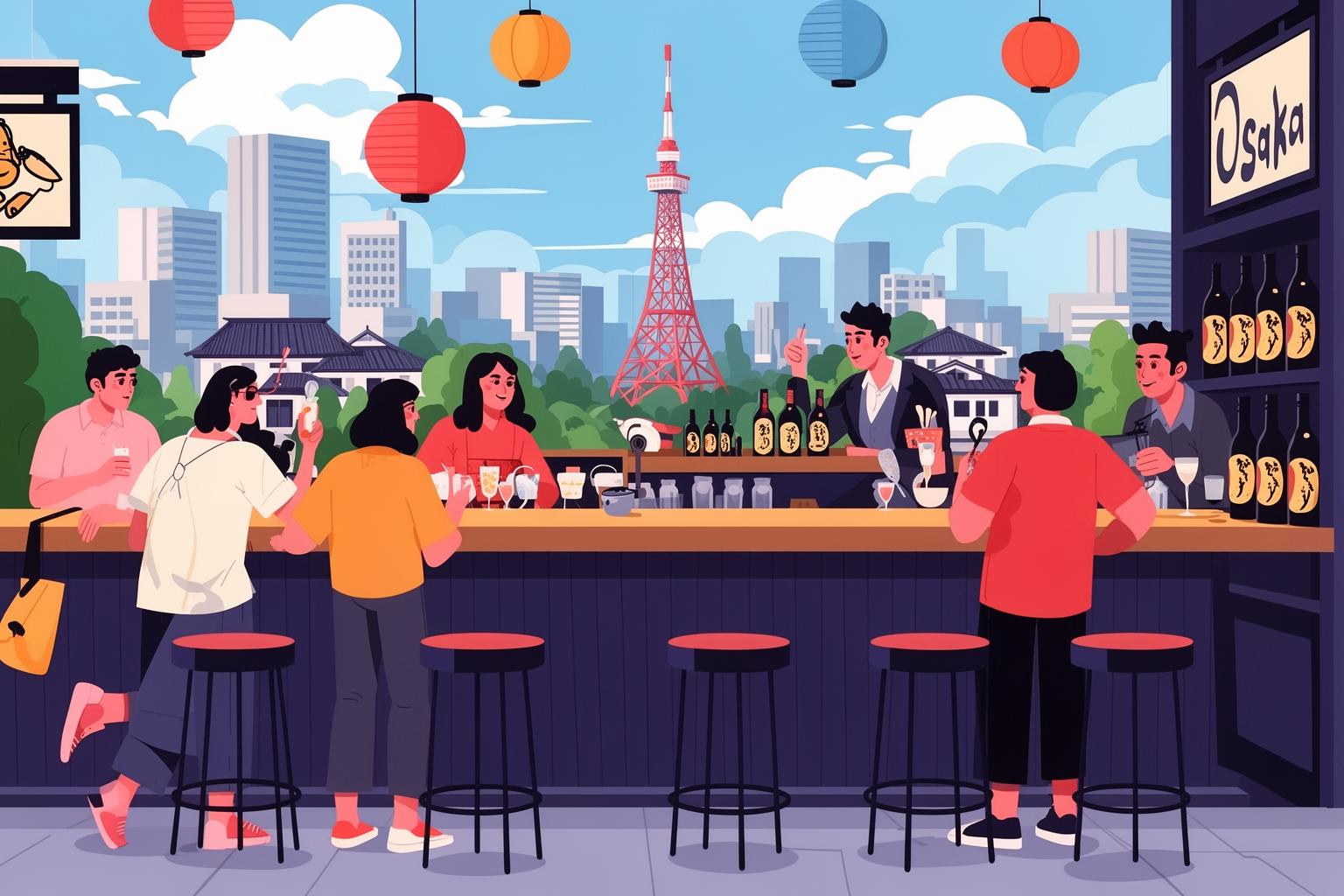
On the surface, the definition seems straightforward: ‘tachi’ means to stand, and ‘nomi’ means to drink. A standing bar. But that’s like describing a smartphone merely as a device for making calls. It misses the essence entirely. The tachinomi is a complex, efficient, and culturally rich institution. It is a finely tuned mechanism designed with a particular purpose: facilitating a quick, affordable, and satisfying shift from the rigid world of work to the private refuge of home.
The Philosophy of “Quick, Cheap, and Good”
To truly grasp the tachinomi, you must first understand the concept of kosupa, or cost performance. It’s a term heard everywhere in Osaka and a cornerstone of the local consumer mindset. Osakans, descendants of a long tradition as Japan’s merchant capital, are famously discerning about value. They don’t simply want things to be cheap; they require that what they get be good for the price. Wasting money on mediocre food or drink is seen as a cardinal sin. The tachinomi represents the ultimate expression of high kosupa.
By doing away with chairs, the owner saves a considerable amount of space. This allows more customers to fit into a compact area, keeping overhead costs low. The rapid turnover—most patrons stay under an hour—ensures a steady stream of revenue from that limited space. These savings are directly passed on to customers through remarkably low prices for beer, sake, and food. A draft beer might cost half as much as it would at a regular seated izakaya. A skewer of grilled chicken or a plate of pickled vegetables might cost little more than a hundred yen. This isn’t a gimmick but a business model grounded in the principles that have guided Osaka commerce for centuries: efficiency, volume, and unbeatable value.
This focus on value gives rise to the well-known concept of senbero—a blend of sen-en (1,000 yen) and berobero (to get drunk). The challenge, and the fun, is to see if you can enjoy a few drinks and some snacks for just a single 1,000 yen coin. It’s a game many locals enjoy and a testament to the incredible affordability made possible by the tachinomi model.
The Third Space: Not Work, Not Home
Beyond economics, the tachinomi holds a vital psychological role in the daily lives of many Osakans. It is the quintessential “third space,” a neutral ground neither the structured office environment nor the private home. For the many salarymen and women pouring out of office buildings every evening, it acts as a decompression chamber.
After a long day filled with hierarchical interactions, strict social protocols, and intense pressure, the tachinomi provides an escape. For 30 to 60 minutes, you can shed your professional identity. You can stand quietly with a drink and simply be. There is no pressure to perform, no obligation to make small talk if you’d rather not. It serves as a moment of punctuation in a long sentence. It’s a place to wash away the day’s frustrations with a cold beer and a hot skewer before starting the often-lengthy commute home. It’s less demanding than a full dinner with colleagues and more social than drinking alone at home. This brief, restorative ritual is woven into the city’s working life, a small act of self-care repeated thousands of times each night across Osaka.
Tachinomi vs. Tokyo Izakaya: A Tale of Two Cities
Nowhere is the cultural divide between Osaka and Tokyo more evident than in their distinct drinking cultures. While Tokyo has its share of standing bars, the typical after-work gathering place is usually a large, chain izakaya. The experience is fundamentally different, revealing the contrasting priorities of each city.
Formality and Spontaneity
A typical night out in Tokyo often requires a reservation made days in advance. You arrive with your group at the designated time, are guided to your private or semi-private table, and are often served an otoshi—a small compulsory appetizer that also serves as a seating charge. The evening follows a certain structure and predictable flow. It’s organized and efficient, in a characteristically Tokyo fashion.
Osaka’s tachinomi culture is the complete opposite. It thrives on spontaneity. You don’t reserve a spot at a tachinomi. The idea is almost laughable. You simply show up. If there’s room, you squeeze in. If not, you wait a few minutes or head to the next one, often just steps away. It’s a fluid, walk-in culture matching the city’s more impromptu social style. You might drop in alone on your way to the station or bump into a friend and decide to share a quick drink. This absence of planning and formality is central to its charm. It offers a break from the scheduled rigidity of modern life.
The Vibe: Grit Over Polish
Many of Tokyo’s drinking spots are polished and sleek. They are designed, branded, and often part of larger corporate chains. They’re clean, comfortable, and predictable. An Osaka tachinomi is frequently none of these things, which is exactly its appeal. The best ones embrace glorious imperfection.
Walls might be stained with decades of smoke and grease. Menus are often handwritten on yellowed paper strips, with prices crossed out and rewritten over time. The counter is worn smooth by the elbows of countless patrons. There’s no background music, only the sizzle of the grill, the gruff calls of the taisho (master), the clatter of plates, and the murmur of conversation. You’re not just a customer in a curated space; you’re a temporary part of a living, breathing organism. This gritty, unpretentious atmosphere reflects Osaka’s character directly. It’s a city that values substance over style, personality over pristine perfection. The tachinomi feels authentic, lived-in, and unapologetically itself—just like Osaka.
The Unwritten Rules: How to Navigate a Tachinomi Like a Local

For a foreigner, the biggest hurdle isn’t the language but the dense web of unspoken rules. Mastering these is the key to fully enjoying the experience. The good news is that these rules are simple, grounded in common sense and the necessity to coexist in a confined space.
Entering and Finding Your Spot
This is your first challenge. Don’t simply walk in and settle at the counter. The entrance is a moment of subtle negotiation. Pause at the doorway and glance inside. Try to make eye contact with the person behind the counter, the taisho. A simple nod and a questioning look usually suffice. They will either wave you in and point to an open spot or raise a finger to signal you should wait. If it’s packed, waiting outside politely for a few minutes is best. Things move quickly, and a space will likely become available soon.
Once inside, space is your most valuable asset. Be compact. If you have a large bag or a winter coat, immediately hang it on the hooks under the counter. Keep your belongings within your designated space. The key principle is not to inconvenience those around you. You are sharing a very small, intimate area temporarily, so spatial awareness is crucial. Take up as little room as possible.
The Art of Ordering
The pace of ordering matters. The very first thing you order, without exception, is a drink. Don’t stand around pondering the food menu. The social norm dictates you claim your spot with a drink order. The classic choice is to catch the staff’s eye and say, “Toriaezu, nama” (“For now, a draft beer”). A highball (haiboru) is also a great option. Once your drink arrives, you have officially checked in.
Then, you can focus on the food. The menus are almost always posted on the walls. If your Japanese reading skills aren’t up to par, don’t worry. This is your chance to observe. Look at what others nearby are eating. If something catches your eye, simply point and say, “Are, kudasai” (“That one, please”).
Order in small increments. A tachinomi isn’t a place for a multi-course meal; it’s a grazing experience. Start with one or two classic items. Doteyaki, a rich, slow-cooked stew of beef sinew and miso, is a quintessential Osaka tachinomi dish. Kushikatsu, deep-fried skewers of meat and vegetables, are another local favorite. Remember the golden rule of kushikatsu if you encounter a communal pot of sauce: NO DOUBLE DIPPING. Dip your skewer only once while it’s clean. Afterward, use the provided cabbage leaves to scoop more sauce if necessary.
Deciphering the Payment System
Paying at a tachinomi can be confusing, as there are generally two methods. Understanding them is essential for a smooth departure. The most common, especially in older places, is kyasshu on, or cash on delivery. You’ll notice a small tray or bowl on the counter in front of you. Place a few thousand-yen bills in it. Each time you order, the staff will take the exact amount from your tray, leaving any change. It’s a beautifully simple, pay-as-you-go system.
The second method is a tab. The staff keep a running total of your orders, sometimes by marking the counter with chalk or simply remembering. When you’re ready to leave, signal the staff and say, “Okaikei, onegaishimasu” (“The bill, please”). They will add everything up, and you pay at once. Regardless of the system, one thing is almost always true: tachinomi are cash-only. Bring yen with you; credit cards are essentially useless here.
Social Etiquette: To Talk or Not to Talk?
This is likely the most subtle aspect of the tachinomi experience. The stereotype of the loud, friendly Osakan might make you think that every standing bar is filled with lively conversations among strangers. This is a misconception. While the possibility of connection is very real, it isn’t guaranteed, nor is it the main reason everyone is there.
Reading the Room
Your most crucial skill in a tachinomi is the ability to read the room. Notice social signals. Is the elderly man beside you gazing deeply into his cup of sake? He’s there for a quiet moment of reflection. Leave him alone. Is a group of coworkers laughing boisterously among themselves? They’re within their own social bubble. Don’t try to intrude. Is the taisho busy rushing orders to a dozen customers? Now isn’t the moment for a lengthy chat about his life story.
The tachinomi consists of individual experiences occurring side by side. Some people come to socialize, but many simply seek solitude in shared company. They find a peculiar comfort in the anonymous buzz of the crowd. Respecting this is what sets apart a savvy patron. Don’t assume everyone wants to be your new best friend.
Breaking the Ice
That said, magical moments of connection do occur. They just need to be earned and approached with care. The easiest and most universally accepted way to start a conversation is by talking about the food. Leaning over to your neighbor and saying, “Sumimasen, sore wa nan desu ka? Oishisouですね” (“Excuse me, what is that? It looks delicious”) is a perfect, unobtrusive opener. People are usually happy to discuss the food and might recommend their favorite dish. Complimenting the food to the taisho is another excellent move. A simple “Kore, meccha oishii!” (“This is super delicious!”) can open the door to a brief, friendly exchange.
If a conversation begins, keep it light and short. This isn’t the place for life stories. It’s about sharing a small, pleasant moment. You might pick up a local tip, share a laugh, and then, ten minutes later, your new acquaintance will finish their drink, say their goodbyes, and disappear into the night. It’s a fleeting form of community, a perfect example of the Japanese concept of ichigo ichie—one time, one meeting. You cherish the moment precisely because it will never happen again.
Finding Your Tachinomi: A Neighborhood Guide for Residents

Once you’re ready to explore, you’ll discover that each neighborhood offers a unique tachinomi experience. Visiting them is an excellent way to grasp the diverse character of Osaka.
Kyobashi: The Salaryman’s Paradise
For a classic, old-school tachinomi experience, make your way to Kyobashi. The covered arcades and narrow streets around the station serve as a time capsule, filled with Showa-era establishments that have offered the same menu for generations. This area is the core hangout for after-work salarymen. The atmosphere is gritty, straightforward, and genuinely authentic. While it might feel intimidating, it’s also where you can enjoy some of the best doteyaki and the cheapest beer in the city. It’s a deep dive into Osaka’s drinking culture.
Tenma: The Foodie’s Choice
Located just north of the city center, Tenma presents a more modern and varied tachinomi scene. Centered around Japan’s longest shopping arcade, Tenjinbashisuji, and a bustling food market, the bars here often emphasize high-quality, creative cuisine. You’ll find tachinomi offering fresh sashimi, Italian-inspired small plates, or craft sake. The crowd is generally younger and more diverse compared to Kyobashi, with an atmosphere that often spills into the streets, creating a lively, festival-like vibe. It’s an ideal spot for those as passionate about the food as they are about the drinks.
Umeda and Namba: The Commuter’s Pit Stop
In the bustling transportation hubs of Umeda and Namba, tachinomi play a crucial role as the perfect commuter pit stop. Often hidden in plain sight, they nestle in the maze-like basements of office buildings (such as the famous Ekimae Buildings in Umeda) or tucked away in dim back alleys. These spots prioritize speed and convenience, serving people who want to grab a quick drink and snack before catching their train home. Discovering these hidden gems feels like an urban adventure, offering a rewarding glimpse into the city’s daily rhythm.
Why Tachinomi Matters to Osaka
Ultimately, the tachinomi is far more than just a bar. It represents a microcosm of Osaka itself, embodying the city’s core values: pragmatism, value for money, simplicity, and a distinctive, situational sense of community.
Importantly, it serves as a great social equalizer. In a society with a deeply embedded hierarchy, the tachinomi counter offers a surprisingly level playing field. The CEO of a major company might stand shoulder to shoulder with a construction worker, both paying the same few hundred yen for the same draft beer, both simply two people at a bar. Status is left outside. This reflects Osaka’s merchant heritage, where—unlike in the samurai-focused capital of Edo (Tokyo)—social standing was often defined more by wealth and cleverness than by birth. The tachinomi is a democratic space, welcoming all who respect its rules.
For any foreigner wishing to understand life in this city, learning to navigate the tachinomi is a rite of passage. It’s a skill acquired over time through observation, trial, and a few minor mistakes. But the moment you can enter a crowded bar, confidently order a beer and your preferred snack, and absorb the rhythm of the room, is when you cease to feel like a visitor. It’s the instant you glimpse the true, unvarnished, and wonderfully gritty heart of Osaka. For a brief, remarkable half-hour, you are no longer an outsider looking in—you are part of it.