Step off the train in Osaka, and the first thing you feel isn’t the humidity or the energy from the crowds. It’s the whiz of a bicycle passing an inch from your elbow. A high school student, one hand on the handlebars, the other scrolling through their phone. Then another, a mother with two kids strapped into her mamachari, a basket overflowing with groceries, gliding through a sea of pedestrians like a shark through a school of fish. You’re standing on the sidewalk, which you thought was safe harbor, but you quickly realize you’re in the middle of a freeway. There are no painted lanes, no angry shouts, just a silent, fluid chaos. Welcome to Osaka. Your first lesson in understanding this city isn’t learned in a classroom or a castle; it’s learned on two wheels, navigating the unspoken rules of its bicycle culture. This isn’t just about transportation. It’s a rolling, kinetic expression of the Osaka mindset: pragmatic, efficient, and fiercely independent.
To understand Osaka, you need to understand its streets. Not the grand avenues, but the narrow shotengai arcades and the residential back-alleys where life actually happens. This is the circulatory system of the city, and the bicycle is its lifeblood. Forget what you learned about cycling in Tokyo, with its orderly lines and strict adherence to the painted bike lane. Here, the rules are written in the air, passed down through observation, and enforced by a collective, non-verbal understanding. It’s a system that can look like pure anarchy to an outsider, but to a local, it’s a beautifully complex dance. This guide is your ticket to joining that dance, to moving beyond being a startled pedestrian and becoming part of the city’s relentless, rhythmic flow.
As you continue deciphering Osaka’s unspoken rules of bicycle riding, consider exploring konamon culture to uncover another facet of the city’s uniquely vibrant lifestyle.
The Great Sidewalk Negotiation
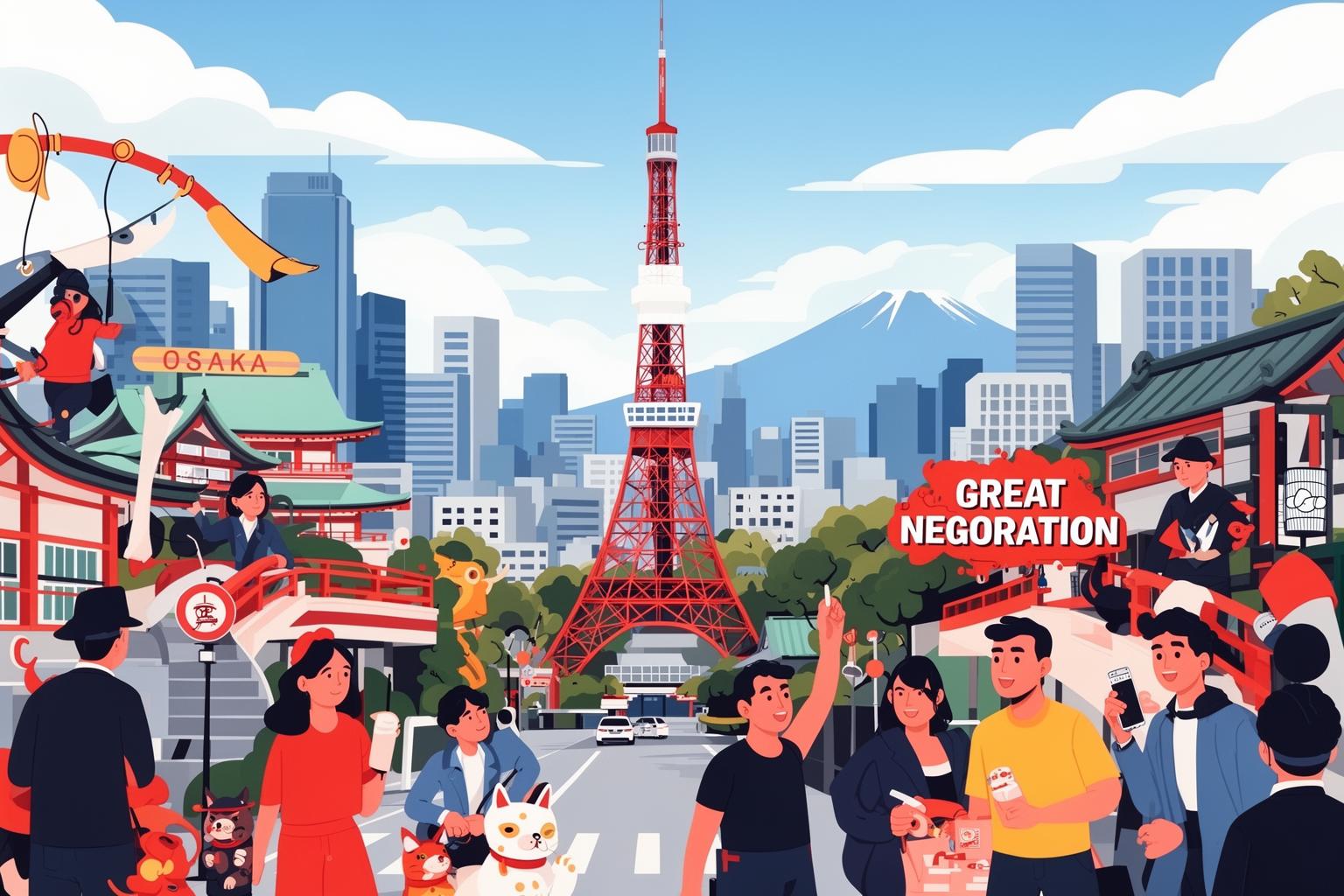
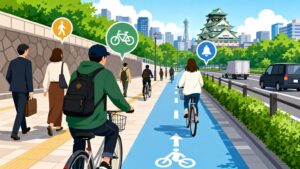
Your initial point of confusion will be the sidewalk. In most countries, and even in many areas of Japan, the sidewalk is intended for walking while the road is designated for vehicles—simple. However, in Osaka, this distinction is intriguingly and alarmingly blurred. The sidewalk serves as a shared space, a multi-use corridor where constant negotiation occurs between cyclists and pedestrians. This isn’t an official regulation but a deeply ingrained social contract born out of necessity. Osaka’s streets are often narrow, and the volume of bicycle traffic is immense. Forcing everyone onto the road alongside cars would be impractical and, honestly, much more dangerous.
Thus, the sidewalk effectively becomes the default cycling lane. But this is not a free-for-all. There is a subtle etiquette in play. The fundamental principle is ‘flow.’ As a cyclist, your role isn’t to stop but to weave. You anticipate the movements of the elderly woman ahead, gauge the trajectory of the salaryman absorbed in his phone, and adjust your speed and path accordingly. It’s a fluid dynamic, a real-time calculation of risk and trajectory. The bicycle bell, which in other cities is often used to announce your presence, is employed sparingly here. A sharp ring can be perceived as aggressive, an impatient demand for others to move aside. It disrupts the flow. Instead, the preferred approach is a silent, graceful pass. If the path is genuinely blocked, a soft, almost apologetic ‘sumimasen’ (excuse me) is the tool of choice. The true master of Osaka cycling requires no bell; their presence is sensed and accommodated without a single sound.
This is where the Osaka mindset truly stands out. It’s not about strict adherence to a written rule (‘bicycles must use the road’). Rather, it’s a pragmatic evaluation of the situation (‘the road is dangerous, the sidewalk is wide enough, let’s make this work’). Everyone implicitly agrees to this bending of the rules because it’s the most efficient way for the greatest number to reach their destinations. It’s a collective understanding that values practical results over procedural correctness. This can be startling for those from rule-based societies, particularly Tokyoites, who often see Osaka’s sidewalk cycling culture as a shocking disregard for the law. But for an Osakan, it’s not disregard; it’s a higher form of social intelligence.
The Mamachari: Queen of the Road
You cannot talk about cycling in Osaka without acknowledging its undisputed queen: the mamachari, or “mommy bike.” These are not sleek, lightweight road bikes or rugged mountain bikes. The mamachari is a tank—a heavy, single-speed, utilitarian machine, always outfitted with a sturdy front basket, a rear rack, and a built-in lock. They serve as the city’s workhorses and are found everywhere. Watching one ridden by a mother with a child in the front seat, another on the back, and a week’s worth of groceries in the basket, all while holding an umbrella during a downpour, is witnessing a level of skill and balance that almost feels like performance art.
The mamachari’s dominance reveals something fundamental about daily life in Osaka. Bicycles here aren’t mainly for leisure or exercise; they are vital tools for living. They’re used for grocery runs, commuting to the local train station, and ferrying kids to daycare. The mamachari is the urban equivalent of a family minivan, built for stability and carrying capacity rather than speed. This emphasis on utility over performance reflects Osaka’s practical spirit. Why invest in an expensive, fancy bike requiring special shoes when a cheap, indestructible mamachari can transport three bags of rice and a toddler through a busy shopping arcade?
This practicality also explains the scarcity of cycling ‘gear.’ You seldom see anyone in Osaka wearing helmets or bright lycra unless they’re serious hobbyists heading out of town. For everyday trips, people ride in their work clothes, school uniforms, or shopping attire. The bicycle is an extension of daily life, not an activity demanding a wardrobe change. This seamless integration fuels such widespread cycling culture. It’s accessible, affordable, and tailored to the reality of urban living rather than an idealized version of it.
Traffic Signals: A Firm Suggestion
Now, we need to address a sensitive yet unavoidable topic: the traffic light. Officially and legally, you must stop at a red light. This is the law throughout Japan. However, in Osaka, you will often notice that a red light is treated more like a strong suggestion, especially by cyclists and pedestrians. This behavior can be the most surprising aspect for newcomers and visitors from more orderly cities like Tokyo.
Before assuming lawlessness, try to grasp the local reasoning. An Osaka cyclist approaching a red light at an empty intersection isn’t thinking, ‘The law says I must stop.’ Instead, they are asking, ‘Is there any real danger? Are there cars coming? Are pedestrians crossing? No? Then stopping seems unnecessary.’ Their decision is based on a risk assessment rooted in the immediate situation, not on a rigid rule. If the intersection is clear, they often slow down, scan carefully with sharp attention, and then proceed cautiously. They aren’t recklessly running the light; they’re making a deliberate choice that values efficiency and momentum. From the local perspective, stopping at an empty intersection is a waste of time and energy.
This highlights a key difference with Tokyo. In Tokyo, rules are absolute. You stop at a red light even at 3 a.m. on a deserted street simply because the light is red, as defying it would disrupt social order. In Osaka, the social order is upheld by avoiding causing ‘meiwaku’ (a nuisance or trouble) to others. If actions—like crossing during a clear red light—cause no meiwaku, the social contract is still seen as honored. This is not a recommendation to break the law, and foreigners should exercise caution. But understanding this mindset is essential to interpreting the city’s behavior: it’s a culture that values individual judgment and situational awareness over strict obedience. It emphasizes the spirit of the law (avoiding accidents) rather than the letter of the law (stopping strictly for red).
The Art of the Crosswalk Weave
A related phenomenon occurs at crosswalks. When the little green man begins flashing, signaling pedestrians shouldn’t start crossing, many Osaka cyclists and walkers make a mad dash to the other side. The flashing green man signals ‘last call,’ not ‘stop.’ Again, it’s about efficiency. ‘Can I cross before the cars move? Yes. Then I’ll go.’ This extends to cyclists turning left or right at busy intersections. They don’t wait for a clear signal but find gaps in pedestrian flow and weave through, blending into the pedestrian crowd for a few seconds before reappearing as vehicles on the other side. It’s a daring maneuver that depends on everyone sharing the same goal: keep moving.
Bicycle Parking: The Urban Game of Tetris
If riding a bike is a smooth dance, parking it is a challenging game of spatial reasoning. Space is incredibly precious in any Japanese city, and Osaka is no exception. Finding a spot to leave your bike, especially near train stations or busy shopping districts, is a daily struggle. Official bicycle parking lots, often underground or in multi-level structures, are generally affordable. However, demand far exceeds supply.
This results in the heaps of bicycles piled in any available public space near major hubs. They are lined up against railings, grouped around trees, and squeezed into unofficial ‘zones’ on sidewalks. Here, an unspoken social contract comes into play. You don’t just leave your bike anywhere; you add it to the cluster as efficiently as possible. You learn to fit your front wheel between two others, turn your handlebars to minimize space, and use the kickstand to keep the bike stable yet compact. It’s like a massive, communal game of Tetris.
There’s a delicate balance to maintain. Park inconsiderately—blocking a store entrance or tactile paving for the visually impaired—and you risk social disapproval or having your bike moved. Park in a strictly forbidden area, and you face the dreaded silver ticket. City workers periodically patrol busy spots, tagging illegally parked bikes with warning notices. If the bike isn’t moved within a few hours or by day’s end, it’s towed to a remote impound lot, where you must pay a fine for its return. Every seasoned Osaka resident has a story about losing a bike this way. It’s a rite of passage. Learning to recognize a ‘safe’ but unofficial parking spot versus one that will almost certainly get towed is an essential urban survival skill. This involves observing existing clusters, checking for any ‘no parking’ signs (often ignored depending on location and time), and developing a sixth sense for the city’s enforcement patrol patterns.
The Rain-Soaked Samurai and Their Umbrella Contraptions
Rain doesn’t deter the Osaka cyclist; it simply adds an extra layer of challenge. While a Tokyoite might choose the subway at the first hint of drizzle, the Osakan cyclist adjusts seamlessly. This adaptability has led to one of the city’s most clever and slightly intimidating innovations: the ‘kasa stand,’ or umbrella holder.
This clamp attaches to the handlebars, holding a full-sized umbrella overhead, forming a mobile, personal canopy. It lets the rider keep both hands on the handlebars—a clear nod to safety—although this is immediately contradicted by the fact they’re now navigating a two-wheeled sail in potentially windy weather. Following someone using one of these is an unusual experience, as the umbrella sways and wobbles, threatening to poke you in the eye at any moment. Yet millions do this daily. It represents the height of Osaka pragmatism. The problem: ‘I need to ride my bike, but it’s raining.’ The solution: ‘Attach the umbrella to the bike.’ Simple. Direct. Effective. The risk of turning the bike into a wind-powered hazard is a secondary concern.
For those without the dedicated holder, the next level of skill is one-handed cycling while holding an umbrella. This sight is common, from teenagers to grandmothers. It showcases the remarkable balance and bike control natural to those who have cycled in these conditions their whole lives. It’s yet another example of how life doesn’t pause for minor inconveniences. Plans aren’t canceled because of rain; instead, people figure out how to keep going. This stubborn resilience, a refusal to be defeated by weather, feels very much part of the city’s character.
What This All Means for You
Living in Osaka and genuinely integrating means learning to interpret this kinetic language. It’s not about memorizing a set of rules but about developing an instinct for the city’s rhythm. When you first arrive, you’ll be like a stationary rock in the river, creating ripples of annoyance as cyclists and pedestrians shift around you. Your aim is to become like water, merging smoothly with the current.
Practical Steps to Join the Flow
Get the Right Bike: Avoid buying a fancy road bike for everyday errands. Choose a mamachari or a simple city bike. It’s what the city is designed for. It signals that you’re here for practical transportation, not racing. It’s also less likely to be targeted by thieves.
Register Your Bike: When buying a bike, new or used, you must register it with the police (bouhan touroku). The small fee links the bike to you. This is mandatory and helps prove ownership if the bike is stolen or you’re stopped by authorities.
Get Insurance: Bicycle insurance is now compulsory in Osaka. It’s affordable and absolutely necessary. Accidents happen, and if you injure a pedestrian, the financial consequences can be severe.
Observe and Absorb: Before riding like a local, spend time observing. Stand near a busy intersection in Namba or a quiet train station in Tennoji. Watch how people navigate, where they park, and how they interact. See the rules in action before applying them yourself.
Start Slow, Stay Aware: When you begin riding, keep your head on a swivel. Assume nothing. Expect a pedestrian to stop suddenly, a bike to appear from a blind spot, or a car door to open. The whole system functions because everyone maintains a heightened, multi-directional awareness. Keep your phone in your pocket.
Don’t Be a Tokyo Cyclist: This is the most crucial rule. Don’t stop suddenly in the middle of the sidewalk. Don’t demand others get out of your way. Don’t cling rigidly to a rule when a pragmatic approach is needed. Be predictable, fluid, and ready to yield—not because you must, but because it preserves the overall flow.
Ultimately, Osaka’s chaotic bicycle culture perfectly mirrors the city itself. It may seem abrasive and disorderly at first glance, but beneath that lies a complex, highly efficient system based on mutual understanding, efficiency, and a strong sense of individualism. It’s a city that trusts its people to navigate things independently. To master Osaka’s cycle means more than simply traveling from point A to point B. It’s about earning a subtle, unspoken nod of acceptance. It’s the moment you flawlessly weave through the crowd in the Shinsaibashi arcade without making anyone break stride, and you realize you’re no longer just living in Osaka—you’re part of its rhythm.