Step off the train in any residential Osaka neighborhood, and the first thing you’ll notice isn’t the neon signs or the towering buildings. It’s the bikes. They’re everywhere. Silver, single-speed workhorses, known as mamachari, are chained to fences, crammed into designated parking corrals, and leaning against shop walls. You’ll see mothers with two kids strapped in, navigating impossibly narrow alleys. You’ll see salarymen in full suits, briefcases in their front baskets, weaving through pedestrian throngs with zen-like calm. You’ll see grandmothers, ramrod straight, pedaling at a pace that defies their age. In many cities, a bicycle is a choice—for fitness, for the environment, for leisure. In Osaka, it feels less like a choice and more like a fundamental part of the urban operating system. It’s the circulatory system of the city, pumping life into the capillary-like backstreets that trains and buses will never reach. For a newcomer, buying a bike feels like an initiation, a key that unlocks a more intimate, ground-level version of the city. But this key also opens the door to a world of beautiful chaos, a system of unwritten rules and shared assumptions that can feel utterly bewildering. It’s a world where the official law is merely a suggestion and the real law is written in the subtle flicks of a wrist and the gentle chirin-chirin of a bell. Relying on a bicycle here isn’t just about transportation; it’s a crash course in the Osakan mindset: pragmatic, impatient, surprisingly cooperative, and always, always in motion.
The city’s dynamic pulse extends beyond its bicycle cadence, inviting newcomers to experience another layer of local life by navigating its hidden zakkai bars.
The Mamachari Kingdom: Your Ticket to Hyper-Local Life
What is a Mamachari?
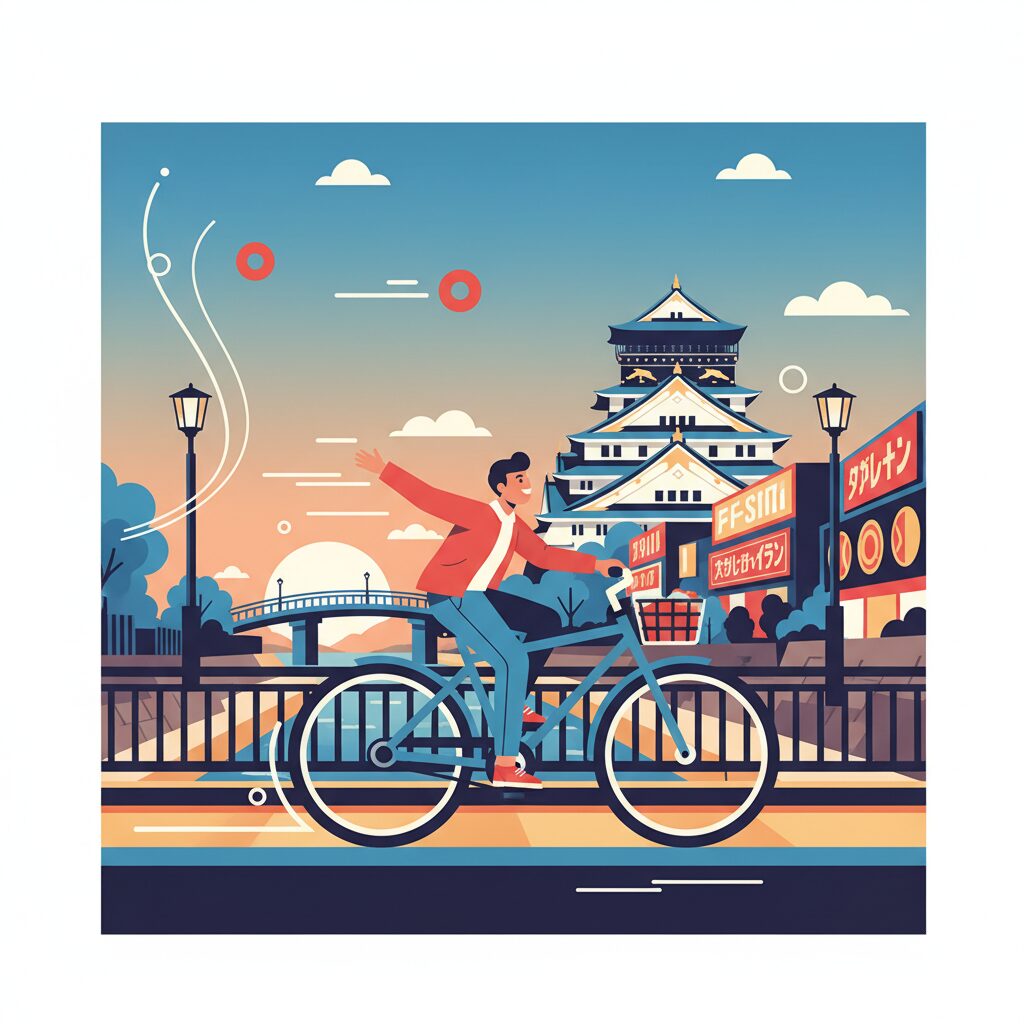
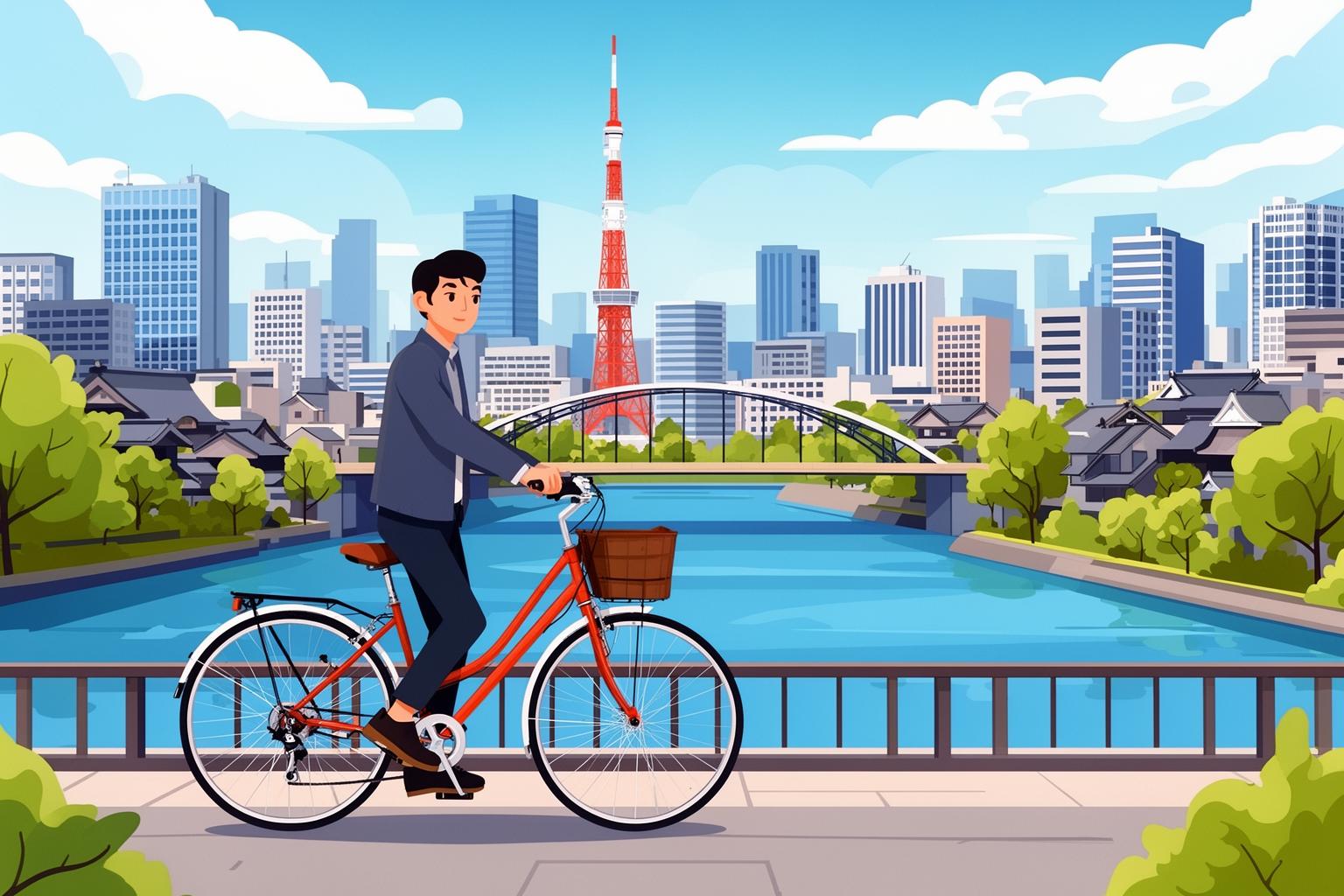
To truly grasp Osaka‘s bike culture, you first need to understand its bike of choice: the mamachari (ママチャリ), which literally means “mom’s chariot.” Forget sleek, lightweight road bikes or rugged mountain bikes. The mamachari reigns supreme on Osaka’s streets. It’s a triumph of practical design. Built low to the ground for easy mounting, featuring a sturdy frame, a single gear suited to the city’s nearly flat terrain, and a built-in lock on the rear wheel. Its most essential elements are the front basket—perfectly sized for groceries or a work bag—and often a solid rack or child seat on the back. It’s not made for speed or style; it’s designed for everyday life. It serves as the urban equivalent of a pickup truck, a tool meant to haul, to last, and to get the job done without any fuss. Owning an expensive, flashy bike in Osaka can almost come across as a social misstep, like wearing a tuxedo to a barbecue. It brands you as an outsider, a hobbyist. The humble, often slightly rusted mamachari, by contrast, is a symbol of belonging. It says, “I’m here to live, to shop, to work. I’m part of the city’s rhythm.”
The Unbeatable Convenience of Two Wheels
Osaka’s train and subway system is world-class, but it follows a hub-and-spoke pattern. It’s excellent for traveling between major hubs like Umeda, Namba, and Tennoji. But what about everything in between? That’s where the bicycle shines. The city stretches across a vast, flat plain that makes cycling feel effortless. A bike changes how you experience distance. A 20-minute walk becomes a relaxed 5-minute ride. A neighborhood that once required a train transfer is now directly accessible. The city transforms from a series of stations into a continuous, explorable environment. With a bike, you can ride along the Yodo River for miles, watching the scenery shift from urban grit to unexpectedly lush parkland. You can explore the maze of vintage shops and old wooden houses in Nakazakicho, a neighborhood nearly impossible to appreciate from a main road. You might impulsively decide to visit a supermarket three neighborhoods away because you’ve heard their produce is superior. This is a freedom the train map can never provide. It connects you to the granular reality of daily life, to the small bakeries, hidden shrines, and family-run tofu shops that make up the true fabric of the city.
Navigating the Urban Jungle: The Unspoken Rules of the Road
Sidewalks, Streets, and the Gray Area in Between
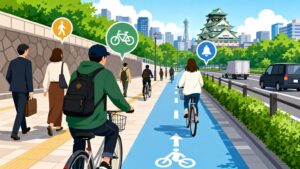
Here lies the first and most significant surprise for many foreigners. You’ll notice a sign with a clear pictogram: a bicycle and a pedestrian separated by a line. According to official rules, this indicates that bikes belong on the road. Now, look around. On that very sidewalk, you’ll see a steady stream of bicycles moving in both directions, skillfully weaving around pedestrians. Welcome to Osaka’s greatest unwritten agreement. While the law technically requires cycling on the street, in reality, cycling on most busy roads is suicidal. The streets are narrow, cars move fast, and dedicated bike lanes are rare. So, by collective, unspoken consent, the sidewalk has become a shared-use space. This isn’t chaos, however. It’s a highly choreographed dance. As a cyclist, you occupy the lowest rung of the hierarchy. You are expected to ride slowly, keep a wide distance from pedestrians, and be ready to stop at any moment. You don’t speed through; you flow with the pedestrian traffic. This approach marks a significant departure from the stricter rule-following often seen in Tokyo. In Osaka, there’s an understanding that if a rule seems impractical or unsafe, a more logical, community-based solution will develop. The sidewalk solution is quintessentially Osaka: it’s not technically correct, but it works, so everyone accepts it.
The Art of the “Suman” Bell Ring
Your bicycle bell is not a horn. It’s not a tool to signal aggression. In Osaka, the bell serves as a communication device, signaling a polite, “Suman” (a casual Osakan form of sumimasen, meaning “excuse me”). A short, gentle chirin as you approach a pedestrian from behind isn’t a demand for them to move. It’s simply a notification: “Just letting you know I’m here, passing on your right.” The pedestrian might adjust slightly, or they might not. It’s your responsibility as the cyclist to maneuver safely around them. Repeated, frantic ringing is the hallmark of a tourist or someone in a hurry. Locals use it with precision and minimalism. Mastering the gentle bell ring is an essential step in adapting. It shows an understanding of the local social contract—one rooted in mutual awareness rather than assertive claims to space. This small gesture communicates a great deal about the preference for harmony, even amid the chaos of the sidewalk.
The Hierarchy of the Sidewalk
To navigate this shared space successfully, you must recognize its invisible social order. There is a clear and absolute hierarchy, and you are at the very bottom. At the top are the elderly, especially the revered obaa-chan (grandmother). They have absolute priority, always. They may stop suddenly, change direction without warning, or walk at a slow pace. You will wait. You will give them room. Below them come parents with young children, who are unpredictable and must be protected. Then come general pedestrians, each moving within their own personal space. And finally, there’s you, the cyclist. Your role is to be like water flowing smoothly around the rocks. This deference isn’t just politeness; it’s a deeply rooted system of social risk management. By yielding to those more vulnerable, the entire system, though seemingly chaotic, operates with remarkable harmony.
The Dark Side of the Cycle: Parking, Theft, and the Dreaded Green Sticker
The Great Parking Puzzle
For every bit of freedom your bike grants you, you’ll pay a price in parking anxiety. Although Osaka thrives on bicycles, its storage infrastructure often feels like an afterthought. Around major stations such as Umeda or Namba, finding a legal parking spot becomes a competitive challenge. You’ll spot designated lots, some free and some paid, that are constantly full. This leads to what I call “bicycle geology,” where bikes are layered, leaning against one another in dense, metallic strata. Often, you’ll have to lift three other bikes just to retrieve your own. Paid parking lots offer a fix. Many feature impressive automation, with multi-story elevators that whisk your bike away. They are clean, secure, and efficient, but even though the cost per use is small, it adds up. This prompts a daily decision: do you circle for ten minutes hunting for a free spot, pay 150 yen for peace of mind, or risk parking illegally? The sea of illegally parked bikes lining the sidewalks outside every station and department store shows which option most choose.
The Impound Lot: A Journey of Shame
That decision carries a risk. One rule the city enforces with surprising rigor is no illegal parking in busy areas. Someday, you’ll return to where you left your bike and find… nothing. Instead, a small green sticker on the pavement signals your bike has been towed. This is a humbling rite of passage for Osaka cyclists. Your first task is to interpret the notice to find out which impound lot your bike was taken to. These lots are always located in the most inconvenient places imaginable—under distant expressways, on man-made islands, miles away from the nearest train station. The trip to recover your bike is a walk of shame. You arrive at a vast, open-air graveyard of confiscated bicycles, present your key and ID, pay the 2,500 yen fine, and reclaim your wayward mamachari. The experience is designed to be just difficult and expensive enough to make you think twice next time. It’s a sharp, bureaucratic reminder that while Osaka’s spirit is flexible, its patience is not.
Bicycle Registration and Theft
When you buy a bicycle in Japan, whether new or used, you are legally required to register it with the police. This is known as bouhan touroku (防犯登録), or crime prevention registration. You’ll pay a small fee (around 600 yen), and a small orange sticker with a registration number will be affixed to your bike’s frame. Many foreigners initially see this as just another piece of paperwork, but it’s essential. While Japan is an incredibly safe country, bicycle theft is surprisingly common. A flashy, unlocked road bike is a prime target, but even old mamacharis can vanish. The registration sticker proves ownership. If the police stop you (and they do random checks), they will run the number to verify the bike isn’t stolen. If your bike is stolen and later recovered, this sticker is the only way for it to be returned to you. Consider it non-negotiable, alongside a thick, heavy-duty lock that you use every single time you park, no matter how short the duration.
The Osaka Cyclist Mindset: Practicality Over Politeness?
The “Ma, Ee ka” Attitude on Wheels
To truly grasp the chaos of cycling in Osaka, you need to understand the local saying, “Ma, ee ka” (まあ、ええか). It roughly means “Ah, well,” or “It’ll be alright.” This phrase reflects a philosophy of pragmatism and acceptance. That cyclist who just cut in front of you without checking? He wasn’t acting out of malice; he simply saw an opening and needed to get through. Ma, ee ka. That delivery person riding the wrong way down a one-way street? She’s on a tight schedule. Ma, ee ka. This mindset acts as the unseen lubricant that keeps the entire shaky system running. It contrasts with the stereotype of Japanese society as strictly polite and rule-bound. In Tokyo, there’s more focus on following procedure and maintaining a smooth, orderly public space. In Osaka, the priority is just getting from Point A to Point B as efficiently as possible. As long as no major accidents or serious disruptions occur, minor infractions are tolerated with a collective shrug. It’s a form of trust—a shared belief that everyone on the sidewalk is simply trying to go about their day and has the basic skills not to crash into you.
The Smartphone Zombie and the Umbrella Ninja
This tolerance for risk is most evident in two all-too-common sights: the “smartphone zombie” and the “umbrella ninja.” The first describes someone cycling, often at high speed, while texting, scrolling, or watching videos on their phone. It’s a breathtaking act of multitasking that defies all logic and safety advice. The second appears on rainy days. You’ll see people skillfully navigating their bikes with one hand on the handlebars and the other holding a full-sized umbrella above them. This practice, known as kasa-sashi unten, is technically illegal and extremely dangerous, turning the cyclist into a moving, spiked hazard. Yet, it’s widespread. Why? Because it’s practical. Carrying rain gear is cumbersome. Getting soaked is unpleasant. So, the high-risk, high-reward choice of the umbrella is taken. These behaviors are intriguing because they reveal a facet of local character that values personal convenience and creativity. It’s a subtle rebellion against both the elements and the rules, a testament to the Osakan confidence in their own ability to manage risk and, against all odds, make it work.
Is a Bicycle Right for You in Osaka?
The Verdict: An Essential Tool for a Deeper Life
So, after all the chaos, parking hassles, and the risk of being impounded, is owning a bicycle in Osaka truly worthwhile? The answer is a firm yes. A bicycle is far more than mere transportation; it’s a vital tool for immersion. It liberates you from the constraints of train schedules and the limitations of the station-focused map. It enables you to engage with the city’s daily life in a richer and more personal way. You’ll discover your favorite neighborhood café, your preferred bakery, and the best supermarket route that avoids all the hills. You’ll sense the subtle changes in atmosphere as you glide between neighborhoods. The downsides are real. You’ll experience moments of frustration searching for parking. You’ll have your heart race when an umbrella ninja whizzes past you. You’ll likely have your bike towed at least once. Yet, these moments are part of life here—they are the cost of admission for the freedom and deeper connection a bike offers. It compels you to learn the city’s unspoken language of movement and to embrace its mindset of practical flexibility.
Final Words of Advice
If you’re ready to dive in, my advice is straightforward. Don’t buy a new, expensive bike. Head to a second-hand bike shop and find a sturdy, dependable mamachari. It will be affordable, less attractive to thieves, and will immediately make you look like you belong. Make sure to register it in your name on the spot. Invest in a high-quality lock and use it diligently. For the first few weeks, simply observe. Watch how locals navigate intersections. Notice the flow of traffic on the sidewalks. Learn the subtle art of the bell. Then, hop on and join the beautiful, chaotic, and endlessly captivating dance of Osaka cyclists. You’ll go from feeling like a visitor to truly feeling like a local.